The Enigmatic Life of Hieronymus Bosch: Beyond the Biographical Gaps
Hieronymus Bosch, a name synonymous with fantastical imagery and unsettling visions, remains one of art history’s most compelling enigmas. Born Jheronimus van Aken around 1450 in ’s-Hertogenbosch, Netherlands, his life is shrouded in a frustrating lack of concrete detail. Unlike many Renaissance artists whose biographies are meticulously documented, Bosch emerges from the historical record as a figure defined more by his work than by personal accounts. We know he came from a family of painters – his grandfather Jan van Aken and several uncles practiced the craft – suggesting an early immersion into artistic techniques. However, the precise nature of his training remains elusive; no surviving works definitively attributable to his predecessors allow us to trace a clear stylistic lineage. What *is* certain is that Bosch quickly developed a uniquely personal style, diverging from the prevailing realism of Early Netherlandish painting and venturing into realms of symbolism and imagination previously unexplored.
Records indicate his membership in the Illustrious Brotherhood of Our Lady in 1486/87, a prestigious confraternity attracting elite patrons. This association undoubtedly provided access to commissions and broadened his artistic reach beyond the confines of ’s-Hertogenbosch. His marriage to Aleid Goyaerts van den Meervenne around 1480 brought financial stability, allowing him greater freedom to pursue ambitious projects. Yet, despite this modest level of documented life events, Bosch’s inner world – the source of his extraordinary creativity – remains largely inaccessible, fueling centuries of speculation and interpretation.
A World Steeped in Symbolism: Unraveling Bosch’s Visual Language
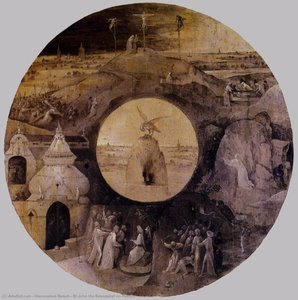 St John the Evangelist on Patmos (reverse)
Explore Hieronymus Bosch’s ‘St John the Evangelist on Patmos.’ A surreal Renaissance masterpiece filled with symbolism & intricate detail. Own a unique reproduction today!
To truly appreciate Hieronymus Bosch is to embark on a journey into a complex and often bewildering world of symbolism. His paintings are not merely depictions of religious narratives; they are intricate allegories, teeming with hidden meanings and moral warnings. Unlike the straightforward iconography common in much Renaissance art, Bosch’s symbols are rarely self-explanatory. Hybrid creatures – part animal, part human, part demon – populate his canvases, their significance open to multiple interpretations. The owl, frequently appearing in his work, is often seen as a symbol of wisdom but also of darkness and hidden knowledge. Fruits, flowers, and everyday objects take on layered meanings, representing temptation, sin, or redemption.
Consider Christ Carrying the Cross, where the scene transcends a simple representation of the Passion. The unsettling landscape, populated by grotesque figures and ominous details, suggests not just physical suffering but also the moral weight of humanity’s sins. Similarly, in Paradise, Ascent of the Blessed, the lush afterlife is not a serene haven but a complex tableau filled with ambiguous imagery, hinting at the fragility of earthly bliss. Bosch masterfully employs visual puns and unexpected juxtapositions to challenge viewers and provoke contemplation. Deciphering his symbolism requires a deep understanding of medieval theology, folklore, and the prevailing anxieties of the era.
Religious Context and Moral Allegory: The Spiritual Undercurrents of His Art
 Wikipedia: Hieronymus Bosch
Hieronymus Bosch (; Dutch: [ɦijeːˈroːnimʏz ˈbɔs] ; born Jheronimus van Aken [jeːˈroːnimʏs fɑn ˈaːkə(n)]; c. 1450 – 9 August 1516) was a Dutch painter from Brabant. He is one of the most notable representatives of the Early Netherlandish painting scho...
Bosch’s art is deeply rooted in the religious fervor of the late 15th and early 16th centuries. Living during a period of intense spiritual questioning, he grappled with themes of sin, temptation, and salvation. However, his approach to these subjects was far from conventional. While many artists focused on depicting scenes of divine grace and heroic piety, Bosch often presented a more pessimistic view of human nature, emphasizing the pervasive presence of evil and the inevitability of damnation.
His paintings frequently serve as moral allegories, warning viewers against the dangers of worldly pleasures and urging them towards spiritual righteousness. The Garden of Earthly Delights, perhaps his most famous work, is a prime example. The triptych unfolds a narrative of creation, temptation, and fall, culminating in a harrowing depiction of hell. It’s not simply a condemnation of sin but a complex exploration of human desire, the allure of earthly pleasures, and the consequences of moral transgression. Bosch's depictions of hell are particularly striking – not as a fiery inferno, but as a grotesque and unsettling realm where sinners are subjected to punishments tailored to their specific vices. This personalized torment underscores the artist’s belief in individual accountability and the weight of one’s actions.
Technique and Innovation: Bosch's Distinctive Style within the Early Netherlandish Tradition
Early Netherlandish painting is the body of work by artists active in the Burgundian and Habsburg Netherlands during the 15th- and 16th-century Northern Renaissance period, once known as the Flemish Primitives. It flourished especially in the cities...
While deeply embedded in the Early Netherlandish tradition, Hieronymus Bosch distinguished himself through a unique artistic style that defied easy categorization. Unlike his contemporaries who prioritized meticulous realism and precise detail, Bosch favored a looser, more expressive technique. His brushwork is often visible, creating a sense of texture and movement. He employed a limited palette, dominated by rich blues, greens, and ochres, which contribute to the otherworldly atmosphere of his paintings.
Bosch’s innovative use of oil paint allowed him to create luminous effects and intricate details that were previously unattainable. He frequently layered glazes to achieve depth and transparency, giving his figures a hauntingly ethereal quality. His compositions are often crowded and complex, filled with fantastical creatures and unsettling imagery. This deliberate departure from the prevailing aesthetic norms reflects his desire to convey not just what he saw but also what he *felt* – the anxieties, fears, and spiritual turmoil that permeated his inner world. He wasn’t interested in simply replicating reality; he sought to create a visual language capable of expressing the intangible realms of the imagination and the soul.
Iconic Masterpieces: Exploring 'The Garden of Earthly Delights', 'Paradise', and Beyond
Bosch's oeuvre, though relatively small – only around 25 paintings are confidently attributed to his hand – is remarkably diverse and consistently captivating. The Garden of Earthly Delights, a triptych completed around 1490-1510, stands as his most celebrated work. Its three panels depict the creation of Eden, earthly paradise, and hell, offering a panoramic vision of human history and moral destiny. The central panel, teeming with nude figures indulging in sensual pleasures, is both alluring and unsettling, prompting endless debate about its meaning.
Paradise, or *The Ascent of the Blessed*, presents a more idyllic scene, yet even here, Bosch’s characteristic ambiguity prevails. The lush landscape and serene atmosphere are juxtaposed with strange creatures and symbolic details, hinting at the fragility of earthly bliss. St John the Evangelist on Patmos (reverse), another compelling work, showcases his mastery of surreal imagery and complex symbolism. These paintings, along with others like *The Temptation of St Anthony* and *The Last Judgment*, demonstrate Bosch’s unparalleled ability to create worlds that are both beautiful and terrifying, familiar and alien.
Bosch’s Enduring Legacy: Influence, Interpretation, and Modern Relevance
Hieronymus Bosch's influence on subsequent generations of artists is undeniable. His fantastical imagery inspired Pieter Bruegel the Elder, who carried his tradition into the 16th century, and his work continues to resonate with contemporary artists today. Surrealists like Salvador Dalí and Max Ernst drew inspiration from Bosch’s dreamlike landscapes and unsettling creatures, recognizing a kindred spirit in his exploration of the subconscious mind.
The enduring appeal of Bosch lies not only in his technical skill but also in his profound understanding of human nature. His paintings grapple with timeless themes – sin, temptation, redemption, and the search for meaning – that continue to resonate with audiences centuries later. While interpretations of his work vary widely, one thing remains certain: Hieronymus Bosch was a visionary artist who dared to challenge conventional norms and explore the darkest corners of the human psyche. His legacy as a master of symbolism, innovation, and unsettling beauty is secure, ensuring his place among the greatest artists in history. Explore these masterpieces further with OriginalUniqueArt.com, where you can discover high-quality reproductions that capture the intricate detail and haunting atmosphere of Bosch’s original works.