


1

脅かされた白鳥
は、芸術家ヤン・アセリンによるキャンバスに描かれた油彩画です。1650年頃に完成したこの作品は、猛烈な防衛の瞬間に身を投じるコブハクチョウの姿を鮮烈に捉えています。迫りくる犬の脅威に対し、翼を大きく広げ、威嚇の声を上げる鳥。その純白の羽毛と、忍び寄る暗い脅威との間で繰り広げられる葛藤が、この絵画の核心となる緊張感を生み出しています。

11月 2026 更新 · 当サイトの人気スコア(各作品の検索数、閲覧数、注文数)に基づくランキング · 84点の ヤン・アセリンの作品がカタログにあります
要約すると
ギャラリーの視点では、ヤン・アセリンの最も有名な作品は脅かされた白鳥 (1652)であり、その原画はアムステルダムの国立美術館に展示されています。 King Gustav Adolf II of Sweden in the Battle of Lutzen, 1632 (1634)とLandscape with a Bridge in the Italian Countryside (1652)が加わり、誰もが一度は目にしたことのある至高のトリオが完成します。 当カタログに含まれるヤン・アセリンの作品84点の中から、特に有名な76点を厳選してご紹介します。各作品は、制作年、所蔵美術館、そしてその作品ならではの魅力とともに、一点物のオリジナル作品として掲載されています。
は、芸術家ヤン・アセリンによるキャンバスに描かれた油彩画です。1650年頃に完成したこの作品は、猛烈な防衛の瞬間に身を投じるコブハクチョウの姿を鮮烈に捉えています。迫りくる犬の脅威に対し、翼を大きく広げ、威嚇の声を上げる鳥。その純白の羽毛と、忍び寄る暗い脅威との間で繰り広げられる葛藤が、この絵画の核心となる緊張感を生み出しています。

Jan Asselijn's “King Gustav Adolf II of Sweden in the Battle of Lutzen, 1632” isn’t merely a painting; it’s a visceral plunge into the heart of a pivotal moment in European history. Completed in 1634, this monumental work captures the chaotic fury and strategic brilliance of the Battle of Lutzen, fought on August 17th of that year, a clash that cemented Gustav Adolf II's reputation as a military genius and…

A stone bridge with arched spans anchors this serene landscape, crossing a calm body of water that reflects the soft, overcast sky. To the left, a solitary figure sits upon a barrel, watching the quiet movement of the scene. On the right, the composition gathers around a horse and carriage; a person guides the animal toward the water's edge while another observer stands nearby. A dog occupies the foreground, grounding…

The air is thick with the scent of wet earth and sulfur. In the center of the chaos, King Gustav Adolf II of Sweden rides a horse through the fray, his sword a flash of cold light against the darkening sky. The Battle of Lutzen is not a quiet affair; it is a collision of muscle and metal. Soldiers on foot and mounted on horseback press against one another in…

In Four Figures, Jan Asselijn organizes a group of men in period attire within a dimly lit, atmospheric setting. The composition centers on this cluster of figures, who are arranged in a loose, triangular formation. This structural choice draws the viewer's eye toward the middle of the group, where the subjects interact in a moment of quietude. One man is captured drinking from a vessel, while another stands holding a…

The artwork titled King Gustav Adolf II of Sweden, Battle near Lutzen 1632 is a work by the artist Jan Asselijn. Dated about 1635, this oil on panel painting belongs to the genre of military history. The subject matter focuses on the Battle of Lützen, a significant conflict from the Thirty Years' War. The scene captures the king amidst the movement of a large-scale military engagement.

The sun hangs low over the horizon, casting a sharp, golden light through the four massive stone arches of the Ponte Molle. This light slices through the atmosphere, painting the sky in a gradient that shifts from a warm, glowing amber on the right to a pale, tranquil aquamarine as the eye moves toward the left. The river below remains placid, reflecting the changing colors of the sky, while the…

Ruined Building with Shepherd and Sheep is an artwork by Jan Asselijn. This piece belongs to the Dutch Golden Age and the Italianate landscape style of the Early Modern period. The subject matter focuses on a pastoral landscape that incorporates ruins and sheep. The composition integrates elements of nature, shepherds, and weathered stone structures within a single scene.

The artwork titled Italian Landscape is a painting by the Dutch Golden Age painter Jan Asselijn. Created in 1638, this work represents a specific period in the artist's career. Asselijn was born in Dieppe, France, around 1610, before his family relocated to Amsterdam. His development as a painter was shaped by the artistic environment of the Dutch Golden Age, a time when landscape painting was evolving toward more atmospheric depictions.

A violent skirmish unfolds across a rugged, rocky landscape, captured in a dramatic monochrome palette. The composition relies on a sharp diagonal arrangement, pulling the eye from the foreground into a chaotic center-right where figures engage in combat. Mounted riders and infantrymen clash amidst dense foliage and spindly, skeletal trees. The atmosphere is heavy with mist and swirling smoke, creating a sense of tension and movement. Light filters through an…
 Lion Hunting1640 · ミュゼ・ファーブル
12
 Italianate landscape with travellers by a stream with cattle1652
13
 Italian Landscape with a view from a Grotto1639 · 国立美術館
14
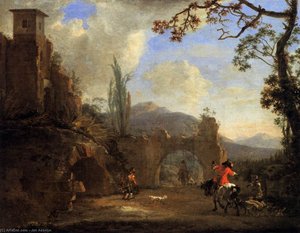 Landscape with Ruins and Hunting Party1645 · Academy of Fine Arts Vienna
15
 PAYSAGE AVEC UN TROUPEAU TRAVERSANT UNE RIVIEREルーブル美術館
16
 River Bank with Herdsmen1650 · Academy of Fine Arts Vienna
17
 Coastal Scene with Resting Riders (detail)1652 · Academy of Fine Arts Vienna
18
 Imaginary Italian Landscape1652 · Mauritshuis王宮美術館
19
 Landscape with a Cowherd1594
20
 Italianate Landscape1631 · バイエルン州立絵画コレクション
21
 Cavalry Engagement1635
22
 Peasants by a River Bank1639 · Yale University Art Gallery
23
 Mountain - landscape1639
24
 Riders Gallopping towards the Gates of the Fortress1645 · エルミタージュ美術館
25
 Winter Landscape1645 · エルミタージュ美術館
26
 Nocturnal Crayfishing1638 · Statens Museum For Kunst
27
 Vesuvius Erupting at Nightfall1638 · Statens Museum For Kunst
28
 Head of an Ox1647 · Musée des Beaux-Arts
29
 Catching Crayfish1645 · ヴィラヌフ宮殿博物館
30
 Ford between High Cliffs1644 · 国立プラハ美術館
31
 Peasants and Cattle beside a Tower1646
32
 Winter landscape with huntsmen on a bridge1647 · Fondation Custodia
33
 A rocky mountain valley with shepherds and cattle1645 · シュタットリッヒェ・クンストハレ・カールスルーエ
34
 Italian Landscape1640 · プーシキン美術館
35
 Frozen Moat outside City Walls1647 · Worcester Art Museum
36
 Italianate Landscape with Drovers, Cattle and Sheep beside Ruins1647 · Fogg Museum of Art
37
 Italianate Landscape with a River and an Arched Bridge1648 · シュライスハイム州立美術館
38
 Southern Landscape with Cattle near Ruins1650 · National Museum in Wrocław
39
 View of the Solario Bridge on the Teverone1650
40
 Head of a lowing Ox1650 · シュヴェリーン州立美術館
41
 Italianate landscape with bridge near Tivoli1649
42
 River Landscape with the Fort Saint-Jean and the Chateau Pierre-Scize in Lyon1650 · Yale University Art Gallery
43
 The restoration of the Diemerdijk or Muiderdijk near Amsterdam in 16511651 · ベルリン絵画館
44
 Breach of a Dyke by Storm Surge on March 5 16511651 · ベルリン絵画館
45
 The Breach of the Sint Anthonisdijk in 16511652 · アムステルダム博物館
46
 The Breach of the Saint Anthony’s Dike near Amsterdam, Jan Asselijn, 16511651
47
 Drovers with Cattle under an Arch of the Colosseum in Rome, Jan Asselijn, 1640 - 16521652 · 国立美術館
48
 A Mediterranean Coastal View with Shipping and Mariners by a Fort1650
49
 A Mediterranean Coastal View with Shipping and Mariners by a Fort1650
50
 River Landscape with the Church of Santi Giovanni e Paolo1650
51
 Landscape with a Drover1649 · Holburne Museum
52
 Landscape with a Bridge in the Italian Countryside1652 · Cannon Hall Museum
53
 Coastal Scene with Resting Riders1652 · Academy of Fine Arts Vienna
54
 PAYSAGE AVEC UNE TOURルーブル美術館
55
 RUINE ET CABANE DE BERGERSルーブル美術館
56
 LANDSCAPE WITH A DEPARTURE FOR A HUNT
57
 Muleteers beside an Italian Ruin1650 · 国立美術館
58
 Hangout in Italy1620 · 国立美術館
59
 Herders with Their Animals under an Arch of the Colosseum in Rome1652 · 国立美術館
60
 Hunting Company out of Rome1652 · 国立美術館
61
 Beggars in front of a Roman Limekiln1638 · Academy of Fine Arts Vienna
62
 Asselijn - (50Riverbank)
63
 Asselijn ruin国立美術館
64
 Italian Coast Scene
65
 Italian Landscape with Two Horsemen and Figures on a Road
66
 Italian Landscape with the Church of Sts. Giovanni e Paolo in Romeブダペスト美術館
67
 Mountainous Landscape
68
 A rocky river landscape with travellers in the foreground and ships beyond
69
 A Landscape with Peasants (also known as Landscape with Herdsmen Fording a River)Ascott House
70
 A Cavalier on Horseback Before a Landscape
71
 Landscape with shepherds and their flock crossing the Ponte Acquoria near Tivoli
72
 an italianate river landscape with herders on a path with their flock and donkeys, classical ruins on a hilltop beyondMinneapolis Institute of Art
73
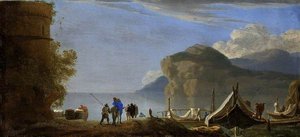 Italian Coast SceneFitzwilliam College
74
 Italian LandscapeFitzwilliam College
75
 Italian Landscape with the Ruins of a Roman Bridge and Aqueduct国立美術館
76
 Cavalry Attack at Sunset, Jan Asselijn, 16461646 · 国立美術館
これらのオリジナル作品に繰り返し描かれている4つの主題と、それぞれの最高傑作。
このページに掲載されている絵画を最も多く所蔵している 8 の美術館
| 美術館 | 都市 | ヤン・アセリンの作品 | このリストの絵画 |
|---|---|---|---|
 国立美術館 |
アムステルダム | 9 | 脅かされた白鳥, Drovers with Cattle under an Arch of the Colosseum in Rome, Jan Asselijn, 1640 - 1652, Muleteers beside an Italian Ruin |
 Statens Museum For Kunst |
コペンハーゲン | 5 | King Gustav Adolf II of Sweden in the Battle of Lutzen, 1632, Italian Landscape, Fight against Robbers |
 Academy of Fine Arts Vienna |
ウィーン | 5 | Landscape with Ruins and Hunting Party, River Bank with Herdsmen, Coastal Scene with Resting Riders (detail) |
 ベルリン絵画館 |
ベルリン | 3 | King Gustav Adolf II of Sweden, Battle near Lutzen 1632, The restoration of the Diemerdijk or Muiderdijk near Amsterdam in 1651, Breach of a Dyke by Storm Surge on March 5 1651 |
 ルーブル美術館 |
パリ | 3 | PAYSAGE AVEC UN TROUPEAU TRAVERSANT UNE RIVIERE, PAYSAGE AVEC UNE TOUR, RUINE ET CABANE DE BERGERS |
 Cannon Hall Museum |
Barnsley | 2 | Landscape with a Bridge in the Italian Countryside, Landscape with a Bridge in the Italian Countryside |
 Yale University Art Gallery |
ニューヘイブン | 2 | Peasants by a River Bank, River Landscape with the Fort Saint-Jean and the Chateau Pierre-Scize in Lyon |
 エルミタージュ美術館 |
サンクトペテルブルク | 2 | Riders Gallopping towards the Gates of the Fortress, Winter Landscape |
その時代を象徴する名作を見るために、年代を選択してください。

Jan Asselijn's "Hangout in Italy," painted around 1620, isn’t merely a depiction of a picturesque scene; it’s an invitation. An invitation to step into a moment of quiet contemplation amidst the burgeoning beauty of the Italianate landscape – a style that would profoundly influence generations of Dutch artists. This paper drawing, now housed in the Rijksmuseum Amsterdam, offers a remarkably intimate view, capturing not just the visual splendor but also…
Jan Asselijn's “King Gustav Adolf II of Sweden in the Battle of Lutzen, 1632” isn’t merely a painting; it’s a visceral plunge into the heart of a pivotal moment in European history. Completed in 1634, this monumental work captures the chaotic fury and strategic brilliance of the Battle of Lutzen, fought on August 17th of that year, a clash that cemented Gustav Adolf II's reputation as a military genius and…
Ruined Building with Shepherd and Sheep is an artwork by Jan Asselijn. This piece belongs to the Dutch Golden Age and the Italianate landscape style of the Early Modern period. The subject matter focuses on a pastoral landscape that incorporates ruins and sheep. The composition integrates elements of nature, shepherds, and weathered stone structures within a single scene.
脅かされた白鳥 (1652)(国立美術館, アムステルダム)。次いでKing Gustav Adolf II of Sweden in the Battle of Lutzen, 1632 (1634)、Landscape with a Bridge in the Italian Countryside (1652)が続きます。
42歳:脅かされた白鳥は1652年の作品で、ヤン・アセリンの生年は1610年です。
脅かされた白鳥, King Gustav Adolf II of Sweden in the Battle of Lutzen, 1632, Landscape with a Bridge in the Italian Countryside, King Gustav Adolf II in the Battle of Lutzen on November 6,1632, Four Figures, King Gustav Adolf II of Sweden, Battle near Lutzen 1632, The Tiber River with the Ponte Molle at Sunset, Ruined Building with Shepherd and Sheep, Italian Landscape と Fight against Robbers。上記のランキングには、それぞれの制作年と所蔵美術館が記載されています。
当カタログには、1620年から1652年にかけて制作されたヤン・アセリンによる84点の作品が収められています。
主に国立美術館 (アムステルダム), Statens Museum For Kunst (コペンハーゲン) と Academy of Fine Arts Vienna (ウィーン)に所蔵されています。上記の美術館一覧にすべて記載されています。
1650s年:このページにある全76作品のうち、24作品がその時期に制作されました。そのうち脅かされた白鳥作品が含まれます。
このページでは、最も古い作品はHangout in Italy (1620)、最新の作品は脅かされた白鳥 (1652)です。
このページに掲載されている76点の作品におけるLandscape (26), Ruins (7) と Figures (6)
このページに掲載されている全76作品のうち、12作品のOil On Canvas
このページに掲載されているオリジナル作品から判断すると、オランダ黄金時代 と Baroqueです。
脅かされた白鳥, Drovers with Cattle under an Arch of the Colosseum in Rome, Jan Asselijn, 1640 - 1652 と Muleteers beside an Italian Ruin:国立美術館, アムステルダムには、このページに掲載されている作品のうち9点が所蔵されています。


