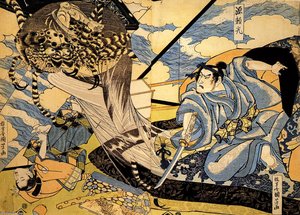
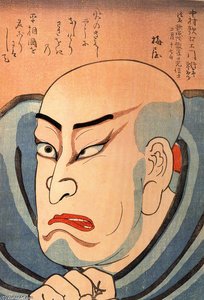
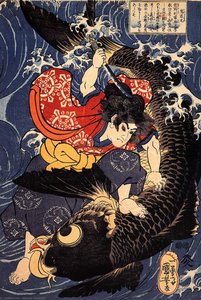
歌川国芳の肖像画

歌川国芳の絵画:ギャラリーの視点で選ぶ、最も有名な100作品

11月 2026 更新 · 当サイトの人気スコア(各作品の検索数、閲覧数、注文数)に基づくランキング · 329点の 歌川国芳の作品がカタログにあります

要約すると

当ギャラリーの視点では、歌川国芳の最も有名な作品はMusashi on the back of a whaleです。 Shikamatsu Kanroku Yukishige (1847)とHatakeyama sitting next to a Go board (1845)が加わり、誰もが一度は目にしたことのある至高のトリオが完成します。 当カタログに含まれる歌川国芳の作品329点の中から、特に有名な100点を厳選してご紹介します。各作品は、制作年、所蔵美術館、そしてその作品ならではの魅力とともに、一点物のオリジナル作品として掲載されています。

1798 – 1861, 東京 Ukiyo-e 最多収蔵館: 慶應義塾大学図書館

ギャラリーが選ぶ歌川国芳のトップ10作品

1
Musashi on the back of a whale による 歌川国芳

Musashi on the back of a whale

Woodblock Print

This arresting image, a masterful execution of Ukiyo-e by the legendary artist Utagawa Kuniyoshi, transports us to 19th century Japan. Kuniyoshi, born Yoshisaburō in 1798 and tragically passing in 1861, was a pivotal figure at the close of the *ukiyo-e* movement – a vibrant artistic tradition that captured the essence of everyday life during the Edo period. This particular scene, depicting Musashi, the famed swordsman, astride a colossal whale, is…

2
Shikamatsu Kanroku Yukishige (1847) による 歌川国芳

Shikamatsu Kanroku Yukishige

1847 · Woodblock Print

Utagawa Kuniyoshi’s “Shikamatsu Kanroku Yukishige” (circa 1847) is more than a depiction of a samurai; it’s a potent distillation of Japanese heroism, loyalty, and the fleeting beauty of a moment captured in woodblock form. This iconic image, part of Kuniyoshi's celebrated series “Stories of the True Loyalty of the Faithful Samurai,” transports us to a pivotal scene from the classic tale of Suikoden – a story of betrayal, redemption, and…

3
Hatakeyama sitting next to a Go board (1845) による 歌川国芳

Hatakeyama sitting next to a Go board

1845 · Acrylic On Canvas

Utagawa Kuniyoshi’s “Hatakeyama Sitting Next to a Go Board” is more than just a depiction of a solitary figure; it's a window into the heart of 19th-century Japan. Painted in 1845, during a period of immense social and artistic change, this ukiyo-e masterpiece captures a quiet moment of contemplation – a scene imbued with layers of meaning reflecting the values and aesthetics of the Edo period. Kuniyoshi, one of the…

4
Yukukawa Sanpei Munenori (1848) による 歌川国芳

Yukukawa Sanpei Munenori

1848 · Acrylic

This exceptional ukiyo-e print, created in 1848 by the master artist Utagawa Kuniyoshi, offers a captivating glimpse into the world of Edo-period Japan. Depicting Yukukawa Sanpei Munenori, a figure likely rooted in historical or legendary lore, the artwork is far more than a simple portrait; it’s a dynamic tableau brimming with action, symbolism, and the raw energy of a warrior's spirit. Kuniyoshi’s skill lies not just in his technical prowess…

5
The Twenty-four Paragons of Filial Piety in China , Script by Tanekazu : Min Ziqian (Bin Shiken) (1852) による 歌川国芳

The Twenty-four Paragons of Filial Piety in China , Script by Tanekazu : Min Ziqian (Bin Shiken)

1852 · Woodblock Print · 慶應義塾大学図書館, 東京

Utagawa Kuniyoshi’s “The Twenty-Four Paragons of Filial Piety,” created circa 1848/50, stands as a pinnacle achievement of *ukiyo-e*, the Japanese woodblock print tradition that flourished during the Edo period. More than just a visually arresting spectacle—a sprawling landscape dominated by towering mountains rendered in subtle shades of azure—this monumental print delves into profound philosophical concepts rooted in Buddhism and Confucianism, offering a timeless meditation on reverence for ancestors and the…

6
Ôtaka Gengo Tadao (1848) による 歌川国芳

Ôtaka Gengo Tadao

1848 · Woodblock Print

Within the vibrant tapestry of Ukiyo-e prints, few images capture the raw power and stoic determination of a warrior quite like Utagawa Kuniyoshi's "Otaka Gengo Tadao," created in 1848. This remarkable woodblock print isn’t merely a depiction of a samurai; it’s a window into the heart of Edo-period Japan, brimming with tales of loyalty, honor, and the enduring spirit of martial prowess. Kuniyoshi, one of the last masters of this…

7
Oki no Jiro Hiroari killing a monstrous tengu による 歌川国芳

Oki no Jiro Hiroari killing a monstrous tengu

Woodblock Print

In the vibrant world of Ukiyo-e, few scenes command the eye with as much visceral intensity as Utagawa Kuniyoshi’s masterpiece, Oki no Jiro Hiroari killing a monstrous tengu. This dynamic mythological painting serves as a window into a moment of profound struggle, where the boundaries between the human and the supernatural blur amidst a backdrop of dark, foreboding shadows. The composition is anchored by the figure of Oki no Jiro…

8
Battle of Uji River. Uji kawa kassen no zu による 歌川国芳

Battle of Uji River. Uji kawa kassen no zu

Acrylic On Canvas · Hammer Museum, ロサンゼルス

Utagawa Kuniyoshi’s “Battle of Uji River,” painted between 1848 and 1850, stands as a quintessential example of *nishiki-e*, or polychrome woodblock printing, capturing the fervor and grandeur of samurai warfare against a backdrop of breathtaking natural beauty. This monumental print transcends mere depiction; it’s an immersive experience designed to evoke emotion and convey profound themes of courage, resilience, and the ephemeral nature of glory.

歌川国芳の絵画、ランキング11位から100位

11The Twenty-four Paragons of Filial Piety in China , Script by Tanekazu : Ding Lan (Tei Ran) (1852) による 歌川国芳The Twenty-four Paragons of Filial Piety in China , Script by Tanekazu : Ding Lan (Tei Ran)1852 · 慶應義塾大学図書館 12Thirty-six Famous Battles (1848) による 歌川国芳Thirty-six Famous Battles1848 13Kiura Okaemon Sadayuki (1848) による 歌川国芳Kiura Okaemon Sadayuki1848 14The Heavenly Weaver and the Heardsman (1842) による 歌川国芳The Heavenly Weaver and the Heardsman1842 · Bristol Museum - Art Gallery 15Yata Gorôemon Suketake (1848) による 歌川国芳Yata Gorôemon Suketake1848 16Oniwakamaru and the Giant Carp Fighting Underwater (1835) による 歌川国芳Oniwakamaru and the Giant Carp Fighting Underwater1835 17A Votive Tablet with Masks of Kabuki Actors at Face Value による 歌川国芳A Votive Tablet with Masks of Kabuki Actors at Face ValueFukuoka City Museum 18The actor (12) による 歌川国芳The actor (12) 19The Sixth Month (Right) (1849) による 歌川国芳The Sixth Month (Right)1849 · 大英博物館 20Bon-bon Uta,Children による 歌川国芳Bon-bon Uta,ChildrenFukuoka City Museum 21Scene from the play “The Life of Onoe Kikugorō III”\n\nScene from the play “The Life of Onoe Kikugorō III” (1847) による 歌川国芳Scene from the play “The Life of Onoe Kikugorō III”\n\nScene from the play “The Life of Onoe Kikugorō III”1847 · Art Museum Riga Bourse 22Minamoto Yorimitsu also known as Raiko による 歌川国芳Minamoto Yorimitsu also known as Raiko 23Mount Fuji from the Sumida River embankment (1842) による 歌川国芳Mount Fuji from the Sumida River embankment1842 24A record of origins of the great country of Japan による 歌川国芳A record of origins of the great country of Japan 25The actor (16) による 歌川国芳The actor (16) 26Seaweed Gatherers at Omari (1833) による 歌川国芳Seaweed Gatherers at Omari1833 27The ghost of Taira Tomomori による 歌川国芳The ghost of Taira Tomomori 28Thaishun with elephants による 歌川国芳Thaishun with elephants 29Raiko tormented by the earth spider による 歌川国芳Raiko tormented by the earth spider 30Benkei holdin a halberd による 歌川国芳Benkei holdin a halberd 31A samurai overwhelming a giant serpent による 歌川国芳A samurai overwhelming a giant serpent 32The Famous Unrivalled Hidari Jingoro による 歌川国芳The Famous Unrivalled Hidari Jingoro 33Samurai and the conquered による 歌川国芳Samurai and the conquered 34Kamigashihime stabbing a giant spider による 歌川国芳Kamigashihime stabbing a giant spider 35Vesper bell at Todaiji による 歌川国芳Vesper bell at Todaiji 36Oniwakamaru about to kill the giant carp による 歌川国芳Oniwakamaru about to kill the giant carp 37Uneme is exorcising the monstrous serpent from the lake による 歌川国芳Uneme is exorcising the monstrous serpent from the lake 38Shoki and Demon, Edo period (1850) による 歌川国芳Shoki and Demon, Edo period1850 · アーサー・M・サックラー・ギャラリー 39Nichiren going into exile on the island of Sado による 歌川国芳Nichiren going into exile on the island of Sado 40Uchiwakamaru fighting Benkei on Gojo bridge による 歌川国芳Uchiwakamaru fighting Benkei on Gojo bridge 41The young Benkei holding a pole による 歌川国芳The young Benkei holding a pole 42New edition of the life of a hundred generals による 歌川国芳New edition of the life of a hundred generals 43Sharks による 歌川国芳Sharks 44Koga Saburo, suspendeding a basket, watching a dragon による 歌川国芳Koga Saburo, suspendeding a basket, watching a dragon 45Kamei Rokuro and the Black Bear in the Snow (1849) による 歌川国芳Kamei Rokuro and the Black Bear in the Snow1849 46Hattara Sonja with his white tiger による 歌川国芳Hattara Sonja with his white tiger 47Ishi-jo, wife of Oboshi Yoshio, one of the loyal ronin (1848) による 歌川国芳Ishi-jo, wife of Oboshi Yoshio, one of the loyal ronin1848 48Untitled (D2X8SB) (801) による 歌川国芳Untitled (D2X8SB)801 · メトロポリタン美術館 49Yoshida Sadaemon Kanesada (1848) による 歌川国芳Yoshida Sadaemon Kanesada1848 50Hara Gôemon Mototoki (1848) による 歌川国芳Hara Gôemon Mototoki1848 51Woodcut (1852) による 歌川国芳Woodcut1852 · Museum of Far Eastern Antiquities 52Woodcut (1852) による 歌川国芳Woodcut1852 · Museum of Far Eastern Antiquities 53Island Enoshima. The Fuji can be seen far away による 歌川国芳Island Enoshima. The Fuji can be seen far away 54Hayano Kanpei Tsuneyo (1848) による 歌川国芳Hayano Kanpei Tsuneyo1848 · クリーブランド美術館 55In the Waves at Kakuda enroute to Sado Island, Edo period (1835) による 歌川国芳In the Waves at Kakuda enroute to Sado Island, Edo period1835 · アーサー・M・サックラー・ギャラリー 56Woman selling decorative bowls による 歌川国芳Woman selling decorative bowls 57A fierce depiction of Uesugi Kenshin seated (1844) による 歌川国芳A fierce depiction of Uesugi Kenshin seated1844 58The Twenty-four Paragons of Filial Piety in China, Script by Tanekazu : Emperor Wen of Han (Kan no Buntei) (1852) による 歌川国芳The Twenty-four Paragons of Filial Piety in China, Script by Tanekazu : Emperor Wen of Han (Kan no Buntei)1852 · 慶應義塾大学図書館 59The Twenty-four Paragons of Filial Piety in China , Script by Tanekazu : Cai Shun (Sai Jun) (1852) による 歌川国芳The Twenty-four Paragons of Filial Piety in China , Script by Tanekazu : Cai Shun (Sai Jun)1852 · 慶應義塾大学図書館 60Isoai Jûroemon Masahisa (1848) による 歌川国芳Isoai Jûroemon Masahisa1848 61Tokuda Sadaemon Yukitaka (1848) による 歌川国芳Tokuda Sadaemon Yukitaka1848 62Tamakatzura Tamatori attacked by the octopus による 歌川国芳Tamakatzura Tamatori attacked by the octopus 63Bijin with a dog in the snow (1845) による 歌川国芳Bijin with a dog in the snow1845 64From Suikoden of Japanese Heroes による 歌川国芳From Suikoden of Japanese Heroes 65Hatakeyama Shigetada による 歌川国芳Hatakeyama Shigetada 66The sailor Tokuso and the sea monster による 歌川国芳The sailor Tokuso and the sea monster 67Tokiwa Gozen in the snow による 歌川国芳Tokiwa Gozen in the snow 68Mongaku doing penace at the Nachi waterfall による 歌川国芳Mongaku doing penace at the Nachi waterfall 69Eight Hundred Heroes of Our Country による 歌川国芳Eight Hundred Heroes of Our Country 70The suicide of morozumi Masakiyo による 歌川国芳The suicide of morozumi Masakiyo 71Tametomo rescued from the sea monster by tengu による 歌川国芳Tametomo rescued from the sea monster by tengu 72Miyamoto Musashi killing a giant による 歌川国芳Miyamoto Musashi killing a giant 73The Twenty-four Paragons of Filial Piety in China , Script by Tanekazu : Tanzi (Enshi) (1852) による 歌川国芳The Twenty-four Paragons of Filial Piety in China , Script by Tanekazu : Tanzi (Enshi)1852 · 慶應義塾大学図書館 74The Twenty-four Paragons of Filial Piety in China , Script by Tanekazu : Jiang Shi (Kyo Shi) (1852) による 歌川国芳The Twenty-four Paragons of Filial Piety in China , Script by Tanekazu : Jiang Shi (Kyo Shi)1852 · 慶應義塾大学図書館 75Hawk による 歌川国芳Hawk 76Tengu による 歌川国芳Tengu 77Otsu-e Paintings Coming Alive Triptych (1847) による 歌川国芳Otsu-e Paintings Coming Alive Triptych1847 78Lady-in-Waiting at Edo Castle (1854) による 歌川国芳Lady-in-Waiting at Edo Castle1854 79Bando Shuka I as the courtesan Shiraito of Hashimoto-ya (1852) による 歌川国芳Bando Shuka I as the courtesan Shiraito of Hashimoto-ya1852 · アートギャラリー・オブ・ニューサウスウェルス 80Self-portrait of the Shunga album による 歌川国芳Self-portrait of the Shunga album 81Saitogo Kunitake, Japanese actor (1816) による 歌川国芳Saitogo Kunitake, Japanese actor1816 82Kuroda Ukinaga, Japanese actor (1816) による 歌川国芳Kuroda Ukinaga, Japanese actor1816 83Sosan returning to his mother (1840) による 歌川国芳Sosan returning to his mother1840 84Strings for night firing による 歌川国芳Strings for night firing 85Woman catching firefly by a stream による 歌川国芳Woman catching firefly by a stream 86Nakamura Kansuke Tadatoki (1848) による 歌川国芳Nakamura Kansuke Tadatoki1848 87Yazama Shinroku Mitsukaze (1848) による 歌川国芳Yazama Shinroku Mitsukaze1848 88Oribe Yasubei Taketsune (1848) による 歌川国芳Oribe Yasubei Taketsune1848 89Katsuta Shin'emon Taketaka (1848) による 歌川国芳Katsuta Shin'emon Taketaka1848 90Senzaki Yagorô Noriyasu (1848) による 歌川国芳Senzaki Yagorô Noriyasu1848 91Ôboshi Rikiya Yoshikane (1848) による 歌川国芳Ôboshi Rikiya Yoshikane1848 92Hayano Wasuke Tsunenari (1848) による 歌川国芳Hayano Wasuke Tsunenari1848 93Writing a Label for Chrysanthemums (1844) による 歌川国芳Writing a Label for Chrysanthemums1844 94Shikamatsu Kanroku’s Manservant, Jinzaburô (1848) による 歌川国芳Shikamatsu Kanroku’s Manservant, Jinzaburô1848 95Tokiwa-Gozen with her three children in the snow (1840) による 歌川国芳Tokiwa-Gozen with her three children in the snow1840 96Neve, the moon is chilling (1845) による 歌川国芳Neve, the moon is chilling1845 97Shoriko kaei shooting a wild goose による 歌川国芳Shoriko kaei shooting a wild goose 98One Hundred and Eight Heroes from the Chinese Tale, The Water Margin- Zhang Shun, alias White Stripe... による 歌川国芳One Hundred and Eight Heroes from the Chinese Tale, The Water Margin- Zhang Shun, alias White Stripe...東京国立博物館 99Head of a Courtesan による 歌川国芳Head of a Courtesanハーバード美術館 100Ishiyakushi による 歌川国芳Ishiyakushi

歌川国芳の代表作、時代別一覧

歌川国芳が心を惹かれた主題

これらのオリジナル作品に繰り返し描かれている4つの主題と、それぞれの最高傑作。

歌川国芳の原画を所蔵する美術館

このページに掲載されている絵画を最も多く所蔵している 8 の美術館

美術館 都市 歌川国芳の作品 このリストの絵画
慶應義塾大学図書館, 東京慶應義塾大学図書館 東京 8 The Twenty-four Paragons of Filial Piety in China , Script by Tanekazu : Min Ziqian (Bin Shiken), The Twenty-four Paragons of Filial Piety in China , Script by Tanekazu : Guo Ju (Kaku Kyo), The Twenty-four Paragons of Filial Piety in China , Script by Tanekazu : Lu Ji (Riku Seki)
Fukuoka City Museum, FukuokaFukuoka City Museum Fukuoka 4 A Votive Tablet with Masks of Kabuki Actors at Face Value, Bon-bon Uta,Children
アーサー・M・サックラー・ギャラリー, ワシントンD.C.アーサー・M・サックラー・ギャラリー ワシントンD.C. 2 Shoki and Demon, Edo period, In the Waves at Kakuda enroute to Sado Island, Edo period
Museum of Far Eastern Antiquities, StockholmMuseum of Far Eastern Antiquities Stockholm 2 Woodcut, Woodcut
Hammer Museum, ロサンゼルスHammer Museum ロサンゼルス 2 Battle of Uji River. Uji kawa kassen no zu
東京国立博物館, 東京東京国立博物館 東京 2 One Hundred and Eight Heroes from the Chinese Tale, The Water Margin- Zhang Shun, alias White Stripe...
Bristol Museum - Art Gallery, ブリストルBristol Museum - Art Gallery ブリストル 1 The Heavenly Weaver and the Heardsman
大英博物館, ロンドン大英博物館 ロンドン 1 The Sixth Month (Right)

歌川国芳、10年ごとに1枚の代表作

年代別作品数

その時代を象徴する名作を見るために、年代を選択してください。

歌川国芳の絵画:ギャラリーの回答

歌川国芳の作品の中で、最も有名な絵画は何ですか?答えを見る

Musashi on the back of a whale。続いてShikamatsu Kanroku Yukishige (1847)、Hatakeyama sitting next to a Go board (1845)が続きます。

歌川国芳の代表的な絵画トップ10は?答えを見る

Musashi on the back of a whale, Shikamatsu Kanroku Yukishige, Hatakeyama sitting next to a Go board, Yukukawa Sanpei Munenori, The Twenty-four Paragons of Filial Piety in China , Script by Tanekazu : Min Ziqian (Bin Shiken), Ôtaka Gengo Tadao, Oki no Jiro Hiroari killing a monstrous tengu, Battle of Uji River. Uji kawa kassen no zu, The Twenty-four Paragons of Filial Piety in China , Script by Tanekazu : Guo Ju (Kaku Kyo) と The Twenty-four Paragons of Filial Piety in China , Script by Tanekazu : Lu Ji (Riku Seki)。上記のランキングには、それぞれの制作年と所蔵美術館が記載されています。

歌川国芳の作品数は?答えを見る

当カタログには、1816年から1854年にかけて制作された歌川国芳による329点の作品が収められています。

歌川国芳の最も有名なオリジナル作品はどこに展示されていますか?答えを見る

主に慶應義塾大学図書館 (東京), Fukuoka City Museum (Fukuoka) と アーサー・M・サックラー・ギャラリー (ワシントンD.C.)に所蔵されています。上記の美術館一覧にすべて記載されています。

歌川国芳が最も有名な作品を描いたのはいつですか?答えを見る

1840s年:このページにある全100作品のうち、33作品がその時期に制作されました。そのうちShikamatsu Kanroku Yukishige作品が含まれます。

歌川国芳の初期および後期の代表作は何ですか?答えを見る

このページでは、最も古い作品はSaitogo Kunitake, Japanese actor (1816)、最新の作品はLady-in-Waiting at Edo Castle (1854)です。

歌川国芳 が最も多く描いた主題は何ですか?答えを見る

このページに掲載されている100点の作品におけるJapanese art (15), Warrior (14) と Samurai (14)

歌川国芳 が最も多く用いた技法は何ですか?答えを見る

このページに掲載されている全100作品のうち、56作品のWoodblock Print

歌川国芳はどの芸術運動に関連していますか?答えを見る

このページに掲載されているオリジナル作品から判断すると、Ukiyo-eです。

慶應義塾大学図書館が所蔵する歌川国芳のオリジナル作品は何ですか?答えを見る

The Twenty-four Paragons of Filial Piety in China , Script by Tanekazu : Min Ziqian (Bin Shiken), The Twenty-four Paragons of Filial Piety in China , Script by Tanekazu : Guo Ju (Kaku Kyo) と The Twenty-four Paragons of Filial Piety in China , Script by Tanekazu : Lu Ji (Riku Seki):慶應義塾大学図書館, 東京には、このページに掲載されている作品のうち8点が所蔵されています。

歌川国芳:アーティスト

浮世絵の隆盛を極めた歌川国芳

江戸時代末期に活躍した歌川国芳(うたがわ くによし)は、日本の浮世絵文化において傑出した存在として知られています。1798年1月1日に江戸(現在の東京)で吉蔵と名して生まれた彼は、華やかな「浮世の絵」の世界を鮮やかに彩り、その生涯を通じて日本人の生活や精神性を深く捉え続けました。しかし、彼の道のりは決して芸術家の集まりの中でのものではなく、父の絹染めの家業から始まりました。幼い頃からの色彩と模様への触れ合いは、後に彼の作品に独特の鮮やかさをもたらすことになります。それでも少年時代から国芳の心を捉えて離さなかったのは、武者や職人の姿が描かれた人気のある浮世絵のドラマティックな世界でした。これらの初期の影響が、彼の一生を貫く情熱を育んでいきました。1811年、彼は歌川豊国一門に入り、「国芳」の名を冠し、厳しい修行に励み、歌川派の伝統的な技法を学びました。

目覚ましい革新への道

国芳の初期のキャリアは、比較的無名な時期でした。確立された様式に通じていたものの、江戸の浮世絵界で独自の個性を打ち出すことは容易ではありませんでした。彼の初期作品は、師である豊国の画風を模倣したものが多く、同時代の人々から際立つものではありませんでした。しかし、この探求の期間は非常に重要でした。彼は様々なジャンルや技法を試し、ダイナミックな構図、大胆な色彩、そして洗練された物語表現力を徐々に身につけていきました。1827年、中国の小説『水滸伝』を基にした大作シリーズ『通俗水滸伝百八人組』を発表したことが転機となりました。この作品は国芳の名声を高め、「武者絵」の大家としての地位を確立しました。しかし、このシリーズは単なる英雄譚の挿絵ではありませんでした。それは、国芳が育み始めたドラマティックな構図と人物描写の才能を示す舞台となりました。彼は単に戦士を描いたのではなく、感情豊かで細部にまでこだわった生き生きとした姿で彼らを表現したのです。

伝統と西洋の影響の融合

国芳を真に特別な存在たらしめているのは、日本の芸術的伝統に深く根ざしながらも、革新を恐れない姿勢です。江戸時代末期には、日本は西洋との交流が深まり、国芳はその中でもいち早く浮世絵の世界に西洋の遠近法や陰影を取り入れました。これは単なる模倣ではなく、奥行き、リアリズム、そしてドラマティックな効果を高めるために巧みにこれらの技法を融合させたものでした。特に彼の風景画は、大気現象と空間的な関係性を巧みに操り、壮大さと畏敬の念を呼び起こします。技術的な側面だけでなく、国芳は浮世絵の主題も広げました。美人画や歌舞伎役者の描写といった伝統的なテーマに加え、歴史的場面、神話上の生き物、そして現代社会に対する風刺的な表現にも挑戦しました。1843年に発表された三幅一組の作品『源氏物語絵合』は、その大胆なアプローチを示す好例であり、ファンタジックな物語の中に政治批判を巧妙に隠しています。

先駆者の遺産

国芳が後世の芸術家に与えた影響は計り知れません。彼は5000点を超える膨大な作品群を残し、今日でも多くの人々に感銘を与え続けています。日本の伝統的な美学と西洋の技法を融合させた彼の革新的な試みは、新たな芸術的可能性を開拓し、浮世絵の範囲を広げました。彼は吉藤芳義をはじめとする多くの弟子を育成し、明治時代へと続く国芳の遺産を受け継がせました。
  • 代表的なシリーズ: 『通俗水滸伝百八人組』は、武者絵における画期的な業績です。
  • 巧みな構図: 彼のダイナミックで視覚的に魅力的な場面を作り出す能力は比類のないものです。
  • 革新的な技法: 西洋の遠近法と陰影の統合は、浮世絵の風景画に革命をもたらしました。
  • 主題の拡大: 彼は浮世絵の境界線を広げ、新しいテーマや物語を探求しました。
国芳の芸術は単なる美しいイメージではありません。それは、魅力的な時代への窓であり、芸術的革新の力と日本の永続する精神を称えるものです。彼は日本美術史における重要な人物であり、彼の作品は世界中の人々に共鳴し続けています。 1861年4月14日、国芳は浮世絵の最後の巨匠としてその名を刻み、生涯を閉じました。