ロ・スケッジャの肖像画

ギャラリー厳選、ロ・スケッジャによる最も有名な26の絵画

11月 2026 更新 · 当サイトの人気スコア(各作品の検索数、閲覧数、注文数)に基づくランキング · 29点の ロ・スケッジャの作品がカタログにあります

要約すると

ロ・スケッジャが遺したオリジナル作品の中で最も有名なものは、フィラデルフィアのフィラデルフィア美術館に収蔵されているPortrait of a Lady (1460)です。 それに次いで、Game of Civettino (detail) (1450)とVirgin and Child Enthroned with Saints Anthony Abbot and Julian and a Donor (1430)が続きます。 ロ・スケッジャによる29点の作品をカタログに掲載しています。当ギャラリーでは、世界が称賛する26点を選定し、制作年、所蔵美術館、そしてその背景にある物語とともにご紹介しています。

1406 – 1486, サン・ジョヴァンニ・ヴァルダルノ Early renaissance 最多収蔵館: Museo di Palazzo Davanzati

ロ・スケッジャの代表作10選:ギャラリー厳選の作品集

1
Portrait of a Lady (1460) による ロ・スケッジャ

Portrait of a Lady

1460 · Tempera On Panel · フィラデルフィア美術館, フィラデルフィア

A single subject is captured in profile, facing left against a deep, monochromatic background. This stark contrast emphasizes the luminosity of her pale complexion and the delicate strands of her blonde hair. The composition focuses entirely on the subject's features and attire, utilizing a classic profile view that provides a shallow depth. Her gaze is fixed toward the distance, lending an air of dignity and restraint to her posture.

2
Game of Civettino (detail) (1450) による ロ・スケッジャ

Game of Civettino (detail)

1450 · Tempera On Panel · Museo di Palazzo Davanzati, Florence

In this detail from the 1450 work, we observe a moment of youthful rivalry. The scene depicts two infants engaged in a playful wrestling match, a depiction of childhood play captured with remarkable immediacy. Rather than a scene of conflict, the interaction suggests the innocent struggle for dominance often found in early childhood. The figures are set within a composition that includes onlookers and a sense of a lived environment,…

3
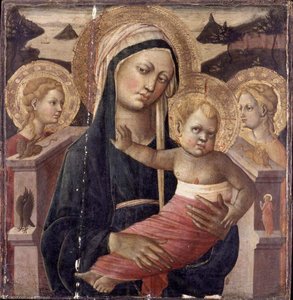
Virgin and Child Enthroned with Saints Anthony Abbot and Julian and a Donor (1430) による ロ・スケッジャ

Virgin and Child Enthroned with Saints Anthony Abbot and Julian and a Donor

1430 · Tempera On Panel · コートールド・ギャラリー, ロンドン

The air within the frame feels heavy with a quiet, luminous stillness. At the center of this sacred assembly, the Virgin Mary sits upon a throne, her presence commanding yet gentle. She holds the Christ Child, whose small form radiates a soft light against the deep blues of her robes. Surrounding them, the saints emerge from a background of shimmering gold leaf, their figures caught in a moment of eternal…

4
Saint Anthony Abbot Tempted by Gold (1400) による ロ・スケッジャ

Saint Anthony Abbot Tempted by Gold

1400 · Tempera On Panel · Birmingham Museum of Art, バーミンガム

The painting titled Saint Anthony Abbot Tempted by Gold is a work by the Italian artist Giovanni di ser Giovanni Guidi, who is also known by the name Lo Scheggia. This tempera on panel work dates to the mid-15th century. The subject matter focuses on the figure of Saint Anthony Abbot, who is depicted with a golden halo. The saint holds a red book and a staff in his hands.

5
Madonna and Child with two Angels (1450) による ロ・スケッジャ

Madonna and Child with two Angels

1450 · Tempera On Panel · Musée du Petit Palais, アヴィニョン

The painting titled Madonna and Child with two Angels is a work by the Florentine artist Giovanni di ser Giovanni Guidi. Created about 1450, the panel captures a quiet moment of divine presence. The figures are centered in a tight, vertical arrangement, held within a space of gold and deep ultramarine blue. This composition focuses on the Virgin Mary as she holds the Christ Child, flanked by two celestial beings.

6
Three panels adorning a Wedding Cassone (1467) による ロ・スケッジャ

Three panels adorning a Wedding Cassone

1467 · Tempera On Panel

The wood bears the weight of centuries, its surface etched with fine cracks that trace the passage of time. These three panels, once part of a wedding cassone, carry the quiet gravity of the Quattrocento. Tempera on wood, the medium allows for a precise, linear clarity that defines every movement. A ceremonial procession moves across the top panel, a frieze of horses and carriages winding through a landscape of architectural…

7
The Triumph of a Roman General (1462) による ロ・スケッジャ

The Triumph of a Roman General

1462 · Tempera On Panel · スコットランド国立美術館, エディンバラ

A horizontal frieze of movement unfolds across the panel. A Roman general sits within a raised golden chariot, a singular point of stillness amidst a rhythmic surge of soldiers. The landscape stretches toward distant, rolling hills and pale skies, creating a sense of immense scale. Beneath the chariot, the terrain is rendered in earthy ochres and browns, while the sky holds a deep, quiet blue. The composition relies on a…

8
The Seven Liberal Arts (1460) による ロ・スケッジャ

The Seven Liberal Arts

1460 · Tempera On Panel · カタルーニャ国立美術館, バルセロナ

The Seven Liberal Arts is an allegorical painting by Giovanni di Ser Giovanni Guidi. Created around 1460, this work offers a structured look into the intellectual disciplines of the Renaissance. The artist, who was also known as Lo Scheggia, approached the subject with a specific sense of order and decorative intent. Each figure within the composition represents a particular branch of knowledge, arranged in a rhythmic, architectural sequence.

9
Triumph of Julius Caesar (1455) による ロ・スケッジャ

Triumph of Julius Caesar

1455 · Tempera On Panel · New York Historical Society, ニューヨーク市

The work is organized as a long, horizontal frieze-like arrangement, guiding the eye across a crowded procession. Numerous figures, horses, and animals move steadily from left to right through a landscape. This movement creates a sense of continuous narrative, as if we are witnessing a single moment of a historical or allegorical triumphal procession. The perspective remains somewhat flattened, a characteristic approach for the mid-15th century, yet the artist achieves…

10
Church of San Lorenzo (San Giovanni Valdarno), Toscana, Italy (1457) による ロ・スケッジャ

Church of San Lorenzo (San Giovanni Valdarno), Toscana, Italy

1457 · Fresco

The work known as Church of San Lorenzo (San Giovanni Valdarno), Toscana, Italy, was executed by Giovanni di ser Giovanni Guidi. This artist, often referred to by the nickname Lo Scheggia, was born in San Giovanni Valdarno, Italy, and remained connected to this region throughout his life until his death in 1486. His presence in the Florentine Renaissance is often noted through his relationship to his brother, Masaccio, though his…

ロ・スケッジャのセレクションが続きます、11から26まで

ロ・スケッジャの代表作、時代別一覧

ロ・スケッジャが心を惹かれた主題

これらのオリジナル作品に繰り返し描かれている4つの主題と、それぞれの最高傑作。

ロ・スケッジャの原画を所蔵する美術館

このページに掲載されている絵画を最も多く所蔵している 8 の美術館

美術館 都市 ロ・スケッジャの作品 このリストの絵画
Museo di Palazzo Davanzati, FlorenceMuseo di Palazzo Davanzati Florence 3 Game of Civettino (detail), Game of Civettino (a Birth Salver), Game of Civettino (a Birth Salver)
Birmingham Museum of Art, バーミンガムBirmingham Museum of Art バーミンガム 2 Saint Anthony Abbot Tempted by Gold, Saint Bernardino of Siena Preaching
Musée du Petit Palais, アヴィニョンMusée du Petit Palais アヴィニョン 2 Madonna and Child with two Angels, Reclining Youth
フィラデルフィア美術館, フィラデルフィアフィラデルフィア美術館 フィラデルフィア 1 Portrait of a Lady
コートールド・ギャラリー, ロンドンコートールド・ギャラリー ロンドン 1 Virgin and Child Enthroned with Saints Anthony Abbot and Julian and a Donor
スコットランド国立美術館, エディンバラスコットランド国立美術館 エディンバラ 1 The Triumph of a Roman General
カタルーニャ国立美術館, バルセロナカタルーニャ国立美術館 バルセロナ 1 The Seven Liberal Arts
New York Historical Society, ニューヨーク市New York Historical Society ニューヨーク市 1 Triumph of Julius Caesar

ロ・スケッジャの年代別名作:各時代を象徴するオリジナル作品

年代別作品数

その時代を象徴する名作を見るために、年代を選択してください。

ロ・スケッジャの絵画に関するコレクターからの質問

ロ・スケッジャの代表作は何ですか?答えを見る

Portrait of a Lady (1460)(フィラデルフィア美術館, フィラデルフィア)。次いでGame of Civettino (detail) (1450)、Virgin and Child Enthroned with Saints Anthony Abbot and Julian and a Donor (1430)が続きます。

Portrait of a Ladyが制作されたとき、ロ・スケッジャは何歳でしたか?答えを見る

54歳:Portrait of a Ladyは1460年の作品で、ロ・スケッジャの生年は1406年です。

ロ・スケッジャの最も有名な10作品とは?答えを見る

Portrait of a Lady, Game of Civettino (detail), Virgin and Child Enthroned with Saints Anthony Abbot and Julian and a Donor, Saint Anthony Abbot Tempted by Gold, Madonna and Child with two Angels, Three panels adorning a Wedding Cassone, The Triumph of a Roman General, The Seven Liberal Arts, Triumph of Julius Caesar と Church of San Lorenzo (San Giovanni Valdarno), Toscana, Italy。上記のランキングには、それぞれの制作年と所蔵美術館が記載されています。

ロ・スケッジャが遺した作品数は?答えを見る

当カタログには、1430年から1467年にかけて制作されたロ・スケッジャによる29点の作品が収められています。

ロ・スケッジャの名作は、どの美術館に収蔵されていますか?答えを見る

主にMuseo di Palazzo Davanzati (Florence), Birmingham Museum of Art (バーミンガム) と Musée du Petit Palais (アヴィニョン)に所蔵されています。上記の美術館一覧にすべて記載されています。

ロ・スケッジャが最も有名な作品を多く描いたのは何年ですか?答えを見る

1450s年:このページにある全26作品のうち、12作品がその時期に制作されました。そのうちGame of Civettino (detail)作品が含まれます。

ロ・スケッジャによる最初と最後の代表的なオリジナル作品は何ですか?答えを見る

このページでは、最も古い作品はVirgin and Child Enthroned with Saints Anthony Abbot and Julian and a Donor (1430)、最新の作品はThree panels adorning a Wedding Cassone (1467)です。

ロ・スケッジャ が最も多く描いた主題は何ですか?答えを見る

このページに掲載されている26点の作品におけるPeople (7), Woman (6) と Architecture (6)

ロ・スケッジャ が最も多く使用した技法は何ですか?答えを見る

このページに掲載されている全26作品のうち、14作品のTempera On Panel

ロ・スケッジャはどの芸術運動に属していますか?答えを見る

このページに掲載されているオリジナル作品から判断すると、Early renaissanceです。

Museo di Palazzo Davanzatiにはどのロ・スケッジャの作品が展示されていますか?答えを見る

Game of Civettino (detail), Game of Civettino (a Birth Salver) と Game of Civettino (a Birth Salver):Museo di Palazzo Davanzati, Florenceには、このページに掲載されている作品のうち3点が所蔵されています。

ロ・スケッジャ:生涯と作品

The Splinter of Florentine Elegance

In the grand, sun-drenched tapestry of the Florentine Renaissance, certain names shine with a revolutionary brilliance that alters the course of art history forever. While his brother Masaccio is celebrated as the pioneer of groundbreaking realism, Giovanni di Ser Giovanni—affectionately known to history as Lo Scheggia, or "the splinter"—carved out a legacy defined by a different, more delicate kind of mastery. Born in San Giovanni Valdarno, Italy, he was part of a family deeply rooted in the artistic traditions of Tuscany, an environment that nurtured his innate talent for visual storytelling and intricate craftsmanship.

The nickname Lo Scheggia likely derived from his slender build, but it also perhaps alluded to his specialized relationship with wooden artifacts. His grandfather, Mone, was a cassaio—a craftsman specializing in the construction of chests—and this heritage profoundly influenced Giovanni’s artistic path. Rather than pursuing the visceral, muscular drama seen in the works of his brother, Lo Scheggia found his calling in the decoration of domestic furnishings, such as wedding chests, birth trays, and spalliera panels.

A Journey Through Workshops and Traditions

The journey of this Florentine master began in earnest when he moved to the heart of the Renaissance. His early years were shaped by rigorous discipline within the workshop of Lorenzo Bicci, an artist still bound to more traditional stylistic features that lacked the modern sophistication of the International Gothic or the emerging perspective approaches. Seeking greater innovation, Giovanni eventually moved to the workshop of his brother, Masaccio, living alongside him and their mother in Via de’ Servi.

Despite the monumental shadow cast by his brother's revolution, Lo Scheggia demonstrated a remarkable sense of artistic integrity. In 1428, he famously declined to inherit Masaccio's estate, a decision that suggests a man deeply committed to forging his own creative identity. His work represents a realm of quieter elegance, where meticulous detail and profound spiritual contemplation reign supreme, stepping away from the heavy realism of his brother to embrace a more graceful, decorative aesthetic.

Mastery of Detail and Symbolism

Lo Scheggia’s technical prowess is most evident in his ability to manipulate tempera paint to create depth and luminosity. His works often feature a meticulous attention to detail that draws the viewer into an intimate, almost private world. One of his most captivating achievements is the Game of Civettino (a Birth Salvor), painted around 1450. This circular painting, executed in tempera on gessoed panel, captures a poignant window into the burgeoning artistic sensibilities of the Early Renaissance through its depiction of two infants engaged in a playful wrestling match.

His ability to blend decorative richness with symbolic depth is further showcased in his commissions for the most powerful families of the era. His work on the Triumph of Fame, part of a large birth tray commissioned for the birth of Lorenzo de’ Medici, illustrates his skill in navigating the complex heraldry and allegorical language of the time. Through the use of muted golds, browns, and ochres, Lo Scheggia created compositions that were both visually captivating and deeply embedded in the social and familial narratives of Renaissance Florence.