Louis Marcoussis (Ludwik Markus): A Pioneer of Cubist Still Life
Louis Marcoussis, born Ludwik Kazimierz Wladyslaw Markus or Ludwig Casimir Ladislas Markus in Łódź, Poland around 1878 or 1883, stands as a singular figure within the vibrant School of Paris movement. His artistic journey spanned from Kraków Academy of Fine Arts to establishing himself as a respected artist in France, where he embraced Cubism alongside fellow luminaries like Joan Miró and Pablo Picasso. Marcoussis’s distinctive style—characterized by fragmented forms, geometric planes, and muted color palettes—captured the essence of modern life with remarkable sensitivity.
Early Life & Education: Born into a family steeped in artistic tradition, Markus received his formative education at Kraków Academy of Fine Arts, honing his skills in drawing and painting before relocating to Paris in 1906.
The Influence of Impressionism: Initially drawn to Impressionistic techniques—particularly the exploration of light and atmosphere—Marcoussis swiftly transitioned towards Cubism’s revolutionary approach. This pivotal shift reflected a broader intellectual engagement with avant-garde ideas circulating throughout Europe.
Cubist Exploration & Formal Innovation
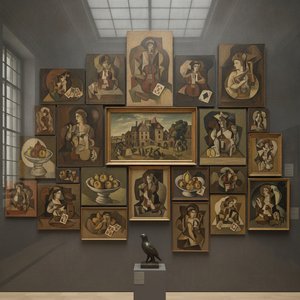
Marcoussis's contribution to Cubism is undeniable, though often overshadowed by Picasso and Braque. He meticulously dissected objects into geometric components—cubes, cylinders, and cones—presenting multiple perspectives simultaneously on a single canvas. Unlike his contemporaries who focused primarily on architectural forms, Marcoussis skillfully incorporated musical instruments – notably the cello – into his compositions, conveying not only visual accuracy but also emotional depth. His still lifes, such as “The Bottle Of Whisky And The Pack Of Scaferlati,” exemplify this masterful technique, demonstrating a profound understanding of spatial relationships and tonal harmonies.
Notable Works: Among his most celebrated pieces are "Interior with a Double Bass," which showcases the artist’s ability to capture the subtle nuances of musical performance; “Concert,” depicting musicians engaged in an artistic endeavor; and numerous portraits reflecting his humanist sensibilities.
Collaboration With Miró: Marcoussis maintained a fruitful creative partnership with Joan Miró, exploring shared interests in Surrealism and experimenting with expressive abstraction. Their collaborative endeavors solidified their position as key figures within the avant-garde landscape of the period.
A Legacy of Quiet Intensity
Despite his relatively modest output compared to Picasso or Braque, Louis Marcoussis’s artistic vision endured. His paintings possess a quiet intensity—a contemplative gaze upon familiar subjects rendered with meticulous detail and imbued with emotional resonance. He skillfully blended Impressionistic sensibilities with Cubist principles, creating artworks that transcend mere representation, inviting viewers into a realm of psychological exploration.
Historical Significance & Artistic Impact
Marcoussis’s work represents an important chapter in the history of modern art. His unwavering commitment to Cubism—particularly his focus on musical instruments—challenged conventional artistic conventions and contributed to the development of abstract expressionism decades later. Today, Louis Marcoussis's paintings continue to inspire artists and scholars alike, cementing his place as a pivotal voice within the School of Paris and a testament to the enduring power of visual art to convey profound human experience.
Explore the revolutionary world of Cubist Still Life with OriginalUniqueArt. Discover Picasso & Braque's groundbreaking techniques, its philosophical roots, and lasting impact on modern art. Expert insights for collectors.