The Shadows of San Severino Marche
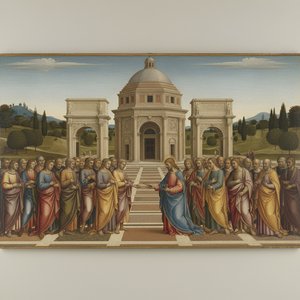
The year is 1400 in San Severino Marche. A young Lorenzo Salimbeni completes the triptych painting of the altarpiece of the Mystical Marriage of St Catherine. The work sits within the Pinacoteca Civica, a singular achievement signed by his own hand. He works alongside his brother, Jacopo, their hands moving through the same provincial air, yet Lorenzo’s individual mark emerges in these early years.
His world is defined by the stone and mortar of east-central Italy. The landscape of his career is a map of churches and oratories: the Abbey of San Lorenzo in Doliolo, the Church of San Domenico, and the old Cathedral of Saint Maria della Pieve. He does not seek the wide horizons of distant lands, but rather the sacred walls of his home region.
A Language of Grisaille and Drama
The technique shifts. The bright colors of earlier traditions give way to the stark, expressive power of grisaille. In a fresco detached from the Provincial Institute for Abandoned Infants in Perugia, the artist demonstrates a mastery of grey tones. He uses shades of grey enriched by subtle nuances of red for blood and yellow ochre for flesh. The contrast between light and shadow creates a heavy, physical presence.
The faces carry a specific weight. In his depiction of Christ crucified between the Madonna, Saint John and the Marys grieving, around 1410, the characters inhabit a state of intense lamentation. The face of Saint John resembles an antique mask, frozen in desperate grief. This is not the courtly, poetic style of Gentile da Fabriano; it is an alternative, more expressionist way of communicating sacred drama.
The Final Frescoes
By 1416, the brush moves to Urbino. In the Oratory of St John the Baptist, Lorenzo and Jacopo execute frescoes of the Crucifixion and scenes from the life of Saint John the Baptist. These works represent the internationalization of a local pictorial language, bringing a broader stylistic element to the provinces of east-central Italy.
The timeline of his life reaches its conclusion in the early decades of the fifteenth century. His presence remains etched into the walls of the Marches and Umbria through:
- The triptych of the Mystical Marriage of St Catherine
- The frescoes within the Oratory of St John the Baptist
- The grisaille works in Perugia