John Francis Murphyの肖像画

John Francis Murphyの絵画:ギャラリーの視点で選ぶ、最も有名な39作品

11月 2026 更新 · 当サイトの人気スコア(各作品の検索数、閲覧数、注文数)に基づくランキング · 41点の John Francis Murphyの作品がカタログにあります

要約すると

ギャラリーの視点では、John Francis Murphyの最も有名な作品はIndian Summer (1903)であり、その原画はWashington, D.C.のスミソニアン・アメリカン・アート・ミュージアムに展示されています。 Woods Clearing (1914)とSunset Landscapeが加わり、誰もが一度は目にしたことのある至高のトリオが完成します。 当カタログに含まれるJohn Francis Murphyの作品41点の中から、特に有名な39点を厳選してご紹介します。各作品は、制作年、所蔵美術館、そしてその作品ならではの魅力とともに、一点物のオリジナル作品として掲載されています。

1853 – 1921, Oswego 最多収蔵館: スミソニアン・アメリカン・アート・ミュージアム

ギャラリーが選ぶJohn Francis Murphyのトップ10作品

1
Indian Summer (1903) による John Francis Murphy

Indian Summer

We are looking at Indian Summer, a work painted by John Francis Murphy in 1903. This oil on canvas captures a specific, quiet moment in the American landscape, rendered with a sensitivity that defines much of Murphy's output during this period. The scale of the piece is intimate, measuring 16 1/4 x 22 in. (41.2 x 56.0 cm), inviting a close, personal observation of its subtle tonal shifts.

2
Woods Clearing (1914) による John Francis Murphy

Woods Clearing

1914 · Oil On Canvas

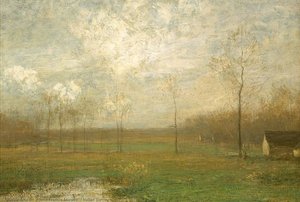
Woods Clearing, painted by John Francis Murphy in 1914, presents a natural landscape centered on a field populated by trees. The work captures a specific moment in the seasonal cycle, focusing on the quietude of the terrain.

4
Eos (1848) による John Francis Murphy

Eos

1848

This statue portrays Prince Albert’s pet greyhound, Eos. The Prince was given her as six-week-old puppy. Although he was only 14 at the time, he brought her up and trained her himself, and she remained his companion until she died on 31 July 1844, when she was ten and a half years old. John Francis, a favourite sculptor of Queen Victoria, exhibited this bronze at the Royal Academy in 1848.

5
October Mist (1902) による John Francis Murphy

October Mist

1902

A Poetic Vision of Autumn: John Francis Murphy's "October Mist" John Francis Murphy’s “October Mist,” painted in 1902, is a captivating example of American Tonalism. This evocative landscape transports the viewer to a serene rural scene, dominated by a solitary tree standing sentinel within a lush field veiled in atmospheric mist. The painting isn't merely a depiction of nature; it's an exploration of mood and feeling, capturing the quiet melancholy…

6
Landscape (1880) による John Francis Murphy

Landscape

1880 · Oil · メトロポリタン美術館, ニューヨーク

is a painting by John Francis Murphy, created about 1880. The artist, who was born in Oswego, United States, in 1853, produced this work during a period of transition in American landscape painting. Murphy lived until 1921, leaving behind a body of work that reflects his specific approach to the natural environment.

John Francis Murphyの絵画、ランキング11位から39位

John Francis Murphyが心を惹かれた主題

これらのオリジナル作品に繰り返し描かれている4つの主題と、それぞれの最高傑作。

John Francis Murphyの原画を所蔵する美術館

このページに掲載されている絵画を最も多く所蔵している 8 の美術館

美術館 都市 John Francis Murphyの作品 このリストの絵画
スミソニアン・アメリカン・アート・ミュージアム, Washington, D.C.スミソニアン・アメリカン・アート・ミュージアム Washington, D.C. 5 Indian Summer, The Path to the Village, Small Landscape
ダラス美術館, ダラスダラス美術館 ダラス 5 Fence Corner, Landscape, Morning in October
インディアナポリス美術館, インディアナポリスインディアナポリス美術館 インディアナポリス 3 Under Gray Skies, Early Autumn, Landscape
メトロポリタン美術館, ニューヨークメトロポリタン美術館 ニューヨーク 2 Landscape, The Old Barn
ボストン美術館, ボストンボストン美術館 ボストン 2 Rocky Fields, Sunset
New Britain Museum of American Art, ニューブリテンNew Britain Museum of American Art ニューブリテン 2 New England Meadow in Spring, Afternoon in October
トレド美術館, トレドトレド美術館 トレド 1 Sunset
Buffalo AKG Art Museum, バッファローBuffalo AKG Art Museum バッファロー 1 Neglected Lands

John Francis Murphy、10年ごとに1枚の代表作

年代別作品数

その時代を象徴する名作を見るために、年代を選択してください。

John Francis Murphyの絵画:ギャラリーの回答

John Francis Murphyの作品の中で、最も有名な絵画は何ですか?答えを見る

Indian Summer (1903)(スミソニアン・アメリカン・アート・ミュージアム, Washington, D.C.)。次いでWoods Clearing (1914)、Sunset Landscapeが続きます。

John Francis MurphyがIndian Summerを完成させた時の年齢は?答えを見る

50歳:Indian Summerは1903年の作品で、John Francis Murphyの生年は1853年です。

John Francis Murphyの代表的な絵画トップ10は?答えを見る

Indian Summer, Woods Clearing, Sunset Landscape, Eos, October Mist, Landscape, The Path to the Village, Rocky Fields, Wooded River Landscape と Small Landscape。上記のランキングには、それぞれの制作年と所蔵美術館が記載されています。

John Francis Murphyの作品数は?答えを見る

当カタログには、1880年から1917年にかけて制作されたJohn Francis Murphyによる41点の作品が収められています。

John Francis Murphyの最も有名なオリジナル作品はどこに展示されていますか?答えを見る

主にスミソニアン・アメリカン・アート・ミュージアム (Washington, D.C.), ダラス美術館 (ダラス) と インディアナポリス美術館 (インディアナポリス)に所蔵されています。上記の美術館一覧にすべて記載されています。

John Francis Murphyが最も有名な作品を描いたのはいつですか?答えを見る

1900s年:このページにある全39作品のうち、11作品がその時期に制作されました。そのうちIndian Summer作品が含まれます。

John Francis Murphyの初期および後期の代表作は何ですか?答えを見る

このページでは、最も古い作品はLandscape (1880)、最新の作品はEarly Autumn (1917)です。

John Francis Murphy が最も多く描いた主題は何ですか?答えを見る

このページに掲載されている39点の作品におけるLandscape (6), Grass (2) と Trees (2)

John Francis Murphy が最も多く用いた技法は何ですか?答えを見る

このページに掲載されている全39作品のうち、2作品のOil On Canvas

スミソニアン・アメリカン・アート・ミュージアムが所蔵するJohn Francis Murphyのオリジナル作品は何ですか?答えを見る

Indian Summer, The Path to the Village と Small Landscape:スミソニアン・アメリカン・アート・ミュージアム, Washington, D.C.には、このページに掲載されている作品のうち5点が所蔵されています。

John Francis Murphy:アーティスト

A Poet of the American Landscape: The Life and Art of John Francis Murphy

John Francis Murphy, born in Oswego, New York, in 1853, emerged as a pivotal figure in American landscape painting during a period of profound artistic transition. His name is inextricably linked with Tonalism, yet to define his work solely by this movement would be to diminish the subtle evolution and quiet innovation that characterized his career. Murphy’s journey began not amidst palettes and easels, but as a sign painter in Chicago – a practical trade that ultimately proved unsatisfying for a spirit yearning for more expressive pursuits. This early experience, however, instilled a foundational understanding of form and color which would later inform his delicate compositions. Dissatisfied with commercial art, he bravely relocated to New York City in 1875, embarking on a path of largely self-directed artistic education. He immersed himself in the study of the masters, frequenting museums and honing his skills through dedicated practice.

From Barbizon Influences to Tonalist Mastery

Murphy’s initial forays into landscape painting were deeply influenced by the Barbizon school – a group of French painters who championed realism and direct observation of nature. He quickly gained recognition, exhibiting at the National Academy of Design as early as 1876. However, it was through his engagement with artists like Alexander Wyant and George Inness that Murphy truly found his artistic voice. These figures emphasized tonal values – the subtle gradations of light and shadow – and atmospheric effects, principles which resonated profoundly with Murphy’s own sensibilities. He wasn't merely replicating what he saw; he sought to capture the *feeling* of a place, the mood evoked by the interplay of light, air, and form. Around 1900, his style began to shift, incorporating more modern approaches to depicting light and atmosphere while retaining the core tenets of Tonalism. This period witnessed a refinement of his technique, marked by increasingly sparse compositions and a masterful use of muted colors – browns, grays, and greens that lent his paintings an air of serene contemplation.

The Pakatakan Artist Colony and Artistic Recognition

In 1887, Murphy established the Pakatakan Artist Colony in Arkville, New York, nestled within the picturesque Catskill Mountains. This haven became a gathering place for artists seeking inspiration from the natural beauty of the region and fostering a collaborative artistic environment. The colony’s influence on Murphy's work is undeniable; the landscapes he produced during his time there are imbued with a sense of quiet intimacy and profound connection to the land. His dedication and talent did not go unnoticed. He was elected an associate of the National Academy of Design in 1885, becoming a full academician just two years later. Further accolades followed, including membership in the Society of American Artists and the American Watercolor Society, as well as prestigious awards like a gold medal at Charleston (1902) and the Inness Medal in 1910. These honors cemented his position as a leading figure in the American art world.

A Legacy of Atmospheric Depth and Poetic Sentiment

Murphy’s paintings are not grand statements or dramatic narratives; they are subtle meditations on the beauty and tranquility of the natural world. Works like October, held by the Corcoran Gallery of Art, and The Path to the Village and Indian Summer, both residing in the National Gallery of Art, exemplify his mastery of atmospheric perspective – creating a convincing illusion of depth and distance through subtle shifts in tone and color. His canvases often depict rural scenes – weathered barns, quiet fields, and winding paths – imbued with a sense of poetic sentiment. He wasn’t simply painting landscapes; he was evoking emotions, inviting viewers to share in his experience of the natural world. His ability to capture the essence of a place, rather than merely its appearance, is what sets him apart. His influence extended beyond his immediate circle, inspiring subsequent generations of artists to explore the expressive possibilities of Tonalism and atmospheric landscape painting. Though he passed away in New York City in 1921 from pneumonia, John Francis Murphy’s legacy endures through the enduring appeal of his paintings – a testament to the power of quiet observation, subtle technique, and profound artistic vision.