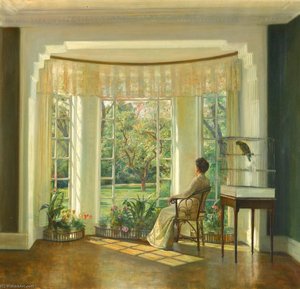
カール・ホルセの肖像画

ギャラリー厳選、カール・ホルセによる最も有名な27の絵画

11月 2026 更新 · 当サイトの人気スコア(各作品の検索数、閲覧数、注文数)に基づくランキング · 28点の カール・ホルセの作品がカタログにあります

要約すると

カール・ホルセが遺した数多くのオリジナル作品の中で、最も有名なものはInterior with the artist's wife sewing at the window. (1881)です。 それに次いで、Interior with the artist's wife reading a book by the window. (1881)とInterior with a Girl Sewing (1888)が続きます。 カール・ホルセによる28点の作品をカタログに掲載しています。当ギャラリーでは、世界が称賛する27点を選定し、制作年、所蔵美術館、そしてその背景にある物語とともにご紹介しています。

1863 – 1935, オーフス Realism 最多収蔵館: Statens Museum For Kunst

カール・ホルセの代表作10選:ギャラリー厳選の作品集

1
Interior with the artist's wife sewing at the window. (1881) による カール・ホルセ

Interior with the artist's wife sewing at the window.

1881 · Oil On Canvas

Interior with the artist's wife sewing at the window. is a quiet study by Carl Holsøe, painted about 1881. The work captures a solitary moment of domestic life, focusing on a woman seated by a window, absorbed in her sewing. It is a scene that prioritizes the stillness of a room and the subtle presence of a person within a structured space.

2
Interior with the artist's wife reading a book by the window. (1881) による カール・ホルセ

Interior with the artist's wife reading a book by the window.

1881 · Oil On Canvas

The quietude of a private moment finds its form in Interior with the artist's wife reading a book by the window., an oil on canvas painted by Carl Holsøe. Created about 1881, the work captures a stillness that feels as though it is happening right now, just as the light shifts across the room. The scene rests within the intimate confines of a domestic space, where the soft glow from…

4
Interior with Girl (1905) による カール・ホルセ

Interior with Girl

1905 · Oil On Canvas · バイエルン州立絵画コレクション, ミュンヘン

A soft, pale light spills from a window on the far left, washing over a domestic scene that feels suspended in a moment of profound stillness. A young girl sits at a table, her form a gentle, organic curve against the rigid, rectangular lines of the room. The scene is rendered in a monochromatic palette, where every detail relies on the subtle interplay of gray, white, and deep black. There…

5
Interior from the artist's home. (1914) による カール・ホルセ

Interior from the artist's home.

1914 · Oil On Canvas

Interior from the artist's home. is a painting by Carl Holsøe. This work was created in 1914. The artist, Carl Holsøe, was born in Aarhus, Denmark, in 1863 and died in Asserbo in 1935. His practice focused primarily on domestic interior scenes, often capturing the specific arrangement of objects and the way light occupies a room.

6
An Italian village with women at the fountain (1916) による カール・ホルセ

An Italian village with women at the fountain

1916 · Oil On Canvas · Imago Museum, Pescara

In "An Italian village with women at the fountain" by Carl Holsøe, we find ourselves observing a quiet moment of daily life. The scene is set within a tranquil Italian village, where the composition is anchored by a stone fountain. Three women are gathered in the central courtyard, their presence providing a soft human element to the structured environment. This central gathering is framed by architectural structures on the left…

7
Self portrait (1920) による カール・ホルセ

Self portrait

1920 · Oil On Canvas

In this 1920 self-portrait, we find the artist, Carl Holsøe, seated within the sanctuary of his studio. The composition is intentionally asymmetrical, placing the figure slightly to the right and creating a sense of lived-in space. An easel rests in the lower foreground, a subtle reminder of the creative act that has just occurred or is about to begin. The atmosphere is one of profound stillness, where the air itself…

8
Mother and Child by a window (1935) による カール・ホルセ

Mother and Child by a window

1935 · Oil On Canvas

Soft, diffused light spills through a large window, washing the room in a gentle glow that seems to suspend time itself. Within this intimate interior, a mother and her child occupy a space of profound stillness. The scene is a quiet study of domesticity, where the weight of the world is replaced by the soft textures of fabric and the warmth of wood. The mother, dressed in dark, solid tones,…

9
Last Autumn (1935) による カール・ホルセ

Last Autumn

1935 · Oil On Canvas

In Last Autumn by Carl Holsøe, a quietude settles over a solitary interior. Created about 1935, the scene captures a lone woman seated in a room where time seems to have paused. She faces a small wooden chest or table, her dark dress providing a sharp, heavy contrast against the pale, muted tones of her surroundings. To her side, a large, closed white door dominates the space, creating a sense…

10
Interior with Mother and Child. (1881) による カール・ホルセ

Interior with Mother and Child.

1881 · Oil On Canvas

Interior with Mother and Child. is an oil on canvas by Carl Holsøe. Created in 1881, the work belongs to a period when the artist was developing his specific approach to domestic spaces. Holsøe was born in Aarhus, Denmark, in 1863 and remained a significant figure in Danish art until his death in Asserbo in 1935.

カール・ホルセのセレクションが続きます、11から27まで

カール・ホルセの代表作、時代別一覧

カール・ホルセが心を惹かれた主題

これらのオリジナル作品に繰り返し描かれている4つの主題と、それぞれの最高傑作。

カール・ホルセの原画を所蔵する美術館

このページに掲載されている絵画を最も多く所蔵している 3 の美術館

美術館 所在都市 カール・ホルセの作品 このリストの絵画
Statens Museum For Kunst, コペンハーゲンStatens Museum For Kunst コペンハーゲン 3 Interior with a Girl Sewing, Interior with a Girl Reading, Interior with the Artist's Wife Emilie Heise
Imago Museum, PescaraImago Museum Pescara 2 An Italian village with women at the fountain, Village in the Apennine Mountains.
バイエルン州立絵画コレクション, ミュンヘンバイエルン州立絵画コレクション ミュンヘン 1 Interior with Girl

カール・ホルセの年代別名作:各時代を象徴するオリジナル作品

年代別作品数

その時代を象徴する名作を見るために、年代を選択してください。

カール・ホルセの絵画に関するコレクターからの質問

カール・ホルセの代表作は何ですか?答えを見る

Interior with the artist's wife sewing at the window. (1881)。続いてInterior with the artist's wife reading a book by the window. (1881)、Interior with a Girl Sewing (1888)が続きます。

Interior with the artist's wife sewing at the window.が制作されたとき、カール・ホルセは何歳でしたか?答えを見る

18歳:Interior with the artist's wife sewing at the window.は1881年の作品で、カール・ホルセの生年は1863年です。

カール・ホルセの最も有名な10作品とは?答えを見る

Interior with the artist's wife sewing at the window., Interior with the artist's wife reading a book by the window., Interior with a Girl Sewing, Interior with Girl, Interior from the artist's home., An Italian village with women at the fountain, Self portrait, Mother and Child by a window, Last Autumn と Interior with Mother and Child.。上記のランキングには、それぞれの制作年と所蔵美術館が記載されています。

カール・ホルセが遺した作品数は?答えを見る

当カタログには、1881年から1935年にかけて制作されたカール・ホルセによる28点の作品が収められています。

カール・ホルセの名作は、どの美術館に収蔵されていますか?答えを見る

主にStatens Museum For Kunst (コペンハーゲン), Imago Museum (Pescara) と バイエルン州立絵画コレクション (ミュンヘン)に所蔵されています。上記の美術館一覧にすべて記載されています。

カール・ホルセが最も有名な作品を多く描いたのは何年ですか?答えを見る

1880s年:このページにある全27作品のうち、5作品がその時期に制作されました。そのうちInterior with the artist's wife sewing at the window.作品が含まれます。

カール・ホルセによる最初と最後の代表的なオリジナル作品は何ですか?答えを見る

このページでは、最も古い作品はInterior with the artist's wife sewing at the window. (1881)、最新の作品はMother and Child by a window (1935)です。

カール・ホルセ が最も多く描いた主題は何ですか?答えを見る

このページに掲載されている27点の作品におけるWoman (16), Table (14) と Window (13)

カール・ホルセ が最も多く使用した技法は何ですか?答えを見る

このページに掲載されている全27作品のうち、19作品のOil On Canvas

カール・ホルセはどの芸術運動に属していますか?答えを見る

このページに掲載されているオリジナル作品から判断すると、Realismです。

Statens Museum For Kunstにはどのカール・ホルセの作品が展示されていますか?答えを見る

Interior with a Girl Sewing, Interior with a Girl Reading と Interior with the Artist's Wife Emilie Heise:Statens Museum For Kunst, コペンハーゲンには、このページに掲載されている作品のうち3点が所蔵されています。

カール・ホルセ:生涯と作品

The Architect of Quietude: The Life and Legacy of Carl Holsøe

Carl Vilhelm Holsøe (1863–1935) remains one of the most evocative voices in Danish art, a master of the silent moment who transformed the mundane boundaries of domestic life into profound meditations on light and space. Born in Aarhus to a family deeply rooted in architectural tradition, Holsøe possessed an innate understanding of structural harmony from his earliest years. As the son of the respected architect N.P.C. Holsøe, his gaze was naturally trained toward the logic of lines, the weight of shadows, and the way a room breathes. This early immersion in the geometry of buildings provided the silent foundation for an artistic vision that would eventually prioritize the atmospheric soul of an interior over its mere physical contents. His formal journey through the Royal Danish Academy of Fine Arts in Copenhagen and the Kunstnernes Frie Studieskoler brought him under the mentorship of luminaries like Peder Severin Krøyer. While these studies grounded him in the technical brilliance of Impressionism, Holsøe’s heart leaned toward a more contemplative realism. He found deep inspiration in the Dutch Masters, particularly the luminous stillness of Johannes Vermeer and the dramatic chiaroscuro of Rembrandt. From them, he learned that a single beam of light falling across a wooden floor could carry as much emotional weight as a grand historical epic.

A Mastery of Light and Interiority

Holsø and his contemporaries often explored the boundaries of the domestic sphere, but Holsøe’s approach was uniquely characterized by a deliberate restraint. His breakthrough at the 1886 Charlottenborg December Exhibition, with a piece titled Interior, was hailed by critics as having "almost the character of a manifesto." It signaled the arrival of an artist who did not need grand gestures to command attention; instead, he used a meticulous, almost architectural precision to capture the subtle shifts of light and the quietude of solitude. His technique was a delicate balance of disciplined brushwork and atmospheric sensitivity. In his most celebrated works, such as Girl in an Interior or A Sunlit Interior, the viewer is invited into a world where time seems to suspend itself. There is a profound sense of stillness, often achieved through a muted palette that emphasizes texture and tone over vibrant color. This mastery allowed him to elevate simple domestic scenes—a woman reading, a sun-drenched corner, or a quiet hallway—into spiritual experiences. His frequent model and wife, Emilie Heise, often graced these canvases, lending a human warmth to the otherwise austere and structured environments he created.
Recognition and Historical Significance

Throughout his prolific career, Holsøe was a constant presence in the Danish art scene, exhibiting regularly at the Charlottenborg Spring and Autumn Exhibitions. His talent was recognized with prestigious accolades, including the academy's annual medal in 1901 and 1908, and a gold medal in Munich in 1891. Beyond his individual achievements, he was a vital part of the artistic fabric of his era, maintaining friendships with other titans of Danish painting, such as Vilhelm Hammershøi. Indeed, much like Hammershøi, Holsøe’s work occupies a space where the domestic and the metaphysical intersect, making him a cornerstone of Scandinavian interior painting. The enduring significance of Carl Holsøe lies in his ability to find the extraordinary within the ordinary. He did not merely paint rooms; he painted the feeling of being within them—the solitude, the peace, and the fleeting beauty of a passing afternoon. His legacy continues to resonate with anyone who finds beauty in the quiet corners of the world, proving that the most profound stories are often told in whispers rather than shouts.