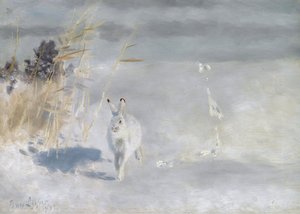
ブルーノ・リリエフォッシュの肖像画

ブルーノ・リリエフォッシュの絵画:ギャラリーの視点で選ぶ、最も有名な72作品

11月 2026 更新 · 当サイトの人気スコア(各作品の検索数、閲覧数、注文数)に基づくランキング · 77点の ブルーノ・リリエフォッシュの作品がカタログにあります

要約すると

ギャラリーの視点では、ブルーノ・リリエフォッシュの最も有名な作品はTitle in Swedish: Duvhök och orrar (1884)であり、その原画はストックホルムの国立美術館に展示されています。 Winterhare (Snow Hare), (1932)とTitle in Swedish: Rävfamilj (1886)が加わり、誰もが一度は目にしたことのある至高のトリオが完成します。 当カタログに含まれるブルーノ・リリエフォッシュの作品77点の中から、特に有名な72点を厳選してご紹介します。各作品は、制作年、所蔵美術館、そしてその作品ならではの魅力とともに、一点物のオリジナル作品として掲載されています。

1860 – 1939, ウプサラ Impressionism 最多収蔵館: 国立美術館

ギャラリーが選ぶブルーノ・リリエフォッシュのトップ10作品

1
Title in Swedish: Duvhök och orrar (1884) による ブルーノ・リリエフォッシュ

Title in Swedish: Duvhök och orrar

1884 · Oil On Canvas · 国立美術館, ストックホルム

The frozen landscape of Ärentuna provides the stage for a sudden, violent encounter. In this 1884 oil on canvas, a goshawk descends with outstretched wings and claws, targeting a juvenile bird amidst a flurry of black grouse. The scene captures a precise moment of avian predation, where the stillness of the snow is broken by the frantic movement of flight and the tension of survival. The composition focuses on the…

3
Title in Swedish: Rävfamilj (1886) による ブルーノ・リリエフォッシュ

Title in Swedish: Rävfamilj

1886 · Oil · 国立美術館, ストックホルム

In this 1886 work, we find ourselves observing a private moment within the Swedish wilderness. A family of foxes occupies a meadow, their forms nestled among the tall grass and wildflowers. There is a sense of stillness here, a pause in the constant movement of the natural world. Several adults and their young ones are positioned throughout the scene, some closer to the viewer and others receding into the depth…

4
Cat on a flowery meadow (1887) による ブルーノ・リリエフォッシュ

Cat on a flowery meadow

1887 · Oil · 国立美術館, ストックホルム

In this 1887 oil painting, a black and white cat rests within a dense meadow of wildflowers. The animal is positioned in the lower right foreground, its body oriented toward the left side of the frame. Its fur is rendered in solid patches of black and white, contrasting with the surrounding vegetation. The meadow is composed of various flora, including yellow wildflowers and small white blossoms, interspersed with green grass…

5
The Fox (1893) による ブルーノ・リリエフォッシュ

The Fox

1893 · Oil On Canvas · 国立美術館, ストックホルム

The Fox is an oil on canvas work by Bruno Liljefors, dated about 1893. The subject features a single red fox moving through a snowy landscape. This naturalist study captures the animal within its natural habitat, focusing on the interaction between the creature and the winter environment.

6
Landscape with Fox (Fox pursued by Jackals) (1899) による ブルーノ・リリエフォッシュ

Landscape with Fox (Fox pursued by Jackals)

1899 · Oil On Canvas · Rijksmuseum Twenthe, エンシェデ

The scene unfolds within the oil on canvas work titled Landscape with Fox (Fox pursued by Jackals). This piece, created by Bruno Liljefors, captures a moment of tension amidst the forest. The artist, Bruno Liljefors, was born in Uppsala Cathedral Assembly, Sweden, in 1860 and lived until 1939. His hand guides the viewer through this natural setting, where the subject matter is deeply rooted in the wild realities of the…

8
An Eagle Owl (1905) による ブルーノ・リリエフォッシュ

An Eagle Owl

1905 · Oil · 国立美術館, ストックホルム

An Eagle Owl by Bruno Liljefors, created about 1905, features a centered composition where the bird occupies much of the middle ground. The owl is positioned against a dark, indistinct background that suggests the interior of a hollow or a shaded forest floor. This setting creates a shallow depth, focusing the viewer's attention entirely on the subject. The color palette is dominated by earthy tones, including various shades of brown,…

9
Duckling (1903) による ブルーノ・リリエフォッシュ

Duckling

1903 · Oil On Board

This naturalist oil painting, created in 1903, presents an intimate and highly realistic depiction of a single young duckling. The composition is centered, with the small bird positioned slightly off-center towards the left to evoke a sense of natural spontaneity. Rendered on a rectangular substrate, likely wood or board, the work focuses entirely on the subject, which emerges from a shallow, atmospheric, and indistinct background.

10
Fox with Cubs (1912) による ブルーノ・リリエフォッシュ

Fox with Cubs

1912 · Oil On Canvas · 国立美術館, ストックホルム

In this work, titled Fox with Cubs, we encounter a quiet moment from the life of a Swedish artist, Bruno Liljefors. Painted in 1912, the piece reflects the naturalist sensibilities that defined his career. Liljefors was born in 1860 in Uppsala, Sweden, and his deep connection to the Swedish landscape remained a constant throughout his life until his death in Stockholm in 1939.

ブルーノ・リリエフォッシュの絵画、ランキング11位から72位

11Självporträtt (1913) による ブルーノ・リリエフォッシュSjälvporträtt1913 · National Portrait Gallery of Sweden 12Foxes Emerging from Snowy Forest Edge (1919) による ブルーノ・リリエフォッシュFoxes Emerging from Snowy Forest Edge1919 · Rijksmuseum Twenthe 13Peregrine Falcon with Little Owl (?) as Prey at its Eyrie on the Coast (1923) による ブルーノ・リリエフォッシュPeregrine Falcon with Little Owl (?) as Prey at its Eyrie on the Coast1923 · Rijksmuseum Twenthe 14Fox in Winter Landscape (1938) による ブルーノ・リリエフォッシュFox in Winter Landscape1938 · 国立美術館 15A Family of Foxes による ブルーノ・リリエフォッシュA Family of Foxes 16Title in Swedish: Nötskrikor (1886) による ブルーノ・リリエフォッシュTitle in Swedish: Nötskrikor1886 · 国立美術館 17Eluding the fox による ブルーノ・リリエフォッシュEluding the fox 18Cat Hunting Birds (1883) による ブルーノ・リリエフォッシュCat Hunting Birds1883 · イェテボリ美術館 19Sledging (1882) による ブルーノ・リリエフォッシュSledging1882 · 国立美術館 20A Cat with a Young Bird in its Mouth. Five studies in one frame NM 2223-2227 (1885) による ブルーノ・リリエフォッシュA Cat with a Young Bird in its Mouth. Five studies in one frame NM 2223-22271885 · 国立美術館 21Sparrows in a Cherry Tree. Five studies in one frame, NM 2223-2227 (1885) による ブルーノ・リリエフォッシュSparrows in a Cherry Tree. Five studies in one frame, NM 2223-22271885 · 国立美術館 22A Cat and a Chaffinch. Five animal studies in one frame, NM 2223-2227 (1885) による ブルーノ・リリエフォッシュA Cat and a Chaffinch. Five animal studies in one frame, NM 2223-22271885 · 国立美術館 23Chaffinches and Dragonflies. Five studies in one frame, NM 2223-2227 (1885) による ブルーノ・リリエフォッシュChaffinches and Dragonflies. Five studies in one frame, NM 2223-22271885 · 国立美術館 24Redstarts and Butterflies. Five studies in one frame, NM 2223-2227 (1885) による ブルーノ・リリエフォッシュRedstarts and Butterflies. Five studies in one frame, NM 2223-22271885 · 国立美術館 25Swedish Foxhound and Fox (1885) による ブルーノ・リリエフォッシュSwedish Foxhound and Fox1885 · 国立美術館 26Black Grouse Display (1889) による ブルーノ・リリエフォッシュBlack Grouse Display1889 · バイエルン州立絵画コレクション 27Nestlings of Red-Backed Shrike (1887) による ブルーノ・リリエフォッシュNestlings of Red-Backed Shrike1887 · 国立美術館 28Four Bird Studies, Red-Backed Shrike, Corncrake, Chaffinches, Willow Warbler. (1887) による ブルーノ・リリエフォッシュFour Bird Studies, Red-Backed Shrike, Corncrake, Chaffinches, Willow Warbler.1887 · 国立美術館 29The Hunter (1891) による ブルーノ・リリエフォッシュThe Hunter1891 · 国立美術館 30Man Warping (1888) による ブルーノ・リリエフォッシュMan Warping1888 · 国立美術館 31Hooded Crows (1891) による ブルーノ・リリエフォッシュHooded Crows1891 · イェテボリ美術館 32Wild Geese (1898) による ブルーノ・リリエフォッシュWild Geese1898 · Statens Museum For Kunst 33Sea Eagles (1897) による ブルーノ・リリエフォッシュSea Eagles1897 · 国立美術館 34Eider Ducks (1894) による ブルーノ・リリエフォッシュEider Ducks1894 · 国立美術館 35Landscape (Fox pursued by Snipe) (1899) による ブルーノ・リリエフォッシュLandscape (Fox pursued by Snipe)1899 · Rijksmuseum Twenthe 36Dovekies (1901) による ブルーノ・リリエフォッシュDovekies1901 · 国立美術館・建築・デザイン美術館 37Capercaillies in a Winter Landscape (1899) による ブルーノ・リリエフォッシュCapercaillies in a Winter Landscape1899 · Finnish National Gallery 38Capercailzie Hen (1904) による ブルーノ・リリエフォッシュCapercailzie Hen1904 · 国立美術館 39White-tailed Eagle with White-tailed Eagle Prey at its Nest on the Coast (1907) による ブルーノ・リリエフォッシュWhite-tailed Eagle with White-tailed Eagle Prey at its Nest on the Coast1907 · Rijksmuseum Twenthe 40Sparrowhawk Buffeting a Reed Bunting (1907) による ブルーノ・リリエフォッシュSparrowhawk Buffeting a Reed Bunting1907 · Rijksmuseum Twenthe 41Blackgame in Springtime (1907) による ブルーノ・リリエフォッシュBlackgame in Springtime1907 · 国立美術館 42Curlew (1907) による ブルーノ・リリエフォッシュCurlew1907 · 国立美術館 43Sea Eagle's Nest (1907) による ブルーノ・リリエフォッシュSea Eagle's Nest1907 · 国立美術館 44Wildgeese Settling (1907) による ブルーノ・リリエフォッシュWildgeese Settling1907 · 国立美術館 45Red Grouse In The Snow による ブルーノ・リリエフォッシュRed Grouse In The Snow 46Eider Ducks Above Turbulent Sea (1912) による ブルーノ・リリエフォッシュEider Ducks Above Turbulent Sea1912 · Rijksmuseum Twenthe 47Rolling Capercaillie with Three Hens (1913) による ブルーノ・リリエフォッシュRolling Capercaillie with Three Hens1913 · Rijksmuseum Twenthe 48Autumn Landscape with Partridges (1913) による ブルーノ・リリエフォッシュAutumn Landscape with Partridges1913 · 国立美術館 49Bellowing Capercaillies with Them (1919) による ブルーノ・リリエフォッシュBellowing Capercaillies with Them1919 · Rijksmuseum Twenthe 50Grazing Brent Geese at Sunset (1921) による ブルーノ・リリエフォッシュGrazing Brent Geese at Sunset1921 · Rijksmuseum Twenthe 51Pair of wild ducks by a hole in the ice (1919) による ブルーノ・リリエフォッシュPair of wild ducks by a hole in the ice1919 · Rijksmuseum Twenthe 52Partridges (1922) による ブルーノ・リリエフォッシュPartridges1922 · Finnish National Gallery 53Pair of Male and Female Ducks by a Cliff (1928) による ブルーノ・リリエフォッシュPair of Male and Female Ducks by a Cliff1928 · Rijksmuseum Twenthe 54White-tailed Eagle Strikes at Wigeon Nest (1924) による ブルーノ・リリエフォッシュWhite-tailed Eagle Strikes at Wigeon Nest1924 · Rijksmuseum Twenthe 55Whooper Swans on Evening Migration (1925) による ブルーノ・リリエフォッシュWhooper Swans on Evening Migration1925 · Rijksmuseum Twenthe 56Winter Landscape with Snow Hare (1923) による ブルーノ・リリエフォッシュWinter Landscape with Snow Hare1923 · Rijksmuseum Twenthe 57Herring Gulls and Arctic Terns on the Skerries off the Scandinavian Coast (1923) による ブルーノ・リリエフォッシュHerring Gulls and Arctic Terns on the Skerries off the Scandinavian Coast1923 · Rijksmuseum Twenthe 58Two curlews in a peat landscape (1927) による ブルーノ・リリエフォッシュTwo curlews in a peat landscape1927 · Rijksmuseum Twenthe 59Black Grouse in a Treetop (1923) による ブルーノ・リリエフォッシュBlack Grouse in a Treetop1923 · Finnish National Gallery 60Moose shifting across a swamp in Sweden (1929) による ブルーノ・リリエフォッシュMoose shifting across a swamp in Sweden1929 · Rijksmuseum Twenthe 61Moose Family Entering a Clearing (1930) による ブルーノ・リリエフォッシュMoose Family Entering a Clearing1930 · Minneapolis Institute of Art 62Hawk attacking prey による ブルーノ・リリエフォッシュHawk attacking prey 63By the Sea. A Spring Day による ブルーノ・リリエフォッシュBy the Sea. A Spring Day国立美術館 64Fox In A Winter Landscape による ブルーノ・リリエフォッシュFox In A Winter Landscape 65I know this works ''Hans Dahl'' による ブルーノ・リリエフォッシュI know this works ''Hans Dahl'' 66Rocher Dans Une Foret による ブルーノ・リリエフォッシュRocher Dans Une Foret 67Study Of A Wild Duck による ブルーノ・リリエフォッシュStudy Of A Wild Duck 68Fox By The Fence による ブルーノ・リリエフォッシュFox By The Fence 69A sea eagle chasing eider duck による ブルーノ・リリエフォッシュA sea eagle chasing eider duck 70The Morning Sun (i Know This Works ''august Wilhelm Nikolaus Hagborg'') による ブルーノ・リリエフォッシュThe Morning Sun (i Know This Works ''august Wilhelm Nikolaus Hagborg'') 71A Poacher (1894) による ブルーノ・リリエフォッシュA Poacher1894 · 国立美術館 72Morning Mood by the Sea (1896) による ブルーノ・リリエフォッシュMorning Mood by the Sea1896 · Thiel Gallery

ブルーノ・リリエフォッシュの代表作、時代別一覧

ブルーノ・リリエフォッシュが心を惹かれた主題

これらのオリジナル作品に繰り返し描かれている4つの主題と、それぞれの最高傑作。

ブルーノ・リリエフォッシュの原画を所蔵する美術館

このページに掲載されている絵画を最も多く所蔵している 8 の美術館

美術館 都市 ブルーノ・リリエフォッシュの作品 このリストの絵画
国立美術館, ストックホルム国立美術館 ストックホルム 29 Title in Swedish: Duvhök och orrar, Title in Swedish: Rävfamilj, Cat on a flowery meadow
Rijksmuseum Twenthe, エンシェデRijksmuseum Twenthe エンシェデ 19 Landscape with Fox (Fox pursued by Jackals), Landscape with Hounds (Fox pursued by Brachies), Foxes Emerging from Snowy Forest Edge
Finnish National Gallery, ヘルシンキFinnish National Gallery ヘルシンキ 3 Capercaillies in a Winter Landscape, Partridges, Black Grouse in a Treetop
イェテボリ美術館, イェテボリイェテボリ美術館 イェテボリ 2 Cat Hunting Birds, Hooded Crows
National Portrait Gallery of Sweden, ストレングセスNational Portrait Gallery of Sweden ストレングセス 1 Självporträtt
バイエルン州立絵画コレクション, ミュンヘンバイエルン州立絵画コレクション ミュンヘン 1 Black Grouse Display
Statens Museum For Kunst, コペンハーゲンStatens Museum For Kunst コペンハーゲン 1 Wild Geese
国立美術館・建築・デザイン美術館, オスロ国立美術館・建築・デザイン美術館 オスロ 1 Dovekies

ブルーノ・リリエフォッシュ、10年ごとに1枚の代表作

年代別作品数

その時代を象徴する名作を見るために、年代を選択してください。

ブルーノ・リリエフォッシュの絵画:ギャラリーの回答

ブルーノ・リリエフォッシュの作品の中で、最も有名な絵画は何ですか?答えを見る

Title in Swedish: Duvhök och orrar (1884)(国立美術館, ストックホルム)。次いでWinterhare (Snow Hare), (1932)、Title in Swedish: Rävfamilj (1886)が続きます。

ブルーノ・リリエフォッシュがTitle in Swedish: Duvhök och orrarを完成させた時の年齢は?答えを見る

24歳:Title in Swedish: Duvhök och orrarは1884年の作品で、ブルーノ・リリエフォッシュの生年は1860年です。

ブルーノ・リリエフォッシュの代表的な絵画トップ10は?答えを見る

Title in Swedish: Duvhök och orrar, Winterhare (Snow Hare), (1932), Title in Swedish: Rävfamilj, Cat on a flowery meadow, The Fox, Landscape with Fox (Fox pursued by Jackals), Landscape with Hounds (Fox pursued by Brachies), An Eagle Owl, Duckling と Fox with Cubs。上記のランキングには、それぞれの制作年と所蔵美術館が記載されています。

ブルーノ・リリエフォッシュの作品数は?答えを見る

当カタログには、1882年から1938年にかけて制作されたブルーノ・リリエフォッシュによる77点の作品が収められています。

ブルーノ・リリエフォッシュの最も有名なオリジナル作品はどこに展示されていますか?答えを見る

主に国立美術館 (ストックホルム), Rijksmuseum Twenthe (エンシェデ) と Finnish National Gallery (ヘルシンキ)に所蔵されています。上記の美術館一覧にすべて記載されています。

ブルーノ・リリエフォッシュが最も有名な作品を描いたのはいつですか?答えを見る

1880s年:このページにある全72作品のうち、16作品がその時期に制作されました。そのうちTitle in Swedish: Duvhök och orrar作品が含まれます。

ブルーノ・リリエフォッシュの初期および後期の代表作は何ですか?答えを見る

このページでは、最も古い作品はSledging (1882)、最新の作品はFox in Winter Landscape (1938)です。

ブルーノ・リリエフォッシュ が最も多く描いた主題は何ですか?答えを見る

このページに掲載されている72点の作品におけるFox (6), Winter (5) と Wildlife (5)

ブルーノ・リリエフォッシュ が最も多く用いた技法は何ですか?答えを見る

このページに掲載されている全72作品のうち、10作品のOil On Canvas

ブルーノ・リリエフォッシュはどの芸術運動に関連していますか?答えを見る

このページに掲載されているオリジナル作品から判断すると、Impressionismです。

国立美術館が所蔵するブルーノ・リリエフォッシュのオリジナル作品は何ですか?答えを見る

Title in Swedish: Duvhök och orrar, Title in Swedish: Rävfamilj と Cat on a flowery meadow:国立美術館, ストックホルムには、このページに掲載されている作品のうち29点が所蔵されています。

ブルーノ・リリエフォッシュ:アーティスト

A Master of Wild Encounters: The Life and Art of Bruno Liljefors

Bruno Andreas Liljefors, born in Uppsala, Sweden, in 1860, emerged as a pivotal figure in late nineteenth and early twentieth-century art, celebrated primarily for his dynamic depictions of wildlife. He wasn’t merely an animal painter; he was a chronicler of nature's raw drama, a master of capturing fleeting moments of predator and prey locked in their ancient dance. Liljefors distinguished himself through an innovative blend of Impressionistic techniques with meticulous observation, creating works that resonated with both scientific accuracy and emotional power. His influence extended far beyond his native Sweden, impacting generations of wildlife artists who followed. His early life offered little indication of the artistic path he would forge. Though born into a modest family—his father was an official in the mining industry—a natural talent for drawing quickly became apparent. Local shopkeepers recognized and nurtured this gift, providing young Bruno with art supplies that fueled his burgeoning passion. This early encouragement laid the foundation for formal training at the Royal Swedish Academy of Fine Arts in Stockholm beginning in 1879.

From Academic Roots to Impressionistic Visions

Liljefors’s artistic journey wasn't immediate or straightforward. His initial studies adhered to the academic realism prevalent at the time, focusing on historical painting and traditional subjects. However, a period of travel across Europe—Düsseldorf, Venice, Florence, Rome, and Paris—proved transformative. Exposure to diverse artistic currents, particularly in France, ignited a shift towards Impressionism. He found himself drawn to the loose brushwork, vibrant colors, and emphasis on capturing fleeting moments of light that characterized the work of artists like Claude Monet and Pierre-Auguste Renoir. This newfound aesthetic sensibility wasn’t simply adopted wholesale; Liljefors ingeniously integrated it with his deep understanding of animal behavior and anatomy. He didn't just paint animals *in* nature, he painted nature *through* the animals, conveying their essence within a dynamic environment. This period also saw him engage with the Scandinavian artist colony in Gréz-sur-Loing, further refining his artistic vision and fostering connections that would shape his career. The influence of Japanese woodblock prints, with their unique perspectives and flattened compositions, also began to subtly permeate his work, adding another layer of complexity to his evolving style.

The Drama of the Wild: Defining Liljefors’s Style

Liljefors carved a niche for himself by focusing on scenes of predation—the hawk descending upon its prey, the sea eagle pursuing an eider duck, the fox stalking a hare. These weren't merely depictions of violence; they were explorations of nature’s inherent drama, rendered with remarkable sensitivity and psychological insight. He avoided sensationalism or moralizing, instead presenting these encounters as natural occurrences within a larger ecological framework. His technique was crucial to achieving this effect. Liljefors employed broken brushstrokes and a vibrant palette to capture the play of light and shadow across feathers, fur, and landscapes. He possessed an exceptional ability to render camouflage patterns, demonstrating a keen understanding of how animals blend into their surroundings. This wasn’t simply about visual accuracy; it was about conveying the animal's perspective—how they perceive and interact with their environment. To ensure authenticity, Liljefors maintained a menagerie of live animals at his home, allowing him to study their movements and behaviors firsthand. He didn’t rely on sketches or photographs; he painted from life, imbuing his works with an immediacy and vitality that set them apart.

Legacy and Enduring Influence

Bruno Liljefors died in Stockholm in 1939, leaving behind a body of work that continues to captivate audiences today. His paintings are held in major museums across Sweden and internationally, serving as testaments to his artistic skill and enduring vision. He remains an iconic figure in Swedish art and culture, celebrated for his ability to capture the essence of the natural world with both scientific precision and poetic grace. His influence on subsequent generations of wildlife artists is undeniable. Artists like Michael Coleman have openly acknowledged their debt to Liljefors’s innovative techniques and profound understanding of animal behavior. Beyond the realm of fine art, Liljefors's work has also had a subtle but significant impact on our perception of nature itself. His paintings encourage us to look more closely at the world around us, to appreciate the beauty and complexity of ecological relationships, and to recognize the inherent drama that unfolds in even the most seemingly tranquil landscapes. His legacy is not merely one of artistic achievement, but also of fostering a deeper connection between humanity and the natural world. He stands as a testament to the power of art to illuminate, inspire, and ultimately, to remind us of our place within the grand tapestry of life.