


1

ドレスデンの旧クルツ教会廃墟
1765年頃に描かれたベルナルド・ベロットの「ドレスデンの旧十字教会の廃墟」は、単なる都市風景画ではありません。それは、戦後のドレスデンという都市が抱える喪失感、そしてそこから立ち直ろうとする人々の不屈の精神を捉えた、力強い瞑想です。ベロットは、崩れかけた旧十字教会の塔と、依然として健在な周囲の建造物を緻密に描き出し、その瞬間を歴史の中に刻み込んでいます。

11月 2026 更新 · 当サイトの人気スコア(各作品の検索数、閲覧数、注文数)に基づくランキング · 230点の ベルナルド・ベロットの作品がカタログにあります
要約すると
ベルナルド・ベロットが遺したオリジナル作品の中で最も有名なものは、ドレスデンのGemäldegalerie Alte Meisterに収蔵されているドレスデンの旧クルツ教会廃墟 (1765)です。 それに次いで、Dresden, the Frauenkirche and the Rampische Gasse (1749)とThe Moat of the Zwinger in Dresden (1749)が続きます。 ベルナルド・ベロットによる230点の作品をカタログに掲載しています。当ギャラリーでは、世界が称賛する100点を選定し、制作年、所蔵美術館、そしてその背景にある物語とともにご紹介しています。
1765年頃に描かれたベルナルド・ベロットの「ドレスデンの旧十字教会の廃墟」は、単なる都市風景画ではありません。それは、戦後のドレスデンという都市が抱える喪失感、そしてそこから立ち直ろうとする人々の不屈の精神を捉えた、力強い瞑想です。ベロットは、崩れかけた旧十字教会の塔と、依然として健在な周囲の建造物を緻密に描き出し、その瞬間を歴史の中に刻み込んでいます。

In the quiet, luminous depths of Bernardo Bellotto’s 1749 masterpiece, Dresden, the Frauenkirche and the Rampische Gasse, we are invited to step through a portal into the eighteenth century. This breathtaking oil on canvas is far more than a mere topographical record; it is a soulful meditation on a city at its zenith. As the eye wanders across the panoramic vista, one is immediately struck by the imposing presence of…

To look upon The Moat of the Zwinger in Dresden is to witness a moment of profound stillness from 1749. This canvas captures the Zwinger complex not as a mere fortification, but as a serene reflection of royal life during the reign of Augustus III. The water in the moat acts as a liquid mirror, its surface broken only by the gentle movement of small boats and the soft ripples…

In the heart of 18th-century Saxony, amidst the burgeoning prosperity of the Enlightenment, Bernardo Bellotto captured a moment of profound serenity and architectural splendor. His masterpiece, The Moat of the Zwinger in Dresden, is far more than a mere topographical record; it is a luminous window into a vanished world. Painted in 1749, this work invites the viewer to step onto the banks of the Zwinger Palace’s moat, where the…
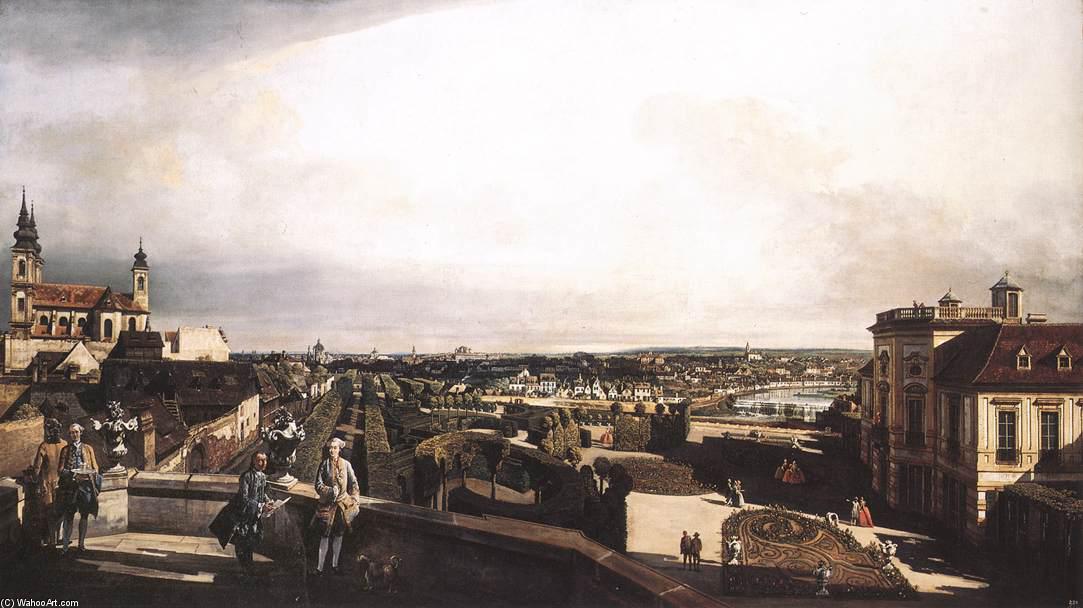
Completed in 1759, this panoramic view captures Vienna at a moment of imperial expansion under Maria Theresa. The composition utilizes a wide format to document the city's topographical layout, guiding the eye from the immediate foreground toward the distant skyline. St Stephen’s Cathedral and the Hofburg Palace emerge as central anchors within the urban sprawl, their silhouettes defined by the specific quality of light characteristic of the era. The work…

In this work, titled Grand canal, view from north, the artist Bernardo Bellotto captures a specific moment within the Venetian cityscape. Painted about 1738, the scene focuses on the activity along the water, where several boats float upon the river. Some vessels occupy the foreground, while others drift toward the distance, creating a sense of depth across the waterway.

The painting titled The Fortress of Konigstein was executed by the Italian artist Bernardo Bellotto in 1758. Bellotto was an urban landscape painter and printmaker who specialized in the veduta style. He was the nephew and pupil of Giovanni Antonio Canal. This specific work was part of a series of views commissioned by the Elector of Saxony, Augustus III.

The scene unfolds within the allegorical realm of Allegory Inclinata Resurgit, a painting that captures a moment of profound symbolic weight. Created by the hand of Bernardo Bellotto, this work invites the viewer into a staged, theatrical space where figures and architecture converge. The piece emerges from about 1762, a time when the artist was deeply engaged with the visual language of his era. Every element within the frame works…

The artwork titled The Arsenal, Venice is a painting by the artist Bernardo Bellotto. This specific piece was executed about 1743. It belongs to a pair of paintings created by the artist during this period.

In this work, titled Venetian Capriccio, View of Santa Maria dei Miracoli, the artist Bernardo Bellotto presents a detailed cityscape of Venice. Painted about 1740, the scene focuses on the architecture of the Santa Maria dei Miracoli church. It is a capriccio, a composition that uses a fanciful or imagined arrangement of real-world elements to create a specific atmosphere.
 Pirna Seen from the Right Bank of the Elbe1750
12
 A Capriccio River Landscape with a Church to the Left1765
13
 Allegory Ex Arduis Immortalitas1762 · ドレスデン州立美術館
14
 Fantastic architecture with portrait of Franciszek Salezy Potocki and his son Stanisław Szczęsny1763 · El Paso Museum of Art
15
 The Fortress of Königstein: Courtyard with the Magdalenenburg1758 · ナショナル・ギャラリー・オブ・アート
16
 The Fortress of Königstein1756
17
 The Election of the King Stanislaus Augustus1764
18
 View of Wilanów meadows1775 · ワルシャワ王宮
19
 Groom leading a horse1773 · ワルシャワ国立博物館
20
 The Elbe between Pirna and Pillnitz1766 · ドレスデン州立美術館
21
 Dresden, the Ruins of the Pirnaische Vorstadt1766
22
 View of Ujazdów from the Royal Baths1776 · ワルシャワ国立博物館
23
 Stable boy leading a horse1773 · ワルシャワ国立博物館
24
 Rio dei Mendicanti with the Scuola di San Marco (detail)1738 · アカデミア美術館
25
 The Imperial Palace Schönbrunn, Garden Side1758 · 美術史美術館
26
 View of Pirna from the Sonnenstein Castle1750 · エルミタージュ美術館
27
 View of Pirna from the Right Bank of the Elba above the Town1753 · エルミタージュ美術館
28
 The Kreuzkirche in Dresden1747 · Gemäldegalerie Alte Meister
29
 Stairs Leading to the Colonnade of a Palace1762 · ドレスデン州立美術館
30
 Lagoon landscape1741
31
 Venice (Marriage of the Doge with the Sea)1727
32
 The Grand Canal from the Campo San Vio, Venice1727 · スコットランド国立美術館
33
 The Pantheon1742 · Dayton Art Institute
34
 View of the Tiber in Rome with the Castel Sant'Angelo1743 · デトロイト美術館
35
 Piazza San Marco, Venice1740 · クリーブランド美術館
36
 The Piazzetta, Venice1743 · カナダ国立美術館
37
 Piazza del Campidoglio with Santa Maria d'Aracoeli, Rome1742 · Petworth House
38
 A View at the Entrance of the Grand Canal, Venice1741 · Fitzwilliam Museum
39
 The Piazza San Martino, Lucca1742 · ヨーク・アート・ギャラリー
40
 Painting of the Church of Santa Maria Formosa, Venice1742
41
 The Campo di SS. Giovanni e Paolo, Venice1743 · ナショナル・ギャラリー・オブ・アート
42
 View of Via di Ripetta in Rome1742 · Museum Kunstpalast
43
 View of the Grand Canal: Santa Maria della Salute and the Dogana from Campo Santa Maria Zobenigo1743 · J・ポール・ゲティ美術館
44
 View of Grand Canal with the Palazzi Foscari and Moro Lin1734 · 国立美術館
45
 The harbor basin of San Marco on Ascension Day, Venice1739
46
 Colosseum and Arch of Constantine (Rome)1742
47
 The Arch of Constantine1742 · ロイヤル・コレクション
48
 Signoria Square in Florence1741
49
 View of the Grand Canal at San Stae1738
50
 Arno in Florence1742
51
 Capriccio Padovano1740 · ティッセン・ボルネミッサ美術館
52
 Pirna with the Dohna Gate1754 · ドレスデン州立美術館
53
 The Arno in Florence with the Ponte Vecchio1745 · Fitzwilliam Museum
54
 The Arno in Florence with the Ponte Alla Carraia1745 · Fitzwilliam Museum
55
 Capriccio with the Dolo lock1748 · ドレスデン州立美術館
56
 The Lock at Dolo1745 · Yale University Art Gallery
57
 The Grand Canal: Santa Lucia and the Church of the Scalzi, Venice1750 · スコットランド国立美術館
58
 View of Pirna from the West, from the Corner of Wide Street1755 · エルミタージュ美術館
59
 View of Pirna, from Sonnestein Castle1753 · プーシキン美術館
60
 View of Verona with the Castelvecchio and Ponte Scaligero1745 · フィラデルフィア美術館
61
 Dresden from the Right Bank of the Elbe, below the Augustus Bridge1750 · National Gallery of Ireland
62
 Dresden from the Right Bank of the Elbe above the Augustus Bridge1750 · National Gallery of Ireland
63
 The Doge's Palace in Venice from the Sea1750 · Musée municipal de Bourg-en-Bresse
64
 View of Pirna from the Right Bank of the Elba1753 · エルミタージュ美術館
65
 The Moat of Zwinger in Dresden1750 · エルミタージュ美術館
66
 Old Fortifications of Dresden1749 · エルミタージュ美術館
67
 Market-Place of the Neustadt in Dresden1751 · エルミタージュ美術館
68
 View of Pirna, from Sonnenstein Castle1755 · ドレスデン州立美術館
69
 Pirna from Kopitz1753 · ドレスデン州立美術館
70
 The Zwinger in Dresden1751 · ドレスデン州立美術館
71
 The Old Ponte delle Navi in Verona1746 · ドレスデン州立美術館
72
 The Old Market in Dresden from Schlossgasse1750 · ドレスデン州立美術館
73
 The Old Fortifications in Dresden1750 · ドレスデン州立美術館
74
 Pirna from Posta1753 · ドレスデン州立美術館
75
 Dresden from the left Bank of the Elbe above the Bridgehead of the Old Town1748 · ドレスデン州立美術館
76
 View from the Bridge of Dresden on the Elbe1749 · サンフランシスコ美術館
77
 Abbruch der Kreuzkirche, Dresden1746
78
 Piazza S. Marco, Venice1746
79
 The Old Market Square in Dresden1750 · ドレスデン州立美術館
80
 The New Market Square in Dresden1750
81
 Verona Veduta1746 · Powys Castle Museum
82
 View of Turin near the Royal Palace1745 · ガッレリア・サバウダ
83
 New Market Square in Dresden1750 · Gemäldegalerie Alte Meister
84
 Dresden from the Left Bank of the Elbe, below the Fortifications1748 · Gemäldegalerie Alte Meister
85
 Pirna Seen from the Harbour Town1753 · Gemäldegalerie Alte Meister
86
 View of an Old Bridge Over the River Po, Turin1745 · ガッレリア・サバウダ
87
 The Neuer Marktplatz in Dresden1747 · エルミタージュ美術館
88
 Venice (Rio di S. Fosca and S. Maria dei Servil)1758
89
 View of München1758
90
 Venice: Riva degli Schiavoni towards the East1760 · ジョン・アンド・メイブル・リンゴリング美術館
91
 Venice: Piazza San Marco, Seen from the Campo San Basso1760 · ジョン・アンド・メイブル・リンゴリング美術館
92
 Saint Mark's Square, Venice1756 · National Gallery of Ireland
93
 Campo San Stin, Venice1760
94
 Old town of Dresden1765 · シュタットリッヒェ・クンストハレ・カールスルーエ
95
 Pirna seen from the right bank of the Elbe1756 · サンディエゴ美術館
96
 Architectural Capriccio1765 · サンディエゴ美術館
97
 Nymphenburg Castle1761
98
 Architectural Caprice with a Palace1765 · ビルバオ美術館
99
 Venice: Canale Grande1758
100
 View of Vienna with St. Charles's Church1758 · Museum Kunstpalast
これらのオリジナル作品に繰り返し描かれている4つの主題と、それぞれの最高傑作。
このページに掲載されている絵画を最も多く所蔵している 8 の美術館
| 美術館 | 都市 | ベルナルド・ベロットの作品 | このリストの絵画 |
|---|---|---|---|
 ドレスデン州立美術館 |
ドレスデン | 19 | Allegory Inclinata Resurgit, Allegory Ex Arduis Immortalitas, The Elbe between Pirna and Pillnitz |
 Gemäldegalerie Alte Meister |
ドレスデン | 12 | ドレスデンの旧クルツ教会廃墟, Dresden, the Frauenkirche and the Rampische Gasse, The Moat of the Zwinger in Dresden |
 エルミタージュ美術館 |
サンクトペテルブルク | 11 | View of Pirna from the Sonnenstein Castle, View of Pirna from the Right Bank of the Elba above the Town, View of Pirna from the West, from the Corner of Wide Street |
 ワルシャワ国立博物館 |
ワルシャワ | 8 | Groom leading a horse, View of Ujazdów from the Royal Baths, Stable boy leading a horse |
 ナショナル・ギャラリー・オブ・アート |
ワシントン | 5 | The Fortress of Konigstein, The Fortress of Königstein: Courtyard with the Magdalenenburg, The Campo di SS. Giovanni e Paolo, Venice |
 Fitzwilliam Museum |
3 | A View at the Entrance of the Grand Canal, Venice, The Arno in Florence with the Ponte Vecchio, The Arno in Florence with the Ponte Alla Carraia | |
 National Gallery of Ireland |
ダブリン | 3 | Dresden from the Right Bank of the Elbe, below the Augustus Bridge, Dresden from the Right Bank of the Elbe above the Augustus Bridge, Saint Mark's Square, Venice |
 Museum Kunstpalast |
デュッセルドルフ | 3 | View of Via di Ripetta in Rome, View of Vienna with St. Charles's Church |
その時代を象徴する名作を見るために、年代を選択してください。
In this work, titled Grand canal, view from north, the artist Bernardo Bellotto captures a specific moment within the Venetian cityscape. Painted about 1738, the scene focuses on the activity along the water, where several boats float upon the river. Some vessels occupy the foreground, while others drift toward the distance, creating a sense of depth across the waterway.
In the quiet, luminous depths of Bernardo Bellotto’s 1749 masterpiece, Dresden, the Frauenkirche and the Rampische Gasse, we are invited to step through a portal into the eighteenth century. This breathtaking oil on canvas is far more than a mere topographical record; it is a soulful meditation on a city at its zenith. As the eye wanders across the panoramic vista, one is immediately struck by the imposing presence of…
Completed in 1759, this panoramic view captures Vienna at a moment of imperial expansion under Maria Theresa. The composition utilizes a wide format to document the city's topographical layout, guiding the eye from the immediate foreground toward the distant skyline. St Stephen’s Cathedral and the Hofburg Palace emerge as central anchors within the urban sprawl, their silhouettes defined by the specific quality of light characteristic of the era. The work…
1765年頃に描かれたベルナルド・ベロットの「ドレスデンの旧十字教会の廃墟」は、単なる都市風景画ではありません。それは、戦後のドレスデンという都市が抱える喪失感、そしてそこから立ち直ろうとする人々の不屈の精神を捉えた、力強い瞑想です。ベロットは、崩れかけた旧十字教会の塔と、依然として健在な周囲の建造物を緻密に描き出し、その瞬間を歴史の中に刻み込んでいます。

The composition of this oil on canvas is defined by a strong horizontal emphasis, with the horizon line positioned near the vertical midpoint. This arrangement creates a sense of immense scale across the landscape. The perspective is elevated, offering a bird's-eye view that recedes into a distant, hazy background, establishing significant depth. The color palette relies on naturalistic tones, specifically earthy browns and greens in the foreground and middle ground.…
ドレスデンの旧クルツ教会廃墟 (1765)(Gemäldegalerie Alte Meister, ドレスデン)。次いでDresden, the Frauenkirche and the Rampische Gasse (1749)、The Moat of the Zwinger in Dresden (1749)が続きます。
43歳:ドレスデンの旧クルツ教会廃墟は1765年の作品で、ベルナルド・ベロットの生年は1722年です。
ドレスデンの旧クルツ教会廃墟, Dresden, the Frauenkirche and the Rampische Gasse, The Moat of the Zwinger in Dresden, The Moat of the Zwinger in Dresden (detail), Vienna, Panorama from Palais Kaunitz, Grand canal, view from north, The Fortress of Konigstein, Allegory Inclinata Resurgit, The Arsenal, Venice と Venetian Capriccio, View of Santa Maria dei Miracoli。上記のランキングには、それぞれの制作年と所蔵美術館が記載されています。
当カタログには、1734年から1776年にかけて制作されたベルナルド・ベロットによる230点の作品が収められています。
主にドレスデン州立美術館 (ドレスデン), Gemäldegalerie Alte Meister (ドレスデン) と エルミタージュ美術館 (サンクトペテルブルク)に所蔵されています。上記の美術館一覧にすべて記載されています。
1740s年:このページにある全100作品のうち、39作品がその時期に制作されました。そのうちDresden, the Frauenkirche and the Rampische Gasse作品が含まれます。
このページでは、最も古い作品はView of Grand Canal with the Palazzi Foscari and Moro Lin (1734)、最新の作品はView of Ujazdów from the Royal Baths (1776)です。
このページに掲載されている100点の作品におけるSky (15), Architecture (13) と People (10)
このページに掲載されている全100作品のうち、24作品のOil On Canvas
このページに掲載されているオリジナル作品から判断すると、Rococoです。
Allegory Inclinata Resurgit, Allegory Ex Arduis Immortalitas と The Elbe between Pirna and Pillnitz:ドレスデン州立美術館, ドレスデンには、このページに掲載されている作品のうち15点が所蔵されています。
ベルナルド・ベロットは、1721年頃または1730年1月30日にヴェネツィアで生まれました。彼は有名なジョヴァンニ・アントニオ・カナル、通称カナルエットの甥であり弟子でした。カナルエットはヴェネツィア派絵画を代表する人物であり、ベロットはその才能をいち早く認められました。幼少の頃から風景描写に秀でており、叔父であるカナルエットからの指導を受けながら、独自の視点と技術を磨いていきました。初期の作品には、ヴェネツィアの美しい街並みや運河の風景が描かれており、その繊細な筆致と光の表現は、すでにベロットならではの個性が現れ始めていました。
ベロットの芸術的スタイルは、建築物や自然の景観を詳細に描写すること、そしてそれぞれの場所特有の光の質感を捉えることに特徴があります。都市の風景を描く卓越した才能により、彼はヨーロッパ各地の王侯貴族から招かれました。1742年にローマへ渡り、その後北イタリア(1744-1745年)を旅し、1747年にはポーランド国王アウグスト3世の依頼を受けてドレスデンに移りました。ドレスデンでの彼の作品は、戦争によって破壊される前の街並みを記録するものとして、貴重な歴史的資料となっています。その後、マリア・テレジア女帝からウィーンへの招請を受け(1758年)、ウィーンの建造物を描きました。
ベロットの代表的な作品としては、以下のものが挙げられます:
彼の遺産は、単なる芸術作品にとどまらず、戦争によって破壊された都市の再建のための貴重な資料として活用されています。ベロットの絵画は、失われた街並みを忠実に再現するための重要な手がかりとなり、都市計画や建築復興に貢献しています。
ベロットの作品は、叔父であるカナルエットからの影響を強く受けていますが、より詳細な描写と光の表現において独自のスタイルを確立しました。特に、ドレスデンやウィーンで描かれた都市風景は、その精密さとリアリズムによって高く評価されています。彼は、単に街並みを記録するだけでなく、そこに生きる人々の生活や雰囲気を描き出すことに情熱を注ぎました。彼の作品には、当時の社会状況や文化背景が反映されており、歴史研究においても重要な価値を持っています。
ベロットの絵画は、18世紀ヨーロッパにおける都市風景画の代表的な存在として、その地位を確立しています。彼の作品は、単なる美しい風景を描くだけでなく、都市の歴史や文化を記録し、後世に伝えるという重要な役割を果たしました。また、彼の技術と表現方法は、多くの画家たちに影響を与え、都市風景画の発展に貢献しました。今日でも、ベロットの絵画は世界中の美術館やコレクションで高く評価され、多くの人々に感動を与え続けています。彼の作品を鑑賞することで、私たちは18世紀ヨーロッパの街並みや文化、そして当時の人々の生活を知ることができます。


