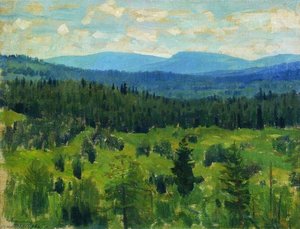
A Pioneer of Russian Landscape: Apollinari Vasnetsov’s Vision
Apollinari Mikhailovich Vasnetsov (1856-1933) stands as a pivotal figure in the evolution of
Russian art, bridging the gap between
Romanticism and the burgeoning
realism of the
early 20th century. Born into a family steeped in religious tradition – his father a village priest – Vasnetsov’s artistic journey began not within formal academies but through immersion in the vibrant cultural landscape of Moscow. Initially drawn to the work of his brother, Viktor Vasnetsov, he quickly established himself as a distinct voice, one deeply connected to the soul of Russia and its vast, elemental landscapes. His art wasn't merely representation; it was an attempt to capture the spirit of a nation, its history etched into the very fabric of its land.
Vasnetsov’s early years were marked by a restless exploration – a period spent teaching in rural provinces before finding his true calling in Moscow. It was here, amidst the city's historical grandeur and burgeoning artistic circles, that he began to develop his signature style: a potent blend of
Romanticism,
realism, and an almost mystical engagement with the Russian wilderness. Influenced by artists like
Ilya Repin and Pavel Tretyakov, Vasnetsov’s work quickly gained recognition, culminating in his inclusion within the “Peredvizhniki” (Wanderers) group – a collective dedicated to depicting contemporary life and social issues through accessible, emotionally resonant imagery. This association proved crucial, providing him with a platform to showcase his unique perspective and challenge prevailing artistic conventions.
The Kremlin’s Guardian: Myth and Majesty
Vasnetsov's most enduring legacy resides in his monumental murals adorning the walls of
the Moscow Kremlin. Commissioned for the Annunciation Cathedral, these vast canvases depict scenes from Russian history – specifically, the events surrounding the capture of Novgorod by Prince Alexander Nevsky in 1238. These aren’t simply historical records; they are dramatic narratives imbued with a palpable sense of heroism and national pride. The sheer scale of the murals, combined with Vasnetsov's masterful use of color, composition, and dynamic figures, creates an immersive experience for the viewer, transporting them directly into the heart of the action. The iconic image of Nevsky’s triumphant charge, rendered in vibrant reds and golds, has become synonymous with Russian military strength and resilience – a powerful symbol that continues to resonate today.
Beyond the Kremlin: Ural Mountains and Mythic Landscapes
While his work on the Kremlin murals cemented his fame, Vasnetsov’s artistic explorations extended far beyond the city walls. He spent considerable time documenting the rugged beauty of the Ural Mountains – a region he considered to be the very heartland of Russia. These landscapes, characterized by their dramatic peaks, dense forests, and shimmering lakes, provided fertile ground for his imagination. He wasn't simply painting what he saw; he was translating the spirit of these wild places onto canvas, imbuing them with a sense of ancient power and timeless mystery. Works like “
A Gray Day” (1883) exemplify this approach, capturing the melancholic beauty of a misty
mountain scene with an almost haunting quality. Similarly, his depictions of
Lake Svetloyar, steeped in local folklore and legend, reveal a fascination with Russian mythology and the enduring power of storytelling.
A Master of Stage Design and Illustration
Vasnetsov’s talents weren't confined to painting alone. He was also a prolific stage designer, contributing significantly to the vibrant theatrical scene of late 19th and
early 20th-century Russia. His designs for operas and ballets – including productions of Rimsky-Korsakov’s *Snow White* and Mussorgsky's *Boris Godunov* – were renowned for their lavishness, historical accuracy, and evocative atmosphere. Furthermore, he produced a substantial body of illustrations for books and journals, showcasing his versatility as an artist and solidifying his position as a leading figure in the Russian cultural landscape.
Legacy and Influence
Apollinari Vasnetsov’s impact on
Russian art is undeniable. He helped to shape the national artistic identity, providing a powerful visual language for expressing Russia's history, mythology, and spirit. His murals continue to draw visitors to
the Moscow Kremlin, while his landscapes evoke a sense of wonder and connection to the natural world. Beyond his individual achievements, Vasnetsov’s work paved the way for future generations of Russian artists, demonstrating the potential of
landscape painting as a vehicle for
social commentary and cultural expression. He remains a beloved figure in Russia, celebrated for his artistic skill, his patriotic fervor, and his enduring contribution to the nation's artistic heritage. His legacy is not just one of beautiful paintings but of a profound engagement with the soul of Russia itself.