Alice Haversの肖像画

世界的に有名なAlice Haversの名作13点、そのすべてが唯一無二の芸術品

11月 2026 更新 · 当サイトの人気スコア(各作品の検索数、閲覧数、注文数)に基づくランキング · 14点の Alice Haversの作品がカタログにあります

要約すると

しかし、マリアはこれらのことを心に留め、心の中で黙想していた - アリス・ヘイヴァース (2026)は、Alice Haversの作品の中で最も注目を集めている絵画です。 その後、視線はBelle of the Village (1883)とBlanchisseuses 'What, no soap ' (1880)へと移ります。 当カタログに含まれるAlice Haversの14点の作品のうち、これら13点は最も有名な作品です。制作年、所蔵美術館、そして時代を超えて愛される理由とともに、一点もののオリジナル作品をご紹介します。

1850 – 1890 最多収蔵館: ウォーカー・アート・ギャラリー

ギャラリーの視点で選ぶ、Alice Haversによるトップ10作品

1
しかし、マリアはこれらのことを心に留め、心の中で黙想していた - アリス・ヘイヴァース (2026) による Alice Havers

しかし、マリアはこれらのことを心に留め、心の中で黙想していた - アリス・ヘイヴァース

2026 · アクリル絵具

「しかし、マリアはこれらのことを心に留め、心の中で黙想していた」―― アリス・ヘイヴァースによる情緒豊かな 水彩画は、ロマン主義の真髄を見事に捉えています。鑑賞者を、ヘイヴァースが芸術的探求に没頭した形成期を過ごした、静謐なフォークランド諸島へと誘います。これは単なる描写ではありません。それは深い感情と 理想化された美の世界への招待状であり、想像力の力を揺るぎなく信じたロマン主義運動の証なのです。

2
Belle of the Village (1883) による Alice Havers

Belle of the Village

1883 · Oil On Canvas

Alice Havers captures a specific moment of rural life in Belle of the Village. Painted about 1883, this work emerges from the artist's deep connection to the landscapes of the United Kingdom. Born in 1850, Havers brought a keen eye for the quiet rhythms of the countryside to her canvas. The scene settles into the viewer's gaze through a series of layered brushstrokes and a focus on the textures of…

4
The Goose Girl による Alice Havers

The Goose Girl

Watercolor

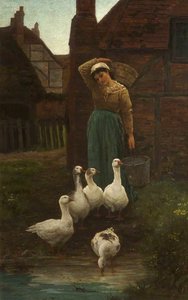
In The Goose Girl by Alice Havers, a woman moves through a quiet landscape. She walks across a field where grass meets patches of bare dirt. In her hands, she holds two birds. These geese are part of a larger gathering, as several other birds are scattered throughout the scene. The woman’s presence is central to this rural setting, her movement steady against the natural terrain.

5
Sheep in an Orchard による Alice Havers

Sheep in an Orchard

Sheep in an Orchard by Alice Havers presents a pastoral scene centered on a herd of sheep. These animals graze upon a field of grass situated within an orchard. At least nine sheep are visible throughout the composition, positioned at varying distances from the viewer to establish a sense of depth. Some sheep occupy the foreground, while others are located further back among the vegetation.

6
They Homeward Wend Their Weary Way (1875) による Alice Havers

They Homeward Wend Their Weary Way

1875 · Oil

In this 1875 composition, a woman and a young boy move through a natural setting near a body of water. The woman carries a large straw basket on her back, her posture suggesting the weight of the object. Beside her, a young boy walks, holding a smaller basket in his hands. They are positioned within a landscape of trees and bushes that line the edge of a stream or river.…

7
Trouble (The Sick Child) (1882) による Alice Havers

Trouble (The Sick Child)

1882 · Oil On Canvas · Southwark Art Collection, ロンドン

The air in the room feels heavy, thick with the scent of medicinal herbs and the stillness of a house in mourning. A woman sits by the bedside, her posture a study in weary devotion. She leans toward a small, pale figure—a child whose breath is a shallow, rhythmic struggle. The light does not dance here; it settles. It clings to the folds of fabric and the rim of a…

8
Roses in a Vase (1887) による Alice Havers

Roses in a Vase

1887 · Oil On Canvas

We are looking at Roses in a Vase, a work by the British artist Alice Havers. Created in 1887, this piece emerged during a period when Havers was establishing her presence within the English art scene. The painting reflects the steady, observant hand of an artist who understood the quiet nuances of her surroundings.

9
'But Mary kept all these things and pondered them in her heart' (1888) による Alice Havers

'But Mary kept all these things and pondered them in her heart'

1888 · Watercolor

The painting titled 'But Mary kept all these things and pondered them in her heart' is a work by the English artist Alice Havers. It emerged from a period of significant recognition for the painter, finding its way into the public eye through prestigious exhibitions. In 1888, the piece was presented at the Royal Academy. A year later, in 1889, it traveled to the Paris Salon.

10
Rush Cutters による Alice Havers

Rush Cutters

Oil On Canvas

In Rush Cutters, Alice Havers captures a quiet moment of rural labor unfolding near the edge of a body of water. The scene centers on the rhythmic, heavy work of harvesting from the marshy ground. Two men bend low over the damp earth, their bodies focused on the task of collecting whatever the marsh yields. Beside them, a woman kneels in the mud, her presence a steady part of the…

Alice Haversの名作、11〜13点目

Alice Haversが心を惹かれた主題

これらのオリジナル作品に繰り返し描かれている4つの主題と、それぞれの最高傑作。

Alice Haversの原画を所蔵する美術館

このページに掲載されている絵画を最も多く所蔵している 3 の美術館

美術館 所在都市 Alice Haversの作品 このリストの絵画
ウォーカー・アート・ギャラリー, リバプールウォーカー・アート・ギャラリー リバプール 1 Blanchisseuses 'What, no soap '
Southwark Art Collection, ロンドンSouthwark Art Collection ロンドン 1 Trouble (The Sick Child)
Touchstones Rochdale, ロッチデールTouchstones Rochdale ロッチデール 1 End of Her Journey

Alice Haversの歩み:それぞれの作品が持つ唯一無二のオリジナル

ここに掲載されているAlice Haversの初作と最晩年のオリジナル作品の間には、1875から1888までの14年の歳月が流れています。各制作年は以下に記載されています。

年別作品数

年代を選択して、当時のオリジナル作品を見る

Alice Haversの絵画:ギャラリーへの質問

Alice Haversの最も有名な作品は何ですか?答えを見る

しかし、マリアはこれらのことを心に留め、心の中で黙想していた - アリス・ヘイヴァース (2026)。続いてBelle of the Village (1883)、Blanchisseuses 'What, no soap ' (1880)が続きます。

Alice Haversの最も有名な10作品は何ですか?答えを見る

しかし、マリアはこれらのことを心に留め、心の中で黙想していた - アリス・ヘイヴァース, Belle of the Village, Blanchisseuses 'What, no soap ', The Goose Girl, Sheep in an Orchard, They Homeward Wend Their Weary Way, Trouble (The Sick Child), Roses in a Vase, 'But Mary kept all these things and pondered them in her heart' と Rush Cutters。上記のランキングには、それぞれの制作年と所蔵美術館が記載されています。

Alice Haversの既知の作品数は?答えを見る

当カタログには、1875年から1888年にかけて制作されたAlice Haversによる14点の作品が収められています。

最も有名なAlice Haversのオリジナル作品はどこで見ることができますか?答えを見る

主にウォーカー・アート・ギャラリー (リバプール), Southwark Art Collection (ロンドン) と Touchstones Rochdale (ロッチデール)に所蔵されています。上記の美術館一覧にすべて記載されています。

Alice Haversが最も有名な作品を制作したのは、どの時期ですか?答えを見る

1875年:このページにある全13作品のうち、2作品がその時期に制作されました。そのうちThey Homeward Wend Their Weary Way作品が含まれます。

Alice Haversの有名な絵画の中で、最も古い作品と最も新しい作品はどれですか?答えを見る

このページでは、最も古い作品はThey Homeward Wend Their Weary Way (1875)、最新の作品は'But Mary kept all these things and pondered them in her heart' (1888)です。

Alice Haversが好んだ主題は何ですか?答えを見る

このページに掲載されている13点の作品におけるWoman (6), Child (5) と Grass (3)

Alice Haversが最も多く使用した画材は何ですか?答えを見る

このページに掲載されている全13作品のうち、6作品のOil On Canvas

Alice Havers:アーティストの肖像画

A Life Amongst Landscapes: The Evocative World of Alice Mary Havers

Alice Mary Havers, a name perhaps less celebrated than some of her Victorian contemporaries, nonetheless carved a significant niche for herself as an English painter specializing in evocative watercolors and poignant illustrations. Born on May 19th, 1850, at Thelton Hall in Norfolk, she was steeped in a world of rural beauty and familial stability—a foundation that would profoundly shape her artistic vision. Her father, Thomas Havers, a man of commerce and administration, instilled within his children an appreciation for observation, while the family’s ancestral home provided a constant source of inspiration. However, this idyllic existence was soon disrupted by a journey to the remote Falkland Islands in 1854, when her father accepted a managerial position with the Falkland Islands Company. This relocation, though challenging, proved formative, exposing young Alice to a dramatically different landscape and culture—a world far removed from the gentle English countryside she had known. The family remained there until 1860, an experience that subtly infused her later work with a sense of melancholy and a keen awareness of social disparities.

From Falkland Islands to Parisian Studios: A Developing Artistic Voice

The Havers family’s subsequent move to Montevideo, Uruguay, further broadened Alice's horizons before their return to England in 1870 following the death of her father. It was upon this return that Alice truly began to pursue her artistic inclinations. She enrolled at the School of Art at South Kensington—now the Royal College of Art—where she quickly distinguished herself and earned a free studentship, demonstrating an innate talent and dedication to her craft. Her early works reflected a growing mastery of watercolor techniques, capturing scenes of domestic life and rural landscapes with remarkable sensitivity. In 1872, Alice married fellow artist Frederick Morgan, and for the next two decades, she exhibited regularly at prestigious venues such as the Society of British Artists and the Royal Academy. A pivotal moment in her artistic development came in 1888 when she moved to Paris with her three children, drawn by the allure of the French school of painting. This immersion in the Parisian art world exposed her to new influences—Impressionism and Realism—which subtly began to inform her style, adding a greater emphasis on light, color, and atmospheric effects.

Themes of Social Conscience and Domesticity

Havers’s oeuvre is characterized by a compelling blend of social commentary and intimate portrayals of domestic life. While she achieved recognition for paintings like *Ought and Carry One*, purchased by Queen Victoria, it was her works addressing the plight of the working class that truly revealed her artistic depth. Paintings such as *'Tis a Very Good World We Live In* and *The Rights of the Poor* offered poignant glimpses into the lives of those less fortunate, challenging Victorian societal norms and prompting viewers to confront uncomfortable truths. These were not merely depictions of poverty; they were empathetic studies of human resilience and dignity. Alongside these socially conscious pieces, Havers also excelled in capturing the quiet moments of everyday life—mothers with children, women engaged in domestic tasks—imbued with a sense of warmth, tenderness, and psychological insight. Her ability to convey emotion through subtle gestures and nuanced expressions established her as a leading figure in Victorian genre painting.

A Brief but Brilliant Career: Legacy and Historical Significance

Tragically, Alice Havers’s career was cut short by her untimely death on August 26th, 1890, at the age of forty. The circumstances surrounding her death—an accidental overdose of morphia—overshadowed much of the critical acclaim she had received during her lifetime. However, in recent years, there has been a renewed appreciation for her artistic achievements and her unique contribution to Victorian art. Her paintings offer valuable insights into the social and cultural landscape of 19th-century England, while her mastery of watercolor techniques continues to inspire artists today. Havers’s work also highlights the challenges faced by women artists during this period—the societal expectations that often limited their opportunities and the tendency to focus on personal tragedies rather than professional accomplishments. Her story serves as a reminder of the importance of recognizing and celebrating the contributions of all artists, regardless of gender or circumstance.

Illustrations and Final Recognition

Beyond her paintings, Havers also found success as an illustrator, collaborating with her sister Dorothy Henrietta Boulger—writing under the pseudonym “Theo Gift”—on several popular stories. This work allowed her to explore different narrative styles and reach a wider audience. Her commissions for special programs at Savoy Operas further demonstrate her versatility and artistic range. While she may not be a household name, Alice Mary Havers’s legacy endures through her evocative paintings, which continue to captivate viewers with their beauty, sensitivity, and social conscience. She stands as a testament to the power of art to illuminate the human condition and challenge conventional perspectives—a truly remarkable artist whose work deserves continued recognition and appreciation.