The Twilight of Ukiyo-e: Yoshitoshi's Historical Context
 Wikipedia: Meiji era
The Meiji era (明治時代, Meiji jidai) was an era of Japanese history that extended from October 23, 1868, to July 30, 1912. The Meiji era was the first half of the Empire of Japan, when the Japanese people moved from being an isolated feudal society at r...
Tsukioka Yoshitoshi (1839-1892) occupies a unique and poignant position in the history of Japanese art. He wasn’t merely an artist; he was a bridge – a final, incandescent flourish at the end of a centuries-long tradition known as ukiyo-e, or “pictures of the floating world.” To understand Yoshitoshi's brilliance, one must first grasp the world from which he emerged and the seismic shifts that threatened to engulf it. For over three hundred years, ukiyo-e had flourished under the Edo shogunate, depicting scenes of everyday life: kabuki actors, beautiful women, landscapes, and historical tales. This art form was intrinsically linked to a vibrant merchant class and a relatively stable society. However, by the mid-19th century, that stability was crumbling. The arrival of Commodore Perry in 1853 forced Japan to open its doors to the West, initiating a period of rapid modernization known as the Meiji Restoration. This wasn’t simply a political upheaval; it was a cultural tsunami. Western technologies, ideas, and artistic styles flooded into Japan, challenging traditional values and practices. Yoshitoshi found himself working in an environment where the very foundations of his art form were being questioned.
Kuniyoshi’s Legacy and Yoshitoshi’s Early Style
 Wikipedia: Tsukioka Yoshitoshi
Tsukioka Yoshitoshi (Japanese: 月岡 芳年; also named Taiso Yoshitoshi 大蘇 芳年; 30 April 1839 – 9 June 1892) was a Japanese printmaker. Yoshitoshi has widely been recognized as the last great master of the ukiyo-e genre of woodblock printing and painting. H...
Born Owariya Yonejiro, Yoshitoshi's artistic journey began with a formal apprenticeship under Utagawa Kuniyoshi, one of the most prolific and imaginative ukiyo-e artists of the late Edo period. Kuniyoshi was renowned for his dynamic compositions, bold colors, and dramatic depictions of warriors and historical scenes. His influence on Yoshitoshi was profound. Early in his career, Yoshitoshi closely emulated his teacher’s style, producing prints that showcased a similar flair for narrative and action. However, even in these early works, hints of Yoshitoshi's unique sensibility began to emerge – a greater attention to psychological depth and emotional nuance. Kuniyoshi emphasized drawing from life, an unusual practice within the ukiyo-e tradition which often prioritized stylized representation over strict realism. This focus on observation would become a hallmark of Yoshitoshi’s work. While he initially followed in his master's footsteps, Yoshitoshi wasn’t content to simply replicate Kuniyoshi’s success; he sought to forge his own path, one that acknowledged the past while simultaneously embracing the challenges and opportunities of a changing world.
Blood and Beauty: Exploring Yoshitoshi’s Warrior Prints
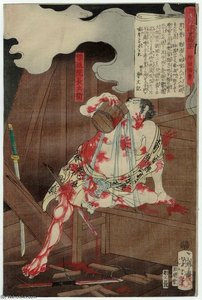 Banzuin Chôbei
Discover Tsukioka Yoshitoshi's powerful woodblock print 'Banzuin Chôbei,' a striking example of Japanese ukiyo-e art. Featuring bold lines, vivid colors, and intense emotional storytelling, perfect for art collectors.
Yoshitoshi's warrior prints are arguably his most iconic works. These weren’t simply depictions of heroic battles; they were often visceral, unsettling, and deeply human. He depicted scenes of violence with a startling realism, capturing the brutality and chaos of combat alongside moments of profound courage and sacrifice. Prints like Banzuin Chôbei, featuring a warrior locked in desperate struggle, exemplify this approach. The bold lines, vivid colors, and intense emotional storytelling create a powerful impact on the viewer. Yoshitoshi didn’t shy away from depicting the gruesome details of war – severed limbs, blood-soaked armor, and expressions of agony. However, he also imbued his warriors with a sense of dignity and pathos. These prints weren't glorifications of violence; they were meditations on mortality, honor, and the human cost of conflict. This willingness to confront difficult subjects set Yoshitoshi apart from many of his contemporaries.
One Hundred Aspects of the Moon: A Masterpiece of Narrative Innovation
Perhaps Yoshitoshi’s most celebrated achievement is One Hundred Aspects of the Moon (1885-1892). This series, comprising 100 individual prints, showcases his extraordinary range and narrative skill. Each print depicts a different scene from Japanese history, legend, or folklore, all unified by the presence of the moon – a symbol rich in cultural significance. Yoshitoshi masterfully integrated Western techniques of shading and perspective with traditional Japanese aesthetics, creating compositions that were both dynamic and emotionally resonant. The series is not merely a collection of beautiful images; it’s a complex tapestry of stories, myths, and historical references. Prints like Prince Semimaru, depicting the blind poet musician in a poignant scene, demonstrate Yoshitoshi's ability to convey profound emotion through subtle gestures and evocative imagery. The success of this series was phenomenal, captivating audiences with its innovative designs and compelling narratives.
Yoshitoshi and the Meiji Transition: Adapting Tradition in a Modernizing Japan
The Meiji Restoration presented Yoshitoshi with an unprecedented challenge: how to preserve the essence of ukiyo-e in a rapidly changing world. As Western art forms gained popularity, traditional woodblock printing faced increasing competition. Photography, in particular, posed a significant threat, offering a more “realistic” alternative to hand-painted prints. Rather than resist these changes, Yoshitoshi embraced them – albeit cautiously. He experimented with new techniques and materials, incorporating elements of Western perspective and shading into his work. However, he remained deeply committed to the traditional methods of woodblock carving and printing, believing that they were essential to capturing the unique beauty and expressive power of ukiyo-e. His series Nihon ryakushi, depicting dramatic battles between warriors and mythical creatures, exemplifies this approach – a fusion of traditional Japanese themes with Western artistic sensibilities.
The Enduring Legacy of Tsukioka Yoshitoshi
Tsukioka Yoshitoshi died in 1892, leaving behind a vast body of work that continues to captivate and inspire. He is widely regarded as the last great master of ukiyo-e, not simply because he was the final prominent artist working in the tradition, but because he revitalized it with his innovative designs and emotional depth. His prints are a testament to the power of art to transcend cultural boundaries and speak to universal human experiences. While the woodblock print industry declined after his death, Yoshitoshi’s legacy lived on, influencing generations of artists and shaping our understanding of Japanese art history. Today, OriginalUniqueArt.com offers high-quality reproductions of Yoshitoshi's masterpieces, allowing art lovers around the world to experience the beauty and power of his work firsthand. His prints serve as a poignant reminder of a bygone era – a time of tradition, transformation, and artistic brilliance.