Introduction
Close your eyes for a moment and imagine the world just before dawn, when the light has retreated but the sun has yet to break the horizon. There is a specific, profound stillness in that blue hour—a depth that feels both infinite and intimate. This is the soul of Prussian Blue . It is not merely a pigment; it is an emotion captured in a jar, a deep, velvety shadow that breathes life into the most evocative moments of art history.
When this synthetic marvel first emerged in the early 18th century, it revolutionized the palette of the masters. Before its discovery, capturing the true, dark intensity of the night or the crushing weight of a deep ocean swell was a feat of immense difficulty. Prussian Blue brought with it a certain drama, a way to layer shadows that felt heavy with mystery and light. For the Impressionists and Post-Impressionists we hold so dear, this pigment became a bridge between reality and sensation. It allowed artists to move beyond simple representation, using those deep, midnight tones to evoke the melancholy of a twilight landscape or the rhythmic pulse of a moonlit sea.
Today, these works remain deeply meaningful because they touch upon something universal in our human experience: the beauty found in the shadows. In an era of bright, fleeting digital images, there is a restorative power in returning to these canvases. We find ourselves drawn to the way the light struggles against the Prussian depths, reminding us that brilliance is only truly understood when contrasted with the dark.
As we wander through this curated selection, I invite you to linger on the edges of each frame. We shall explore ten extraordinary masterpieces where Prussian Blue does not just exist as a color, but reigns as the very atmosphere of the soul. Let us step into the blue.
Drowning girl - Roy Lichtenstein
 Drowning girl - Roy Lichtenstein
In the heart of Roy Lichtenstein’s 1963 masterpiece, Drowning Girl , we encounter a gaze of profound, cinematic despair. While the piece is a cornerstone of Pop Art, it finds its soul within those deep, heavy shadows of Prussian blue that anchor the composition. The woman’s eyes, framed by thick, expressive lines, reflect an emotional turbulence as vast and swirling as the dark, halftone-patterned waters surrounding her. There is a striking, almost tactile tension in the way the saturated blues collide with the stark white of her distress, creating a visual rhythm that feels both modern and timeless.
This painting serves as a universal mirror for our own moments of internal upheaval. To display such a powerful use of Prussian blue tones in your home is to invite a sense of dramatic prestige and quiet introspection. It transforms a personal sanctuary into a space where the weight of human emotion is met with bold, unapologetic beauty, allowing one to find a strange, reflective calm amidst the swirling depths of the art itself.
The Large Blue Horses - Franz Marc
 The Large Blue Horses - Franz Marc
To behold The Large Blue Horses by Franz Marc is to step into a sacred realm where color transcends the physical world. As one of the most profound examples of German Expressionism, this 1911 masterpiece commands its place among the top paintings dominated by deep, Prussian blue tones through its spiritual use of pigment. For Marc, blue was not merely a hue; it was a vessel for masculinity, purity, and the divine essence of nature.
The composition breathes with a rhythmic vitality, where the heavy, impasto brushstrokes create a tactile landscape of swirling reds and verdant greens that cradle the majestic, cobalt figures. This interplay of primary colors creates an emotional intelligence that resonates deeply within modern, sophisticated interiors, offering a focal point of both strength and tranquility. To possess a reproduction of this work is to invite a legacy of soulful abstraction into your home, celebrating a moment in art history where the spirit of the animal kingdom was captured in its most luminous, blue-tinted glory.
Celestina - Pablo Picasso
 Celestina - Pablo Picasso
To encounter Celestina is to step directly into the melancholic heart of Picasso’s Blue Period. Painted in 1904, this portrait is a profound meditation on age and solitude, draped in the heavy, somber weight of deep Prussian blue and midnight tones. The subject, an elderly woman with a gaze that pierches through time, sits enveloped in a dark, sweeping cloak that seems to swallow the light, leaving only the soft, ochre highlights of her weathered skin to emerge from the shadows.
The painting is a masterclass in emotional texture; the way the cool, indigo shadows cling to the folds of her garments evokes a sense of quiet resilience and mystery. Owning Celestina by Pablo Picasso isn’t merely a purchase; it is an inheritance of a profound artistic lineage. It brings the introspective gravity of early modernism into your private sanctuary, allowing the dramatic interplay of light and blue to transform your walls into a space of deep contemplation and timeless elegance.
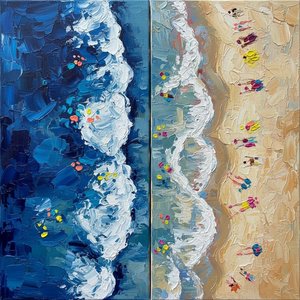
Ephemeral Tides of Cobalt and Sand in a Sculptural Impasto Masterpiece - David Moreau
 Ephemeral Tides of Cobalt and Sand in a Sculptural Impasto Masterpiece - David Moreau
In the breathtaking Ephemeral Tides of Cobalt and Sand in a Sculptural Impasto Masterpiece , David Moreau invites us into a sensory dialogue between the depths of the ocean and the serenity of the shore. While many famous paintings dominated by Prussian blue tones rely on flat expanses of pigment, Moreau elevates the movement through a visceral, sculptural language. The work functions as a rhythmic meditation; a central, undulating white wave—rendered with thick, heavy impasto ridges—slices through deep oceanic blues and warm sandy beiges like a pulse of light caught in motion.
This masterpiece transcends mere abstraction, offering a profound exploration of controlled chaos. In today’s curated interiors, where the desire for tactile, organic textures meets a need for tranquil escapism, Moreau’s use of Prussian blue and cobalt creates a hypnotic focal point. The scattered accents of magenta and cyan act like sea spray, lending an energetic vitality to the heavy, textured surface. It is a piece that does not just sit upon a wall; it breathes, capturing the ephemeral essence of the tide through every palette knife scrape and raised peak.
Marilyn - Andy Warhol
 Marilyn - Andy Warhol
While Andy Warhol’s 1967 Marilyn is a cornerstone of Pop Art, its presence in a collection focused on famous paintings dominated by Prussian Blue tones offers a fascinating study in color tension. In this iconic silkscreen, the deep, cool blue background acts as a melancholic stage, providing a profound contrast to the electric pinks and vibrant greens that define Monroe’s face. This use of heavy, saturated blue does more than just frame the subject; it evokes a sense of cinematic shadows and the twilight of celebrity, grounding the neon brilliance of the portrait in something much more somber.
Warhol uses this striking color palette to explore the duality of fame—the radiant, manufactured glamour set against a backdrop of profound vulnerability. In modern curated spaces, this interplay of high-contrast hues remains a powerful talking point, mirroring our contemporary obsession with digital personas and filtered realities. The work stands as a masterful example of how deep blue pigments can transform a commercial image into a haunting, eternal symbol of both American myth and human fragility.
Irises - Claude Monet
 Irises - Claude Monet
In Claude Monet’s 1914 masterpiece, Irises , the lines of nature aren’t merely drawn; they are choreographed . This is not a simple botanical study, but a dance frozen in time, where the deep, soulful depths of Prussian blue and indigo meet the delicate whispers of lavender. As you gaze upon the canvas, you feel the weight of Giverny’s garden—a place where light and shadow perform a silent, rhythmic ballet across velvety petals.
Monet uses broken color to create an atmospheric depth that pulls the viewer into a serene, blue-toned dreamscape. The way the cool pigments interweave with verdant greens makes the composition feel alive, as if your very walls could breathe rhythm . For those seeking to bring this same sense of tranquil harmony into their own homes, this painting serves as a profound reminder that even the most complex layers of color can achieve perfect balance. It is a symphony of blue tones that transforms a space into a sanctuary of light and quiet contemplation.
Madonna at the Fountain - Jan van Eyck
 Madonna at the Fountain - Jan van Eyck
To encounter Madonna at the Fountain by Jan van Eyck is to step into a luminous sanctuary of Northern Renaissance mastery. While this 1439 masterpiece predates the chemical invention of Prussian Blue, it serves as a profound ancestor to the deep, soulful indigo tones we celebrate in our collection, utilizing layered oil glazes to achieve a similarly breathtakingly saturated blue in the Virgin’s mantle.
Van Eyck’s pioneering technique allows the light to dance within the pigment, creating a sense of divine presence that feels almost tactile. The way the deep blues contrast with the rich, crimson drapery and the soft, ethereal glow of the Christ Child evokes a serenity that is both regal and intimately tender. For the discerning collector, this painting represents the pinnacle of emotional intelligence in art; its profound stillness and symbolic depth offer a timeless elegance that anchors any refined interior. It is not merely a depiction of sacred love, but a masterclass in how color can capture the very essence of the infinite.
Melancholy Woman - Pablo Picasso
 Melancholy Woman - Pablo Picasso
To step into the presence of Melancholy Woman by Pablo Picasso is to enter a world where silence has a color. During his profound Blue Period, Picasso mastered the art of translating human sorrow into a visual language of shadows and depth. This particular masterpiece earns its place among the most evocative works dominated by Prussian blue tones through its haunting, monochromatic atmosphere. The painting captures a seated figure lost in thought, her downward gaze heavy with an unspoken grief that seems to vibrate within the cool, indigo depths of her attire.
The artist’s brushwork here is not yet the fractured geometry of Cubism, but rather a soulful, fluid exploration of light and weight. The deep, midnight blues bleed into softer, muted tones, creating a sense of isolation and quiet introspection that pulls the viewer into her private moment of mourning. It is a breathtaking example of how a single, somber palette can command an entire room, offering a timeless sanctuary of reflection for any collector seeking to infuse their home with emotional resonance and historical grace.
OOF - edward joseph ruscha iv
 OOF - edward joseph ruscha iv
In the striking composition of OOF by Edward Ruscha, we encounter a masterclass in geometric tension and chromatic impact. The work achieves a profound structural harmony through the stark, centered placement of bold yellow typography against an expansive, deep azure field. This intense blue—reminiscent of the profound depths found in Prussian blue-dominated masterpieces—serves as a silent, atmospheric stage for the linguistic event unfolding before us.
The balance here is not merely visual but conceptual; the weight of the thick, rounded letters provides a grounding force that anchors the eye, much like the principles of modern minimalist design. There is a rhythmic precision in how the shapes interact, creating a sense of timeless perfection that resonates within our top ten selection. By stripping away all unnecessary ornament, Ruscha allows the interplay of light and saturated pigment to speak directly to the soul. It is a piece that embodies a clean, contemporary aesthetic, offering a sophisticated focal point that feels both strikingly modern and eternally composed.
Speed Skater - Andy Warhol
 Speed Skater - Andy Warhol
To step into the world of late 20th-century Pop Art is to embrace a landscape where movement is frozen and color speaks with an electric pulse. While many masters sought the soft light of dawn, Andy Warhol found his rhythm in the bold, mechanical energy of the modern age. In Speed Skater by Andy Warhol , we encounter a striking departure from traditional landscapes, yet it earns its place among the most captivating works defined by deep, atmospheric pigments. The composition is anchored by a profound use of cool, saturated tones—where heavy, midnight-like blues and sharp Prussian blue accents collide with a vibrant, sun-drenched yellow background.
The skater, draped in an assertive red, appears suspended in a moment of pure, kinetic grace. Warhol’s signature silkscreen technique creates flat, impactful color blocks that emphasize the tension between the figure and the deep, oceanic blues surrounding him. This interplay of light and shadow, much like the most celebrated works dominated by Prussian blue tones, creates a visual depth that is both nostalgic and strikingly modern. It is a piece that does not merely decorate a room; it breathes life into it, reminding us how a single, bold splash of color can transform a space into a sanctuary of movement and memory.
Conclusion
As the light fades and we step back from these deep, indigo depths, we realize that Prussian Blue is far more than a mere pigment on a palette; it is a vessel for the infinite. These ten masterpieces do not simply exist within the quiet halls of history; they breathe alongside us, casting long, soulful shadows across our modern lives. To live with such works is to invite a certain stillness into one's home, a gentle reminder of the vastness of the night sky and the profound mysteries of the sea that continue to stir the human spirit.
These paintings serve as an eternal dialogue between the artist’s initial stroke and our own contemporary emotions. They shape our interiors not just through color, but through the atmosphere of contemplation they bestow upon a room. Whether it is the melancholic weight of a twilight landscape or the rhythmic energy of a star-swept sky, these tones connect us to a shared human heritage of wonder and introspection. They remind us that even in a fast-paced world, there is beauty to be found in the shadows, in the depths, and in the quiet strength of a single, perfect shade.
We invite you to continue this journey through the blue hour and find a piece of this timeless serenity for your own sanctuary by exploring our full collection . May these works continue to inspire your heart, much as they have inspired the masters who first captured their light.