聖エミディウスを伴う受胎告知
の手による祭壇画、聖エミディウスを伴う受胎告知。1486年に制作されたこの傑作は、緻密なディテールというレンズを通して、神聖な宗教的出来事を鮮烈に描き出しています。もともとはマルケ州アスコリ・ピチェーノのサンタ・アンヌンツィアータ教会のために依頼された作品であり、その背景には、1482年に教皇シクストゥス4世によってアスコリ・ピチェーノの自治権が認められたことを祝うという、市民としての誇りを込めた重要な目的がありました。
要約すると
ギャラリーの視点では、カルロ・クリヴェッリの最も有名な作品は聖エミディウスを伴う受胎告知 (1486)であり、その原画はロンドンのナショナル・ギャラリーに展示されています。 PietàとVirgin and Child (1482)が加わり、誰もが一度は目にしたことのある至高のトリオが完成します。 当カタログに含まれるカルロ・クリヴェッリの作品227点の中から、特に有名な100点を厳選してご紹介します。各作品は、制作年、所蔵美術館、そしてその作品ならではの魅力とともに、一点物のオリジナル作品として掲載されています。
の手による祭壇画、聖エミディウスを伴う受胎告知。1486年に制作されたこの傑作は、緻密なディテールというレンズを通して、神聖な宗教的出来事を鮮烈に描き出しています。もともとはマルケ州アスコリ・ピチェーノのサンタ・アンヌンツィアータ教会のために依頼された作品であり、その背景には、1482年に教皇シクストゥス4世によってアスコリ・ピチェーノの自治権が認められたことを祝うという、市民としての誇りを込めた重要な目的がありました。
To stand before Carlo Crivelli’s depiction of the Pietà is to be enveloped by an atmosphere of exquisite, sorrowful beauty. This masterpiece transcends a mere representation of tragedy; it is a meditation on devotion, loss, and enduring love. The scene centers upon the Virgin Mary, her posture conveying both profound grief and serene acceptance, as she cradles the lifeless body of Jesus Christ. Crivelli, working in the late 15th century…
To gaze upon this magnificent depiction of the Virgin Mary cradling the Christ Child is to step directly into the luminous, devotional world of the Italian Renaissance. Carlo Crivelli’s Virgin and Child, dating from 1482, is far more than a mere portrait; it is a carefully constructed moment of divine intimacy rendered with breathtaking technical skill. The composition immediately draws the eye to the tender connection between mother and son,…
In the quiet corners of art history, few works capture the breathtaking intersection of the divine and the terrestrial as exquisitely as Carlo Crivelli’s Annunciation with Saint Emidius. This masterpiece, a jewel of the Venetian Gothic tradition, invites the viewer into a sacred space where every brushstroke serves a higher purpose. At its heart, the painting depicts the profound moment of the Annunciation—the celestial announcement of Christ's incarnation to the…
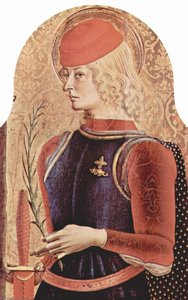
This work presents Saint Lucy, a figure rendered with the distinctive, meticulous hand of Carlo Crivelli. Created about 1476, the painting emerged from a larger, cohesive program. It was originally part of the Four Panels from an Altarpiece, Ascoli Piceno. This grouping was designed to inhabit a specific sacred space, serving the devotional needs of its original setting.
The figure of Saint Catherine of Alexandria is presented within a shallow architectural niche, her presence defined by a vertical composition and a sense of quiet dignity. She is rendered in tempera on panel, a medium that allows for the meticulous layering of translucent glazes to build depth and luminosity. Her attire consists of a deep blue gown adorned with shimmering gold embroidery, a vibrant red cloak, and a striking…
Carlo Crivelli's "Saint Michael," painted around 1476, isn’t merely a depiction of an angel battling a demon; it’s a meticulously crafted tableau of spiritual warfare, brimming with Renaissance artistry and profound symbolism. This panel, once part of a larger altarpiece intended for the church of San Domenico in Ascoli Piceno, Italy, immediately draws the eye into a dynamic scene where youthful Michael, radiating aristocratic beauty yet possessing an undeniable ferocity,…
The Virgin Mary sits enveloped in a deep red background, a color that holds the weight of both royalty and sacrifice. She cradles her child with a steady, nurturing grace, her form defined by sharp, linear precision. A crown rests upon her head, catching the light and marking her status within this sacred space. Two apples appear in the composition—one near the bottom right and another toward the top left—resting…
The scene is a dense knot of grief, a tight arrangement of figures pressed against a luminous, gold-over-gesso background. At the center, the pale, sculptural flesh of Christ rests heavily, his torso rendered with anatomical precision. The Virgin Mary cradles him, her blue garment edged in reddish gold, her face marked by three large, distinct teardrops. Beside her, the figures of Mary Magdalene and another mourning companion overlap in a…
Created in 1482, this panel captures a pivotal moment of celestial intervention. The angel, poised in a state of graceful movement, holds a scroll, signaling the weight of the message being delivered to Mary. The scene unfolds within a structured architectural setting, where a brick wall provides a sense of tangible depth and permanence. A single bird flies above the angel, a subtle detail that punctuates the stillness of the…
これらのオリジナル作品に繰り返し描かれている4つの主題と、それぞれの最高傑作。
このページに掲載されている絵画を最も多く所蔵している 8 の美術館
| 美術館 | 都市 | カルロ・クリヴェッリの作品 | このリストの絵画 |
|---|---|---|---|
| ロンドン | 27 | 聖エミディウスを伴う受胎告知, Annunciation with St Emidius (detail), Saint Lucy | |
| ミラノ | 10 | Virgin and Child, ピエタ, Coronation of the Virgin | |
| アヴィニョン | 4 | Saint Lucy, Saint Augustine, Saint Nicholas | |
| ベルリン | 4 | Saint Benedict, Bonaventure, Christ in the grave with saints | |
| マーストリヒト | 3 | St Antony of Padua, St Dominic, St Ambrose | |
| ヴェネツィア | 4 | St Jerome and St Augustine (detail), St Peter and St Paul (detail) | |
| フランクフルト | 2 | Annunciation angel, Virgin proclamation | |
| ロンドン | 2 | St Roch, Saint Roch |
その時代を象徴する名作を見るために、年代を選択してください。
The figure of Saint Lucy emerges from a dark, shadowed background, her presence defined by a sharp, sculptural clarity that feels almost tangible. She stands in profile, facing left, her gaze directed toward an unseen horizon. Her form is draped in heavy, flowing garments that fall in deep, rhythmic folds, suggesting the weight and texture of thick textile. A delicate halo, rendered with fine, radiating lines, encircles her head, catching…
In "Man of Sorrow" by Carlo Crivelli, the viewer encounters a close-up depiction of the Deposition of Christ. The composition focuses intently on the body of Jesus as he is lowered from the cross. This central figure, marked by vulnerability and suffering, occupies the immediate foreground. Around him, the presence of Mary and other figures is felt through partial visibility, their forms emerging from the shadows to witness the descent.…
This work presents Saint Lucy, a figure rendered with the distinctive, meticulous hand of Carlo Crivelli. Created about 1476, the painting emerged from a larger, cohesive program. It was originally part of the Four Panels from an Altarpiece, Ascoli Piceno. This grouping was designed to inhabit a specific sacred space, serving the devotional needs of its original setting.
の手による祭壇画、聖エミディウスを伴う受胎告知。1486年に制作されたこの傑作は、緻密なディテールというレンズを通して、神聖な宗教的出来事を鮮烈に描き出しています。もともとはマルケ州アスコリ・ピチェーノのサンタ・アンヌンツィアータ教会のために依頼された作品であり、その背景には、1482年に教皇シクストゥス4世によってアスコリ・ピチェーノの自治権が認められたことを祝うという、市民としての誇りを込めた重要な目的がありました。
The figure of Saint Catherine of Alexandria is presented within a shallow architectural niche, her presence defined by a vertical composition and a sense of quiet dignity. She is rendered in tempera on panel, a medium that allows for the meticulous layering of translucent glazes to build depth and luminosity. Her attire consists of a deep blue gown adorned with shimmering gold embroidery, a vibrant red cloak, and a striking…
聖エミディウスを伴う受胎告知 (1486)(ナショナル・ギャラリー, ロンドン)。次いでPietà、Virgin and Child (1482)が続きます。
51歳:聖エミディウスを伴う受胎告知は1486年の作品で、カルロ・クリヴェッリの生年は1435年です。
聖エミディウスを伴う受胎告知, Pietà, Virgin and Child, Annunciation with St Emidius (detail), Saint Lucy, Saint Catherine of Alexandria, Saint Michael, Madonna and Child, Pietà と Annunciation angel。上記のランキングには、それぞれの制作年と所蔵美術館が記載されています。
当カタログには、1450年から1493年にかけて制作されたカルロ・クリヴェッリによる227点の作品が収められています。
主にナショナル・ギャラリー (ロンドン), ピナコテカ・ディ・ブレラ (ミラノ) と Musée du Petit Palais (アヴィニョン)に所蔵されています。上記の美術館一覧にすべて記載されています。
1470s年:このページにある全100作品のうち、42作品がその時期に制作されました。そのうちSaint Lucy作品が含まれます。
このページでは、最も古い作品はSaint Lucy (1450)、最新の作品はピエタ (1493)です。
このページに掲載されている100点の作品におけるMan (32), Woman (22) と Book (22)
このページに掲載されている全100作品のうち、59作品のTempera On Panel
このページに掲載されているオリジナル作品から判断すると、初期ルネサンスです。
聖エミディウスを伴う受胎告知, Annunciation with St Emidius (detail) と Saint Lucy:ナショナル・ギャラリー, ロンドンには、このページに掲載されている作品のうち11点が所蔵されています。
水の都ヴェネツィアに生を受けたカルロ・クリヴェッリは、画家を輩出する家系に育ちました。その血筋は、彼が幼少期から芸術の神髄を深く理解する上で、大きな役割を果たしたに違いありません。彼の形成期は、ヴィヴァリーニ派の様式やパドヴァの伝統が持つ線的な精密さを吸収し、ヴェネト地方の芸術的潮流を体現する日々でした。しかし、彼は極めて独特で、時に頑固とも言えるほどの独自の感性を持った人物でもありました。同時代の画家たちが初期ルネサンスの自然主義へと歩みを進めていた一方で、カルロ・クリヴェッリは後期ゴシック様式が持つ装飾的な豊穣さへの献身を貫いたのです。この選択こそが、彼を15世紀における比類なき存在へと押し上げました。古き良き伝統と新時代の潮流との間で揺れ動きながら、彼は極めて個人的で、時にマニエリスム的とも言える表現主義によって、独自の芸術世界を切り拓いていったのです。
彼の人生を大きく変えたのは、ヴェネツィアという中心地からの突然の離脱でした。1457年、既婚女性を誘惑したとされる法的紛争をきっかけに、彼はヴェネツィアを去ることになります。この追放の歳月は、彼をイタリア東部のマルケ地方、特にアスコリ・ピチェーノ周辺へと導きました。この地で、彼は祭壇画の作者として多作な活動を展開し、また異なる形の成功を収めます。彼は決して当時の主流な流行を追う者ではありませんでした。むしろ、イタリアの主要な芸術都市で起こっていた大きな変革から距離を置き、形態の明晰さと鋭い線的な定義を優先させた、独自の様式を研鑽し続けたのです。
カルロ・クリヴェッリの作品を定義づけるのは、聖なるものと触れられる現実との境界を埋めようとする、驚異的な技術的技巧です。彼はトロンプ・ルイユ(だまし絵)の達人であり、絵具を用いて驚くべき正確さで現実世界を模倣しました。彼は単に物体を描写するのではなく、それらが鑑賞者と同じ空間に存在しているかのような錯覚を与えようとしたのです。彼の描く画面は、擬似的な大理石の建築、果実のガーランド、そしてパネルから飛び出してくるかのような羊皮紙のカルテッリーニ(銘板)によって、圧倒的な密度で満たされています。こうした物質性への執着は、彼の信仰心に基づいた意図の核心であり、祭壇画の前に立つ人々に、目の前で出来事が起きているかのような切実な臨場感をもたらしました。
色彩と光へのアプローチは、鮮烈かつ計算し尽くされたものでした。彼は、精緻な模様を刻んだ金箔を巧みに用い、絹や宝石、石材の写実的な質感とは対照的な、この世のものとは思えない神々しい輝きを創り出しました。描かれた人物たちは、しばしば過剰なまでの蒼白な肌と完璧な美貌を湛え、その彫刻的な立体感を強調する鋭い輪郭線によって描き出されます。この高度な装飾性と強烈な写実性の融合は、彼独自の視覚言語を形作り、以下の特徴によって彩られています。
彼が遺した傑作の多くは、ブレラ絵画館やナショナル・ギャラリーといった世界的なコレクションに収蔵されており、その並外れた技術的才能を今に伝えています。彼の描く聖母子像や聖人像は、深い感情を伝えるために身振りが誇張されることもある、独特の表現主義に満ちています。騎士の甲冑の輝きから、聖母の衣の繊細な襞に至るまで、彼はまさに「細部の画家」でした。ルネサンスが遠近法やプロポーションの新たな理想へと進化を遂げていく中で、カルロ・クリヴェッリは自らの緻密で細密なヴィジョンを貫き通し、その時代において最も際立った個性を放つ芸術家としての地位を不動のものにしたのです。