Chapel of the Cross at Karlštejn Castle: A Gothic Testament to Bohemian Royalty
Karlštejn Castle, perched majestically atop Velká hora hill overlooking the Berounka River near Prague, stands as a testament to the ambition and piety of Holy Roman Emperor Charles IV. More than just a fortress, it’s a repository of Czech history and artistic achievement—a place where Gothic grandeur intertwines with royal relics and spiritual contemplation.
The Chapel of the Cross at Karlštejn Castle is more than simply a building; it's an embodiment of Bohemian identity during the fourteenth century. Constructed under Charles IV’s watchful eye, its soaring ribbed vaults, pointed arches, and meticulously carved limestone walls speak to a profound understanding of structural engineering and artistic expression—a reflection of the intellectual fervor that characterized the imperial court.
Collection Highlights: Illuminating Faith Through Stone and Light
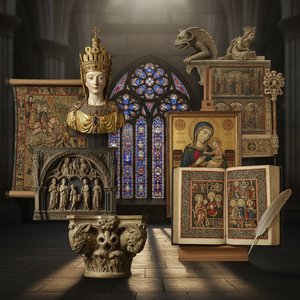
The Chapel’s artistic treasures are unparalleled within Bohemia. Dominating the interior is a breathtaking stained glass window depicting “The Exaltation of the Cross,” executed by Limbourg Brothers, demonstrating exceptional skill in capturing the ethereal beauty of medieval illumination. This masterpiece exemplifies the International Gothic style—characterized by delicate detail and vibrant color palettes—reflecting the chapel’s devotion to Christian iconography. The Limbourg brothers' meticulous craftsmanship ensured that every shard of glass radiated with divine light, creating an atmosphere of solemn reverence.
Beyond the central altar, numerous paintings adorn the chapel walls, portraying biblical scenes and saints—primarily Saint Catherine and Saint Elizabeth—executed by artists affiliated with Charles IV’s court. These artworks showcase the stylistic influences of Northern European Gothic art, blending geometric precision with expressive emotion. The palette employed was rich in blues and golds, mirroring the splendor of Bohemian royalty and conveying a sense of spiritual aspiration.
Architectural Marvel: A Cathedral in Miniature
The chapel’s design is remarkable for its scale relative to other religious buildings of the period. Its Great Tower—constructed concurrently with the chapel—houses a stunning suspension bridge and offers panoramic vistas of the surrounding landscape. The tower’s interior walls are adorned with murals depicting scenes from Bohemian history, further enriching the chapel's narrative dimension.
The Chapel’s construction represents an extraordinary feat of engineering for its time, utilizing innovative techniques to achieve structural stability and aesthetic grandeur. Skilled stonemasons painstakingly sculpted limestone blocks into intricate patterns—a testament to Bohemian craftsmanship and artistic sensibility. The tower’s soaring height symbolizes the ambition of Charles IV—who envisioned Karlštejn as a symbol of imperial power and spiritual devotion.
Historical Significance: A Royal Pilgrimage
Commissioned by Charles IV to commemorate his ascension to the throne and to honor Saint Wenceslas—the patron saint of Bohemia—the chapel reflects the religious fervor and political maneuvering characteristic of the era. Its walls bear witness to pivotal moments in Bohemian history, from Hussite uprisings to Habsburg rule. The Chapel served as a focal point for royal pilgrimages during times of crisis—a tangible expression of Czech national identity.
Today, Karlštejn Castle welcomes visitors eager to immerse themselves in the splendor of medieval Bohemia and contemplate the legacy of Charles IV and Saint Wenceslas. The Chapel of the Cross stands as a beacon of artistic excellence and spiritual contemplation—inviting observers to appreciate the enduring beauty of Gothic architecture and the profound symbolism embedded within its stained glass windows and murals.