Ritratto di Spencer Gore

I 89 dipinti più famosi di Spencer Gore, una selezione della galleria

Aggiornato Ottobre 2026 · classificato in base al nostro punteggio di popolarità (ricerche, visite e ordini per ogni opera) · 89 opere di Spencer Gore nel nostro catalogo

In breve

Tra tutti gli originali lasciati da Spencer Gore, il più famoso è Mornington Crescent, Londra (1911). Subito dopo troviamo Panshanger Park (1908) e La casa di Harold Gilman a Letchworth, Hertfordshire (1912). Il nostro catalogo contiene 89 opere di Spencer Gore; la galleria ha conservato le 89 che il mondo ammira di più, ognuna presentata con la sua data, il suo museo e la sua storia.

1878 – 1914, Epsom Post-impressionismo Più opere: Tate Gallery

I 10 migliori dipinti di Spencer Gore: la scelta della galleria

1
Mornington Crescent, Londra (1911) di Spencer Gore

Mornington Crescent, Londra

1911 · Olio su tela

Mornington Crescent, Londra, è un'opera a olio su tela realizzata da Spencer Gore nel 1911. Questo dipinto cattura un momento specifico dello sviluppo urbano della metropoli, concentrandosi sull'animata attività dell'area di Mornington Crescent all'inizio del ventesimo secolo. La scena offre uno sguardo sui ritmi quotidiani di Londra, documentando la transizione dei mezzi di trasporto mentre le carrozze trainate da cavalli condividono la strada con i primi veicoli a motore e…

2
Panshanger Park (1908) di Spencer Gore

Panshanger Park

1908 · Olio su tela

In questo olio su tela del 1908, Spencer Gore ci presenta Panshanger Park. L'opera cattura un momento di quiete all'interno di un paesaggio boschivo, dove il mondo naturale incontra la sottile presenza del tempo libero umano. È una scena definita dal suo manto verde e dall'abbraccio avvolgente degli alberi che popolano l'ambientazione.

3
La casa di Harold Gilman a Letchworth, Hertfordshire (1912) di Spencer Gore

La casa di Harold Gilman a Letchworth, Hertfordshire

1912 · Olio su tela

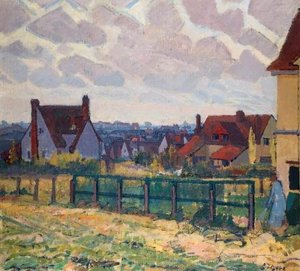
La scena si svela nella quiete del 1912, catturata attraverso lo sguardo di Spencer Gore nel suo dipinto, La casa di Harold Gilman a Letchworth, Hertfordshire. Quest'opera emerge da un periodo di intenso fermento creativo, un momento in cui l'artista sta attivamente plasmando il linguaggio visivo di una nuova era. Gore, nato a Epsom, nel Regno Unito, nel 1878, infonde una prospettiva vissuta e autentica a questo paesaggio. Egli attraversa…

4
From a Canal Bridge, Chalk Farm Road (1913) di Spencer Gore

From a Canal Bridge, Chalk Farm Road

1913 · Watercolor

In "From a Canal Bridge, Chalk Farm Road" by Spencer Gore, a watercolor captures a slice of urban life from about 1913. A canal cuts through the center of the scene, flanked by buildings that line the water's edge. In the distance, a large brick building anchors the background, its heavy presence watching over the waterway. Several boats rest upon the surface, some drifting near the foreground while others recede…

5
The Toilet di Spencer Gore

The Toilet

Oil On Canvas

In The Toilet, Spencer Gore turns his gaze toward the quietude of a private interior. The painting centers on a nude female figure, captured in a moment of stillness. She stands within the confines of a bedroom, a space defined by the soft geometry of domestic life. To her side, a bed is draped in white linens, their folds catching the light in the dimness of the room.

6
Inez e Taki (1910) di Spencer Gore

Inez e Taki

1910 · Olio su tela · Tate Gallery, Londra

Nel cuore del 1910, Spencer Frederick Gore catturò molto più di una semplice scena di strada; egli distillò l'essenza stessa di un'era bohémien in pieno fermento. “Inez e Taki” funge da vibrante finestra su un mondo in cui il trambusto urbano di Parigi incontra lo spirito intimo e artistico del Camden Town Group di Londra. Il dipinto presenta un tableau affascinante: un musicista, forse un autoritratto dello stesso Gore, assorto…

La selezione di Spencer Gore continua, da 11 a 89

11The Fig Tree (1912) di Spencer GoreThe Fig Tree1912 12The Artist’s Wife (1913) di Spencer GoreThe Artist’s Wife1913 13The Blue Petticoat (1912) di Spencer GoreThe Blue Petticoat1912 14L'abito verde (1908) di Spencer GoreL'abito verde1908 · Fitzwilliam Museum 15Panshanger Park (1908) di Spencer GorePanshanger Park1908 16Il fornello a gas (1913) di Spencer GoreIl fornello a gas1913 · Tate Gallery 17Portrait of a Lady (1830) di Spencer GorePortrait of a Lady1830 · Metropolitan Museum of Art 18Mary Ann Garrits (1834) di Spencer GoreMary Ann Garrits1834 · Metropolitan Museum of Art 19Frances Ludlum Morris (Mrs. Robert Morris) (?) (1838) di Spencer GoreFrances Ludlum Morris (Mrs. Robert Morris) (?)1838 · National Gallery of Art 20The Britannia Ballet, the Alhambra (1907) di Spencer GoreThe Britannia Ballet, the Alhambra1907 · Fenton House 21Autumn, Sussex (1907) di Spencer GoreAutumn, Sussex1907 · Art Gallery of South Australia 22Tennis In Mornington Crescent Gardens (1910) di Spencer GoreTennis In Mornington Crescent Gardens1910 · Galleria d'Arte di Auckland - Toi o Tāmaki 23Ballet Scene from "On the Sands" (1910) di Spencer GoreBallet Scene from "On the Sands"1910 · Yale Center for British Art 24Tennis at Hertingfordbury (1910) di Spencer GoreTennis at Hertingfordbury1910 · Yale Center for British Art 25An Extensive Landscape in Yorkshire (1907) di Spencer GoreAn Extensive Landscape in Yorkshire1907 · Yale Center for British Art 26Mornington Crescent (1911) di Spencer GoreMornington Crescent1911 · Museum of Fine Arts 27Yorkshire Landscape (1907) di Spencer GoreYorkshire Landscape1907 28The Garden City, Letchworth di Spencer GoreThe Garden City, Letchworth 29Rule Britannia (1910) di Spencer GoreRule Britannia1910 30Landscape, Somerset (1909) di Spencer GoreLandscape, Somerset1909 31The Cricket Match (1909) di Spencer GoreThe Cricket Match1909 32Panshanger Park, Hertfordshire (1909) di Spencer GorePanshanger Park, Hertfordshire1909 33The Mimrain, Panshanger Park, Hertfordshire (1910) di Spencer GoreThe Mimrain, Panshanger Park, Hertfordshire1910 34Hertfordshire Landscape (1909) di Spencer GoreHertfordshire Landscape1909 35The Garden, Hertingfordbury (1909) di Spencer GoreThe Garden, Hertingfordbury1909 36Mornington Crescent (1911) di Spencer GoreMornington Crescent1911 · Amgueddfa Cymru – Museo Nazionale del Galles 37Interior with Nude (1907) di Spencer GoreInterior with Nude1907 38Hertingfordbury, Hertfordshire (1908) di Spencer GoreHertingfordbury, Hertfordshire1908 39Interior, Mornington Crescent (1910) di Spencer GoreInterior, Mornington Crescent1910 40Someone who Waits (1907) di Spencer GoreSomeone who Waits1907 41Somerset Landscape (1909) di Spencer GoreSomerset Landscape1909 42Garden at Hertingfordbury (1908) di Spencer GoreGarden at Hertingfordbury1908 43Portrait of the Artist's Wife (1911) di Spencer GorePortrait of the Artist's Wife1911 · Birmingham Museum and Art Gallery 44Mornington Crescent (1911) di Spencer GoreMornington Crescent1911 · Tate Gallery 45Landscape (1907) di Spencer GoreLandscape1907 46The Garden of Rowlandson House (1911) di Spencer GoreThe Garden of Rowlandson House1911 47View from a Window (1909) di Spencer GoreView from a Window1909 48Somerset Landscape (1910) di Spencer GoreSomerset Landscape1910 49Self portrait (1906) di Spencer GoreSelf portrait1906 · Birmingham Museum and Art Gallery 50The Cinder Path (1912) di Spencer GoreThe Cinder Path1912 51The Beanfield, Letchworth (1912) di Spencer GoreThe Beanfield, Letchworth1912 52Cambrian Road, Richmond (1913) di Spencer GoreCambrian Road, Richmond1913 · Yale Center for British Art 53Design for Deer Hunting Mural in the Cabaret Theatre Club (1912) di Spencer GoreDesign for Deer Hunting Mural in the Cabaret Theatre Club1912 · Yale Center for British Art 54Blue and Green Bottles and Orange (1914) di Spencer GoreBlue and Green Bottles and Orange1914 · Yale Center for British Art 55Back Gardens from Houghton Place (1913) di Spencer GoreBack Gardens from Houghton Place1913 · Museum of Fine Arts 56The Pond (1912) di Spencer GoreThe Pond1912 57Study for a Mural Decoration for 'The Cave of the Golden Calf' (1912) di Spencer GoreStudy for a Mural Decoration for 'The Cave of the Golden Calf'1912 58Letchworth Station (1912) di Spencer GoreLetchworth Station1912 59Richmond Park (1914) di Spencer GoreRichmond Park1914 · Tate Gallery 60In Berkshire (1912) di Spencer GoreIn Berkshire1912 61Icknield Way (1912) di Spencer GoreIcknield Way1912 · Art Gallery of New South Wales 62Still Life with Apples (1912) di Spencer GoreStill Life with Apples1912 · Galleria d’Arte Ferens 63Letchworth, The Road (1912) di Spencer GoreLetchworth, The Road1912 64Wood in Richmond Park (1914) di Spencer GoreWood in Richmond Park1914 · Birmingham Museum and Art Gallery 65Harold Gilman's House at Letchworth (1912) di Spencer GoreHarold Gilman's House at Letchworth1912 66Self portrait (1914) di Spencer GoreSelf portrait1914 · National Portrait Gallery 67Harrington Square from No.2 Houghton Place (1913) di Spencer GoreHarrington Square from No.2 Houghton Place1913 68A Singer at the Bedford Music Hall (1912) di Spencer GoreA Singer at the Bedford Music Hall1912 · Tate Gallery 69The Terrace Gardens (1912) di Spencer GoreThe Terrace Gardens1912 70Letchworth (1912) di Spencer GoreLetchworth1912 · Tate Gallery 71Suburban Street (1913) di Spencer GoreSuburban Street1913 72Ragazza del Nord di Londra (1911) di Spencer GoreRagazza del Nord di Londra1911 · Tate Gallery 73Interno, 31, Mornington Crescent, Londra (1910) di Spencer GoreInterno, 31, Mornington Crescent, Londra1910 74The Garden Path, Garth House (1910) di Spencer GoreThe Garden Path, Garth House1910 75Richmond Park (1914) di Spencer GoreRichmond Park1914 · Ashmolean Museum 76Houghton Place (1912) di Spencer GoreHoughton Place1912 · Tate Gallery 77Mornington Crescent, London (1911) di Spencer GoreMornington Crescent, London1911 78Scena del porto (1906) di Spencer GoreScena del porto1906 · Ashmolean Museum 79Il giardino, Garth House (1908) di Spencer GoreIl giardino, Garth House1908 · Walker Art Gallery 80Hampstead Road, Camden Town (1910) di Spencer GoreHampstead Road, Camden Town1910 · Te Papa 81Interior di Spencer GoreInterior 82The Gravel Pit di Spencer GoreThe Gravel Pit 83Nearing Euston Station di Spencer GoreNearing Euston Station 84Marie Hayes di Spencer GoreMarie Hayes 85Harold Gilman's House at Letchworth, Hertfordshire di Spencer GoreHarold Gilman's House at Letchworth, Hertfordshire 86A View from the Window at 6 Cambrian Road, Richmond di Spencer GoreA View from the Window at 6 Cambrian Road, RichmondFitzwilliam Museum 87Reclining Nude di Spencer GoreReclining Nude 88From a Window in Cambrian Road, Richmond (1913) di Spencer GoreFrom a Window in Cambrian Road, Richmond1913 · Tate Gallery 89Letchworth, Hertfordshire (1912) di Spencer GoreLetchworth, Hertfordshire1912

I dipinti più famosi di Spencer Gore, periodo per periodo

I soggetti che hanno catturato lo sguardo di Spencer Gore

I quattro soggetti che ricorrono più spesso in questi originali, ognuno con il suo esempio più raffinato.

I musei che conservano gli originali di Spencer Gore

I 8 musei che ospitano la maggior parte dei dipinti presenti in questa pagina.

Musei Città Opere di Spencer Gore Dipinti di questo elenco
Tate Gallery, LondraTate Gallery Londra 9 Inez e Taki, Il fornello a gas, Mornington Crescent
Yale Center for British Art, New HavenYale Center for British Art New Haven 6 Ballet Scene from "On the Sands", Tennis at Hertingfordbury, An Extensive Landscape in Yorkshire
Birmingham Museum and Art Gallery, BirminghamBirmingham Museum and Art Gallery Birmingham 3 Portrait of the Artist's Wife, Self portrait, Wood in Richmond Park
Fenton House, LondraFenton House Londra 2 The Frenchwoman, The Britannia Ballet, the Alhambra
Galleria Nazionale di Arte Moderna Scozzese, EdimburgoGalleria Nazionale di Arte Moderna Scozzese Edimburgo 2 Mrs Spencer Frederick Gore in the Garden of Rowlandson House, Conversation Piece and Self-Portrait
Fitzwilliam MuseumFitzwilliam Museum 2 L'abito verde, A View from the Window at 6 Cambrian Road, Richmond
Metropolitan Museum of Art, New YorkMetropolitan Museum of Art New York 2 Portrait of a Lady, Mary Ann Garrits
Museum of Fine Arts, BostonMuseum of Fine Arts Boston 2 Mornington Crescent, Back Gardens from Houghton Place

Spencer Gore anno dopo anno: gli originali che definiscono ogni fase

In poco più di un decennio, da 1906 a 1914, Spencer Gore ha regalato al mondo ogni opera originale datata in questa selezione: eccola, anno dopo anno.

Opere per anno

Scegli un anno per vedere gli originali.

Domande dei collezionisti sulle opere di Spencer Gore

Per quale opera è più famoso Spencer Gore?Scopri la risposta

Mornington Crescent, Londra (1911). Seguono Panshanger Park (1908) e La casa di Harold Gilman a Letchworth, Hertfordshire (1912).

Che età aveva Spencer Gore quando è stata realizzata Mornington Crescent, Londra?Scopri la risposta

33 anni: Mornington Crescent, Londra risale al 1911, e Spencer Gore è nato/a nel 1878.

Quali sono i dieci dipinti più famosi di Spencer Gore?Scopri la risposta

Mornington Crescent, Londra, Panshanger Park, La casa di Harold Gilman a Letchworth, Hertfordshire, From a Canal Bridge, Chalk Farm Road, The Toilet, Inez e Taki, The Frenchwoman, Mrs Spencer Frederick Gore in the Garden of Rowlandson House, Conversation Piece and Self-Portrait e Landscape with Pond. La classifica sopra riporta l'anno e il museo di ciascuna opera.

Quante opere ha lasciato Spencer Gore?Scopri la risposta

Il nostro catalogo comprende 89 opere di Spencer Gore, datate da 1906 a 1914.

In quali musei sono esposti i capolavori di Spencer Gore?Scopri la risposta

Principalmente in Tate Gallery (Londra), Yale Center for British Art (New Haven) e Birmingham Museum and Art Gallery (Birmingham). La tabella dei musei sopra li elenca tutti.

In quali anni Spencer Gore ha dipinto le sue opere più famose?Scopri la risposta

In 1912: 19 delle 89 opere in questa pagina sono state realizzate in quel periodo, tra cui La casa di Harold Gilman a Letchworth, Hertfordshire.

Quali sono le prime e le ultime opere originali famose di Spencer Gore?Scopri la risposta

In questa pagina, il più antico risale al Self portrait (1906) e il più recente al Blue and Green Bottles and Orange (1914).

Quali soggetti ha scelto più spesso Spencer Gore?Scopri la risposta

Landscape (9), Gardens and parks (8) e Buildings (5), tra le 89 opere in questa pagina.

Quale tecnica ha utilizzato maggiormente Spencer Gore?Scopri la risposta

Olio su tela, per 11 delle 89 opere in questa pagina.

A quale movimento artistico appartiene Spencer Gore?Scopri la risposta

Post-impressionismo, a giudicare dagli originali presenti in questa pagina.

Quali opere di Spencer Gore sono esposte al Tate Gallery?Scopri la risposta

Inez e Taki, Il fornello a gas e Mornington Crescent: il Tate Gallery, Londra custodisce 9 delle opere presenti in questa pagina.

Spencer Gore: vita e opera

Spencer Gore (1878 – 1914): A Pioneer of Camden Town

Spencer Frederick Gore was a British painter who emerged as one of the foremost figures in the burgeoning Camden Town Group, marking a pivotal moment in early twentieth-century British art. Born on May 26th, 1878, at Epsom, Surrey, he descended from a family steeped in artistic tradition – his father, Spencer Gore (the Wimbledon tennis champion), was himself a painter, and his brother Charles Gore was a theologian, fostering an environment that nurtured creativity and intellectual curiosity. Gore’s formative years were shaped by attending Harrow School, where he honed his observational skills before pursuing formal training at the Slade School of Fine Art alongside contemporaries like Harold Gilman, cementing his connection to Impressionist ideals.
  • Early Influences: Gore's artistic sensibilities were profoundly impacted by Post-Impressionists such as Claude Monet and Vincent van Gogh, whose explorations of color and light served as a springboard for his own distinctive style. Monet’s dappled sunlight and Van Gogh’s expressive brushstrokes instilled in Gore a desire to capture not merely what he saw but also how he felt—a core principle that underpinned his entire artistic practice.
  • The Camden Town Group: He spearheaded the formation of the Camden Town Group in 1904, alongside Walter Sickert, Lucien Pisarro, Harold Gilman, and Charles Ginner—a collective dedicated to capturing the atmosphere of London’s bohemian district with bold brushstrokes and vibrant palettes. This group represented a radical departure from academic conventions, prioritizing subjective experience and embracing innovative techniques. Gore's leadership was instrumental in establishing Camden Town as a hub for artistic experimentation.

Notable Works: Landscapes That Breathe

Gore’s oeuvre comprises a remarkable collection of landscapes, music hall scenes, and interiors, characterized by meticulous detail and an unwavering commitment to portraying natural beauty. Particularly noteworthy are his thirty-two Richmond Park canvases completed in the final months of his life—a testament to his enduring fascination with the English countryside. These paintings aren't simply representations of trees and shrubs; they’re imbued with a palpable sense of emotion, reflecting Gore’s profound connection to his surroundings. Tate curator Helena Bonett noted that Gore’s death from pneumonia was sudden, leaving behind an unfinished masterpiece—a testament to his unwavering pursuit of artistic excellence. The Richmond Park series exemplifies Gore's masterful command of color and form, capturing the subtle nuances of light and shadow with breathtaking precision.
  • Richmond Park Series: These canvases depict scenes from Richmond Park during autumn, bathed in golden sunlight—a motif that recurs throughout his work.
  • Hartington Square: Considered Gore’s masterpiece, Hartington Square captures the quiet dignity of a London townhouse interior with remarkable subtlety and tonal harmony.

Technique and Style: Pictorial Construction Illuminated

Gore’s artistic approach distinguished itself through a deliberate embrace of pictorial construction, mirroring the stylistic innovations championed by Impressionists and Post-Impressionists. He skillfully employed layering techniques—often applying thin glazes over underpaintings—to achieve luminous effects and imbue his canvases with depth and resonance. This meticulous attention to detail extended beyond mere representation; Gore sought to convey not just what he saw but also how he felt, reflecting the emotional intensity inherent in capturing fleeting moments of experience. His paintings like “Hartington Square” exemplify this stylistic commitment, demonstrating a masterful command of color and form. He meticulously observed light and shadow, translating these perceptions into expressive brushstrokes that conveyed both visual accuracy and profound feeling. “Gore’s technique,” Bonett remarked, “was characterized by an almost obsessive desire to capture the essence of his subjects—a pursuit that resulted in paintings of extraordinary beauty and emotional power.”

Legacy and Influence

Spencer Gore's contribution to British art is undeniable. He helped establish Camden Town as a center for artistic innovation, fostering a dialogue between observation and emotion that continues to inspire artists today. His Richmond Park landscapes stand as enduring symbols of the English countryside—a testament to his unwavering dedication to portraying natural beauty with unparalleled skill. Furthermore, Gore’s son, Frederick John Pym Gore CBE RA (1892-1979), followed in his father's footsteps as a painter, inheriting his artistic vision and establishing himself as a respected figure within the British art world—a continuation of Gore’s legacy that ensured his influence would endure for generations.