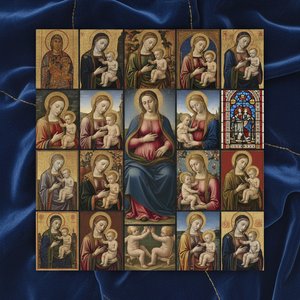
Lippo d'Andrea di Lippo: A Bolognese Master of Madonna Portraits
Lippo d’Andrea di Lippo (c. 1352 – 1410), often referred to as Lippo delle Madonne, stands as a pivotal figure in the burgeoning artistic landscape of Bologna during the Quattrocento—the Florentine Renaissance's sister city. While overshadowed by contemporaries like Piero della Francesca and Andrea Mantegna, Lippo’s contribution to Bolognese painting is undeniable, particularly his prolific output of Madonna and Child depictions that cemented his reputation as “The Painter of Madonnas.” His work embodies a synthesis of Tuscan humanist ideals with the expressive fervor characteristic of the Bolognese school, resulting in images imbued with profound spiritual depth and meticulous artistic craftsmanship.Early Life and Training
Born in Florence around 1352, Lippo’s formative years coincided with the zenith of Florentine artistic innovation under Cosimo de' Medici. Evidence suggests he received his initial training from Andrea di Cione (Orcagna), a celebrated sculptor and painter known for his monumental frescoes in Siena Cathedral—a testament to Orcagna’s influence on shaping Lippo’s aesthetic sensibilities. Furthermore, Lippo was deeply connected to the broader Tuscan artistic milieu, absorbing stylistic cues from artists like Simone Martini and Matteo Giovannetti. However, unlike many Florentine painters of his era who pursued humanist scholarship alongside artistic pursuits, Lippo’s path led him towards Bologna in 1389 where he joined the workshop of Vitale da Bologna—a school renowned for its refined decorative arts and its embrace of naturalistic observation. This association exposed Lippo to a distinctly Bolognese artistic tradition characterized by a heightened sensitivity to color and texture, shaping his distinctive visual vocabulary. Vitale da Bologna’s influence was paramount in establishing Lippo's artistic trajectory. The Bolognese workshop prioritized meticulous detail and naturalistic representation—a departure from the more stylized conventions of Florentine art—inspiring Lippo to adopt similar approaches. He honed his skills alongside other prominent artists, absorbing stylistic nuances that would contribute to the distinctive character of his oeuvre.Style and Technique
Lippo’s artistic style is immediately recognizable by its serene composure and masterful execution. He eschewed the dramatic theatricality favored by some of his peers, opting instead for compositions that prioritize clarity and elegance—a hallmark of Bolognese painting. His Madonna portraits are distinguished by their luminous color palettes—often dominated by blues and golds—which convey a sense of ethereal beauty and spiritual transcendence. Lippo’s technique involved meticulous layering of pigments, utilizing glazing techniques to achieve subtle gradations of tone and luminosity that captured the softest nuances of light. He skillfully rendered drapery folds with remarkable realism, conveying both volume and texture through careful observation and painstaking brushwork. The artist's attention to detail extended beyond mere visual representation; he infused his paintings with symbolic gestures and expressions intended to convey profound theological concepts—reflecting the humanist preoccupation with moral virtue and spiritual contemplation prevalent in Bolognese art circles. He achieved this remarkable level of realism by employing a technique known as *sfumato*, pioneered by Leonardo da Vinci, which softens outlines and blends colors seamlessly—creating an illusion of depth and atmospheric perspective. This masterful manipulation of light and shadow underscored Lippo’s commitment to capturing the psychological complexity of his subjects—a characteristic trait of Bolognese painting that distinguished it from its Florentine counterpart.Notable Works
Lippo’s oeuvre comprises numerous Madonna and Child panels, several of which bear his signature—a rare occurrence for artists of his time—providing invaluable insight into his artistic practice and stylistic evolution. Among his most celebrated paintings are *Sant'Andrea a Brozzi*, housed in Sant'Andrea a Brozzi Museum, showcasing the artist’s masterful depiction of drapery and color harmony. The Museo del Cenacolo di San Salvi houses *Cenacolo di Andrea del Sarto*, which exemplifies Lippo’s ability to capture emotion and psychological depth within a religious scene—a testament to his artistic prowess. Furthermore, *Madonna and Child Enthroned* is considered one of Lippo's finest achievements, demonstrating his unparalleled skill in portraying the Virgin Mary with grace and dignity. These works stand as enduring symbols of Bolognese artistic excellence and exemplify Lippo’s unwavering dedication to conveying spiritual contemplation through visual artistry.Legacy and Historical Significance
Lippo d’Andrea di Lippo’s influence extended beyond his immediate contemporaries, establishing him as a foundational figure within the Bolognese school of painting—a movement that would propel artistic innovation throughout Italy during the fifteenth century. His unwavering commitment to naturalistic observation combined with humanist ideals profoundly shaped the aesthetic sensibilities of subsequent generations of artists. Although overshadowed by more flamboyant figures like Piero della Francesca and Andrea Mantegna, Lippo’s enduring legacy resides in his contribution to the development of Madonna portraiture—a genre that continues to inspire artists today. He remains a symbol of Bolognese artistic excellence and a testament to the transformative power of humanist thought within the visual arts.Domande e risposte
A quale periodo storico appartiene l'opera di Lippo delle Madonne?
Lippo delle Madonne ha operato nel periodo Tardo Medioevo, collocando storicamente la sua attività.
Dove posso trovare statistiche relative alle opere di Lippo delle Madonne?
Le statistiche relative alle opere di Lippo delle Madonne sono disponibili nella pagina Statistiche dell'artista.
Dove posso vedere le opere di Lippo delle Madonne in ordine cronologico?
Le opere di Lippo delle Madonne possono essere consultate in ordine cronologico nella pagina Cronologia delle opere dell'artista.