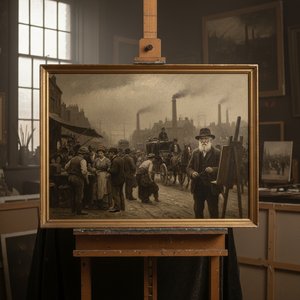
Joseph Wrightson Macintyre: A Master of Victorian Portraiture
Joseph Wrightson Macintyre, a name perhaps less familiar than some of his contemporaries, nevertheless stands as a significant figure in 19th-century British art. Born in Derby in 1842 and tragically passing away in 1897, Macintyre’s career was marked by a dedication to the portraiture genre, particularly within the context of Victorian society. His meticulous technique, coupled with an astute understanding of capturing psychological depth, resulted in works that offer intimate glimpses into the lives and personalities of his subjects – from wealthy industrialists to humble domestic scenes.
Macintyre’s artistic journey began under the tutelage of his father, a landscape painter, providing him with a foundational appreciation for observation and tonal rendering. However, it was his time spent studying at the Derby Art Union that truly shaped his style. This early training instilled in him a rigorous approach to drawing and painting, emphasizing accuracy and detail – qualities he would later become renowned for. Crucially, Macintyre’s artistic development coincided with a period of immense social and economic change in Britain; the rise of industrialization, the expansion of the middle class, and the increasing demand for portraiture as a symbol of status all contributed to the burgeoning market for artists like himself.
The Portraitist's Palette: Technique and Style
Macintyre’s distinctive style is immediately recognizable through his painstaking attention to detail. He was a master of capturing subtle nuances in texture, light, and expression – evident in works such as “Mary Beal, née Turner,” a remarkably realistic depiction of a young woman that showcases his ability to render the delicate play of light on skin and fabric. His brushwork is generally smooth and controlled, building up layers of paint to achieve a rich, luminous surface. He frequently employed a palette knife alongside traditional brushes, allowing him to apply thick impasto – particularly in areas requiring textural emphasis, such as clothing or hair.
Furthermore, Macintyre’s portraits weren't merely representations of outward appearances; he sought to convey the inner lives of his subjects. He skillfully used composition and pose to suggest character, mood, and social standing. His ability to capture a sense of quiet contemplation, as seen in works like “The Brickfields, East Heath (sketch),” reveals an understanding of psychology that elevated his portraits beyond simple likenesses.
Notable Works and Themes
Among Macintyre’s most celebrated paintings is "A Gleam of Hope," a dramatic maritime scene depicting a small fishing boat battling turbulent seas. This work exemplifies his ability to capture the power of nature and the vulnerability of human life – a recurring theme in his oeuvre. His subject matter often reflected the realities of Victorian society, including scenes of industrial labor, domestic interiors, and portraits of prominent figures within Derby’s business community. “The Brickfields, East Heath (sketch)” offers a more intimate glimpse into rural life, capturing the quiet dignity of workers engaged in a simple task.
His work also included several studies of women, often portraying them in domestic settings or engaged in everyday activities. These portraits demonstrate his keen eye for detail and his ability to capture the subtle nuances of female character. The meticulous rendering of clothing, jewelry, and facial expressions reveals a deep understanding of Victorian fashion and social customs.
Legacy and Historical Significance
Despite not achieving widespread fame during his lifetime, Joseph Wrightson Macintyre’s contribution to British portraiture is now recognized as significant. His works are held in collections such as the Sheffield Galleries and Museums Trust, providing a valuable window into Victorian society and artistic practices. Macintyre's legacy lies not only in his technical skill but also in his ability to capture the essence of his subjects – offering viewers intimate and enduring portraits of a bygone era.
His work stands as a testament to the quiet artistry that flourished within the provincial art scene of 19th-century Britain, demonstrating that true mastery can be found not only in the grand capitals but also in the dedicated hands of artists like Joseph Wrightson Macintyre.
Domande e risposte
Esiste un elenco completo delle opere di Joseph Wrightson Macintyre?
Ogni opera di Joseph Wrightson Macintyre su questo sito può essere consultata nella pagina Tutte le opere d'arte dell'artista.
In quale periodo storico ha operato Joseph Wrightson Macintyre?
Joseph Wrightson Macintyre ha operato nel periodo 19th Century. Tale epoca colloca storicamente l'attività dell'artista.
Dove si trovano le opere di Joseph Wrightson Macintyre mappate per soggetto?
La pagina Atlante dei soggetti mappa le opere di Joseph Wrightson Macintyre per soggetto.
Come posso trovare le opere di Joseph Wrightson Macintyre in una specifica palette cromatica?
Le opere di Joseph Wrightson Macintyre possono essere consultate per palette cromatica nella pagina Per palette dell'artista.
Quali colori ha usato più spesso Joseph Wrightson Macintyre?
L'uso del colore di Joseph Wrightson Macintyre nelle opere elencate su questo sito può essere approfondito consultando la pagina Genoma della Palette dell'artista.
Quante opere di Joseph Wrightson Macintyre sono disponibili per la consultazione?
Puoi sfogliare 11 opere d'arte opere di Joseph Wrightson Macintyre nella pagina Tutte le opere d'arte.
Posso sfogliare le opere di Joseph Wrightson Macintyre in base all'umore?
Le opere di Joseph Wrightson Macintyre possono essere esplorate per emozione nella pagina Stanze d'atmosfera dell'artista, che organizza le opere d'arte in base alle emozioni che trasmettono.