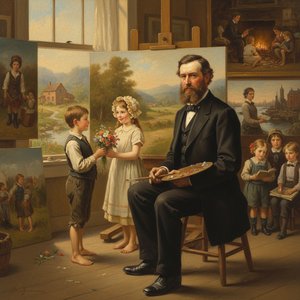
Johann Georg Ziesenis the Younger
Johann Georg Ziesenis the Younger (1716–1776) emerged as a prominent German-Danish portrait painter during the Rococo era, leaving an indelible mark on Danish art history. Born in Copenhagen, he was deeply rooted in artistic lineage; his father, Johan Jürgen Ziesenis, himself a respected artist from Hanover, had secured Danish citizenship in 1709 – a connection that profoundly shaped Johann Georg’s formative years and instilled within him a passion for visual representation. From an early age, he received invaluable instruction from his father, mastering the foundational skills of drawing and establishing a trajectory toward artistic excellence.Early Career and Training
Following this crucial initial training, Johann Georg relocated to Düsseldorf, where he immersed himself in the vibrant artistic milieu of the Rhineland. This move proved instrumental in furthering his technical prowess and refining his stylistic sensibilities. Düsseldorf’s renowned academies fostered an environment conducive to experimentation and innovation, allowing Ziesenis to hone his craft alongside fellow artists—a period that cemented his reputation as a skilled portraitist capable of capturing nuanced expressions and conveying psychological depth. Notably, he studied under Anton Graff, whose influence contributed significantly to the development of Ziesenis’s distinctive approach to composition and color palette.Notable Works and Artistic Style
Ziesenis's artistic output spanned approximately 260 portraits and sketches, reflecting his unwavering dedication to documenting the faces of his time—primarily members of royal families and aristocratic circles. Among his most celebrated achievements are portraits of Crown Prince Frederik (completed in 1767), now housed at Fredensborg Palace – a masterful depiction capturing the prince’s youthful charisma and regal bearing. He also produced iconic representations of Frederick II and Charlotte of Mecklenburg-Strelitz, the future consort of King George III, showcasing his ability to portray complex characters with remarkable accuracy and sensitivity. Furthermore, Ziesenis's portrait of Hans Egede (1764), commissioned by the Danish Crown, exemplifies his meticulous attention to detail and his command of chiaroscuro—a technique that dramatically enhances the emotional impact of his paintings. His style is characterized by delicate brushstrokes, luminous colors, and an emphasis on capturing subtle nuances of expression, aligning perfectly with the aesthetic ideals of Rococo art.Family Legacy and Artistic Influence
Johann Georg Ziesenis’s artistic legacy extends beyond his individual creations; he fostered a family tradition of artistic endeavor. His daughters, Maria Elisabeth Ziesenis (Lampe) and Margaretha Ziesenis, pursued careers as painters themselves—a testament to the familial encouragement that nurtured creativity and upheld the values of artistic excellence. Ziesenis’s work served as inspiration for subsequent generations of Danish artists, contributing to the enduring appreciation for portraiture as a genre within Danish art history. His paintings continue to be exhibited in prominent museums across Denmark, ensuring that his contribution to the visual arts remains visible and appreciated by scholars and enthusiasts alike.Domande e risposte
A quale periodo storico appartiene l'opera di Johann Georg Ziesenis?
Johann Georg Ziesenis ha operato nel periodo Età Moderna, collocando storicamente la sua attività.
Quante opere di Johann Georg Ziesenis sono disponibili nel catalogo?
Puoi sfogliare 1 opere opere di Johann Georg Ziesenis nella pagina Tutte le opere.
Dove posso esplorare le opere di Johann Georg Ziesenis suddivise per soggetto?
Le opere di Johann Georg Ziesenis possono essere esplorate per soggetto nella pagina Catalogo per soggetti dell'artista.