Joaquín Agrasot y Juan: A Pioneer of Costumbrismo
Joaquín Agrasot y Juan (December 24, 1836 – January 8, 1919) stands as a monumental figure in Spanish Realist painting and an undisputed cornerstone of the Costumbrismo movement—a stylistic revolution that irrevocably altered the landscape of nineteenth-century art. Born in Orihuela, Alicante Province, Spain, Agrasot’s artistic journey commenced with rigorous training at the Real Academia de Bellas Artes de San Carlos de Valencia, where he immersed himself amongst fellow artists dedicated to achieving academic excellence. This formative period instilled within him an unwavering commitment to meticulous observation and skillful representation of everyday life—a characteristic that would become synonymous with his distinctive artistic vision.
Early Life & Education: Seeds of Artistic Passion
Information regarding Agrasot’s upbringing remains somewhat elusive, yet biographical accounts reveal a childhood nurtured by an innate appreciation for artistic pursuits. His enrollment at San Carlos solidified his determination to master traditional techniques and accurately depict the multifaceted tapestry of Spanish society—a pursuit fueled by intellectual curiosity and a profound sensitivity to visual aesthetics. The Academy's curriculum fostered not merely technical proficiency but also a deep understanding of artistic history and theory, shaping Agrasot’s formative worldview.
Roman Influences & Artistic Circle: Exposure to Renaissance Grandeur
A pivotal juncture in Agrasot’s artistic trajectory arrived in 1860 when he secured a prestigious fellowship to undertake scholarly studies in Rome—a pilgrimage that transported him into the opulent embrace of Italian Renaissance art and broadened his artistic horizons exponentially. Situated at the antico caffè greco, Agrasot joined an influential artistic circle comprised of luminaries who championed realism and expressive brushwork—a milieu characterized by spirited debates and reciprocal inspiration. These encounters with contemporaries like Francisco de Zurbarán and Juan Cabré Aguiló profoundly impacted Agrasot’s stylistic sensibilities, propelling him toward a bolder and more emotionally resonant approach to painting.
The Costumbrismo Style: Capturing the Soul of Spain
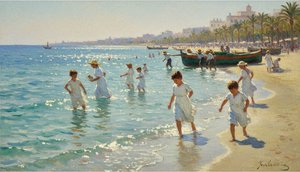
Agrasot’s artistic ethos crystallized into the Costumbrismo genre—a movement singularly devoted to portraying scenes of ordinary Spanish life imbued with regional character and psychological depth. Rejecting the idealized depictions favored by academic painting, Costumbrismo embraced unflinching realism, prioritizing honest portrayals of landscapes, interiors, and portraits of common people—a deliberate defiance of artistic conventions that sought to capture the essence of Spanish identity. Agrasot’s canvases pulsate with vibrant hues and dynamic compositions—a testament to his mastery of technique and his ability to convey not merely what is seen but also what is felt—reflecting the spirit of a transformative era marked by social reform and burgeoning artistic experimentation. His works aspire to evoke empathy and understanding, prompting viewers to contemplate the complexities of human experience within the context of their surroundings.
Notable Works & Legacy: A Timeless Artistic Testament
Agrasot’s oeuvre encompasses a remarkable diversity of subjects—from serene landscapes bathed in golden light to intimate portraits capturing fleeting expressions of emotion—each piece exemplifies his unwavering dedication to Costumbrismo principles and his unparalleled skill in conveying psychological nuance. Among his most celebrated paintings are “A Picador on a grey horse,” “Nude,” and “Interior with woman embroidering”—each masterpiece showcases Agrasot’s meticulous attention to detail, masterful use of color, and expressive brushwork—techniques that continue to inspire artists today. His enduring legacy resides not only in the beauty of his artworks but also in their profound reflection on the human condition—a timeless reminder of art's capacity to illuminate the complexities of daily life and encapsulate the spirit of a bygone era. Agrasot’s contribution to Spanish artistic heritage remains indelible, securing his place as one of the foremost figures of Costumbrismo and a champion of authentic visual representation.