


1


Aggiornato Novembre 2026 · classificato in base al nostro punteggio di popolarità (ricerche, visite e ordini per ogni opera) · 28 opere di Henri Evenepoel nel nostro catalogo
In breve
Man in Red (1894) è il dipinto di Henri Evenepoel che attira più sguardi; l'originale è conservato presso il Musées Royaux Des Beaux, Bruxelles. Successivamente, lo sguardo si sposta su My Ill Grandfather (1892) e Charles Milcendeau (1899). Tra i 28 opere di Henri Evenepoel nel nostro catalogo, queste 28 sono le più famose, ognuna un originale unico presentato con il suo anno, il suo museo e il motivo per cui è eterna.


Questo ritratto, intitolato Charles Milcendeau, fu dipinto da Henri Evenepoel nel 1899. L'opera cattura un individuo specifico, Charles Edmond Théodore Soullans, che conosciamo attraverso questo lavoro con il nome di Charles Milcendeau. La pittura offre un incontro diretto con il soggetto, presentato in un modo che appare allo stesso tempo intimo e silenzioso.


 Count Aymer de la Chevalerie1896 · Museo Reale di Belle Arti di Anversa
12
 The running girl1895 · Museo Reale di Belle Arti di Anversa
13
 Wrestling Barrack at a Fair1898 · Museo Reale di Belle Arti di Anversa
14
 The Poulterer1897 · Museo Reale di Belle Arti di Anversa
15
 The Box1896 · Museo Reale di Belle Arti di Anversa
16
 Portrait of Edward Tuck, Vice-Consul of the United States in Paris1899 · Museo delle Belle Arti di Gand (MSK)
17
 Sunday at the Bois de Boulogne1899 · Museo Reale di Belle Arti di Anversa
18
 Sunday in the Bois de Boulogne1891
19
 Portrait with the Green Chair1897 · Museo Reale di Belle Arti di Anversa
20
 Orange Market at Blida1898 · Musei Reali di Belle Arti del Belgio
21
 Avenue de la Motte-Picquet in Paris1897 · Museo Reale di Belle Arti di Anversa
22
 Sunday Fair at Les Invalides1897 · Museo Reale di Belle Arti di Anversa
23
 Mendiant. Algerie1897
24
 Veterans' Festival1898 · Musées Royaux des Beaux-Arts
25
 Henriette in a Large Hat1899 · Musées Royaux Des Beaux
26
 La chambre de l'artiste
27
 Charles in a Striped Jersey1898
28
 The Spaniard in Paris1899 · Museo delle Belle Arti di Gand (MSK)
I 8 musei che ospitano la maggior parte dei dipinti presenti in questa pagina.
| Musei | Città | Opere di Henri Evenepoel | Dipinti di questo elenco |
|---|---|---|---|
 Museo Reale di Belle Arti di Anversa |
Anversa | 12 | My Ill Grandfather, Louise in Mourning, Returning from Work at Sunset |
 Museo delle Belle Arti di Gand (MSK) |
Gand | 4 | Portrait of Hélène Roulet, the Wife of the Artist Adolphe Crespin, The Clown, Portrait of Edward Tuck, Vice-Consul of the United States in Paris |
 Musées Royaux Des Beaux |
Bruxelles | 2 | Man in Red, Henriette in a Large Hat |
 Musei Reali di Belle Arti del Belgio |
Bruxelles | 2 | Pictures - Portrait of Louis Charles Crespin, Orange Market at Blida |
 Musée d'Orsay |
Parigi | 1 | Charles Milcendeau |
 Städel Museum |
Francoforte sul Meno | 1 | In the Café d'Harcourt in Paris |
 Museum of Fine Arts |
Houston | 1 | At the Moulin Rouge |
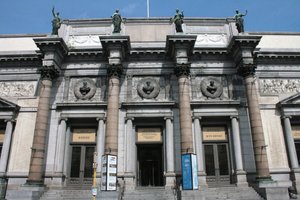 Musées Royaux des Beaux-Arts |
Bruxelles | 1 | Veterans' Festival |
Gli originali datati di Henri Evenepoel qui esposti coprono un arco di circa dieci anni, da 1891 a 1899: l'occhio li segue anno dopo anno.
Scegli un anno per vedere gli originali.

Altro da 1896
Questo ritratto, intitolato Charles Milcendeau, fu dipinto da Henri Evenepoel nel 1899. L'opera cattura un individuo specifico, Charles Edmond Théodore Soullans, che conosciamo attraverso questo lavoro con il nome di Charles Milcendeau. La pittura offre un incontro diretto con il soggetto, presentato in un modo che appare allo stesso tempo intimo e silenzioso.
Altro da 1899
Man in Red (1894), Musées Royaux Des Beaux, Bruxelles. Seguono My Ill Grandfather (1892) e Charles Milcendeau (1899).
22 anni: Man in Red risale al 1894, e Henri Evenepoel è nato/a nel 1872.
Man in Red, My Ill Grandfather, Charles Milcendeau, In the Café d'Harcourt in Paris, Pictures - Portrait of Louis Charles Crespin, At the Moulin Rouge, Portrait of Hélène Roulet, the Wife of the Artist Adolphe Crespin, The Clown, Louise in Mourning e Returning from Work at Sunset. La classifica sopra riporta l'anno e il museo di ciascuna opera.
Il nostro catalogo comprende 28 opere di Henri Evenepoel, datate da 1891 a 1899.
Principalmente in Museo Reale di Belle Arti di Anversa (Anversa), Museo delle Belle Arti di Gand (MSK) (Gand) e Musées Royaux Des Beaux (Bruxelles). La tabella dei musei sopra li elenca tutti.
In 1897: 7 delle 28 opere in questa pagina sono state realizzate in quel periodo, tra cui In the Café d'Harcourt in Paris.
In questa pagina, il più antico risale al Sunday in the Bois de Boulogne (1891) e il più recente al Charles Milcendeau (1899).
My Ill Grandfather, Louise in Mourning e Returning from Work at Sunset: il Museo Reale di Belle Arti di Anversa, Anversa custodisce 12 delle opere presenti in questa pagina.


