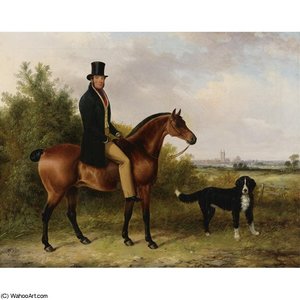
George Cole: vita e opera
George Cole Senior: A Painter of Victorian England’s Heartland
George Cole Senior (1810-1883), a name perhaps less familiar than some of his contemporaries, nevertheless holds a significant place in the history of English landscape painting. Born in France – though often associated with Portsmouth, where he spent much of his career – Senior dedicated his life to capturing the serene beauty and industrious spirit of rural England during the Victorian era. His canvases offer a poignant glimpse into a disappearing world, a time when agriculture dominated daily life and the rhythms of the seasons dictated the pace of existence. His work isn’t characterized by dramatic narratives or bold brushstrokes; instead, it's defined by an almost meditative quality, a quiet reverence for the land and its inhabitants.
Early Life and Influences
Details surrounding Senior’s early life remain somewhat sparse, contributing to the enigmatic aura that surrounds his work. It is believed he received some formal training, though specific institutions are undocumented. However, it's clear that his artistic sensibilities were profoundly shaped by the Dutch Masters – particularly their meticulous attention to detail and ability to render light and atmosphere with remarkable precision. The influence of artists like Jacob van Ruisdael, known for his atmospheric landscapes, is readily apparent in Senior’s compositions. Furthermore, the burgeoning Romantic movement, with its emphasis on emotion and the sublime beauty of nature, undoubtedly played a role in shaping his artistic vision, though he tempered this with a more restrained and observational approach. The paintings of John Wilson, another English landscape painter, also seem to have influenced him.
Subject Matter: Pastoral Scenes and Rural Life
Senior’s oeuvre is overwhelmingly focused on the countryside – idyllic pastures dotted with grazing cattle, bustling harvest scenes, and quiet moments of rural life. He wasn't interested in grand historical events or heroic figures; his subjects were humble – farmers tending their fields, shepherds guiding their flocks, and families celebrating the bounty of the land. His most celebrated works depict cattle droves, rendered with a remarkable understanding of animal behavior and anatomy. These paintings aren’t simply depictions of livestock; they are imbued with a sense of movement, energy, and connection to the natural world. He frequently portrayed scenes of harvest – sheaves of wheat piled high, farmers collecting their bounty – capturing both the physical labor and the spiritual significance of this essential agricultural ritual. The light in his paintings is particularly noteworthy: often diffused and golden, it evokes a feeling of warmth and tranquility.
Technique and Style
Senior’s technique was characterized by a meticulous attention to detail and a subtle use of color. He employed a layering approach, building up the image gradually with thin washes of paint, creating a luminous effect. His brushwork is generally smooth and controlled, avoiding any overtly expressive gestures. He favored a palette dominated by earthy tones – browns, greens, ochres – punctuated by touches of brighter colors to highlight key elements within the composition. While he certainly possessed technical skill, it’s his ability to convey atmosphere and mood that truly distinguishes his work. He wasn't simply painting what he saw; he was capturing *how* he felt about the landscape—a deep appreciation for its beauty and a sense of connection to its enduring rhythms.
Legacy and Significance
George Cole Senior’s contribution to English landscape painting may not be as widely recognized as some of his contemporaries, but his work offers a valuable window into Victorian England's rural world. His paintings are more than just pretty pictures; they are documents of a disappearing way of life—a testament to the enduring connection between humans and the land. His meticulous observation, coupled with an understated elegance, ensures that his landscapes continue to resonate with viewers today, evoking a sense of nostalgia for a simpler time. Works like “A Toy Spaniel” demonstrate his ability to capture both the beauty of the natural world and the intimacy of domestic life. His legacy lies in his quiet celebration of rural England—a painter who found profound beauty in the everyday rhythms of the countryside.