Ritratto di Everett Shinn

Dipinti di Everett Shinn: i 100 più famosi, attraverso lo sguardo di una galleria

Aggiornato Ottobre 2026 · classificato in base al nostro punteggio di popolarità (ricerche, visite e ordini per ogni opera) · 139 opere di Everett Shinn nel nostro catalogo

In breve

Per la critica, il dipinto più famoso di Everett Shinn è Prima fila all'opera (1942), l'originale del quale è esposto al Boca Raton Museum of Art, Boca Raton. Bagnanti nude e L'East River di notte (1906) completano il trio che ogni occhio riconosce. Dei 139 lavori di Everett Shinn nel nostro catalogo, la galleria presenta di seguito i 100 più famosi, ognuno originale con il proprio anno, il proprio museo e ciò che lo rende unico.

1876 – 1953, Woodstown Realism Più opere: Boca Raton Museum of Art

I 10 migliori dipinti di Everett Shinn nella galleria

1
Prima fila all'opera (1942) di Everett Shinn

Prima fila all'opera

1942 · Pittura · Boca Raton Museum of Art, Boca Raton

In quest'opera del 1942, ci troviamo immersi nell'atmosfera intima e concentrata di un teatro d'opera. La scena è resa attraverso una tavolozza monocromatica, che spoglia l'immagine dalla distrazione del colore per enfatizzare l'energia pura dell'esibizione. Una figura centrale si staglia davanti a un pubblico seduto, con un microfono tra le mani come se fosse colta nel mezzo di un canto o di un monologo parlato. Emana un senso di immediatezza,…

2
Bagnanti nude di Everett Shinn

Bagnanti nude

Pastello

In Bagnanti nude, Everett Shinn ci presenta un momento di svago tranquillo e senza filtri. La scena si concentra su quattro figure principali, tutte donne nude, riunite in un parco. Sono adagiate sull'erba, sembrano godersi un momento condiviso di riposo all'aria aperta. L'atmosfera è pervasa da un senso di quiete e relax, catturando un intervallo privato di complicità.

3
L'East River di notte (1906) di Everett Shinn

L'East River di notte

1906

La notte si posa pesantemente sull'East River, trasformando il mondo in uno studio di ombre e d'argento. Due imbarcazioni fluttuano sulla superficie scura, le loro sagome si stagliano contro le profondità torbide dell'acqua. Una barca riposa verso sinistra, mentre l'altra occupa il centro, creando un senso di equilibrio nella quiete. Vicino ai natanti, tre figure si muovono nell'oscurità, forse per curare le imbarcazioni o semplicemente per contemplare l'immensità notturna. Sopra…

4
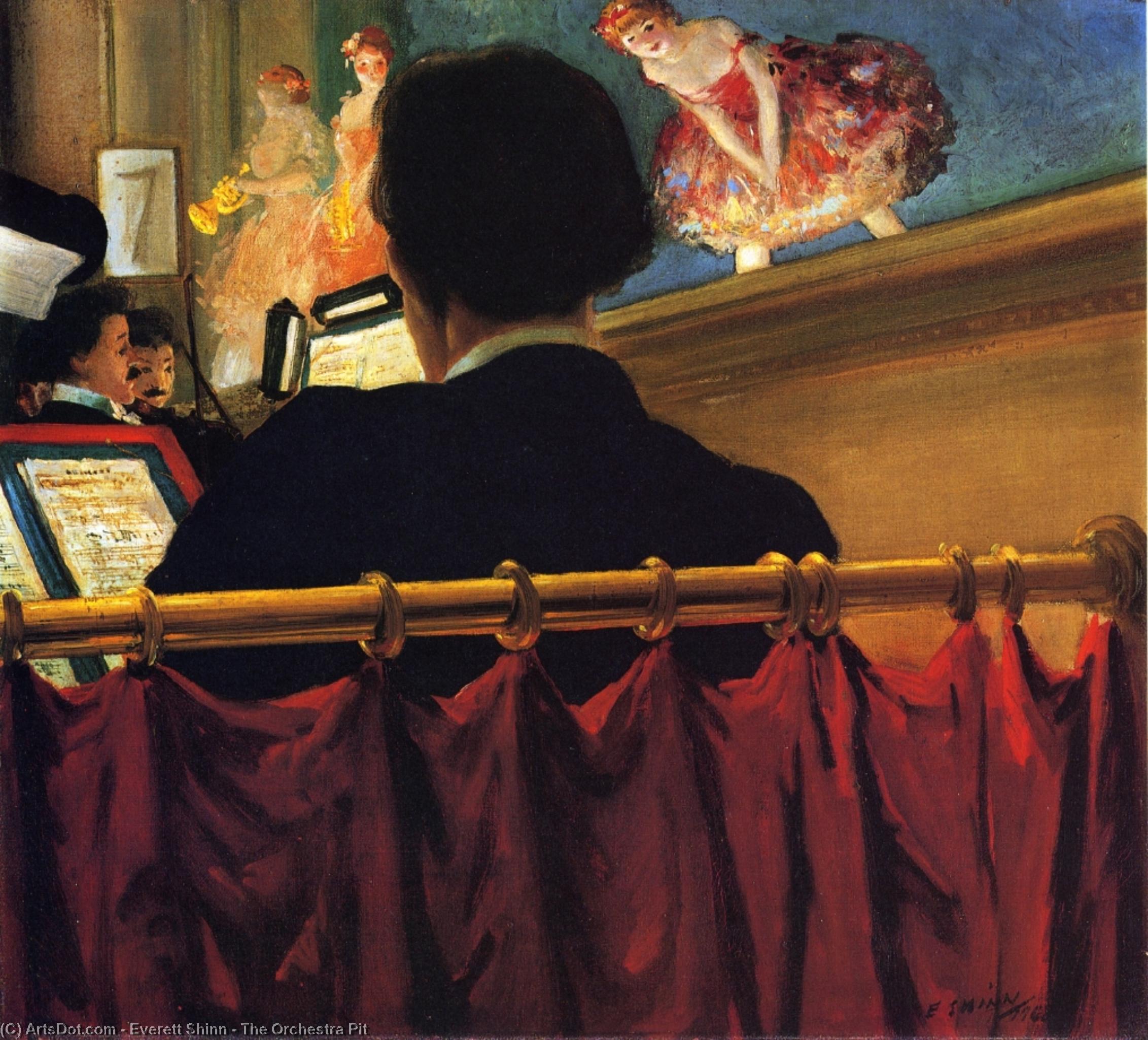
La buca dell'orchestra (1906) di Everett Shinn

La buca dell'orchestra

1906 · Olio su tela

è un'opera a olio su tela dell'artista americano Everett Shinn. Realizzato nel 1906, il dipinto cattura un momento specifico all'interno del Fifth Avenue Theater di Old Proctor. La composizione si concentra sull'ambiente specializzato della buca dell'orchestra, offrendo una veduta dello spazio situato al di sotto del livello del palcoscenico.

5
Il balletto bianco (1904) di Everett Shinn

Il balletto bianco

1904 · Pittura a olio · Smithsonian American Art Museum, Washington, D.C.

Una pacata e oscurata tribuna teatrale offre il punto di osservazione per questo dipinto a olio del 1904, posizionando lo spettatore tra un pubblico silenzioso. Da questa periferia in ombra, lo sguardo viene guidato verso un palcoscenico brillantemente illuminato dove si esibisce un corpo di ballo. La composizione si fonda su una tensione netta tra i toni scuri e smorzati degli spettatori in primo piano e la presenza luminosa ed…

10
The Hippodrome, Londra (1902) di Everett Shinn

The Hippodrome, Londra

1902 · Olio su tela · Art Institute of Chicago, Chicago

è un dipinto a olio su tela realizzato da Everett Shinn nel 1902. Quest'opera rappresenta un momento cruciale nella carriera dell'artista, fungendo da prezioso ricordo del suo unico viaggio in Europa. Attraverso questo pezzo, Shinn riesce a catturare un'atmosfera peculiare legata all'intrattenimento internazionale, segnando l'inizio di un interesse duraturo per lo spettacolo teatrale.

Dipinti di Everett Shinn, classificati dal 11 all' 100

11Over the Audience di Everett ShinnOver the Audience 12Fifth Avenue di Everett ShinnFifth Avenue 13Girl On A Swing di Everett ShinnGirl On A Swing 14Paris Street No. 2 (1902) di Everett ShinnParis Street No. 21902 · New Britain Museum of American Art 15The Singer (1902) di Everett ShinnThe Singer1902 16The Fight (1899) di Everett ShinnThe Fight1899 17Saturday Night (1905) di Everett ShinnSaturday Night1905 18Rehearsal of the Ballet (1905) di Everett ShinnRehearsal of the Ballet1905 19Olympic Theater (1907) di Everett ShinnOlympic Theater1907 20The Argument di Everett ShinnThe Argument 21Trinity Church, New Year's Eve di Everett ShinnTrinity Church, New Year's Eve 22Figure di Everett ShinnFigure 23The Hatpin di Everett ShinnThe Hatpin 24Woman in a Bed di Everett ShinnWoman in a Bed 25Man Walking Through Snow Storm di Everett ShinnMan Walking Through Snow Storm 26Woman With Fox Collar di Everett ShinnWoman With Fox Collar 27Snow Storm di Everett ShinnSnow Storm 28Woman Getting Into Bed di Everett ShinnWoman Getting Into Bed 29The Mirror di Everett ShinnThe Mirror 30Study of Nude Woman di Everett ShinnStudy of Nude Woman 31Woman Combing Her Hair di Everett ShinnWoman Combing Her Hair 32Manon di Everett ShinnManon 33Julie Bonbon 1 di Everett ShinnJulie Bonbon 1 34Washington Square Park in Winter di Everett ShinnWashington Square Park in Winter 35Albert Pinkham Ryder di Everett ShinnAlbert Pinkham Ryder 36Matinée Crowd, Manhattan di Everett ShinnMatinée Crowd, Manhattan 37Broadway, late in the afternoon di Everett ShinnBroadway, late in the afternoon 38In the Boudoir di Everett ShinnIn the Boudoir 39The Princess di Everett ShinnThe Princess 40Street Scene, Paris di Everett ShinnStreet Scene, Paris 41Ballet Girls di Everett ShinnBallet Girls 42Julie Bonbon di Everett ShinnJulie Bonbon 43The Bright Shawl di Everett ShinnThe Bright Shawl 44Trapeze Artists Proctors Theatre di Everett ShinnTrapeze Artists Proctors Theatre 45Girl at her toilet di Everett ShinnGirl at her toilet 46The Magician di Everett ShinnThe Magician 47Boudoir scene di Everett ShinnBoudoir scene 48Study of a man in a fur collared coat smoking a cigar di Everett ShinnStudy of a man in a fur collared coat smoking a cigar 49Winter on 21st Street, New York di Everett ShinnWinter on 21st Street, New York 50Fifth Avenue 1 di Everett ShinnFifth Avenue 1 51Ballet Dancers di Everett ShinnBallet Dancers 52Fleishman's Bread Line di Everett ShinnFleishman's Bread Line 53The Mishap di Everett ShinnThe Mishap 54Nude (1910) di Everett ShinnNude1910 55Vaudeville Dancer (1912) di Everett ShinnVaudeville Dancer1912 56French Vaudeville (1917) di Everett ShinnFrench Vaudeville1917 57Girl with Japanese Lanterns (1912) di Everett ShinnGirl with Japanese Lanterns1912 58The Canfield Gambling House (1912) di Everett ShinnThe Canfield Gambling House1912 59Ladies on a Swing (1921) di Everett ShinnLadies on a Swing1921 60Music Hall Spagnolo di Everett ShinnMusic Hall Spagnolo 61Revue (1908) di Everett ShinnRevue1908 62Fire on 24th Street, New York City di Everett ShinnFire on 24th Street, New York City 63London Music Hall (1918) di Everett ShinnLondon Music Hall1918 · Metropolitan Museum of Art 64The Golden Lancet di Everett ShinnThe Golden LancetGeorgia Museum of Art 65Blossoms in a lacquered vase di Everett ShinnBlossoms in a lacquered vase 66Female Figure In Black Gown di Everett ShinnFemale Figure In Black Gown 67The Duel di Everett ShinnThe Duel 68Singer di Everett ShinnSinger 69Dancer With Fan di Everett ShinnDancer With Fan 70Winter, New York City di Everett ShinnWinter, New York City 71Street Carnival di Everett ShinnStreet Carnival 72Musicians di Everett ShinnMusicians 73The Cafe di Everett ShinnThe Cafe 74Young Woman and Her Maid di Everett ShinnYoung Woman and Her Maid 75Fifth Avenue Bus, 23rd Street and Broadway di Everett ShinnFifth Avenue Bus, 23rd Street and Broadway 76The Yellow Dancer di Everett ShinnThe Yellow DancerThiel Gallery 77Bonnie Glass di Everett ShinnBonnie Glass 78Bathing Wood Nymphs di Everett ShinnBathing Wood Nymphs 79Ballet di Everett ShinnBallet 80Nude With Green Fan di Everett ShinnNude With Green Fan 81City Scene di Everett ShinnCity Scene 82Women Seated In The Park di Everett ShinnWomen Seated In The Park 83View of Washington Square, New York di Everett ShinnView of Washington Square, New York 84French Maiden di Everett ShinnFrench Maiden 85Two men conversing from The Mystery of Edwin Drood, Chapter 9 di Everett ShinnTwo men conversing from The Mystery of Edwin Drood, Chapter 9 86The Dress Rehearsal di Everett ShinnThe Dress Rehearsal 87Canfields Gambling House di Everett ShinnCanfields Gambling House 88Washington Square di Everett ShinnWashington Square 89Clown With Big Pants di Everett ShinnClown With Big Pants 90Rooftop Cafe di Everett ShinnRooftop Cafe 91Flower Market Paris di Everett ShinnFlower Market Paris 92Music Hall Scene di Everett ShinnMusic Hall Scene 93Geen Park London di Everett ShinnGeen Park London 94Washington Square Park New York di Everett ShinnWashington Square Park New York 95Man seen from behind from The Mystery of Edwin Drood, Chapter Head di Everett ShinnMan seen from behind from The Mystery of Edwin Drood, Chapter Head 96Interior-Man in Red Vest di Everett ShinnInterior-Man in Red Vest 97Alley Cat di Everett ShinnAlley Cat 98He Is The Man For Me di Everett ShinnHe Is The Man For Me 99The Clown di Everett ShinnThe Clown 100Working at 21st Street and 4th Avenue di Everett ShinnWorking at 21st Street and 4th Avenue

I dipinti più famosi di Everett Shinn, periodo per periodo

I soggetti che hanno catturato lo sguardo di Everett Shinn

I quattro soggetti che ricorrono più spesso in questi originali, ognuno con il suo esempio più raffinato.

I musei che conservano gli originali di Everett Shinn

I 7 musei che ospitano la maggior parte dei dipinti presenti in questa pagina.

Musei Città Opere di Everett Shinn Dipinti di questo elenco
Boca Raton Museum of Art, Boca RatonBoca Raton Museum of Art Boca Raton 1 Prima fila all'opera
Smithsonian American Art Museum, Washington, D.C.Smithsonian American Art Museum Washington, D.C. 1 Il balletto bianco
Art Institute of Chicago, ChicagoArt Institute of Chicago Chicago 1 The Hippodrome, Londra
New Britain Museum of American Art, New BritainNew Britain Museum of American Art New Britain 1 Paris Street No. 2
Metropolitan Museum of Art, New YorkMetropolitan Museum of Art New York 1 London Music Hall
Georgia Museum of Art, AteneGeorgia Museum of Art Atene 1 The Golden Lancet
Thiel Gallery, StoccolmaThiel Gallery Stoccolma 1 The Yellow Dancer

Everett Shinn, un dipinto iconico per ogni decennio

Opere per decennio

Scegli un decennio per scoprire l'opera originale che lo ha definito.

I dipinti di Everett Shinn: le risposte della galleria

Quale dipinto di Everett Shinn è il più famoso di tutti?Scopri la risposta

Prima fila all'opera (1942), Boca Raton Museum of Art, Boca Raton. Seguono Bagnanti nude e L'East River di notte (1906).

Che età aveva Everett Shinn quando ha completato Prima fila all'opera?Scopri la risposta

66 anni: Prima fila all'opera risale al 1942, e Everett Shinn è nato/a nel 1876.

Quali sono i 10 dipinti più famosi di Everett Shinn?Scopri la risposta

Prima fila all'opera, Bagnanti nude, L'East River di notte, La buca dell'orchestra, Il balletto bianco, Theatre Box, Mrs A Stewart Walker in a Fur, Girl on Stage, The Revue (c. 1915) e The Hippodrome, Londra. La classifica sopra riporta l'anno e il museo di ciascuna opera.

Quante opere ha creato Everett Shinn?Scopri la risposta

Il nostro catalogo comprende 139 opere di Everett Shinn, datate da 1899 a 1942.

Dove sono esposti gli originali più famosi di Everett Shinn?Scopri la risposta

Principalmente in Boca Raton Museum of Art (Boca Raton), Smithsonian American Art Museum (Washington, D.C.) e Art Institute of Chicago (Chicago). La tabella dei musei sopra li elenca tutti.

Quando ha realizzato i suoi dipinti più famosi Everett Shinn?Scopri la risposta

In 1900s: 12 delle 100 opere in questa pagina sono state realizzate in quel periodo, tra cui L'East River di notte.

Quali sono le prime e le ultime opere celebri di Everett Shinn?Scopri la risposta

In questa pagina, il più antico risale al The Fight (1899) e il più recente al Prima fila all'opera (1942).

Quali soggetti ha trattato più spesso Everett Shinn?Scopri la risposta

New york (10), Music (8) e Men (8), tra le 100 opere in questa pagina.

Qual è la tecnica che Everett Shinn ha utilizzato più spesso?Scopri la risposta

Olio su tela, per 3 delle 100 opere in questa pagina.

A quale movimento è associato Everett Shinn?Scopri la risposta

Realism, a giudicare dagli originali presenti in questa pagina.

Everett Shinn: l'artista

A Chronicler of Urban Life: The World of Everett Shinn

Everett Shinn, born in Woodstown, New Jersey, in 1876, wasn’t simply a painter; he was a visual poet of the burgeoning metropolis. He captured the raw energy, the vibrant spectacle, and often, the underlying grit of early 20th-century America with an immediacy that set him apart. From his beginnings as a newspaper illustrator in Philadelphia to his prominence within the Ashcan School, Shinn’s artistic journey reflects a commitment to portraying life as it was lived – unvarnished, compellingly real. Art historian Sam Hunter affectionately dubbed him “the dandy of the realists,” a moniker reflecting both his refined aesthetic and his embrace of the city’s pleasures. His early training at the Spring Garden Institute and later, the Pennsylvania Academy of the Fine Arts in Philadelphia, provided a solid foundation, but it was his work as an artist-reporter for Philadelphia newspapers – the *Press*, the *Inquirer*, and the *Ledger* – that truly honed his observational skills. This experience instilled in him a fascination with urban life and a knack for capturing fleeting moments before they vanished.
  • Early Life: Shinn was born to Isaiah Conklin Shinn and Josephine Ransley Shinn, agricultural farmers, in Woodstown, New Jersey, a Quaker-dominated community. His father’s fervent admiration for Edward Everett Hale—the author of “The Wonderful Wizard of Oz”—influenced his formative years. As Shinn himself recounted, “Shinn’s ability to draw was evident from very early childhood.” At age 15 he enrolled at the Spring Garden Institute in Philadelphia, where he studied mechanical drawing. The following year he took classes at the Pennsylvania Academy of the Fine Arts and by age 17 was working as a staff artist for the Philadelphia Press.
  • The Newspaper Years: Moving to New York City in 1897, Shinn swiftly established himself as an illustrator for publications like *Harper’s Weekly*, demonstrating remarkable skill in depicting animated movement—a talent that would soon be eclipsed by photography. He collaborated closely with fellow newspaper artists William J. Glackens and George Luks, forming a core group within the Ashcan School, led by Robert Henri. This association profoundly shaped Shinn’s artistic vision, challenging academic conventions and rejecting idealized representations in favor of honest portrayals of urban existence—its poverty, its vibrancy, its struggles, and its joys.

From Philadelphia Streets to New York Stages

The Ashcan School's ethos demanded a radical departure from traditional art circles, prioritizing robust images of real life over polished aesthetics. Shinn’s participation in the landmark exhibition “The Eight” in 1908 solidified his position within this movement, though he maintained a slightly more refined artistic sensibility than some of his peers. He wasn’t merely documenting what he saw; he was interpreting it through a lens of dramatic flair and psychological insight. His fascination with theater stemmed from its ability to convey complex emotions and explore social dynamics—a passion that would permeate much of his subsequent work. Shinn’s canvases frequently depicted scenes of urban life, capturing the energy and dynamism of New York City during its formative years. He excelled at portraying moments of crisis or dramatic confrontation, reflecting a deep engagement with the human condition.
  • Notable Collaborations: Shinn worked alongside influential artists like Henri Glackens and Sloan, fostering a collaborative spirit that enriched their artistic endeavors.
  • The Theater as Inspiration: His depictions of theater performances—particularly those staged in New York City—were marked by meticulous detail and psychological depth. He saw the stage as a microcosm of human experience, capturing both its grandeur and its vulnerability.

A Master of Pastel

Shinn distinguished himself from many of his contemporaries through his preference for pastel as a medium. Unlike oil paints, which required extensive layering and blending techniques, pastels offered Shinn unparalleled freedom to achieve luminous effects and capture subtle nuances of color—a stylistic choice that reflected his artistic sensibilities and contributed significantly to the distinctive character of his paintings. His ability to render light and shadow with remarkable precision elevated pastel painting to new heights, establishing him as a pioneer in this expressive medium.
  • Technique: Shinn’s masterful use of pastel allowed for spontaneous blending and layering, resulting in vibrant colors and textural surfaces that conveyed emotion and immediacy.
  • Signature Style: His distinctive pastel technique became synonymous with his artistic vision—a testament to his unwavering commitment to capturing the essence of urban life through a medium that prioritized directness and luminosity.
## Major Achievements & Legacy Shinn’s prolific output spanned decades, encompassing murals for prominent buildings, theater productions, and countless portraits—demonstrating his versatility as an artist and cementing his place in American art history. He received numerous awards recognizing his artistic excellence and participated in exhibitions that showcased his groundbreaking work to audiences worldwide. Despite facing financial difficulties during the Great Depression, Shinn persevered with unwavering determination, continuing to paint and exhibit until his death in 1953. His enduring legacy resides not only in his impressive body of paintings but also in his pioneering use of pastel—a medium he elevated to new artistic heights—and in his profound contribution to the Ashcan School’s ethos of honest representation and dramatic engagement with the human experience. Shinn remains a vital figure for understanding the complexities of urban life and the transformative power of artistic observation, inspiring generations of artists to embrace realism and explore the expressive potential of unconventional mediums. Shinn's unwavering dedication to capturing the spirit of his time—the energy of New York City, the drama of theater, and the raw beauty of everyday life—continues to resonate with viewers today.