Ritratto di Augustus Vincent Tack

I 72 dipinti più famosi di Augustus Vincent Tack, una selezione della galleria

Aggiornato Novembre 2026 · classificato in base al nostro punteggio di popolarità (ricerche, visite e ordini per ogni opera) · 76 opere di Augustus Vincent Tack nel nostro catalogo

In breve

Tra tutti gli originali lasciati da Augustus Vincent Tack, il più famoso è Autoritratto (1897), nella collezione del The Phillips Collection, Washington, D.C.. Subito dopo troviamo Mountain Slopes (1914) e Elihu Root (1922). Il nostro catalogo contiene 76 opere di Augustus Vincent Tack; la galleria ha conservato le 72 che il mondo ammira di più, ognuna presentata con la sua data, il suo museo e la sua storia.

1870 – 1949, Pittsburgh Più opere: The Phillips Collection

I 10 migliori dipinti di Augustus Vincent Tack: la scelta della galleria

1
Autoritratto (1897) di Augustus Vincent Tack

Autoritratto

1897 · Fotografia · The Phillips Collection, Washington, D.C.

Creata nel 1897, quest'opera riflette un periodo di transizione nello sviluppo dell'artista. Mentre il titolo suggerisce uno studio intimo, il contenuto visivo si concentra sull'ingresso di una tenuta curata o di un parco. La precisione del paesaggio suggerisce un focus sulla realtà fisica dell'ambiente. La composizione enfatizza la tranquillità e l'organizzazione strutturata della natura attraverso l'intervento umano. La quiete della scena è mantenuta dall'arrangiamento equilibrato e centrato dell'architettura e della…

2
Mountain Slopes (1914) di Augustus Vincent Tack

Mountain Slopes

1914 · Photography · The Phillips Collection, Washington, D.C.

The painting titled Mountain Slopes was created by the American painter Augustus Vincent Tack. This specific work was executed about 1914. It offers a glimpse into the early development of an artist who would eventually become a significant figure in American art history.

3
Elihu Root (1922) di Augustus Vincent Tack

Elihu Root

1922 · Oil On Canvas · National Portrait Gallery, Washington, D.C.

The portrait depicts an older man seated in a dark suit against a muted brown background. He is positioned centrally, his posture creating a strong vertical line within the frame. The subject wears a formal dark jacket and a white shirt, with the fabric of his clothing rendered through visible brushstrokes that suggest a textured surface. His face is oval-shaped, illuminated by a directional light source originating from above and…

4
Rosa Mystica (1923) di Augustus Vincent Tack

Rosa Mystica

1923 · Oil · Cleveland Museum of Art, Cleveland

In Rosa Mystica, Augustus Vincent Tack organizes the pictorial space through a hierarchical perspective that separates the celestial from the mortal. The composition centers on a divine female figure, likely the Virgin Mary, who floats within a luminous blue mandorla. She is positioned in a higher plane above the earthly realm, surrounded by a sky of fragmented, pale clouds. Her arms are outstretched in a gesture of grace, draped in…

5
Benjamin Nathan Cardozo (1931) di Augustus Vincent Tack

Benjamin Nathan Cardozo

1931 · Oil On Canvas

In this formal portrait, Augustus Vincent Tack presents Benjamin Nathan Cardozo in a moment of quiet, judicial dignity. Painted about 1931, the work captures the subject in his capacity as a judge, a role that informs the entire gravity of the piece. There is a certain stillness here, a sense of the weight of responsibility that accompanies such a position. Tack avoids the superficiality of a mere likeness, focusing instead…

6
John Munro Woolsey (1934) di Augustus Vincent Tack

John Munro Woolsey

1934 · Oil · New York Historical Society, New York City

This oil portrait by Augustus Vincent Tack depicts John Munro Woolsey, a United States district judge. Painted about 1934, the work presents the subject in a formal setting that emphasizes his professional status. The composition focuses on the man seated behind a wooden desk, positioned in a medium close-up view that establishes a direct presence before the viewer.

7
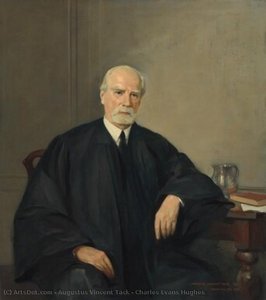
Charles Evans Hughes (1941) di Augustus Vincent Tack

Charles Evans Hughes

1941 · Oil On Canvas

This formal portrait of Charles Evans Hughes, executed by Augustus Vincent Tack, offers a quiet moment of reflection. Painted about 1941, the work captures the subject in a setting that suggests a private study or a professional office. There is a sense of stillness here, as if we have interrupted a moment of deep thought. The composition places Hughes at the center of the viewer's attention, establishing a presence that…

8
Harry S. Truman (1948) di Augustus Vincent Tack

Harry S. Truman

1948 · Oil On Canvas

In this formal portrait of Harry S. Truman, Augustus Vincent Tack captures the subject in a half-length composition that centers the viewer's attention on the man's face and upper body. The figure sits slightly off-center to the right, creating a subtle tension within the frame. A strong light source emerges from the upper left, casting deep shadows that define the contours of the face and the heavy folds of the…

9
Harlan F. Stone (1944) di Augustus Vincent Tack

Harlan F. Stone

1944 · Oil On Canvas

In this formal portrait, Augustus Vincent Tack presents Harlan F. Stone in a moment of quiet, seated dignity. Painted in 1944, the work captures the subject in a three-quarter view, a composition that emphasizes his presence and the weight of his position. There is a certain stillness to the figure, which is likely intended to reflect Stone's role as Chief Justice of the United States Supreme Court. The subject's expression…

10
The High Command Right Panel (1949) di Augustus Vincent Tack

The High Command Right Panel

1949 · Oil On Canvas · National Portrait Gallery, Washington, D.C.

The High Command Right Panel is a work by Augustus Vincent Tack, executed in 1949. The painting captures two men seated within the quiet confines of an office setting. Their presence is anchored by the weight of their surroundings, suggesting a moment of professional stillness. The subject matter centers on naval officers or individuals tied to maritime affairs, a theme reflected in the nautical elements that populate the scene.

La selezione di Augustus Vincent Tack continua, da 11 a 72

11Getsemani di Augustus Vincent TackGetsemaniThe Phillips Collection 12Canyon di Augustus Vincent TackCanyonThe Phillips Collection 13Rising Wind and Tide (1905) di Augustus Vincent TackRising Wind and Tide1905 · Reading Public Museum 14Windswept (Snow Picture, Leyden) di Augustus Vincent TackWindswept (Snow Picture, Leyden)The Phillips Collection 15Passacaglia di Augustus Vincent TackPassacagliaThe Phillips Collection 16Ideal Figure in Rose di Augustus Vincent TackIdeal Figure in RoseThe Phillips Collection 17Court of Romance (Garden of Romance) di Augustus Vincent TackCourt of Romance (Garden of Romance)The Phillips Collection 18Allegro Giocoso di Augustus Vincent TackAllegro GiocosoThe Phillips Collection 19Canyon (The Valley) (1914) di Augustus Vincent TackCanyon (The Valley)1914 · The Phillips Collection 20The Entombment (1922) di Augustus Vincent TackThe Entombment1922 · The Phillips Collection 21Spring Night (1931) di Augustus Vincent TackSpring Night1931 · The Phillips Collection 22Outposts of Time II (1929) di Augustus Vincent TackOutposts of Time II1929 · The Phillips Collection 23Liberation (1929) di Augustus Vincent TackLiberation1929 · The Phillips Collection 24Flight (Fugue) (1930) di Augustus Vincent TackFlight (Fugue)1930 · The Phillips Collection 25Far Reaches (1930) di Augustus Vincent TackFar Reaches1930 · The Phillips Collection 26Ecstasy (1929) di Augustus Vincent TackEcstasy1929 · The Phillips Collection 27Christmas Night (1931) di Augustus Vincent TackChristmas Night1931 · The Phillips Collection 28Balance (1929) di Augustus Vincent TackBalance1929 · The Phillips Collection 29Night, Amargosa Desert (1935) di Augustus Vincent TackNight, Amargosa Desert1935 · The Phillips Collection 30Reverend Cornelius Clifford (1937) di Augustus Vincent TackReverend Cornelius Clifford1937 · Campion Hall 31The High Command Left Panel (1949) di Augustus Vincent TackThe High Command Left Panel1949 · National Portrait Gallery 32Truman and his Military Advisors (1949) di Augustus Vincent TackTruman and his Military Advisors1949 · National Portrait Gallery 33Dwight D. Eisenhower (1949) di Augustus Vincent TackDwight D. Eisenhower1949 34Winter (1934) di Augustus Vincent TackWinter1934 · The Phillips Collection 35John La Farge (1897) di Augustus Vincent TackJohn La Farge1897 · Metropolitan Museum of Art 36La Voce di Molte Acque di Augustus Vincent TackLa Voce di Molte AcqueThe Phillips Collection 37Nuvole Notturne e Polvere di Stelle di Augustus Vincent TackNuvole Notturne e Polvere di StelleMetropolitan Museum of Art 38Study for Mr. Winthrop's Portrait di Augustus Vincent TackStudy for Mr. Winthrop's PortraitThe Phillips Collection 39Self-Portrait di Augustus Vincent TackSelf-PortraitThe Phillips Collection 40Self-Portrait di Augustus Vincent TackSelf-PortraitThe Phillips Collection 41Sea of Hills di Augustus Vincent TackSea of HillsThe Phillips Collection 42Sketch for Portrait of Nicholas Murray Butler di Augustus Vincent TackSketch for Portrait of Nicholas Murray ButlerThe Phillips Collection 43Portrait of Nicholas Murray Butler di Augustus Vincent TackPortrait of Nicholas Murray ButlerThe Phillips Collection 44Portrait of Man with Dog di Augustus Vincent TackPortrait of Man with DogThe Phillips Collection 45Elizabeth Hudson di Augustus Vincent TackElizabeth HudsonThe Phillips Collection 46Palace of Enchantment di Augustus Vincent TackPalace of EnchantmentThe Phillips Collection 47Ox Cart di Augustus Vincent TackOx CartThe Phillips Collection 48Winter (New York in Snow) di Augustus Vincent TackWinter (New York in Snow)The Phillips Collection 49Allegory - Love and Life (Mother and Child) di Augustus Vincent TackAllegory - Love and Life (Mother and Child)The Phillips Collection 50Magi's Journey di Augustus Vincent TackMagi's JourneyThe Phillips Collection 51Largo di Augustus Vincent TackLargoThe Phillips Collection 52Hill and Sky (Hilltop?) di Augustus Vincent TackHill and Sky (Hilltop?)The Phillips Collection 53Head of Model, Profile di Augustus Vincent TackHead of Model, ProfileThe Phillips Collection 54The Glacier di Augustus Vincent TackThe GlacierThe Phillips Collection 55Forgotten Poem di Augustus Vincent TackForgotten PoemThe Phillips Collection 56Figure in Red with Beads di Augustus Vincent TackFigure in Red with BeadsThe Phillips Collection 57Evening di Augustus Vincent TackEveningThe Phillips Collection 58Deerfield in Twilight (The Dance) di Augustus Vincent TackDeerfield in Twilight (The Dance)The Phillips Collection 59Study of Sister Death for Death of St. Francis di Augustus Vincent TackStudy of Sister Death for Death of St. FrancisThe Phillips Collection 60Death of St. Francis di Augustus Vincent TackDeath of St. FrancisThe Phillips Collection 61Daybreak di Augustus Vincent TackDaybreakThe Phillips Collection 62Dawn di Augustus Vincent TackDawnThe Phillips Collection 63The Crowd di Augustus Vincent TackThe CrowdThe Phillips Collection 64Cloud Wrack di Augustus Vincent TackCloud WrackThe Phillips Collection 65Christ Bearing the Cross di Augustus Vincent TackChrist Bearing the CrossThe Phillips Collection 66Blue Oval di Augustus Vincent TackBlue OvalThe Phillips Collection 67Twilight di Augustus Vincent TackTwilightThe Phillips Collection 68Above the Treetops di Augustus Vincent TackAbove the TreetopsThe Phillips Collection 69David E. Finley di Augustus Vincent TackDavid E. Finley 70John Russell Pope di Augustus Vincent TackJohn Russell Pope 71Grande Cortile di Augustus Vincent TackGrande CortileThe Phillips Collection 72Madonna delle Colline Eterne di Augustus Vincent TackMadonna delle Colline EterneThe Phillips Collection

I soggetti che hanno catturato lo sguardo di Augustus Vincent Tack

I quattro soggetti che ricorrono più spesso in questi originali, ognuno con il suo esempio più raffinato.

I musei che conservano gli originali di Augustus Vincent Tack

I 7 musei che ospitano la maggior parte dei dipinti presenti in questa pagina.

Musei Città Opere di Augustus Vincent Tack Dipinti di questo elenco
The Phillips Collection, Washington, D.C.The Phillips Collection Washington, D.C. 55 Autoritratto, Mountain Slopes, Getsemani
National Portrait Gallery, Washington, D.C.National Portrait Gallery Washington, D.C. 4 Elihu Root, The High Command Right Panel, The High Command Left Panel
Metropolitan Museum of Art, New YorkMetropolitan Museum of Art New York 2 John La Farge, Nuvole Notturne e Polvere di Stelle
Cleveland Museum of Art, ClevelandCleveland Museum of Art Cleveland 1 Rosa Mystica
New York Historical Society, New York CityNew York Historical Society New York City 1 John Munro Woolsey
Reading Public Museum, ReadingReading Public Museum Reading 1 Rising Wind and Tide
Campion Hall, OxfordCampion Hall Oxford 1 Reverend Cornelius Clifford

Augustus Vincent Tack decennio per decennio: l'originale che definisce ogni epoca

Opere per decennio

Scegli un decennio per scoprire l'opera originale che lo ha definito.

Domande dei collezionisti sulle opere di Augustus Vincent Tack

Per quale opera è più famoso Augustus Vincent Tack?Scopri la risposta

Autoritratto (1897), The Phillips Collection, Washington, D.C.. Seguono Mountain Slopes (1914) e Elihu Root (1922).

Che età aveva Augustus Vincent Tack quando è stata realizzata Autoritratto?Scopri la risposta

27 anni: Autoritratto risale al 1897, e Augustus Vincent Tack è nato/a nel 1870.

Quali sono i dieci dipinti più famosi di Augustus Vincent Tack?Scopri la risposta

Autoritratto, Mountain Slopes, Elihu Root, Rosa Mystica, Benjamin Nathan Cardozo, John Munro Woolsey, Charles Evans Hughes, Harry S. Truman, Harlan F. Stone e The High Command Right Panel. La classifica sopra riporta l'anno e il museo di ciascuna opera.

Quante opere ha lasciato Augustus Vincent Tack?Scopri la risposta

Il nostro catalogo comprende 76 opere di Augustus Vincent Tack, datate da 1897 a 1949.

In quali musei sono esposti i capolavori di Augustus Vincent Tack?Scopri la risposta

Principalmente in The Phillips Collection (Washington, D.C.), National Portrait Gallery (Washington, D.C.) e Metropolitan Museum of Art (New York). La tabella dei musei sopra li elenca tutti.

In quali anni Augustus Vincent Tack ha dipinto le sue opere più famose?Scopri la risposta

In 1930s: 9 delle 72 opere in questa pagina sono state realizzate in quel periodo, tra cui Benjamin Nathan Cardozo.

Quali sono le prime e le ultime opere originali famose di Augustus Vincent Tack?Scopri la risposta

In questa pagina, il più antico risale al Autoritratto (1897) e il più recente al The High Command Right Panel (1949).

Quali soggetti ha scelto più spesso Augustus Vincent Tack?Scopri la risposta

Man (4), Alberi (3) e Portraiture (3), tra le 72 opere in questa pagina.

Quale tecnica ha utilizzato maggiormente Augustus Vincent Tack?Scopri la risposta

Oil On Canvas, per 6 delle 72 opere in questa pagina.

Quali opere di Augustus Vincent Tack sono esposte al The Phillips Collection?Scopri la risposta

Autoritratto, Mountain Slopes e Getsemani: il The Phillips Collection, Washington, D.C. custodisce 55 delle opere presenti in questa pagina.

Augustus Vincent Tack: vita e opera

Augustus Vincent Tack: Pioniere del Paesaggio Spirituale

Augustus Vincent Tack (1870 – 1949) si staglia come una figura singolare nella storia dell'arte americana, riconosciuto principalmente per la sua distintiva fusione tra realismo e astrazione—un approccio stilistico che anticipò il nascente movimento dell’Espressionismo Astratto. Nato a Pittsburgh, in Pennsylvania, il percorso artistico di Tack ebbe inizio con una formazione accademica presso lo St. Francis Xavier College, prima di affinare le sue doti presso la Art Students League di New York, assorbendo le influenze di luminari come John La Farge, il cui studio frequentava abitualmente. Questo periodo formativo gettò le basi per le sue successive esplorazioni nella pittura di paesaggio e, soprattutto, nelle rappresentazioni profondamente simboliche della natura—una preoccupazione che avrebbe definito gran parte della sua opera.
  • L'inizio della carriera e le influenze: La sua esposizione al debutto presso la Kraushaar Galleries nel 1896 segnò l'inizio di una prolifica carriera artistica, caratterizzata da un costante coinvolgimento con prestigiose istituzioni come il Worcester Art Museum, le Carnegie International Exhibitions e la Pennsylvania Academy of Fine Arts. Le sue collaborazioni con Duncan Phillips—in particolare la partecipazione al Allied War Salon del 1918—dimostrarono non solo le sue connessioni sociali, ma anche il suo impegno nel dare voce alle urgenti questioni della società attraverso l'espressione artistica.
  • La colonia di Deerfield e il matrimonio: Alla ricerca di ispirazione e cameratismo, Tack si trasferì a Deerfield, nel Massachusetts, dove fondò una colonia di artisti e sposò Agnes Gordon Fuller, figlia del rinomato pittore George Fuller. Questa unione favorì un ambiente di sostegno propizio alle ricerche creative e consolidò la sua posizione all'interno della comunità artistica.
  • L'insegnamento e l'Università di Yale: Il ruolo pedagogico di Tack si estese ben oltre Deerfield; tenne lezioni presso la Art Students League di New York tra il 1906 e il 1910 e successivamente insegnò all'Università di Yale dal 1910 al 1913, trasmettendo la sua visione artistica a una nuova generazione di artisti.

Uno stile distintivo: Realismo intriso di misticismo

Lo stile artistico di Tack si distinse per un attento equilibrio tra il realismo tradizionale e un'evocativa astrazione. Mentre i suoi ritratti aderivano alle convenzioni accademiche—catturando somiglianze con dettagli meticolosi e luci drammatiche—i suoi paesaggi trascendevano la mera rappresentazione, addentrandosi in regni di contemplazione spirituale. Opere come “Time and Timelessness” esemplificano questo approccio, accostando forme geometriche a elementi figurativi per trasmettere un senso di bellezza eterna e profondo simbolismo. La critica osservò che l'opera di Tack "era una rielaborazione contemporanea dell'idealismo eroico del XIX secolo", sottolineandone l'ambizione di elevare lo spettatore al di sopra del mondano.
  • Opere celebri: Tra i suoi pezzi più celebrati figurano “The High Command Right Panel” (1949), che ritrae ufficiali della marina con magistrale realismo e complessità compositiva; i ritratti di Harry S. Truman ed Elihu Root—eseguiti rispettivamente nel 1948 e nel 1922—che dimostrano la capacità di Tack di trasmettere carattere ed emozione attraverso una pennellata sfumata; e “Time and Timelessness”, un capolavoro del paesaggio che riflette la sua fascinazione per i temi spirituali.

Eredità e riconoscimento

Nonostante le difficoltà commerciali, l'eredità artistica di Tack persiste come precursore dell'Espressionismo Astratto—un movimento che avrebbe rimodellato il panorama dell'arte americana nei decenni successivi alla sua morte. I suoi dipinti sono conservati in importanti collezioni e continuano a ispirare artisti e studiosi allo stesso modo. Il contributo di Augustus Vincent Tack all'arte americana non risiede solo nelle sue innovazioni stilistiche, ma anche nella sua incrollabile ricerca della verità artistica—una testimonianza del potere duraturo dell'immaginazione e della visione.