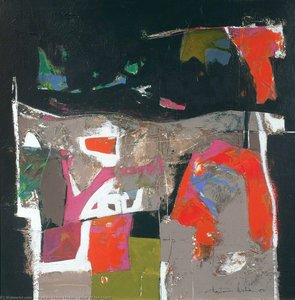
Alastair Michie: A Landscape of Memory and Emotion
Born in St Omer, northern France, in 1921 – a location steeped in artistic heritage due to his mother’s lineage within the Redpath family of Scottish painters – Alastair Michie's life was one profoundly shaped by both familial legacy and a determined pursuit of individual expression. Initially following in his father’s footsteps as an architect, he received a scholarship to study at Edinburgh College of Art, a path briefly interrupted by service during World War II as a Royal Air Force pilot – a period that instilled within him a unique perspective on the world, both literally from above and emotionally through the experience of conflict. It was after this wartime service, and a pivotal visit to the 1962 Venice Biennale, that Michie’s artistic trajectory irrevocably shifted; confronted with the bold abstractions of artists like Mark Rothko, Franz Kline, and Robert Motherwell, he abandoned architectural ambitions for a life dedicated to painting.
Michie's early work reveals a clear debt to these American masters. He embraced large-scale acrylic paintings characterized by rich color palettes and a palpable sense of texture – a deliberate departure from the more restrained styles prevalent in Scotland at the time. However, Michie’s art wasn’t merely an imitation; he infused his canvases with a distinctly personal vision, drawing heavily on his experiences as a pilot and later, his residence along the Dorset coast. The rugged beauty of the coastline, particularly Studland beach with its driftwood and remnants of wartime activity, became a constant source of inspiration, informing both his sculptural endeavors and his paintings.
Sculpting Memory: From Beach Debris to Bronze Forms
Michie’s sculptural practice emerged organically from his engagement with the landscape. He began collecting discarded objects – fragments of wood, shrapnel from wartime battles, even shells – transforming these seemingly insignificant materials into evocative forms that spoke to themes of memory, loss, and resilience. His early bronze sculptures, notably “Nemesis,” were directly inspired by the bones and flints unearthed on Studland beach, reflecting a deep connection between the artist’s personal history and the natural world. This fascination with found objects continued throughout his career, culminating in the "Shrapnel" series – a poignant meditation on the enduring impact of conflict and the passage of time.
The influence of his wartime experiences is undeniable, not just in the subject matter of his sculptures but also in their formal qualities. The aerodynamic shapes reminiscent of aircraft wings—as seen in “Endeavour,” commissioned by British Aerospace – subtly allude to his past as a fighter pilot, adding another layer of complexity to his artistic vocabulary. Michie’s approach was fundamentally interdisciplinary; he believed that painting and sculpture were mutually enriching practices, each informing and enhancing the other.
A Dialogue with Color: Influences and Style
While deeply influenced by Abstract Expressionism, Michie's style never fully aligned with any single movement. He possessed a unique sensibility, blending elements of color field painting with gestural abstraction. His palette was consistently vibrant and emotionally charged, often employing bold blues, reds, and yellows to evoke powerful feelings – a characteristic that resonated strongly with the Edinburgh School of Colourists, though he maintained a deliberate distance from their more overtly decorative tendencies.
The impact of Anne Redpath, his mother, is also evident in Michie’s work. Like her, he possessed an innate ability to capture the essence of nature and imbue it with emotional resonance. However, Michie forged his own distinct path, rejecting the more representational aspects of his mother's style and embracing a purely abstract approach.
Legacy and Recognition
Despite lacking the backing of a major London gallery during much of his career, Alastair Michie achieved significant recognition throughout Britain and internationally. His work was exhibited at prestigious venues such as the Royal West of England Academy, the Royal Academy, and the Royal Scottish Academy, and he was elected to the latter in 1984. His sculptures were showcased at the Barbican Centre in London, while his paintings found a home in museums across Europe, including those in São Paulo and Rio de Janeiro. Michie’s legacy extends beyond his individual achievements; he represents a significant voice within British abstract art, demonstrating the power of personal experience to shape artistic vision.
Alastair Michie died in 2008, leaving behind a body of work that continues to captivate and inspire. His paintings and sculptures serve as poignant reminders of the enduring beauty of the natural world and the profound impact of memory on the human spirit.
Domande e risposte
È possibile visitare un museo virtuale delle opere di Alastair Milne Michie?
Le opere di Alastair Milne Michie sono visibili in una galleria 3D nella pagina Galleria 3D dell'artista.
Con quali pseudonimi o nomi alternativi è conosciuto Alastair Milne Michie?
Alastair Milne Michie è noto anche con il nome di Alastair Michie, A. Milne Michie.
Come posso seguire l'evoluzione dell'opera di Alastair Milne Michie anno dopo anno?
La pagina Cronologia delle opere dell'artista presenta le opere di Alastair Milne Michie in ordine cronologico, anno dopo anno.