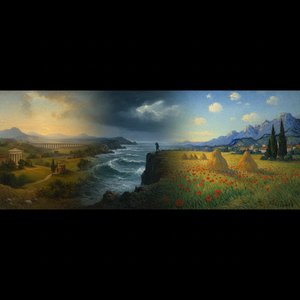
The Gobustan Rock Art Cultural Landscape is a historic site in Azerbaijan, comprising a large collection of petroglyphs that reflect the flora, fauna, hunting practices, social structures, and cultural expressions of human societies from prehistoric ...
To look upon a landscape is to observe more than just a collection of hills, rivers, or forests; it is to witness the physical residue of time itself. Every geological formation and human-made structure within a view carries the weight of its own era. In the early stages of art, what we now call landscapes were often secondary, serving as mere topographical records of territory or the backdrop for more significant historical events. These works functioned as visual ledgers, documenting the expansion of borders, the construction of landmarks, and the changing use of the earth.
The concept of a landscape as a record of human presence is perhaps most visible in the ancient petroglyphs of the Gobustan Rock Art Cultural Landscape in Azerbaijan. Here, carvings dating back thousands of years provide an unmediated look at the flora, fauna, and hunting practices of prehistoric societies. These engravings do not merely show animals; they document the environmental transformations from the Pleistocene to the Holocene, showing how shifts in climate altered the very targets of human survival. Just as these stones record a lost world, a painting like (Landscape of Dead Fallen Tree and Pond) by Frank Harold Hayward uses the decay of organic matter to reflect on the inevitable passage of time. We see in both the ancient rock and the modern canvas a shared impulse: to freeze a specific moment of environmental reality before it is erased by the next era.
The Birth of Perspective: Reimagarying the World Landscape
A Pioneer of the Northern Renaissance Landscape Joachim Patinir, a name often whispered alongside that of Albrecht Altdorfer as a foundational figure in landscape painting, emerged from the artistic milieu of the Low Countries during the early 16th c...
As artistic traditions matured, particularly during the Renaissance, the way artists organized space underwent a fundamental shift. The development of linear and aerial perspective allowed painters to move away from flat, symbolic arrangements toward a more immersive experience. This was not merely a technical achievement in geometry; it was a new way of conceptualizing the relationship between the viewer and the infinite. Artists began to invent ways of seeing that could bridge the gap between the immediate foreground and a distant, unreachable horizon.
Joachim Patinir, a pioneer of the Northern Renaissance, was instrumental in this transition. By moving landscape from a background detail to a primary subject, he helped birth the "world landscape." His work often combined naturalistic detail with a lyrical fantasy, creating expansive vistas that felt both grounded and otherworldly. This expansion of vision finds a profound echo in Leonardo da Vinci’s Mona Lisa. Through his use of sfumato, Leonardo allows the distant mountains to dissolve into a smoky, blue-toned dreamscape. He uses atmospheric perspective to suggest an infinite depth, much like Patinir, proving that the mastery of space is what allows a painting to function as a window into a larger, more complex reality.
Captivating Subject and Composition This exquisite landscape captures a profound biblical moment—the appearance of Christ to the apostles at the Sea of Tiberias. The scene is rendered with a masterful balance of natural beauty and spiritual significa...
Throughout much of Western art history, the landscape was rarely a neutral space; it was often a stage for the divine. Before the genre achieved complete independence, landscapes were frequently utilized to provide a setting for biblical or mythological dramas. In these works, a winding river or a jagged mountain peak was not just scenery, but a symbolic conduit between the earthly realm and the heavens. The physical features of the land were imbued with spiritual significance, turning the natural world into a map of religious truth.
A striking example of this is Pieter Bruegel the Elder’s Landscape with Christ Appearing to the Apostles at the Sea of Tiberias. Created in 1553, this work uses an expansive, winding river to emphasize themes of faith and renewal. The landscape does not just host the event; it participates in the divine revelation. This tradition of using nature to frame the sacred is mirrored in the way da pier francesco mola approaches his Rocky Landscape with Two Carthusian Monks. In such works, the ruggedness of the terrain and the solitude of the setting are essential to communicating the monastic life of contemplation. The landscape becomes a character, as much a part of the story as the figures inhabiting it.
Atmospheric Truths: The Evolution of Light and Weather
Discover 'Landscape, Evening' by Karl Heffner – a serene German oil painting of twilight beauty. Atmospheric realism & subtle tones evoke tranquility. Explore this timeless landscape.
As we moved into the eras of Realism and Impressionism, the focus of landscape art shifted from the structural to the ephemeral. Artists became less interested in the permanent bones of the earth and more preoccupied with the fleeting qualities of light, moisture, and air. This movement toward capturing the "sensory truth" meant that a landscape was no longer a static image, but a living entity that changed with every passing cloud or shift in temperature.
The Realist movement sought to represent subject matter without artificiality, focusing on the honest, often unadorned textures of the world. We see this in Karl Heffner’s Landscape, Evening, where subtle tones and atmospheric realism evoke a sense of quiet twilight. This pursuit of light reaches a fever pitch in the works of the Impressionists, who sought to capture the very breath of nature. This evolution from the structured to the atmospheric is also evident in the work of Samuel Bough, whose depictions of the Scottish Highlands embraced the raw, melancholic power of mist and rain. Whether through the precise observation of a Realist or the emotive brushwork of an Impressionist, the goal remains the same: to capture the transient moment that can never be repeated.
Preserving Place: Art as a Record of Regional Identity
A Symphony of Governance and Grace In the heart of Fleet, Hampshire, an extraordinary dialogue unfolds between the structured world of civic duty and the ethereal beauty of British landscape artistry. The Hart District Council offers a cultural exper...
Beyond the grand narratives of religion or science, landscape art serves a vital role in maintaining local and national identity. A landscape defines the self-image of the people who inhabit it; it provides a sense of place that differentiates one region from another. Through the depiction of specific flora, architectural styles, and even the unique quality of local light, artists create a visual vocabulary for their homelands.
The Hart District Council collection in the United Kingdom is a beautiful manifestation of this principle. By housing works that capture the pastoral tranquility of the Hampshire countryside, the collection acts as a sanctuary for local heritage. Paintings like Cows Drinking or Sheep in Wooded Landscape do more than show animals; they document the essential connection between the inhabitants and their specific terrain. This preservation of regional character finds a parallel in the work of James Henry Monk, whose depictions of the Somerset countryside helped cement Bristol’s artistic identity during the Edwardian era. In both cases, the art serves as a bulwark against the homogenization of the modern world, keeping the unique spirit of a place alive through the medium of paint.
The Abstracted Terrain: Mapping the Internal Landscape
The Soulful Resonance of Color: The Life and Art of Wayne Bennett To understand the visual language of Wayne Bennett , one must first listen to the rhythm of the blues. Born in Memphis, Tennessee, on December 13, 1932, Bennett’s early life was define...
In the modern and contemporary eras, the definition of landscape has expanded once again, moving inward. The genre has begun to explore the "internal landscape"—the use of color, texture, and form to represent human emotion and psychological states. Here, the physical world serves only as a starting point for a deeper exploration of intensity and atmosphere. The landscape is no longer just something we look at; it is something we feel.
The work of Wayne Bennett exemplifies this shift. Drawing from the rhythmic, improvisational spirit of the Memphis blues, Bennett uses heavy impasto and bold colors to communicate an emotional landscape. His paintings are not photographic representations of Tennessee, but rather a dialogue between light and shadow that mirrors internal tension. Similarly, the contemporary works of Donald Pass use the quiet power of the Scottish landscape to evoke solitude and memory. In these modern interpretations, the horizon may be blurred or abstracted, but the connection to the earth remains profound. We see that even when the physical details are stripped away, the landscape continues to serve as a powerful vessel for the human experience.
If you find yourself moved by the textures and histories described in these works, we invite you to explore our collection of hand-painted oil reproductions at OriginalUniqueArt.com. Whether you wish to bring the atmospheric depth of a Renaissance master into your home or commission a custom portrait that transforms a personal memory into a classical masterpiece, our artists are dedicated to preserving the soul of art history on canvas.
A cura del team editoriale di OriginalUniqueArt.com
Viaggio emozionante tra 10 capolavori del paesaggio: da Monet a Van Gogh. Scoprite la storia e la tecnica di opere leggendarie per ispirare il vostro arredamento con riproduzioni d'arte di pregio. Esplora l'intera collezione su OriginalUniqueArt.com.
Esplora 10 capolavori del paesaggio: dai colori vibranti di Van Gogh alla luce di Monet. Scopri la storia e la tecnica dietro i grandi maestri dell'arte per ispirare il tuo arredamento con riproduzioni d'arte di qualità museale. Esplora l'intera collezione su OriginalUniqueArt.com.
Esplora 10 capolavori che celebrano la natura: dai colori vibranti di Van Gogh alla luce di Monet. Scopri la storia e la tecnica dietro i grandi paesaggi dell'arte mondiale. Trova riproduzioni d'eccellenza per il tuo arredamento su OriginalUniqueArt.com. Esplora la collezione online.
Viaggio emozionante tra i 10 capolavori del paesaggio: da Monet a Van Gogh. Scoprite la storia, i colori e le tecniche dei maestri dell'arte per ispirare il vostro arredamento con riproduzioni di qualità museale. Esplora l'intera collezione su OriginalUniqueArt.com.

 Gobustan Rock Art Cultural Landscape
 Joachim Patinir
 Landscape with Christ Appearing to the Apostles at the Sea of Tiberias
 Landscape, Evening
 Hart District Council
 Wayne Bennett