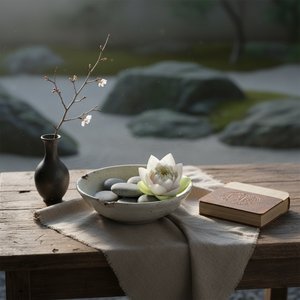
Tranquillity (also spelled tranquility) is the quality or state of being tranquil; that is, calm, serene, and worry-free. The word tranquillity appears in numerous texts ranging from the religious writings of Buddhism—where the term passaddhi refers ...
In an era defined by constant motion and digital noise, the human psyche seeks a specific kind of equilibrium. We find ourselves drawn to environments that offer more than just an absence of sound; we crave a presence of peace. This state of quietude is not merely a lack of disturbance but a deliberate engagement with what researchers call soft fascination—a way of looking at the world that allows the mind to wander without the exhaustion of directed attention. Art has long served as the architect of this stillness, providing a structured sanctuary where the viewer can find respite from the relentless pace of modern life.
The pursuit of tranquility in painting is rarely about emptiness. Instead, it is found in the intentional curation of atmosphere through balanced compositions and harmonious transitions. Whether through the expansive, light-drenched horizons of the nineteenth century or the controlled, rhythmic planes of early twentieth-century abstraction, artists have mastered the ability to freeze time. These works act as visual anchors, turning a simple wall into a zone of mental clarity. By revisiting these landscapes, we do not merely observe scenery; we participate in a restorative process that reconnects us to the enduring rhythms of the natural world.
The Weight of Observation: Dürer and the Precision of Nature
Admire Albrecht Dürer's 'A Young Girl of Cologne and Dürer’s Wife,' a meticulously detailed pencil drawing capturing two women with quiet contemplation. Explore the Renaissance master’s artistry at OriginalUniqueArt.
To find true stillness, one must often first encounter the profound weight of reality. In the early sixteenth century, Albrecht Dürer approached the natural world with a level of precision that demanded a slower pace of life. His 1502 work, Young Hare, serves as a quiet handshake across centuries, bringing the hyper-focused detail of the Northern Renaissance into the modern viewer's space. There is a meditative quality in his meticulous rendering of every strand of fur and the subtle glint within the animal's eye. It is a sense of captured breath, where the intensity of the observation creates its own form of silence.
This precision does not feel clinical; rather, it is anchored by an organic tranquility. Dürer utilized a palette of muted earth tones, soft ochres, and deep russets that ground the subject within a peaceful energy. By eschewing the loud, chaotic visuals found in contemporary trends, he focused on the dignity of the individual creature. This level of naturalism reminds us that peace can be found in the smallest, most overlooked details of our surroundings, provided we possess the patience to truly see them.
Atmospheric Transitions: Corot’s Bridge to Impressionism
Introduction To step into the world of Jean-Baptiste-Camille Corot is to leave behind the clamor of the modern age and enter a realm of profound stillness, where the air feels heavy with morning mist and the light dances softly through silvered leave...
As art progressed toward the nineteenth century, the definition of serenity shifted from the sharp clarity of the Renaissance to a more fluid, atmospheric experience. Jean-Baptiste-encoded-Camille Corot stood at this vital historical junction, acting as a bridge between the structured discipline of Neoclassicism and the emotive freedom of Impressionism. His landscapes do not merely document topography; they capture the very breath of the French countryside. In his works, the air feels heavy with morning mist, and light dances softly through silvered leaves, inviting a profound sense of stillness.
Corot’s mastery lay in his ability to paint the atmosphere itself—the way light filters through a canopy or the subtle transition of shadows at dusk. He moved beyond mere recording to achieve a spiritual connection with the landscape. This approach paved the way for later movements, demonstrating that the true subject of a painting could be the ephemeral quality of light and air. His use of muted greens, silvery greys, and warm ochres offers a sanctuary of visual peace, proving that even as techniques evolved toward greater abstraction, the fundamental human longing for connection to nature remained unchanged.
Luminous Horizons: The Quietude of American Luminism
Luminism is a style of American landscape painting from the 1850s to 1870s, characterized by effects of light in a landscape, through the use of aerial perspective and the concealing of visible brushstrokes. Luminist landscapes emphasize tranquility,...
In the mid-nineteenth century, a distinct movement emerged in the United States known as Luminism, an offshoot of the Hudson River School that sought a different kind of quietism. Unlike the dramatic grandeur often associated with its predecessors, Luminist painters like Fitz Henry Lane and Martin Johnson Heade focused on the effects of light through aerial perspective and concealed brushstrokes. Their canvases emphasize the horizontal plane, presenting landscapes of calm, reflective water and soft, hazy skies that suggest an experience of silence.
The hallmark of this style is a cool, hard, and non-diffuse light that avoids the painterly haze of Impressionism in favor of a crystalline clarity. By hiding the hand of the artist, these painters minimized the recognition of the canvas as an artifact, allowing the viewer to merge with the scene. This creates a sense of timeless intimacy, where the landscape is reduced to its essential, poetic components. The result is a profound sense of stability and trust, mirroring the transcendentalist ideals of the era through a visual language of absolute composure.
Rhythmic Geometry: Finding Peace in Braque’s Planes
Explore Georges Braque’s ‘The Archery.’ This minimalist print features stylized doves symbolizing peace in a geometric abstraction reminiscent of Cubism. A serene & impactful artwork.
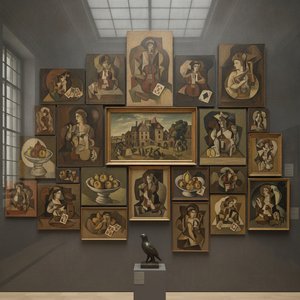
The search for serenity eventually moved into the realm of structure and form, finding a new expression in the early twentieth century. In the works of Georges Braque, such as Mandola, the concept of light is reimagined through interlocking geometric planes. There are no dramatic spotlights or harsh shadows here; instead, a diffuse, even illumination flows across muted ochres, grays, and earthy browns. This creates a rhythmic, low-frequency energy—a visual hum that provides a sophisticated form of calm.
By stripping away vibrant distractions, Braque directs our focus to the structural soul of his subjects. The subtle play of light across these facets evokes the quiet resonance of a single, sustained note. It is a masterclass in controlled luminosity, where peace is found not in the absence of complexity, but in the harmonious arrangement of it. This approach offers a way to anchor a modern interior with intellectual depth, proving that even within the fragmented language of Cubism, the pursuit of equilibrium remains a central human endeavor.
The Language of Color: From Goethe to the Impressionist Palette
Introduction Close your eyes for a moment and imagine the world not as a collection of fixed lines and rigid shapes, but as a shimmering dance of light and atmosphere. Imagine the way a morning mist clings to the reeds of a pond, or how the setting s...
Ultimately, the ability of art to command silence relies heavily on the psychological impact of color. Long before the advent of modern color theory, thinkers like Johann Wolfgang von Goethe explored the emotional nature of hues, noting how certain colors could evoke repose or excitement. The Impressionists took these observations and revolutionized them, using unmixed colors side-by-side to simulate the flickering movement of light. They replaced the somber, academic shadows of the past with vibrant, colored shadows, filling the canvas with a sensory truth.
The use of blue, for instance, has long been associated with stability and introspection, while the warmth of yellow can evoke hope and energy. The Impressionists utilized these psychological triggers through broken brushstrokes and an en plein air technique that captured the transient beauty of the world. When we look upon these works today, we are not just seeing color; we are experiencing a carefully constructed emotional landscape. Whether through a hand-painted oil reproduction on cotton canvas or a meticulously curated museum collection, these colors continue to serve as a visual detox, guiding us away from the noise and into a deep, resonant quiet.
At OriginalUniqueArt.com, we believe that the profound tranquility found in these historical movements should be accessible to all. Our artists, holding degrees from prestigious Fine Arts academies, specialize in creating high-quality oil reproductions that preserve the tactile depth and visible brushstrokes of the masters. From the precise naturalism of Dürer to the light-drenched atmospheres of Monet, we offer a way to bring these sanctuaries of stillness into your own living space.
A cura del team editoriale di OriginalUniqueArt.com
Explore the profound beauty of serenity in art history & contemporary works. Discover how artists evoke calm through color, composition & minimalism. Find artwork to cultivate peace and wellbeing.

 Tranquillity
 A Young Girl of Cologne and Dürer's Wife
 Mastering Light: The 25 Most Iconic Landscapes by Jean-Baptiste-Camille Corot
 Luminism (American art style)
 The archery. Ten Plates
 10 Iconic Impressionist Landscapes That Changed Art Forever