Introduction
In the history of nineteenth-century art, the terms Realism and Naturalism are frequently used interchangeably, yet they represent two distinct, successive movements. Realism emerged in France around 1848, led by figures such as Gustave Courbet and Jean-François Millet, who insisted that art must confront the present and the lives of ordinary people. Following this, Naturalism gained momentum in the 1870s and 1880s, spreading across Europe as artists sought to capture the world with near-photographic precision.
The confusion between these two styles arises because they share a common foundation: both reject idealized, mythological, or heroic subjects in favor of the unadorned truth of human existence. However, while they share a subject, their intentions differ fundamentally. This article will clarify these distinctions by examining how Realism functioned as a provocative social and political statement, whereas Naturalism shifted the focus toward a refined technical method, emphasizing the meticulous observation of light, setting, and detail.
| Naturalism | Realism | |
|---|---|---|
| Dates | 1870s-1880s | c. 1848 |
| Where | Paris, Britain, Scandinavia, Germany | France |
| Key painters | Jules Bastien-Lepage, Léon Lhermitte, Max Liebermann | Gustave Courbet, Jean-François Millet, Honoré Daumier |
| Palette and light | Silvery outdoor light, even diffused light | Dark earthy colours, thick paint |
| Typical subjects | Peasants, rural work, near-photographic truth | Ordinary people, labourers, urban life, social issues |
| Technique | Tighter finish, crisp foregrounds, soft backgrounds | Rough and heavy, broad handling |
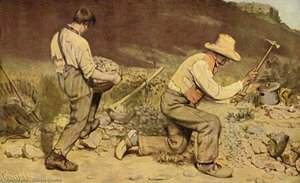
| One key work | Joan of Arc (1879) by Jules Bastien-Lepage | The Stone Breakers (1849) by Gustave Courbet |
The Precision of Naturalism and the Photographic Eye
 Joan of Arc - Jules Bastien-Lepage
 Interior of a Butcher Shop - Léon Augustin L'Hermitte
 Free hour at Amsterdam orphanage - Max Liebermann
While Realism focused on the social weight of the subject, Naturalism shifted the artistic emphasis toward the precision of the method. By the 1870s and 1880s, painters sought a near-photographic truth, prioritizing the meticulous observation of light, setting, and minute detail. This movement moved away from the heavy, dark palettes of earlier decades, opting instead for the subtle, diffused qualities of natural daylight often captured through outdoor study.
The technical execution of Naturalism is characterized by a refined finish. Artists often employed crisp foregrounds contrasted against softer, atmospheric backgrounds to mimic the depth of field found in early photography. This approach allowed for a highly detailed recording of the environment, capturing the specific textures of the landscape and the nuances of light as it interacts with the physical world.
Several key works exemplify this dedication to observational accuracy:
- Jules Bastien-Lepage, Joan of Arc (1879): Currently held in the Metropolitan Museum of Art, this work serves as a cornerstone of the movement, capturing a sense of spiritual conviction through meticulous observation.
- Léon Augustin Lhermitte, Paying the Harvesters (1882): A notable example of the movement's ability to record rural labor with careful, precise drawing.
- Max Liebermann, Free hour at Amsterdam orphanage (1876): This work demonstrates the transition toward a more fluid style, utilizing loose, visible brushstrokes to capture the essence of communal life in an outdoor courtyard.
Through these techniques, Naturalism transformed the act of painting into a precise, almost scientific record of existence, capturing the world not just as a social statement, but as a visual reality defined by light and atmosphere.
Realism and the Bold Statement of Subject Matter
 The origin of the world - Gustave Courbet
 The Angelus - Jean-François Millet
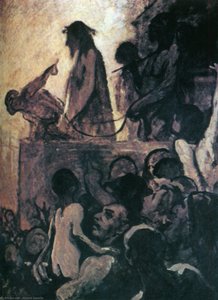 Honoré Daumier Nous voulons Barabbas (Ecce Homo) We want Barabbas (Ecce Homo) - Honoré Daumier
Realism emerged in France around the revolutions of 1848, functioning primarily as a radical statement regarding subject matter. This movement rejected the idealized gods and grand narratives of history painting in favor of the present, the ordinary, and the unadorned. Rather than seeking to escape into the subconscious or the purely decorative, Realist painters insisted that art should address the tangible, often difficult, socio-political conditions of the working class.
The movement was defined by a refusal to look away from the friction of modern existence. Key figures utilized a technique that was often rough and heavy, employing dark, earthy colors and thick paint to convey the weight of their subjects. Notable examples include:
- Gustave Courbet: His 1849 work The Stone Breakers presented two anonymous laborers at life size, while his 1866 masterpiece The Origin of the World challenged conventional beauty standards through a raw, unapologetic depiction of the female form.
- Jean-François Millet: A central figure of the Barbizon School, Millet imbued the peasantry with a sense of biblical dignity. His iconic The Angelus (c. 1857–1859) captures two peasants pausing their harvest for prayer, while The Sower (1850) and The Gleaners (1857) emphasize the quiet gravity of rural labor.
- Honoré Daumier: Known for his ability to capture the complexities of urban life, Daumier’s Nous voulons Barabbas (Ecce Homo) (1852) uses a raw, expressive style to explore themes of human suffering and social justice.
Whether through the crowded city scenes of Daumier or the provocative canvases of Courbet, Realism was a confrontation. It challenged the viewer's ideas of what was worthy of being painted, turning the canvas into a witness to the social and political realities of the nineteenth century.
Comparing the Social Revolt and the Technical Method
The transition from Realism to Naturalism represents a shift from political provocation to technical refinement. While both movements rejected idealized, classical subjects in favor of the working classes, they differed fundamentally in their intent and their reception by the art establishment. Realism was a movement of confrontation, often using the canvas as a tool for social critique to challenge the status quo of 19th-century France.
Realist works often felt weighty and confrontational. For example, Gustave Courbet’s The Origin of the World (1866) challenged conventional beauty standards through a raw, unapologetic depiction of the female form. Similarly, Honoré Daumier’s Nous voulons Barabbas (Ecce Homo) (1852) utilized a gestural, expressive style to evoke human vulnerability and social injustice. These artists often employed thick paint and dark, earthy tones to emphasize the grit of their subjects, making their work a direct statement about the present moment.
Naturalism, emerging in the 1870s and 1880s, took this rebellious subject matter and integrated it into a more polished, academic framework. This allowed the movement to become a respected international style, embraced by official juries and governments. The focus moved from the social message to the precision of the method. Consider the following distinctions:
- Realism focused on the argument: It used broad handling and heavy textures to demand attention to the struggles of the laborer, such as in the works of Jean-François Millet.
- Naturalism focused on the observation: It sought a near-photographic truth, utilizing silvery, diffused light and crisp details to record the world.
Where a Realist canvas might feel like a social manifesto, a Naturalist work, such as Jules Bastien-Lepage’s Joan of Arc (1879), feels like a precise, meticulously observed record of light and atmosphere.
Conclusion
To distinguish these movements in a museum, look to the intent behind the brushstroke. When standing before a Realist canvas from the 1850s, expect a work that feels weighty and confrontational. These paintings often use dark, earthy tones and broad, heavy handling to make a social or political argument about the dignity of the working class. In contrast, a Naturalist work from the 1880s functions as a precise, almost photographic record. Look for silvery, diffused outdoor light, crisp foreground details, and a tighter, more academic finish that suggests the presence of a camera.
Despite these technical differences, both movements are united by a singular, revolutionary ambition: the rejection of idealized gods and heroes. Whether through the provocative social statements of Courbet or the meticulous observations of Bastien-Lepage, both movements insisted on depicting the world as it truly is, elevating the ordinary person to the status of a masterpiece.
Explore these historical masterpieces in our collection.
Frequently asked questions
What is the difference between Realism and Naturalism?
Realism was a statement about subject matter, focusing on ordinary people and the present. Naturalism followed in the 1870s and 1880s, shifting the emphasis from the message to the method. While Realists used heavy, dark colors, Naturalists sought near-photographic truth to light and detail, often working outdoors to capture diffused daylight.
Who are the famous painters of Realism?
Key figures of the Realism movement include Gustave Courbet, Jean-François Millet, and Honoré Daumier. Courbet was known for his controversial depictions of life, such as his 1866 masterpiece The origin of the world. Millet focused on the dignity of peasants, while Daumier was a noted caricaturist who painted crowded city life.
Who are the famous painters of Naturalism?
Jules Bastien-Lepage was the figurehead of Naturalism, known for works like Joan of Arc. Other significant painters include Léon Augustin Lhermitte, who recorded rural work, and Max Liebermann, who blended realism with impressionistic elements in works such as Free hour at Amsterdam orphanage.
What are some famous works of Realism?
Notable Realist works include Gustave Courbet's The Stone Breakers, Jean-François Millet's The Angelus, and Honoré Daumier's Nous voulons Barabbas (Ecce Homo). These paintings often rejected idealized beauty in favor of depicting the laboring classes and the unadorned truth of human existence.
Famous painters of Naturalism
- 1848 – 1884Jules Bastien-Lepage
- 1844 – 1925Léon Augustin Lhermitte
- 1847 – 1935Max Liebermann


Famous artworks of Naturalism
- Jules Bastien-Lepage · 1879Joan of Arc
- Jules Bastien-Lepage · 1877Les Foins
- Léon Augustin L'Hermitte · 1881Interior of a Butcher Shop
- Léon Augustin L'Hermitte · 1876Le lavage des moutons
- Max Liebermann · 1876Free hour at Amsterdam orphanage
- Max Liebermann · 1878Old Woman with Cat


Famous painters of Realism
- 1819 – 1877Gustave Courbet
- 1814 – 1875Jean-François Millet
- 1808 – 1879Honoré Daumier


Famous artworks of Realism
- Gustave Courbet · 1866The origin of the world
- Gustave Courbet · 1849The Stone Breakers
- Jean-François MilletThe Angelus
- Jean-François Millet · 1862Man With A Hoe
- Honoré Daumier · 1852Honoré Daumier Nous voulons Barabbas (Ecce Homo) We want Barabbas (Ecce Homo)
- Honoré Daumier · 1861The Drinkers