The Great Reset: Moving from Rococo Excess to Neoclassical Order
 Neoclassicism Unveiled: The Timeless Elegance of Order, Reason, and Classical Antiquity
The Enlightenment Catalyst: From Rococo Excess to Rational Restraint The Revival of Antiquity: Exploring Neoclassical Art's Ideals & Enduring Legacy The Seeds of Revival: Enlightenment Ideals & Rediscovering Classical Antiquity The latter half of the...
To understand the seismic shift that birthed Neoclassicism, one must first envision the sensory overload of the mid-18th century. Before the era of rational restraint, European art was dominated by the Rococo—a style defined by its whimsical frivolity, asymmetrical flourishes, and an almost breathless preoccupation with the ornamental. It was an art of the salon, intimate and decorative, often steeped in the lighthearted eroticism of the aristocracy. However, as the intellectual currents of the Enlightenment began to surge across Europe, this perceived decadence faced a rigorous critique from thinkers like Voltaire and Rousseau. They championed a new era of human agency, advocating for a return to natural law and the cultivation of civic virtue.
This intellectual revolution demanded a visual language that could mirror its core values: reason, order, and clarity. The frantic, unscripted energy of the Rococo was increasingly viewed as a symptom of moral decay, prompting a deliberate turning away from the ornate toward something more permanent and disciplined. This was not merely a change in aesthetic preference but a profound philosophical realignment. Artists began to seek a sanctuary of logic, where the chaotic emotions of the moment were replaced by universal truths of form and composition, establishing an aesthetic attitude that prioritized restraint over excess and universality over the ephemeral.
The Blueprint of Antiquity: Decoding the Greco-Roman Influence
--- title: Neoclassicism - The Metropolitan Museum of Art author: Cybele Gontar url: https://www.metmuseum.org/essays/neoclassicism hostname: metmuseum.org description: The Neoclassical style arose from first-hand observation and reproduction of anti...
The heartbeat of Neoclassicism was found in the rediscovered echoes of Classical Antiquity. The second half of the eighteenth century saw a renewed fascination with the achievements of ancient Greece and Rome, a passion fueled by the burgeoning science of archaeology. The spectacular remnants unearthed at sites like Pompeii and Herculane_neam brought a buried world of immense beauty back into the light, providing artists with first-hand observations of antique works. This was not just about copying old shapes; it was about absorbing the very soul of the Greco-Roman world—its emphasis on harmony, simplicity, and proportion.
This revival drew heavily from the precedents set during the Renaissance by masters such as Raphael and Poussin, who had already established a conduit for classical ideals. The movement sought to anchor the human spirit in the enduring principles of the past, utilizing the monumental scale of ancient ruins to inspire modern greatness. Whether through the study of weathered coins, delicate jewelry, or imposing sculptures, the Neoclassical artist looked to the Mediterranean basin to find a sense of timelessness. By reproducing these antique forms, they aimed to create an art that transcended the fleeting trends of their own era, reaching instead for a permanent, universal standard of beauty.
Masters of Precision: The Visionaries of Form and Symmetry
 Classical Bust of a Bearded Male Seen in Profile
Classical Bust of a Bearded Male Seen in Profile by Vincenzo Camuccini Vincenzo Camuccini’s “Classical Bust of a Bearded Male Seen in Profile” is more than just a meticulously rendered pencil sketch; it's a window into the artistic sensibilities of N...
The execution of Neoclassical art required a level of technical mastery that bordered on the scientific. Unlike the soft, blurred edges of later movements, Neoclassicism demanded anatomical accuracy and formal restraint. Artists like Vincenzo Camuccini embodied this spirit through meticulous rendering; his works, such as his classical busts, utilized precise hatching and cross-hashing to build tonal values that enhanced the illusion of depth and texture. In these works, we see a rejection of emotional excess in favor of rational clarity, where every line serves to define form with absolute precision.
Other visionaries, such as the antiquarian painter Gavin Hamilton, bridged the gap between scholarship and artistry. Hamilton’s life was inextricably linked to the pursuit of classical antiquities; his monumental paintings depicting scenes from Greek and Roman mythology were not merely decorative but served as historical interpretations of ancient narratives. Similarly, the sculptor Johann Gottfried Schadow demonstrated the era's sensitivity to form through works like his Draped Female Figure, where the subtle modeling of fabric and smooth surfaces evoked the spirit of ancient Greece. These masters shared a common goal: to use symmetry and precision to communicate notions of virtue, dignity, and moral fortitude.
Beyond the Canvas: Architecture and the Aesthetic of Permanence
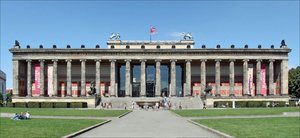 Altes Museum
A Bastion of Antiquity: Exploring the Altes Museum The Altes Museum in Berlin isn’t merely a building; it's a statement etched in stone—a powerful articulation of Enlightenment ideals rendered tangible on the celebrated Museum Island. Conceived by Ki...
Neoclassicism was never confined to the frame of a painting; it was an all-encompassing architectural and decorative movement that sought to reshape the physical world. This era produced structures that acted as statements etched in stone, designed to embody Enlightenment ideals. A prime example is the Altes Museum in Berlin, conceived by Karl Friedrich Schinkel. The museum stands as a powerful articulation of classical values, signaling a shift where art was no longer the exclusive domain of royalty but a shared human inheritance. Such buildings utilized the language of columns, pediments, and domes to create a sense of monumental stability.
This architectural grandeur extended into the decorative arts, where the principles of order and proportion were applied to everything from furniture to large-scale frescoes. The movement’s influence can be seen in the way spaces were curated to foster a sense of intellectual reverence. Even today, the legacy of Neoclassical architecture persists in our most prestigious institutions, reminding us of a time when design was used to inspire civic pride and a connection to the eternal. It was an era where the built environment served as a permanent dialogue between the glory of the past and the aspirations of the present.
Curating the Classics: Integrating Neoclassical Grandeur into Modern Spaces
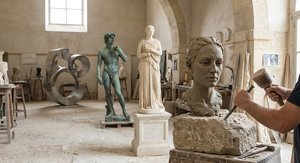
 Mougins Museum of Classic Art
A Timeless Dialogue: The Soul of Mougins Nestled within the sun-drenched, medieval heart of Provence, the Mougins Museum of Classic Art serves as a profound sanctuary where the echoes of antiquity meet the vibrant pulse of modernity. To step into thi...
In our contemporary, fast-paced world, the allure of Neoclassicism offers a much-needed sanctuary of profound logic. For the modern collector or interior designer, integrating these classical motifs is not about recreating a museum; it is about injecting timeless elegance and a sense of historical weight into a modern aesthetic. The beauty of Neoclassical art lies in its ability to breathe life into contemporary spaces, providing a focal point of stability amidst the frantic energy of modern life. Whether through a large-format mural or a meticulously rendered portrait, these works offer a tangible connection to the foundations of Western culture.
The true power of Neoclassicism is found in its versatility. Much like the way the Mougins Museum of Classic Art orchestrates an encounter between ancient antiquities and contemporary vision, modern decorators can use classical elements to create a curated conversation between eras. By pairing the structured grace of a Neoclassical reproduction with bold, modern textures or minimalist furniture, one achieves a sophisticated balance of order and innovation. It is an invitation to move beyond the ephemeral and surround oneself with art that celebrates the enduring strength of human reason and the everlasting beauty of the classical ideal.