The Professional Guide to Tempera Paint: History, Techniques, and Applications for High-End Interior Design
Master the art of tempera painting with our expert guide. Explore its historical significance, technical precision, and professional applications for luxury hotel design and large-scale architectural projects.
The Alchemy of Pigment: Understanding the Egg Tempera Medium The Timeless Glow of Tempera: Discovering the Sacred Art of Egg Yolk Painting The Alchemy of Egg and Pigment: Understanding the Tempera Medium To touch upon the subject of tempera is to rev...
To touch upon the subject of tempera is to revisit a time when art was not merely an expression of the self, but a profound ritual of transformation. Long before the fluid, expressive freedom of oil paints allowed for the sweeping gestures we admire in the Impressionist masters, there existed a more disciplined, almost alchemical process. The heart of this medium lies in its humble yet potent ingredients: the yolk of an egg, acting as a delicate binder, and pure, ground pigments derived from the earth, minerals, and precious stones. This is the essence of egg tempera, a permanent, fast-drying painting medium that demands a marriage of precision and patience.
As the emulsion dries, it creates a surface that is remarkably matte yet possesses an internal luminosity, as if the light itself is trapped within the microscopic layers of the paint. Unlike the heavy, translucent layers of oil that can sit atop a canvas, tempera requires an intimate understanding of chemistry. For the professional designer or collector, this translates to a visual depth that is uniquely stable. The chemical bond formed by the egg yolk ensures that the pigments are locked into a durable matrix, providing a soft, even radiance—a gentle glow that feels as though it emanates from within the subject rather than reflecting off its surface. This inherent longevity makes tempera-style works an enduring choice for high-traffic environments where visual permanence is paramount.
Historical Foundations: From Medieval Scriptoriums to Renaissance Masterpieces
Origins and the Dawn of Illuminated Script Within the shadowed halls of medieval monasteries, a remarkable tradition blossomed – the art of the scriptorium. More than simply a room for copying manuscripts, it was a crucible where faith, scholarship, ...
The history of tempera is etched into the very fabric of European heritage, originating in the shadowed halls of medieval monasteries within the scriptorium. Here, a remarkable tradition blossomed where faith, scholarship, and artistry converged. In these centers of learning, particularly in Northern Italy during the 13th to 16th centuries, artists meticulously crafted illuminated manuscripts that served as windows into the divine. This era of religious fervor and royal patronage laid the groundwork for a technique that would eventually define the visual language of the Renaissance.
As we moved into the High Renaissance, the medium evolved from the intimate scale of parchment to monumental works on wood panels. Artists like Andrea Mantegna utilized the tonal precision of tempera to capture the spirit of antiquity, creating works such as his "Triumphs of Caesar" series. These pieces were not merely historical records but explorations of sculptural illusionism and Roman glory. The transition from the medieval period to the Renaissance saw a shift toward classical ideals, where the disciplined application of tempera allowed for an unprecedented level of detail and anatomical accuracy. This historical lineage provides a sense of gravity and prestige to any space, connecting modern architectural environments to the profound cultural legacies of the past.
Technical Execution: The Disciplined Art of Layering and Tonal Precision
--- title: Tempera paint (video) | Khan Academy url: https://www.khanacademy.org/humanities/special-topics-art-history/creating-conserving/painting-materials-techniques/v/tempera-paint hostname: khanacademy.org description: Tempera painting, popular ...
Working with egg tempera is an exercise in mindfulness; one cannot rush the medium, for each stroke must be deliberate and carefully layered to build depth and tone. Because the paint dries almost instantly upon contact with the surface, the artist cannot blend colors directly on the support as one might with oils. Instead, the technique relies on a meticulous process of hatching and cross-hatching—applying thousands of tiny, overlapping strokes to create the illusion of gradation and volume. This method requires an extraordinary level of technical mastery to achieve what is known as sculptural illusionism.
This disciplined approach results in a clarity of form that is unmatched by almost any other medium. The artist prepares the surface, often using gesso—a liquid plaster—to ensure the wood panel or canvas provides a smooth, non-absorbent base. By building up thin, translucent layers, the painter can manipulate light and shadow with surgical precision. For the discerning eye, this technique offers a crispness of detail that draws the viewer in, making it an ideal choice for focal pieces in galleries or grand lobbies where the fine details of the composition are meant to be studied closely over time.
Architectural Integration: Utilizing Tempera Aesthetics in Luxury Hotel Design
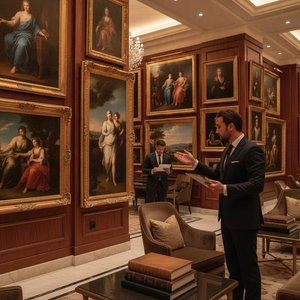
For the modern hotel designer and architect, the aesthetic of tempera offers a unique opportunity to infuse a space with timelessness and quiet luxury. The matte finish and internal luminosity characteristic of this medium provide a sophisticated alternative to the high-gloss or overly dramatic finishes found in contemporary decor. In a hospitality setting, where the goal is often to create an atmosphere of calm, elegance, and prestige, the soft, even radiance of tempera-style works can ground a room, providing a sense of historical weight without overwhelming the modern architectural lines.
Integrating these aesthetics can be achieved through various scales, from intimate portraiture in private suites to large-format murals that transform grand corridors. The ability to utilize "period shifts"—transforming modern imagery into the light-drenched style of the masters—allows designers to customize the narrative of a property. Whether it is a multi-panel arrangement spanning a wide staircase or a singular, commanding fresco on a ceiling, the use of tempera-inspired art allows for a cohesive, high-end look that resonates with guests seeking an experience of cultured refinement.
Sourcing and Procurement: Selecting Authentic Reproductions for Large-Scale Projects
In the realm of large-scale procurement, particularly for hospitality chains and corporate spaces, the challenge lies in balancing artistic authenticity with operational reliability. Sourcing true historical artifacts is often impossible due to preservation constraints; however, the rise of high-quality, hand-painted reproductions offers a viable and professional solution. These works are not mere prints but are meticulously crafted by artists trained in academic traditions, ensuring that the visible brushstrokes and tonal depth of the original masters are preserved.
When managing large orders for hotel renovations or new builds, procurement managers require a streamlined, dependable process. This includes the ability to select from vast catalogs, customize dimensions to fit specific architectural requirements, and receive clear, transparent pricing with full VAT documentation. The value of professional-grade reproductions lies in their repeatability and scalability. By choosing works that emulate the techniques of egg tempera—focusing on texture, light, and historical accuracy—designers can execute a unified vision across multiple properties, ensuring that every installation meets the rigorous standards of luxury hospitality while remaining within the practical bounds of large-scale project management.
At OriginalUniqueArt.com, we specialize in making these masterworks accessible to professionals worldwide. From custom commissions and digital mockups to large-format murals for hotel ceilings, our service is built for the needs of the modern decorator and procurement manager. Whether you are looking to transform a personal photo into a Renaissance masterpiece or require bulk orders of classical reproductions for a global hotel brand, our team provides the reliability, quality, and logistical expertise required for seamless integration into your most ambitious design projects.
A cura del team editoriale di OriginalUniqueArt.com
A professional procurement guide for hotel designers sourcing Academic Realism. Discover scalable solutions for large-scale hospitality projects, featuring hand-painted oil reproductions, custom sizing, and reliable global logistics for high-volume art installations.
Elevate your hotel design with expertly crafted art reproductions & bespoke commissions. Discover how strategic artwork selection enhances guest experience, brand identity & ROI. Expert guidance from OriginalUniqueArt.
Streamline your hospitality decor with professional bulk art solutions. From high-traffic durability to scalable multi-panel layouts, we provide procurement managers with museum-quality oil reproductions and prints designed for hotels and restaurants worldwide.
Optimize large-scale hospitality and corporate projects with professional bulk art solutions. From hand-painted oil reproductions to premium Giclée prints, we provide scalable, high-volume decor, custom sizing, and reliable global logistics for designers and procurement managers.
Streamline your hospitality art procurement with premium, hand-painted oil reproductions of classic seated portraits. We provide scalable, high-volume solutions for hotel designers and procurement managers, featuring custom sizing, bulk order efficiency, and reliable global shipping.


 The Alchemy of Egg Yolk: Mastering the Timeless Art of Tempera Painting
 north western italy scriptorium