Passa alle stampe
 Espandi i dettagli







































 Per opere d'arte o riproduzioni con un lato superiore a 105 cm (circa 41 pollici), la cornice verrà spedita in forma di kit smontato. Questo metodo garantisce una consegna sicura e previene danni durante il trasporto.


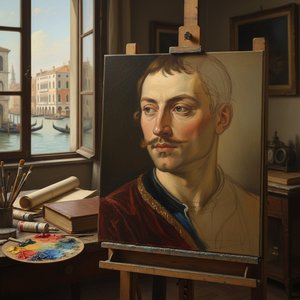
Portrait of Jacopo Strada
The Portrait of Jacopo Strada, painted by the renowned artist Titian Ramsey Peale II, is a captivating piece that showcases the artist’s skill and attention to detail. This oil on canvas painting, measuring 95 x 125 cm, is housed in the esteemed Kunsthistorisches Museum in Vienna, Austria.Artistic Style and Technique
Titian Ramsey Peale II was a master of the Renaissance style, and this portrait exemplifies his expertise. The subject, Jacopo Strada, is depicted wearing a red jacket with a fur trim, complemented by a beard and mustache. He holds a statue or figurine in his hand, adding an element of elegance to the scene. The artist’s use of warm colors and subtle lighting creates a cozy atmosphere, drawing the viewer into the painting. Peale II's technique is characterized by meticulous detail and a masterful blending of pigments—a hallmark of Venetian art that he skillfully adopted. Notice how Strada’s drapery folds are rendered with remarkable realism, conveying texture and movement. The artist’s careful observation of anatomy contributes to the portrait’s expressive power.Symbolism and Composition
The composition of the painting is rich with symbolism. A clock on the wall above Jacopo Strada's head represents time, while a nearby book signifies knowledge. A vase placed towards the right side of the image adds an element of decoration, balancing the scene. These objects not only add depth but also reflect the subject’s personality and interests. The artist deliberately arranges these elements to convey a sense of intellectual refinement and aristocratic status. Strada's posture—slightly turned toward the viewer—suggests contemplation and conveys confidence. The statue he holds is a Roman copy of Venus Pseliumene by Praxiteles, symbolizing beauty and mythological inspiration.Historical Context
The Kunsthistorisches Museum, where this painting is housed, is a treasure trove of royal treasures and artifacts from the Habsburg dynasty. This museum provides a unique context for understanding the historical significance of the portrait. It reflects the artistic tastes of Maximilian II, Holy Roman Emperor, who commissioned Peale II to create this masterpiece—a testament to the emperor’s patronage of art and scholarship. The painting's creation coincided with a period of intellectual ferment in Vienna, where humanist ideals were gaining prominence.Comparison with Other Works
Titian Ramsey Peale II’s work can be compared to that of other notable artists. For instance, Tiziano Vecellio (Titian)'s version of Portrait of Jacopo Strada, also housed in the Kunsthistorisches Museum, offers a different interpretation of the subject—a more formal and idealized depiction—highlighting variations within Renaissance artistic conventions. Additionally, Peale II’s exploration of naturalism aligns with broader trends in European art during his time.- Painting by 'Titian Ramsey Peale Ii' | Titian Ramsey Peale Ii: Portrait of Jacopo Strada
- The Hofmuseum Vienna, Austria Introduction
- Kunsthistorisches Museum on Wikipedia
Domande e risposte
Quale tonalità dominante caratterizza "Ritratto di Jacopo Strada" di Tiziano Ramsay Peale II?
La tonalità dominante di "Ritratto di Jacopo Strada" di Tiziano Ramsay Peale II è Dall'ocra al seppia, un colore che costituisce il tono di fondo dell'intera tavolozza.
Qual è il formato di "Ritratto di Jacopo Strada"?
"Ritratto di Jacopo Strada" di Tiziano Ramsay Peale II ha un formato Orientamento verticale. Il formato descrive le proporzioni della composizione.
Quanto è conosciuta "Ritratto di Jacopo Strada" di Tiziano Ramsay Peale II?
"Ritratto di Jacopo Strada" è classificata come Iconici.
Maggiori informazioni su questo dipinto
 Anteprima in scala reale
 Invia
Invia Condividi
 Dettagli opera
 Guida
Guida

 Scarica
 Simili
 Radiografia
 Slideshow
 Domande e risposte
 Statistiche