Rinascimento
8 (Raffaello Sanzio)
Raffaello Sanzio (1483–1520) ha realizzato 8. Fa parte del movimento Rinascimento. È realizzato in Acrilico su tela.
- Acrilico su tela

 Anteprima in scala reale

 Dipinto a olio fatto a mano
 Invia
 Condividi
 Scheda didattica


 Scarica
 Simili
 Radiografia
 Slideshow
 Domande e risposte

 Statistiche
8, in breve
- Titolo
- 8
- Artista
- Raffaello Sanzio (1483–1520)
- Artista nato a
- Urbino, Italia
- Tecnica
- Acrilico su tela
- Movimento
- Rinascimento
- Epoca
- Rinascimento
- Soggetto
- renaissance, philosophy, classical antiquity, humanism, perspective, allegory
Cosa raffigura 8?
Stanze Vaticane - The School of Athens: A Renaissance Dialogue on Wisdom and Beauty
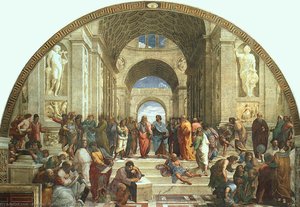
Raphael’s “School of Athens,” a breathtaking fresco residing within the Vatican’s Stanza della Segnatura, isn't merely a depiction of philosophers; it’s a vibrant testament to the humanist ideals that defined the High Renaissance. Completed between 1509 and 1511, this monumental work transcends its physical space, inviting viewers into a timeless conversation about knowledge, reason, and the pursuit of truth. The scene unfolds within an architectural setting subtly inspired by Bramante’s ambitious plans for rebuilding St. Peter's Basilica – a nod to the burgeoning grandeur of Rome itself – creating a backdrop that simultaneously anchors the composition in reality and elevates it towards a realm of intellectual aspiration.
At the heart of the fresco stand Plato and Aristotle, their figures rendered with an exquisite balance of realism and idealized beauty. Plato, gesturing upwards toward the heavens, embodies the pursuit of abstract ideals – his flowing robes and contemplative posture suggesting a detachment from the earthly world. Opposite him, Aristotle, grounded and engaged in a lively debate, represents the emphasis on empirical observation and the study of nature. This dynamic pairing immediately establishes the core tension within Renaissance philosophy: the conflict between idealism and realism, a theme that resonates powerfully throughout the composition. The surrounding figures – Pythagoras, Heraclitus, Euclid, Socrates, and many others – are not simply historical footnotes; they’re carefully chosen representatives of diverse schools of thought, each contributing to a rich tapestry of intellectual discourse.
Raphael's mastery of technique is immediately apparent in the fresco’s astonishing detail. The figures are rendered with remarkable anatomical accuracy, yet imbued with an almost ethereal quality. Note the subtle gradations of color, the delicate modeling of drapery, and the precise rendering of architectural elements – all hallmarks of Raphael’s refined style. The use of *chiaroscuro*, the dramatic interplay of light and shadow, adds depth and volume to the scene, drawing the viewer's eye across the complex arrangement of figures. The perspective is meticulously executed, creating a convincing illusion of space and contributing to the overall sense of realism. It’s important to note that Raphael learned this technique from Leonardo da Vinci, who had been experimenting with linear perspective in his paintings.
Beyond its artistic merits, “The School of Athens” carries profound symbolic weight. The fresco is a celebration of classical Greek philosophy and science, which were experiencing a revival during the Renaissance – a period marked by renewed interest in ancient texts and ideas. By placing these figures within a contemporary setting, Raphael suggests that the wisdom of antiquity remains relevant to modern thought. The inclusion of Euclid, the father of geometry, further emphasizes the importance of reason and logic as tools for understanding the world. The painting’s overall message is one of optimism – a belief in the power of human intellect to unlock the secrets of the universe. It’s a powerful statement about the enduring legacy of classical thought and its continued influence on Western civilization.
The Figures: A Dialogue of Ideas
Each figure within “The School of Athens” is carefully chosen not just for their historical significance but also for their symbolic representation of specific philosophical concepts. Plato, with his upward gaze, embodies the realm of Forms – the eternal and unchanging ideas that exist beyond the physical world. His book, "Timaeus," symbolizes his theory of cosmology, suggesting a universe governed by mathematical principles. Aristotle, in contrast, is depicted gesturing downwards, engaging in a more earthly debate about ethics and politics. His book, “Nicomachean Ethics,” represents his focus on practical wisdom and the pursuit of happiness within the human experience.
Observe the details surrounding each figure: Pythagoras, with his geometric diagrams, embodies mathematical knowledge; Euclid, holding a compass and ruler, symbolizes geometry; Heraclitus, depicted as a river, represents the concept of constant change. The inclusion of these specific figures demonstrates Raphael’s deep understanding of classical philosophy and his ability to translate complex ideas into a visually compelling narrative. Even seemingly minor details, such as the scrolls held by each philosopher, are laden with symbolic meaning, further enriching the painting’s intellectual depth.
Architectural Setting & Renaissance Influence
The architectural setting of “The School of Athens” is not merely decorative; it’s integral to the composition and serves as a visual metaphor for the pursuit of knowledge. The building behind the philosophers is clearly inspired by Bramante's designs for St. Peter's Basilica, reflecting the Renaissance fascination with classical architecture and its grandeur. However, Raphael subtly transforms this architectural model, incorporating elements from various historical periods – including Roman and Greek styles – to create a harmonious blend of past and present.
The use of columns, arches, and pediments evokes the monumental scale of ancient temples, suggesting that the philosophers are engaged in a dialogue worthy of the gods. The perspective lines converge towards a central vanishing point, drawing the viewer's eye into the heart of the scene. This masterful manipulation of space reinforces the sense of depth and realism, while simultaneously elevating the painting to a realm of timeless beauty. The architectural elements also serve as a reminder of the ambition and innovation that characterized the Renaissance – a period marked by a renewed interest in classical art and architecture.
Owning a Piece of History: A OriginalUniqueArt Reproduction
Experience the profound beauty and intellectual depth of Raphael’s “School of Athens” with a meticulously crafted, handmade oil painting reproduction from OriginalUniqueArt. Our skilled artists painstakingly recreate every detail of this iconic masterpiece, using traditional techniques and archival-quality materials to ensure lasting vibrancy and authenticity. Each reproduction is created on canvas, capturing the texture and luminosity of the original fresco.
Whether you’re an art collector, a design enthusiast, or simply someone who appreciates timeless beauty, a OriginalUniqueArt reproduction of “The School of Athens” offers a unique opportunity to bring this masterpiece into your home or office. Explore our selection of sizes and framing options to find the perfect piece that complements your personal style. Visit OriginalUniqueArt.com today to discover how you can own a tangible connection to one of the greatest works of art in history.
Photo Description: The painting is a portrait of three people, two men and one woman, all wearing hats. The man on the left has a black hat, while the other man on the right has a white hat. The woman in between them also has a hat. They are all looking at each other with smiles on their faces. The painting is set against a backdrop of a window, which can be seen in the background. There are two books visible in the scene, one located near the left side and another closer to the right side. The overall atmosphere appears to be friendly and warm as they all engage with each other. Size: Unknown Date: Unknown ARTIST INFORMATION: ================== Artist: Raphael Birth Year: 1483 Death Year: 1520 Birth City: Urbino Birth Country: Italy Biography:The Urbino Renaissance: Raphael’s Early Life and Formation
Raffaello Sanzio da Urbino, known to the world as Raphael, emerged from a remarkably fertile cultural landscape. Born in 1483 within the small but intellectually vibrant city-state of Urbino in the Marches region, his earliest years were steeped in an atmosphere that prized both artistic skill and humanist learning. His father Giovanni Santi, was not merely a painter employed by Duke Federico da Montefeltro—he was a man deeply engaged with the currents of Renaissance thought, a poet who chronicled the Duke’s life and actively sought out innovative artistic ideas from across Italy and beyond. This immersion in a courtly environment, one that valued refinement and intellectual discourse, profoundly shaped the young Raphael's sensibilities. The loss of his father at age eleven thrust responsibility upon him, but also provided an opportunity to hone his skills within the family workshop, absorbin"
Immagini ad alta risoluzione di 8

Pubblico dominio: l'artista è deceduto nel 1520.
Altre dimensioni, ritagli e citazioni →Raffaello Sanzio, 8.
Raffaello Sanzio (1483–1520), 8, acrilico su tela. Pubblico dominio Immagine di OriginalUniqueArt.com.
Domande su 8, risposte
Con quale tecnica è realizzata "8" di Raffaello Sanzio?
La tecnica utilizzata per "8" di Raffaello Sanzio è Acrilico su tela. Le riproduzioni mirano a restituire l'aspetto di questa tecnica.
Cosa rappresenta "8" di Raffaello Sanzio?
"8" di Raffaello Sanzio raffigura: renaissance, philosophy, classical antiquity, humanism, perspective, allegory, virtue.
"8" di Raffaello Sanzio è di pubblico dominio?
Per quanto riguarda il copyright, "8" è di pubblico dominio - il copyright è scaduto.
A quale artista è attribuito "8"?
"8" è attribuito a Raffaello Sanzio.
A quale stile appartiene "8"?
Il movimento associato a "8" di Raffaello Sanzio è Rinascimento. Questa classificazione colloca l'opera tra artisti e opere d'arte correlati.
A quale fase della carriera di Raffaello Sanzio appartiene "8"?
"8" appartiene al Mature Period della carriera di Raffaello Sanzio. Questa classificazione riconduce l'opera all'evoluzione dell'artista.
Per quale motivo lo stato del copyright di "8" è questo?
"8" di Raffaello Sanzio è di di pubblico dominio - il copyright è scaduto. La durata del copyright decorre dalla morte dell'artista, avvenuta nel 1520.
In che modo "8" si inserisce nel percorso artistico di Raffaello Sanzio?
All'interno della produzione di Raffaello Sanzio, "8" si inserisce nello stile Rinascimento, affiancandosi ai temi di inspired by leonardo da vinci’s mastery., celebrates humanist ideals & classical wisdom., reflects papal patronage & theological discourse., a cornerstone of raphael's vatican legacy..
In che modo il soggetto di "8" si relaziona ai temi abituali di Raffaello Sanzio?
I temi ricorrenti di Raffaello Sanzio includono inspired by leonardo da vinci’s mastery., celebrates humanist ideals & classical wisdom., reflects papal patronage & theological discourse., a cornerstone of raphael's vatican legacy.; "8" si concentra su renaissance, philosophy, classical antiquity, humanism, perspective, allegory, virtue.
Informazioni sull'artista, Raffaello Sanzio

1483–1520, Italia
Raffaello Sanzio
La Vita e l'Identità di Raffaello Raffaello, noto alla storia con diversi nomi tra cui Raffaello Sanzio, Raffaello Santi e Raffaello Sanzio da Urbino, è stato una figura centrale del Rinascimento italiano. La sua esistenza è stata definita da una doppia maestria nella pittura e nell'architettura, una versatilità che gli ha permesso di muoversi con naturalezza tra la scala intima di un ritratto e le monumentali esigenze delle costruzioni papali. Nacque a Urbino, in Italia, il 6 aprile 1483, immerso in un mondo vibrante di attività intellettuale e artistica. La sua carriera fu segnata da un'immensa produttività, tale da richiedere la gestione di una vasta bottega per soddisfare le richieste dei suoi committenti.
Altre opere di Raffaello Sanzio
 Scuola di Atene1511
 La Madonna Sistina1513
 La Trasfigurazione1520
 Matrimonio della Vergine1504
Saggi su 8
 Dall'oro alla gravità: stile Italo-Bizantino contro il Proto-RinascimentoScopri le differenze tra stile Italo-Bizantino e Proto-Rinascimento. Impara a distinguere l'oro dal realismo con i nostri esperti.
 I 25 Capolavori di Raffaello: L'Incanto della Perfezione RinascimentaleScopri i 25 capolavori di Raffaello e l'armonia del Rinascimento. Esplora la collezione su OriginalUniqueArt.com.
 Alto Rinascimento vs. Manierismo: l'armonia e il passaggio alla tensioneScopri le differenze tra l'armonia del Rinascimento e la tensione del Manierismo. Approfondisci l'evoluzione dell'arte italiana ora.