
 Anteprima in scala reale
 Acquista stampa
 Invia
Invia Condividi


 Scarica immagine
 Simili
 Radiografia
 Slideshow
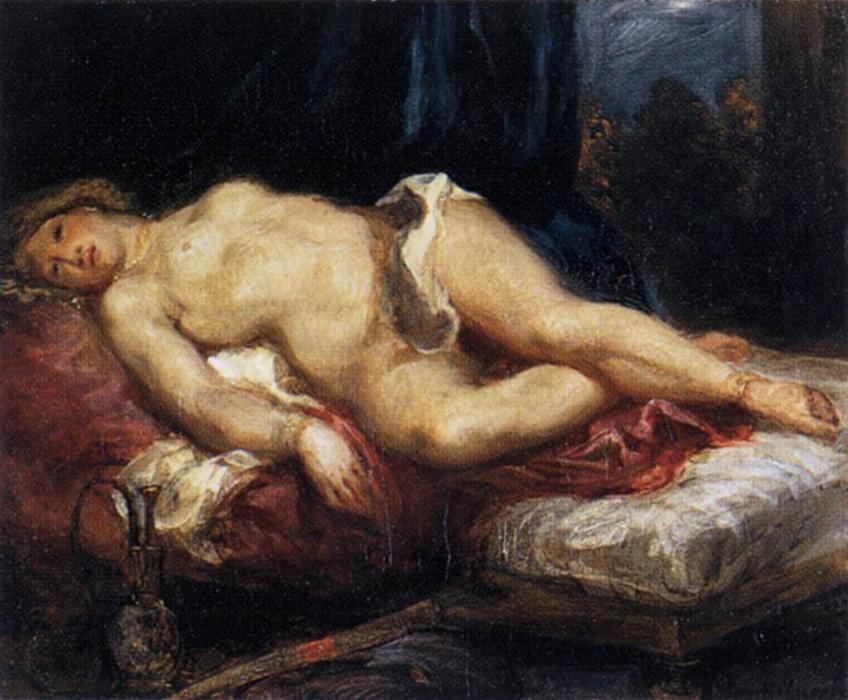
Odalisque Reclining on a Divan


Odalisque Reclining on a Divan by Eugène Delacroix
Eugène Delacroix’s *Odalisque Reclining on a Divan* is more than just a beautiful painting; it's a cornerstone of Romantic art and a testament to the artist’s unparalleled ability to capture emotion and atmosphere. Completed in 1857, this monumental canvas—measuring 86 x 130 cm—holds its place within the permanent collection of the Musée de la Chasse et de la Nature in Paris, France, attracting visitors eager to immerse themselves in Delacroix’s visionary world. The painting immediately draws the eye with its vibrant palette dominated by reds and blues – hues deliberately chosen to evoke warmth and coolness simultaneously, mirroring the duality inherent in Orientalist depictions of desire and contemplation. Delacroix skillfully employs loose brushstrokes and impasto technique, layering paint thickly onto the canvas to create a palpable sense of texture and movement. This expressive approach contrasts sharply with the polished surfaces favored by Neoclassical painters, firmly establishing Delacroix as a champion of Romantic dynamism. Delacroix’s fascination with the exotic stemmed from his travels to Morocco in 1832-33, where he witnessed firsthand the splendor and complexity of Islamic culture. This experience profoundly influenced his artistic vision, propelling him toward subjects like harems and opulent interiors—spaces brimming with sensual energy and symbolic significance. The woman at the center of *Odalisque Reclining on a Divan* embodies this Romantic ideal: draped in luxurious fabrics adorned with intricate patterns – mirroring the richness of Moroccan textiles – she exudes an aura of serene repose despite the suggestive presence of a narghile pipe and a yatagan sword, hinting at both vulnerability and latent power. The painting’s composition is equally masterful. Delacroix arranges the figures—the reclining woman and a shadowy male attendant—within a shallow space that emphasizes depth through subtle gradations of color and light. The drapery folds cascade downwards, creating a sense of rhythm and movement that draws the viewer's gaze across the canvas. Furthermore, Delacroix’s masterful use of chiaroscuro – dramatic contrasts between light and dark – sculpts the woman’s form and highlights her skin tone, conveying an impression of luminous beauty. Beyond its aesthetic qualities, *Odalisque Reclining on a Divan* speaks to broader themes explored by Romantic artists: the exploration of human emotion, the celebration of sensual experience, and the questioning of societal conventions. As a symbol of feminine allure and aristocratic leisure, it continues to inspire admiration and debate centuries after its creation. Its legacy extends far beyond the confines of the Musée de la Chasse et de la Nature, influencing generations of painters and artists who sought to capture the spirit of their time—a spirit characterized by passion, imagination, and a profound engagement with the mysteries of the human psyche.- Other notable works by Eugène Delacroix include Women of Algiers in Their Apartment, available at /art/list/?Filter=eugène+delacroix,+women+of+algiers+in+their+apartment,%26;
- For more information on Eugène Delacroix and his works, visit https://OriginalUniqueArt.com/@/Eugene-Delacroix
- For more information on the Musée de la Chasse et de la Nature, visit /art/list/?Filter=museu+de+la+chasse+et+de+la+nature,%26;
- Other notable works by Eugène Delacroix include Women of Algiers in Their Apartment, available at /art/list/?Filter=eugène+delacroix,+women+of+algiers+in+their+apartment,%26;
- For more information on Eugène Delacroix and his works, visit https://OriginalUniqueArt.com/@/Eugene-Delacroix
- For more information on the Musée de la Chasse et de la Nature, visit /art/list/?Filter=museu+de+la+chasse+et+de+la+nature,%26;
https://commons.wikimedia.org/wiki/File:Eug%C3%A8ne_Delacroix_(1798-1863)_-_Odalisque_Reclining_on_a_Divan_-_PD.3-1957_-_Fitzwilliam_Museum.jpg Other notable works by Eugène Delacroix:
- Women of Algiers in Their Apartment, available at /art/list/?Filter=eugène+delacroix,+women+of+algiers+in+their+apartment,%26;
- For more information on the Musée de la Chasse et de la Nature, visit /art/list/?Filter=museu+de+la+chasse+et+de+la+nature,%26;
Eugène Delacroix (1798 – 1863)
Scopri Eugène Delacroix, il maestro del Romanticismo francese! Ammira opere iconiche come "La Libertà guida il popolo" e lasciati ispirare dai suoi colori vibranti e dalle scene drammatiche che hanno rivoluzionato l'arte.
Informazioni sull'opera
- Titolo: Odalisque Reclining on a Divan
- Artista: Eugène Delacroix
- Formato: Landscape
- Stato del copyright: Di pubblico dominio
- Tipo di tecnica: Opere da parete
- Palette colori: Toni della terra
- Descrizione: Accento cromatico
- Parole chiave: orientalismo , simbolo , romanticismo francese
- Tonalità colore: Amber to Saffron
- Intensità del colore: Monocromatico
Informazioni rapide
- Influences:
- Rubens
- Titian
- Subject or theme: Female nude; Orientalism
- Year: 1857
- Movement: Romanticism
- Artistic style: Orientalist
- Notable elements or techniques: Narrative scene; Exotic colors.
- Dimensions: 86 x 130 cm
Codice QR



_-_Odalisque_Reclining_on_a_Divan_-_PD.3-1957_-_Fitzwilliam_Museum.jpg)