Expressionism
Prophet (Emil Nolde)
Emil Nolde (1867–1956) ha realizzato Prophet. Fa parte del movimento Expressionism. È realizzato in Woodcut.
- Woodcut

 Anteprima in scala reale

 Dipinto a olio fatto a mano
 Invia
 Condividi
 Guida


 Scarica
 Simili
 Radiografia
 Slideshow
 Domande e risposte

 Statistiche
Prophet: l'essenziale
- Titolo
- Prophet
- Artista
- Emil Nolde (1867–1956)
- Artista nato a
- Nolde, Danimarca
- Tecnica
- Woodcut
- Movimento
- Expressionism
- Epoca
- Modern
- Soggetto
- man, face, beard, black and white, portrait, eyes
Cosa raffigura Prophet?
The Portrait of Prophet by Emil Nolde
In Prophet, the German Expressionist painter Emil Nolde captures a man who exists between the physical and the divine. The subject is a portrait of a man likely intended to represent a prophet, a figure carved from shadow and light. His beard and hairstyle suggest a man from a distant past or a religious leader, a person shaped by the weight of revelation. The face is a landscape of heavy lines and stark contrasts.
The man’s intense gaze pierces through the grain of the medium. A furrowed brow carries the imprint of deep emotion, perhaps a mixture of sadness, concern, or a singular, driving determination. This is not a likeness of a person in repose, but a study of a soul under pressure. The features are simplified, stripped of unnecessary detail to reveal the raw essence of the subject's internal state.
Emil Nolde uses the starkness of the form to emphasize this spiritual tension. Every line serves the gravity of the man's expression. The eyes do not merely look; they witness. The stillness of the portrait holds a quiet, heavy ache.
Composition and Visual Elements
The man's face occupies the center, a heavy presence that fills most of the frame. His head tilts slightly, caught in a moment of quiet anguish or deep contemplation. Around him, the background remains largely empty, a void that forces the eye back to the subject's features. There is no horizon, only the weight of the gaze.
Bold, thick lines carve the anatomy of the man. They define the coarse texture of his beard, the sharp ridge of his nose, and the deep-set hollows of his eyes. These lines are not smooth; they are angular and sharp, cutting through the space to shape his hair and facial structure. The geometry is simplified, reducing the man to essential, striking forms.
The color palette is stripped of all distraction. It exists in a narrow world of black and white, bridged only by subtle shades of grey. This lack of color heightens the dramatic tension, turning the portrait into a study of light and shadow. The starkness leaves no room for anything but the raw emotion of the expression.
Technique and Artistic Medium
The work emerges from the physical resistance of wood. This woodcut print relies on the deliberate act of carving lines into a solid block to define its form. Each stroke is a subtraction, a removal of material that leaves behind a sharp, angular topography. The artist works with wood, ink, and paper to translate a vision into a permanent, tactile presence.
Ink meets the paper through the pressure of the press. This contact creates a grainy texture across the surface, a subtle roughness that speaks of the material's origin. The depth of the shadows and the brightness of the highlights depend entirely on the variation of the lines. Thicker cuts hold more ink to create heavy shadows, while thinner, delicate lines allow the paper to breathe through the composition. The result is a stark, high-contrast landscape of light and dark.
The medium demands a directness of hand. There is no blending here, only the immediate impact of the carved edge. The grain of the wood and the weight of the ink settle into the fibers of the paper, creating a surface that feels both raw and finished. It is a quiet collision of tool and grain.
Prophet ad alta risoluzione
Pubblico dominio: l'artista è deceduto nel 1956.
Emil Nolde, Prophet. Pubblico dominio
Un esperto digitale verifica la resa cromatica rispetto al dipinto originale e ritocca il file, rispettando fedelmente la pennellata dell'artista.
Acquista l'immagine ad alta risoluzioneDomande su Prophet
Chi è l'autore di "Prophet" e a quale movimento appartiene?
"Prophet" è stata creata da Emil Nolde in stile Expressionism. L'artista e il movimento definiscono la tradizione dell'opera.
Qual è la luminosità complessiva di "Prophet"?
La luminosità percepita di "Prophet" di Emil Nolde è deep_shadow. Può essere armonizzata con la luce dello spazio destinato all'opera.
Quanto sono vivaci i colori di "Prophet"?
La saturazione del colore di "Prophet" è Muted e la sua intensità è Monochromatic.
Che posto occupa "Prophet" tra i temi ricorrenti di Emil Nolde?
I temi ricorrenti di Emil Nolde includono post-impressionism, die brücke, religious themes, expressionist style; "Prophet" si concentra su man, face, beard, black and white, portrait, eyes.
Quante persone visualizzano "Prophet"?
Le statistiche relative a "Prophet" di Emil Nolde sono consultabili nella pagina Statistiche dell'opera: visite mensili dell'opera, visite alle opere dell'artista e ripartizione dei visitatori recenti per paese e lingua.
Dove e per quale uso è consigliata "Prophet"?
"Prophet" è ideale per Conversation e si adatta perfettamente a un Living Room.
Qual è la luminosità di "Prophet" di Emil Nolde?
La luminanza rilevata per "Prophet" di Emil Nolde è Soft Shadow.
Dove posso vedere un'anteprima di "Prophet"?
È disponibile un'anteprima di "Prophet" di Emil Nolde nella pagina Anteprima in ambiente dell'opera.
A quale movimento artistico appartiene "Prophet" di Emil Nolde?
"Prophet" è un'opera di Expressionism. Il movimento indica la tradizione artistica di cui l'opera fa parte.
Informazioni sull'artista, Emil Nolde
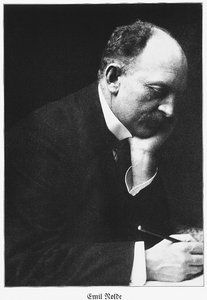
1867–1956, Danimarca
Emil Nolde
La Vita e l'Identità di Emil Nolde Nato Hans Emil Hansen il 7 agosto 1867, l'uomo che sarebbe diventato noto come Emil Nolde crebbe nei pressi del villaggio di Nolde, nel Ducato dello Schleswig. I suoi primi anni furono plasmati dalla vita rurale e agraria della sua famiglia. Col tempo, decise di allontanarsi da quel sentiero, scegliendo invece di lavorare come intagliatore del legno e decoratore di mobili. Questo lavoro manuale, così tattile e fisico, precedette la sua transizione verso la pittura e la stampa.
Altre opere di Emil Nolde
 Tramonto
 Mare con cielo rosso
 Coppia sulla spiaggia1903
 Masks1911
Saggi su Prophet
 I 25 capolavori di Egon Schiele: l'emozione pura dell'EspressionismoScopri i 25 capolavori di Egon Schiele e l'essenza dell'Espressionismo. Esplora la collezione su OriginalUniqueArt.com.
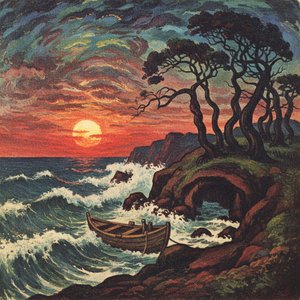 Emile Nolde: Un Viaggio nell'Espressionismo tra Natura e l'Io PrimordialeEsplora il mondo intenso di Emil Nolde, pioniere dell'Espressionismo tedesco. Analisi approfondita della sua arte, dalle origini nordiche a…
 I 25 capolavori di Rogier van der Weyden: l'emozione pura del RinascimentoScopri i 25 capolavori di Rogier van der Weyden e il pathos fiammingo. Esplora la collezione su OriginalUniqueArt.com.