Expressionism
Sea (Emil Nolde)
Emil Nolde (1867–1956) ha realizzato Sea. Fa parte del movimento Expressionism. È realizzato in Oil On Canvas.
- Oil On Canvas

 Anteprima in scala reale

 Dipinto a olio fatto a mano
 Invia
 Condividi
 Scheda didattica


 Scarica
 Simili
 Radiografia
 Slideshow
 Domande e risposte

 Statistiche
Sea, in breve
- Titolo
- Sea
- Artista
- Emil Nolde (1867–1956)
- Artista nato a
- Nolde, Danimarca
- Tecnica
- Oil On Canvas
- Movimento
- Expressionism
- Epoca
- Modern
- Soggetto
- sea, sky, waves, clouds, blue, orange
Cosa raffigura Sea?
Identification of the Artwork and Artist
The artwork titled Sea is a painting by Emil Nolde. The artist was born in 1867 in Nolde, Denmark. He became a prominent figure in German expressionism, a movement characterized by the use of color and form to convey internal states rather than objective reality.
This specific work, Sea, focuses on a seascape. The composition centers on the interaction between a dramatic sky and the water below. The artist's approach to the subject matter emphasizes the movement of the elements through the application of pigment. The visual presentation relies on the contrast between the tones used for the clouds and those used for the undulating surface of the water.
Composition and Visual Elements
The composition is organized into distinct horizontal bands that establish a layered perspective. The upper portion of the canvas is occupied by a turbulent sky, which transitions into a middle band representing the water’s surface. At the bottom, a suggestion of a distant shoreline or horizon line provides a boundary to the scene. This arrangement creates a sense of depth through the stacking of color and form rather than through traditional linear perspective.
The color palette relies on high-contrast temperature shifts. The sky is dominated by warm yellows and oranges, while the clouds within this upper section contain strokes of purple and red. Below the sky, the sea is rendered in cool blues and greens. These colors are applied in thick, visible strokes that create a palpable texture across the surface. The water is depicted as undulating waves, formed by broad, heavy brushstrokes that emphasize the movement of the liquid surface.
Artistic Style and Technique
The work is executed in an Expressionistic style. The application of paint relies on an impasto technique, where thick layers of pigment are built up on the surface. These layers create a palpable texture that remains visible across the canvas. The paint is not smoothed or blended into a flat plane; instead, the material maintains a physical presence that defines the forms of the sky and the water.
Bold and expressive brushstrokes characterize the entire composition. In the sky, large, amorphous forms are created through the application of color rather than through the use of precise lines or defined outlines. The sea is rendered with broad, undulating strokes that suggest the movement of waves. These strokes are thick and visible, contributing to the overall tactile quality of the surface. The interaction between the light and the heavy pigment creates a sense of luminosity, as the light appears to emanate from behind the cloud forms.
The Artist and His Artistic Movement
Emil Nolde was a German painter and printmaker who emerged as one of the first Expressionists. His practice involved a tactile connection to his materials, a quality stemming from his early years working as a woodcarver and furniture decorator. He was a member of the Die Brücke group, a collective that sought to move away from academic traditions by searching for a new pictorial language. His approach often prioritized the internal sensation of a subject over its literal likeness, focusing on the psychological and the primal through the use of color and form.
The artist explored color extensively in both oil painting and watercolor. In his oil works, he often utilized heavy, golden yellows and deep reds to provide a sense of weight to the surface. From the 1930s until his death, watercolor became a primary medium for him. He found that this medium allowed him to translate his concepts to the paper with greater speed than oil painting. His watercolors often feature vivid, brooding storm-scapes and brilliant florals, where the color functions as the substance of the shape itself.
- Autumn Sea (about 1908)
- The Mocking of Christ (1909)
- Masks (about 1906-1907)
Related Works by Emil Nolde
The artist's exploration of maritime themes continues in several other compositions. Autumn Sea presents a turbulent seascape where deep reds, magenta, and pink appear in the foreground waves against a sky of yellow and orange. In Sea and ship in the sunset, an oil on canvas, the composition features a large expanse of sky transitioning from yellow to orange above a body of water that reflects these specific tones. This work includes a solitary vessel drifting toward the horizon.
Other works demonstrate a focus on atmospheric conditions and different mediums. Sea with Red Sky is an expressionist painting where the sky is rendered in a deep, saturated red. In Light Sea Mood, the scene depicts the ocean at sunset with a beach in the foreground and clouds forming a backdrop. The water meets the shore in a manner described as calm and serene, featuring two people standing upon the sand.
The artist also utilized watercolor to capture movement. Stormy Sea is a watercolor landscape painting from 1930. This piece contains organic lines and uses bright colors, specifically blues and oranges. The work includes two boats on the horizon and a steam boat positioned off to the right side. The orange light in the sky contrasts with the dark blue waters, and white pigment is used to indicate the crests of moving waves.
Immagini ad alta risoluzione di Sea
Pubblico dominio: l'artista è deceduto nel 1956.
Emil Nolde, Sea. Pubblico dominio
Domande su Sea, risposte
Con quale tecnica è realizzato "Sea"?
"Sea" è realizzata con Oil On Canvas.
Cosa rappresenta "Sea" di Emil Nolde?
I temi presenti in "Sea" di Emil Nolde includono sea, sky, waves, clouds, blue, orange, yellow, horizon, elementi che insieme sintetizzano il soggetto dell'opera.
L'immagine di "Sea" di Emil Nolde può essere riprodotta liberamente?
Per quanto riguarda il copyright, "Sea" è di pubblico dominio - il copyright è scaduto.
Chi è l'artista dietro "Sea"?
"Sea" è attribuito a Emil Nolde.
A quale movimento artistico appartiene "Sea" di Emil Nolde?
Il movimento associato a "Sea" di Emil Nolde è Expressionism. Questa classificazione colloca l'opera tra artisti e opere d'arte correlati.
A quale fase della carriera di Emil Nolde appartiene "Sea"?
"Sea" appartiene al Mature Period della carriera di Emil Nolde. Questa classificazione riconduce l'opera all'evoluzione dell'artista.
Per quale motivo lo stato del copyright di "Sea" è questo?
Lo stato del copyright di "Sea" - di pubblico dominio - il copyright è scaduto - è determinato dalla data di morte dell'artista, avvenuta nel 1956.
In che modo "Sea" si inserisce nel percorso artistico di Emil Nolde?
All'interno della produzione di Emil Nolde, "Sea" si inserisce nello stile Expressionism, affiancandosi ai temi di post-impressionism, die brücke, expressionism, subjective emotion, nature's raw power.
Il soggetto di "Sea" è coerente con i temi abituali di Emil Nolde?
I temi ricorrenti di Emil Nolde includono post-impressionism, die brücke, expressionism, subjective emotion, nature's raw power; "Sea" si concentra su sea, sky, waves, clouds, blue, orange, yellow, horizon.
Informazioni sull'artista, Emil Nolde
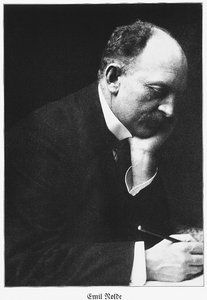
1867–1956, Danimarca
Emil Nolde
La Vita e l'Identità di Emil Nolde Nato Hans Emil Hansen il 7 agosto 1867, l'uomo che sarebbe diventato noto come Emil Nolde crebbe nei pressi del villaggio di Nolde, nel Ducato dello Schleswig. I suoi primi anni furono plasmati dalla vita rurale e agraria della sua famiglia. Col tempo, decise di allontanarsi da quel sentiero, scegliendo invece di lavorare come intagliatore del legno e decoratore di mobili. Questo lavoro manuale, così tattile e fisico, precedette la sua transizione verso la pittura e la stampa.
Altre opere di Emil Nolde
 Tramonto
 Mare con cielo rosso
 Coppia sulla spiaggia1903
 Masks1911
Saggi su Sea
 Pittori tedeschi del XVIII secoloScopri i capolavori di Caspar David Friedrich e del Romanticismo tedesco. Esplora la collezione su OriginalUniqueArt.com.
 Emil Nolde: i 25 capolavori più potenti dell'EspressionismoScopri i 25 capolavori di Emil Nolde e l'essenza dell'Espressionismo. Esplora la collezione su OriginalUniqueArt.com.
 Espressionismo vs. Nuova Oggettività: Emozione vs. Precisione nell'arte tedescaScopri le differenze tra Espressionismo e Nuova Oggettività nell'arte tedesca. Analizza i grandi maestri con la nostra guida esperta.