Romanticism · 1829
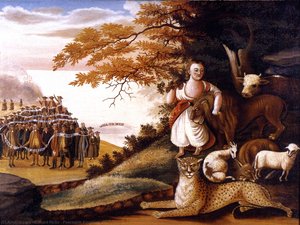
Peaceable Kingdom (Edward Hicks, 1829)
Edward Hicks (1780–1849) ha realizzato Peaceable Kingdom. Risale al 1829. Fa parte del movimento Romanticism. È realizzato in Oil On Canvas.
- 1829
- Oil On Canvas

 Anteprima in scala reale

 Dipinto a olio fatto a mano
 Invia
 Condividi
 Scheda didattica


 Scarica
 Simili
 Radiografia
 Slideshow
 Domande e risposte

 Statistiche
Peaceable Kingdom, in breve
- Titolo
- Peaceable Kingdom
- Artista
- Edward Hicks (1780–1849)
- Artista nato a
- Langhorne, Stati Uniti d'America
- Date
- 1829
- Tecnica
- Oil On Canvas
- Movimento
- Romanticism
- Epoca
- 19th Century
- Soggetto
- pastoral scene, adam and eve, animal kingdom, edenic landscape, biblical story, harmony nature
Cosa raffigura Peaceable Kingdom?
Identification of the Peaceable Kingdom Artwork
This artwork is Peaceable Kingdom (18) by the American folk painter Edward Hicks. The piece was created in 1829. It belongs to a significant series of compositions that the artist produced throughout his life. Hicks was a man of dual vocations, living as both a dedicated Christian minister and a painter. He was a member of the Society of Friends.
Edward Hicks was born on April 4th, 1780, in Langhorne, United States. His background as a minister informed the visual language he employed on canvas. This specific iteration of the Peaceable Kingdom reflects his position at the intersection of religious devotion and American folk art tradition. The work is an oil painting on canvas.
The Composition and Visual Elements
The arrangement of the scene relies on an asymmetric balance. On one side, various animals gather in a manner that avoids strict symmetry. A lion reclines in close proximity to a lamb, while a leopard is positioned alongside a kid goat. These figures occupy the landscape alongside a child who guides a wolf or yearling. The placement of these subjects creates a sense of organized movement across the pictorial space.
The landscape features an outdoor setting where the light source originates from the sky or the sun. The color palette utilizes warm or brown tones, maintaining a consistent temperature throughout the composition. The figures and animals are distributed across the terrain, with some elements appearing in the foreground and others receding into the distance. This layering of objects provides a sense of depth within the wooded environment.
The Artist and His Unique Style
Edward Hicks was an American folk painter who also functioned as a distinguished Quaker minister. His artistic development was shaped by his early training as an apprentice to coach makers, where he mastered decorative painting on surfaces like carriages and furniture. This practical background contributed to a distinctly American folk art style. His compositions often utilize asymmetric balance, where the arrangement of figures and animals does not follow strict formal symmetry but maintains a visual equilibrium. The color palettes in his work are frequently uncomplicated, relying on warm or brown tones to establish a sense of uniformity.
The technique employed in his paintings involves a visible but blended application of paint. He often utilized an outdoor setting as the backdrop for his subjects, frequently placing the light source in the sky or the sun to illuminate the scene. His approach to form is characterized by organic lines that follow the natural contours of the animals and foliage. Rather than using highly detailed rendering, he achieved depth through the layering of objects and subtle variations in color intensity. This method creates a sense of calm and order within the landscape.
Thematic and Religious Interpretations
The imagery in this work is rooted in the biblical prophecy found in Isaiah 11:6–9. This scripture describes a state of universal harmony where natural predators and prey coexist without violence. The presence of specific animals, such as a lion reclining with a lamb or a leopard alongside a kid goat, functions as a visual representation of this prophetic vision. These figures symbolize the cessation of predation and the restoration of an Edenic peace within the natural order.
Hicks utilized these compositions to reflect his personal Quaker theology, specifically regarding the quest for a redeemed soul and the attainment of moral redemption. The arrangement of animals and children suggests a divine order where conflict is replaced by tranquility. Furthermore, the painting reflects a specific belief that the landscape of Pennsylvania represented a physical fulfillment of the peace foretold in the Book of Isaiah. Through this lens, the pastoral scene becomes a visual manifestation of a spiritual and social ideal of justice and gentleness.
Related Works by Edward Hicks
Edward Hicks produced over sixty variations of the Peaceable Kingdom throughout his career. These compositions often feature different arrangements of animals and figures within a landscape. One such version, Peaceable Kingdom (18), was created in 1829. Another iteration, Peaceable Kingdom (39), dates to 1832. The artist continued to produce these works into his later years, including Peaceable Kingdom (21) in 1849.
The variations in these paintings often involve the specific placement of predators and prey. Common elements include a lion reclining with a lamb, a leopard alongside a kid goat, and a child guiding a wolf. Some versions incorporate historical or religious figures, such as William Penn negotiating treaties with Native Americans, while others focus on the animals and children interacting in an outdoor setting. The color palettes across these works frequently utilize warm or brown tones to maintain a sense of uniformity.
Immagini ad alta risoluzione di Peaceable Kingdom

Pubblico dominio: l'artista è deceduto nel 1849.
Altre dimensioni, ritagli e citazioni →Edward Hicks, Peaceable Kingdom (1829). Pubblico dominio
Domande su Peaceable Kingdom, risposte
In che anno è stata realizzata "Peaceable Kingdom"?
L'opera "Peaceable Kingdom" di Edward Hicks risale al 1829.
Quale tecnica è stata utilizzata per "Peaceable Kingdom" di Edward Hicks?
"Peaceable Kingdom" è realizzata con Oil On Canvas.
Qual è il soggetto di "Peaceable Kingdom"?
I soggetti di "Peaceable Kingdom" sono pastoral scene, adam and eve, animal kingdom, edenic landscape, biblical story, harmony nature, american art, folk art.
"Peaceable Kingdom" è di pubblico dominio?
"Peaceable Kingdom" di Edward Hicks è di pubblico dominio - il copyright è scaduto. Questo stato determina le modalità con cui l'immagine dell'opera può essere riprodotta.
Chi ha creato "Peaceable Kingdom"?
"Peaceable Kingdom" è attribuito a Edward Hicks.
A quale corrente artistica appartiene "Peaceable Kingdom" di Edward Hicks?
"Peaceable Kingdom" di Edward Hicks appartiene al movimento Romanticism. Questo movimento fornisce il contesto stilistico dell'opera.
A quale periodo della carriera di Edward Hicks appartiene "Peaceable Kingdom"?
"Peaceable Kingdom" rappresenta il Mature Period di Edward Hicks.
Quanti anni aveva Edward Hicks quando ha creato "Peaceable Kingdom" nel 1829?
Quando "Peaceable Kingdom" fu creata nel 1829, Edward Hicks - nato nel 1780 - aveva 49 anni.
Per quale motivo lo stato del copyright di "Peaceable Kingdom" è questo?
"Peaceable Kingdom" di Edward Hicks è di di pubblico dominio - il copyright è scaduto. La durata del copyright decorre dalla morte dell'artista, avvenuta nel 1849.
Informazioni sull'artista, Edward Hicks

1780–1849, Stati Uniti d'America
Edward Hicks
Primi Anni e Formazione Nato: 4 aprile 1780, ad Attleboro (ora Langhorne), Bucks County, Pennsylvania Morto: 23 agosto 1849 I genitori erano anglicani, ma fu cresciuto dalla Matrona Elizabeth Twining, una Quacchera. Questo lo introdusse alle credenze quacchere in tenera età. Apprendista presso i produttori di carrozze William e Henry Tomlinson a partire dai tredici anni, imparando tecniche di pittura per carrozze. Lasciò l'azienda nel 1800 per lavorare in modo indipendente come pittore di case e carrozze.
Altre opere di Edward Hicks
 Regno Pacifico (39)1832
 L'arca di Noè1846
 Il trattato di Penn con gli indiani1830
 La fattoria Cornell1848
Saggi su Peaceable Kingdom
 Edward Hicks’ ‘Peaceable Kingdom’: American Folk Art & the Shaping of a National IdentityExplore the profound symbolism & historical context of Edward Hicks’ ‘Peaceable Kingdom.’ Discover how this iconic American folk art master…
 Pintori britannici del XIX secoloScopri i capolavori di William Robinson e E. J. Turner. Esplora la collezione su OriginalUniqueArt.com per riproduzioni di alta qualità.
 Opere d'arte americane degli anni 1840Scopri i capolavori americani degli anni 1840 tra George Catlin e Winslow Homer. Esplora la collezione su OriginalUniqueArt.com.