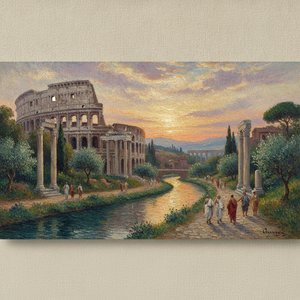
A Living Chronicle of Roman Grandeur
Piazza di Campitelli stands as a profound testament to Rome's enduring spirit, acting as a living chronicle that transcends the boundaries of mere urban space. More than just an intersection of ancient cobblestones and storied buildings, it embodies the grandeur of imperial ambition, the fervor of religious devotion, and the blossoming creativity of the Renaissance. Located in the heart of Rione X , this square possesses a strategic position that overlooks the Capitoline Hill and Trajan's Forum, offering breathtaking vistas that have captivated the souls of artists for generations. Historically, the area evolved from a bustling Market Square into a focal point for civic life and intellectual discourse. The echoes of history are palpable here; one can almost sense the religious fervor ignited by St. Bernardino of Siena’s sermons in 1442, or the scholarly energy brought by the founding of the Collegio Romano by St. Ignatius of Loyola . It is a place where the layers of time are not merely observed but felt, as the square bears the scars and triumphs of dramatic urban transformations.
Architectural Masterpieces and Stylistic Dialogues
The architectural landscape of the Piazza offers a breathtaking dialogue between distinct artistic eras, presenting a collection of structures that reflect the evolving tastes of Roman patrons. The eye is immediately drawn to Palazzo Muti-Bussi , completed around 1585 by the master Giacomo della Porta . This magnificent palace showcases a revolutionary pentagonal structure, a bold departure from conventional design, featuring an entrance adorned with an intricately carved crest that speaks to the precision of classical ornamentation. In delightful contrast, the Palazzo Fani presents a more delicate, Mannerist aesthetic, characterized by a graceful frieze embellished with floral motifs that reflect the humanist ideals of its time. This architectural tension is harmonized by the central fountain, also a creation of Della Porta , which stands as a sculptural masterpiece embodying the Renaissance fascination with hydraulic engineering and classical form. For the collector or designer, these facades offer an unparalleled study in geometric precision and ornamental elegance.
A Vista Beyond Time: The Artist's Muse
What truly distinguishes Piazza di Campitelli is its unparalleled panoramic view, a spectacular urban landscape that serves as a window into the very heart of the Eternal City. While the ambitious construction of the Vittoriano monument and subsequent demolitions altered the square’s original intimacy, they paradoxically unveiled a vista of immense power. From this vantage point, one can gaze upon the majestic Capitoline Hill , the iconic Trajan's Column , and the imposing Torre delle Milizie , all framed within a single, dramatic perspective. This unique landscape has long served as an inspiration for painters such as Frederick Childe Hassam and Aleksandr Deineka , who sought to capture the spirit of Rome through their canvases. To visit the Piazza is to witness a masterpiece of urban composition, where the ancient and the modern coalesce into a timeless panorama that continues to inspire awe in every traveler and art lover.