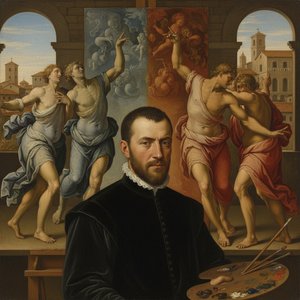
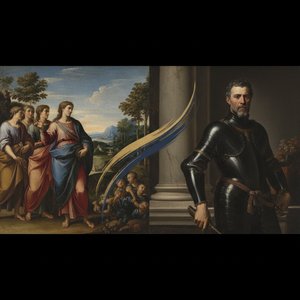
Ventura di Archangelo Salimbeni was born into a family with artistic ties. His father, Arcangelo Salimbeni, was a painter in Siena, providing Ventura with his initial training.
He studied alongside his half-brother, Francesco Vanni, also an artist, under their father's tutelage. This close collaboration significantly shaped Ventura’s early development.
The artistic environment of Siena, steeped in tradition and patronage from religious orders and noble families, fostered his burgeoning talent.
Roman Period and Early Career
Around 1588, Salimbeni moved to Rome seeking broader opportunities and exposure to the city's vibrant art scene.
He participated in fresco painting at the Vatican Library under Pope Sixtus V, gaining valuable experience working on a large-scale project.
Commissions from Cardinal Bonifacio Bevilacqua Aldobrandini (later Pope Clement VIII) led to works in the Church of the Gesù and Basilica di Santa Maria Maggiore. These commissions demonstrated his rising status.
His Roman style reflected late Mannerism, characterized by complex compositions, dynamic figures, and sophisticated use of light and color. He was influenced by artists like Cavalier d'Arpino.
Return to Siena and Artistic Development
In 1595, Salimbeni returned to Siena, where he continued his artistic career.
He embraced a reformist or Counter-Mannerist style, influenced by Federico Barocci. This is evident in works like "Birth of a Virgin" in the San Domenico church in Ferrara (1607–1608).
Salimbeni produced cycles of paintings for Sienese churches, including the Oratory of Santa Trinità and Santo Spirito.
He was known for detailed preparatory drawings, now held in the Uffizi Gallery in Florence and the Fine Arts Museum of San Francisco.
Major Works and Commissions
"Life of St Hyacinth": A series of paintings for the church of Santo Spirito in Siena, showcasing innovative perspective and style.
Frescoes at Basilica della Santissima Annunziata di Firenze: Lunettes illustrating events in the history of the Servite order (1605–1608).
Frescoes in Assisi: A fresco of "The Resurrection of Christ" and "The Dying Saint Clare is Visited by the Pope" in the vault of chapel of San Massimo in the basilica of Santa Maria degli Angeli.
Frescoes for Church of SS Quirico e Giulitta, Siena: Paintings depicting scenes from the church's patron saints’ lives (around 1603).
"The Ascension of the Virgin": A canvas painted for San Frediano, Pisa (1607).
"Life of Saint Galganus": Oil paintings for the church of the santuccio in Siena (1612).
"Marriage of the Virgin": An oil painting for the Seminario diocesano in Foligno (1613), his last known work.
Influences and Legacy
Federico Barocci: A significant influence on Salimbeni's style, particularly evident in drapery and use of light.
Domenico Beccafumi: An earlier Sienese master whose work informed Salimbeni’s artistic foundation.
Lodovico Cigoli: His rich and harmonious palette influenced Salimbeni’s color choices.
Salimbeni's etchings, created in Rome between 1589 and 1594, are considered among the finest Italian prints of the period.
Explore the captivating world of Domenico Beccafumi, a pivotal figure bridging Mannerism & Baroque art. Discover his unique style, religious masterpieces, and lasting legacy with OriginalUniqueArt.
Explore the captivating art of Sebastiano del Piombo, a Renaissance master bridging Venetian colorism & Roman grandeur. Discover his iconic portraits and lasting influence on art history. Learn more at OriginalUniqueArt.
Which artistic movement is Ventura Salimbeni most associated with?
High Renaissance
Milyen színpaletta jellemzi Ventura Salimbeni munkásságát?
earthy
Who significantly influenced Salimbeni's early artistic development, besides his father?
Michelangelo
Milyen más neveken is ismert Ventura Salimbeni?
Bevilacqua Salimbeni, Ventura Salembene, Ventura di Arcangelo Salimbeni, Ventura Salimbeni Senese, Ventura Salinbene, Ventura Salinbeni, Salembeni, gen. Cavaliere Bevilacqua Bonaventura Salimbeni, Ventura Salembeni, A. Salimbeni
Mi a(z) legnépszerűbb Ventura Salimbeni festmény a ArtsDot.com oldalon?
The Annunciation
Mely művészeti korszakba tartozott Ventura Salimbeni?
Renaissance
Hol és mikor született Ventura Salimbeni?
1568, Siena, Italy
Hány Ventura Salimbeni festménye található a ArtsDot.com oldalon?
8
Ki Ventura Salimbeni?
Early Life and Artistic Training
Born: Siena, Italy, January 20, 1568
Died: 1613, Siena, Italy
Ventura di Archangelo Salimbeni was born into a family with artistic ties. His father, Arcangelo Salimbeni, was a painter in Siena, providing Ventura with his initial training.
He studied alongside his half-brother, Francesco Vanni, also an artist, under their father's tutelage. This close collaboration significantly shaped Ventura’s early development.
The artistic environment of Siena, stee
Még szerzői jogi védelem alatt áll Ventura Salimbeni munkássága?
Nem, e művész alkotásai a jogi szabad tartományba tartoznak.