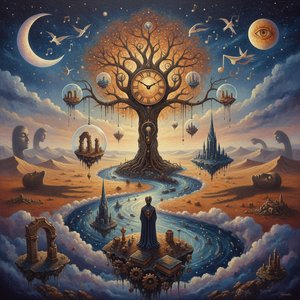
A Life Immersed in Imagination: The World of Julian Trevelyan
Julian Otto Trevelyan, born in Dorking, Surrey, in 1910, was a figure who navigated the currents of 20th-century British art with an independent spirit and a deeply personal vision. He wasn’t merely a painter or printmaker; he was a storyteller, a dreamer, and a dedicated educator whose influence resonated through generations of artists. Trevelyan's lineage hinted at a life steeped in intellectualism – his grandfather was the liberal politician Sir George Trevelyan, and his uncle the renowned historian G.M. Macaulay Trevelyan – yet he forged his own path, one that led him from the hallowed halls of Cambridge to the vibrant artistic milieu of 1930s Paris and ultimately back to a riverside studio in Hammersmith, London, which would become both home and creative sanctuary for the rest of his life. His early education at Bedales School fostered an environment of free thought, while studies in English Literature at Trinity College, Cambridge, provided a foundation for the narrative quality that would permeate much of his work. However, it was the pull towards visual expression that proved strongest, prompting him to abandon academic pursuits and seek artistic training abroad.Early Life and Influences
Trevelyan’s formative years instilled in him a profound appreciation for both literature and observation—a duality that would become central to his artistic sensibility. Bedales School nurtured his inquisitive mind, encouraging independent thinking and fostering a love of nature. Cambridge University cemented this intellectual grounding with rigorous study of English Literature, shaping his understanding of storytelling and symbolism. Crucially, Trevelyan recognized the transformative power of art itself, rejecting conventional academic paths in favor of pursuing visual experimentation. This decision was profoundly influenced by his family’s intellectual heritage—the liberal convictions of Sir George Trevelyan and the historical scholarship of G.M. Macaulay Trevelyan—creating an environment where artistic ambition could flourish alongside scholarly pursuits.Parisian Encounters and Surrealist Exploration
The pivotal moment in Trevelyan's artistic development arrived in 1931 when he relocated to Paris, enrolling at Atelier Dix-Sept, Stanley William Hayter’s groundbreaking engraving school. This institution wasn’t simply a place of technical instruction; it was an immersion into the epicenter of avant-garde creativity—a crucible where artists like Max Ernst, Oskar Kokoschka, Joan Miró and Pablo Picasso challenged established artistic conventions. The Atelier Dix-Sept experience ignited Trevelyan's passion for Surrealism, exposing him to techniques rooted in automatism and fueled by subconscious imagery. He became a founding member of the British Surrealist Group in 1936, participating in the International Surrealist Exhibition held at New Burlington Galleries in London that same year. This engagement with Surrealism profoundly shaped his artistic vision—he embraced its rejection of rational thought and celebrated the realm of dreams as a source of inspiration.Wartime Service and Artistic Resilience
The Second World War dramatically altered Trevelyan’s trajectory, compelling him to serve as a camouflage officer in the Royal Engineers during North Africa and Palestine from 1940 to 1943. This experience honed his observational skills and instilled in him an understanding of visual deception—skills that would later inform his artistic practice. Simultaneously, he continued to develop his artistic talent, producing evocative landscapes and prints that captured the spirit of the era. Trevelyan’s unwavering dedication to art persisted despite the challenges posed by wartime service, demonstrating remarkable resilience and reaffirming his belief in the transformative power of creative expression.The Thames Suite and Legacy
Trevelyan's magnum opus, *The Thames Suite*, completed in 1969, stands as a testament to his lifelong fascination with the River Thames—a subject he revisited repeatedly throughout his career. This ambitious project wasn’t merely a topographical depiction; it was an exploration of the river’s history, mythology and emotional resonance. Trevelyan blended realism with fantastical elements, creating images that were both familiar and unsettling—reflecting his artistic philosophy: to capture essence rather than mere representation. His work gained recognition as a cornerstone of modern printmaking, influencing generations of artists who embraced similar stylistic approaches. Julian Trevelyan received a Senior Fellowship at the Royal College of Art in 1986 and was appointed a Royal Academician in 1987—solidifying his place within British art history. He died peacefully in Hammersmith in 1988, leaving behind a rich and varied body of work that continues to inspire admiration and contemplation. Trevelyan’s legacy resides not only in his artistic achievements but also in the enduring influence he exerted on subsequent generations of artists—a testament to his unwavering commitment to imaginative vision and experimental technique.Gyakran Ismételt Kérdések
Mely Trevelyan Julian művei a legnézettebbek?
Létre van hozva egy Statisztika oldal Trevelyan Julian számára, amely statisztikákat mutat be a művész alkotmányairól a ez a weboldal felületén.
Létezik-e egy időrendi áttekintés Trevelyan Julian műveiről?
Megக் exists egy időrendi áttekintés Trevelyan Julian műveiről: a művész Műalkotások időrendje oldala a alkotások létrehozásának dátuma szerint rendszerezi a műveket.
Hol és 어느 해 született Trevelyan Julian?
Trevelyan Julian Dörög városban született, 1910 évben.