Pinturicchio portréja

A 78 legnevesebbebb Pinturicchio festmény, mindegyik egyedistens

Frissítve: november 2026 · rangsorolva népszerűségi pontszámunk alapján (minden mű keresései, látogatásai és megrendelései alapján) · 87 mű Pinturicchio alkotása a katalógusunkban

Röviden

Saint Catherine of Alexandria with a Donor (1490) az a Pinturicchio festmény, amely a legtöbb tekintetet felvonja; az eredeti mű a National Gallery gyűjteményében található, London. Ezután a tekintet Virgin and Child with Saints Jerome and Francis of Assisi (1485) és The beheading of Saint Catherine of Alexandria (1485) elemre irányul. A Pinturicchio 87 műve közül a katalógusunkban megtalálható 78 legnépesebb alkotás, melyeket az év, a múzeum és az örökévalóságának okai kísérnek.

1454 – 1513, Perugia Renaissance A legtöbb mű: Galleria Nazionale dell'Umbria

A galéria szemével: Pinturicchio legjobb 10 festménye

1
Saint Catherine of Alexandria with a Donor (1490) (1889) -ja Pinturicchio

Saint Catherine of Alexandria with a Donor

1490 · Tempera On Panel · National Gallery, London

This Renaissance-era tempera painting on panel, dated 1490, presents a vertical and balanced religious scene. The composition features two primary figures set against a landscape background. At the center stands Saint Catherine of Alexandria, identified by her crown and a broken wheel. She is depicted looking down toward a male donor, who is shown in profile kneeling with his hands pressed together in prayer. The scene is characterized by smooth,…

2
Virgin and Child with Saints Jerome and Francis of Assisi (1485) (1889) -ja Pinturicchio

Virgin and Child with Saints Jerome and Francis of Assisi

1485 · Tempera On Panel · Yale University Art Gallery, New Haven

In this devotional scene, the Virgin and Child with Saints Jerome and Francis of Assisi appear before us, held within a quiet, sacred space. The Madonna holds the Christ Child, their presence forming the central focus of the composition. They are flanked by two holy figures who watch over the viewer. To the left, Saint Jerome is draped in the red robes of a cardinal, while to the right, Saint…

3
The beheading of Saint Catherine of Alexandria (1485) (1889) -ja Pinturicchio

The beheading of Saint Catherine of Alexandria

1485 · Tempera On Panel · Bonnefanten Museum, Maastricht

In The beheading of Saint Catherine of Alexandria, painted by Pinturicchio about 1485, the central figure is depicted in a state of prayerful submission. The saint kneels in the lower left foreground, her body oriented toward the right side of the composition. She wears a flowing red cloak draped over a dark garment. Her head is encircled by a golden halo, and her face is upturned toward the sky. This…

5
Madonna with child (1479) (1889) -ja Pinturicchio

Madonna with child

1479 · Tempera On Panel

This vertical composition from 1479 captures a quiet moment of maternal connection. The Virgin Mary holds the Christ Child in a tight, intimate arrangement that prioritizes the physical and emotional bond between mother and son. Her mantle, rendered in deep, dark tones, provides a heavy frame for the luminous, pale skin of the figures. In the background, a distant landscape unfolds through atmospheric perspective, where stylized trees and soft contours…

6
Virgin and Child (1495) (1889) -ja Pinturicchio

Virgin and Child

1495 · Tempera On Panel · Cleveland Museum of Art, Cleveland

In this vertical portrait from 1495, we find ourselves in the presence of a serene, devotional scene. The Virgin Mary is the central figure, shown from the waist up as she cradles the Christ Child in her lap. There is a natural movement to her posture, a slight off-center positioning that avoids the stiffness of more formal compositions. She is draped in a deep blue mantle over a muted pink…

7
Virgin and Child with St John the Baptist (1490) (1889) -ja Pinturicchio

Virgin and Child with St John the Baptist

1490 · Tempera On Panel · Fitzwilliam Museum

The work before us is titled Virgin and Child with St John the Baptist. It was executed by the Italian Renaissance painter Pinturicchio, whose given name was Bernardino di Betto. This particular piece dates to about 1490, a period during which the artist was establishing his presence within the artistic landscape of Italy. Pinturicchio lived from 1454 to 1513, a span of years that saw the transition into the High…

8
Madonna and Child with Saint John the Baptist (1492) (1889) -ja Pinturicchio

Madonna and Child with Saint John the Baptist

1492 · Tempera On Panel · Museum of Fine Arts, Houston, Houston

Created in 1492, Madonna and Child with Saint John the Baptist is a serene and highly detailed Renaissance religious painting. The composition is centered on the large figure of the Virgin Mary seated in the foreground, establishing a strong pyramidal structure that anchors the entire piece. Mary is depicted nursing the Christ Child, while Saint John the Baptist appears in the mid-ground. The scene is set within a lush, expansive…

9
Madonna and Child with St. John the Baptist (1490) (1889) -ja Pinturicchio

Madonna and Child with St. John the Baptist

1490 · Oil On Panel · Varsói Nemzeti Múzeum, Varsó

The composition follows a strict pyramidal structure, centering the Virgin Mary and the Christ Child against a rugged landscape. Deep blue and red tones define the primary figures, creating a visual weight that anchors the scene. Soft, diffused light illuminates the faces and hands, utilizing subtle chiaroscuro to suggest three-dimensionality. In the background, atmospheric perspective renders distant mountains in lighter, less detailed hues, providing a sense of depth behind the…

10
Holy Family and Saint John (1493) (1889) -ja Pinturicchio

Holy Family and Saint John

1493 · Tempera On Panel · Harvard Art Museums, Cambridge

The artwork, titled Holy Family and Saint John, is a Renaissance-style painting created in 1493. The composition presents an intimate, close-up grouping of four figures set against a landscape background. In the center, the Virgin Mary is depicted with a downward gaze, her head covered by a dark veil that drapes over her shoulders. To her left, an older man, Saint Joseph, is partially visible looking toward the children. The…

Pinturicchio híres festményei, 11 és 78 között

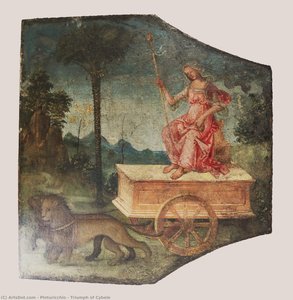
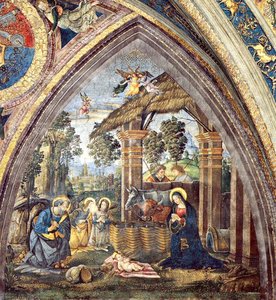
11Saint Bartholomew (1497) (1889) -ja PinturicchioSaint Bartholomew1497 12The Virgin and Child (1492) (1889) -ja PinturicchioThe Virgin and Child1492 · Isabella Stewart Gardner Museum 13Madonna and Child with St. Jerome and St. Gregory the Great (1502) (1889) -ja PinturicchioMadonna and Child with St. Jerome and St. Gregory the Great1502 14Portrait of a Young Man (1500) (1889) -ja PinturicchioPortrait of a Young Man1500 · Brooklyn Museum 15Helle on a Ram (1509) (1889) -ja PinturicchioHelle on a Ram1509 16Triumph of Cybele (1509) (1889) -ja PinturicchioTriumph of Cybele1509 17Putto with garlands (1509) (1889) -ja PinturicchioPutto with garlands1509 18Putto with garlands (1509) (1889) -ja PinturicchioPutto with garlands1509 19Untitled (D2X9QX) (1509) (1889) -ja PinturicchioUntitled (D2X9QX)1509 20Triumph of a Warrior (1509) (1889) -ja PinturicchioTriumph of a Warrior1509 21Rape of Proserpine (1509) (1889) -ja PinturicchioRape of Proserpine1509 22Antique Hero (1889) -ja PinturicchioAntique HeroMusée du Petit Palais 23Portrait of a Boy (1889) -ja PinturicchioPortrait of a Boy 24Untitled (739) (1889) -ja PinturicchioUntitled (739) 25Susanna and the Elders (1889) -ja PinturicchioSusanna and the Elders 26Aeneas Piccolomini Leaves for the Council of Basle (1889) -ja PinturicchioAeneas Piccolomini Leaves for the Council of Basle 27Deux Children Sitting, (1513) (1889) -ja PinturicchioDeux Children Sitting,1513 · Château de Chantilly 28Putto with garlands (1509) (1889) -ja PinturicchioPutto with garlands1509 29Rape of Europa (1509) (1889) -ja PinturicchioRape of Europa1509 30Jupiter and Antiope (1509) (1889) -ja PinturicchioJupiter and Antiope1509 31Galatea (?) (1509) (1889) -ja PinturicchioGalatea (?)1509 32Venus and Cupid (1509) (1889) -ja PinturicchioVenus and Cupid1509 33Bacchus, Pan and Silenus (1509) (1889) -ja PinturicchioBacchus, Pan and Silenus1509 34The Three Graces (1509) (1889) -ja PinturicchioThe Three Graces1509 35Triumph of Mars (1509) (1889) -ja PinturicchioTriumph of Mars1509 36Triumph of Alexander (1509) (1889) -ja PinturicchioTriumph of Alexander1509 37Untitled (627) (1889) -ja PinturicchioUntitled (627) 38Untitled (349) (1889) -ja PinturicchioUntitled (349) 39Untitled (836) (1889) -ja PinturicchioUntitled (836) 40Untitled (919) (1889) -ja PinturicchioUntitled (919) 41Untitled (212) (1889) -ja PinturicchioUntitled (212) 42Untitled (963) (1889) -ja PinturicchioUntitled (963) 43Untitled (643) (1889) -ja PinturicchioUntitled (643) 44Death of St. Bernardine (1889) -ja PinturicchioDeath of St. Bernardine 45The Resurrection (center view) (1889) -ja PinturicchioThe Resurrection (center view) 46Pope Aeneas Piccolomini Canonizes Catherine of Siena (detail) (1889) -ja PinturicchioPope Aeneas Piccolomini Canonizes Catherine of Siena (detail) 47Untitled (487) (1889) -ja PinturicchioUntitled (487) 48The Return of Odysseus (1889) -ja PinturicchioThe Return of Odysseus 49Aeneas Piccolomini Canonizes Catherine of Siena (1889) -ja PinturicchioAeneas Piccolomini Canonizes Catherine of Siena 50Untitled (913) (1889) -ja PinturicchioUntitled (913) 51Adoration of the Christ Child (1889) -ja PinturicchioAdoration of the Christ Child 52Untitled (364) (1889) -ja PinturicchioUntitled (364) 53Aeneas Piccolomini Arrives to Ancona (1889) -ja PinturicchioAeneas Piccolomini Arrives to Ancona 54Untitled (343) (1889) -ja PinturicchioUntitled (343) 55Adoration of the Child (1889) -ja PinturicchioAdoration of the Child 56The Mystical Marriage of St Catherine (1889) -ja PinturicchioThe Mystical Marriage of St Catherine 57Untitled (824) (1889) -ja PinturicchioUntitled (824) 58The arithmetic (1889) -ja PinturicchioThe arithmetic 59The Virgin and Child (1889) -ja PinturicchioThe Virgin and Child 60The resurrection (1889) -ja PinturicchioThe resurrection 61The Return of Odysseus (1889) -ja PinturicchioThe Return of Odysseus 62Bernardino di betto the madonna and child before a landscape (1889) -ja PinturicchioBernardino di betto the madonna and child before a landscape 63The Return of Odysseus (1889) -ja PinturicchioThe Return of Odysseus 64Madonna and Crucifixion and Saints (1496) (1889) -ja PinturicchioMadonna and Crucifixion and Saints1496 · Galleria Nazionale dell'Umbria 65Madonna with Writing Child (1498) (1889) -ja PinturicchioMadonna with Writing Child1498 · Philadelphia Művészeti Múzeum 66The Crucifixion with Sts Jerome and Christopher (1889) -ja PinturicchioThe Crucifixion with Sts Jerome and ChristopherGalleria Borghese 67Saint Augustine (1500) (1889) -ja PinturicchioSaint Augustine1500 · Galleria Nazionale dell'Umbria 68Madonna with Writing Child and St. Jerome (1481) (1889) -ja PinturicchioMadonna with Writing Child and St. Jerome1481 · Gemäldegalerie 69Semi-Gods Ceiling (1490) (1889) -ja PinturicchioSemi-Gods Ceiling1490 70Saint Jerome in the Wilderness (1477) (1889) -ja PinturicchioSaint Jerome in the Wilderness1477 · Walters Art Museum 71Madonna with child (1490) (1889) -ja PinturicchioMadonna with child1490 72Madonna and Child (1494) (1889) -ja PinturicchioMadonna and Child1494 · North Carolina Museum of Art 73Madonna with Writing Child and Bishop (1495) (1889) -ja PinturicchioMadonna with Writing Child and Bishop1495 74Coronation of Pius III (1503) (1889) -ja PinturicchioCoronation of Pius III1503 75Madonna del Latte (1492) (1889) -ja PinturicchioMadonna del Latte1492 76Infant Christ blessing (1492) (1889) -ja PinturicchioInfant Christ blessing1492 77Self-portrait (1501) (1889) -ja PinturicchioSelf-portrait1501 78Madonna enthroned with child and saints (1506) (1889) -ja PinturicchioMadonna enthroned with child and saints1506

Pinturicchio híres festményei, korszakonként

A témák, amelyek Pinturicchio figyelmét meghúzták

A négy leggyakorobban előforduló téma ebben az eredeti művekben, mindegyik a legkiválóbb példájával.

A műemlékek, amelyek Pinturicchio eredeti műveit őrzik

A 8 olyan múzeum, amely a legtöbb ezen az oldalon szereplő festményet őrzi.

Múzeum Város Pinturicchio művei Ebből a listából származó festmények
Galleria Nazionale dell'Umbria, PerugiaGalleria Nazionale dell'Umbria Perugia 2 Madonna and Crucifixion and Saints, Saint Augustine
National Gallery, LondonNational Gallery London 1 Saint Catherine of Alexandria with a Donor
Yale University Art Gallery, New HavenYale University Art Gallery New Haven 1 Virgin and Child with Saints Jerome and Francis of Assisi
Bonnefanten Museum, MaastrichtBonnefanten Museum Maastricht 1 The beheading of Saint Catherine of Alexandria
Művészeti Múzeum, Boston, BostonMűvészeti Múzeum, Boston Boston 1 Virgin and Child with Saint Jerome
Cleveland Museum of Art, ClevelandCleveland Museum of Art Cleveland 1 Virgin and Child
Fitzwilliam MuseumFitzwilliam Museum 1 Virgin and Child with St John the Baptist
Museum of Fine Arts, Houston, HoustonMuseum of Fine Arts, Houston Houston 1 Madonna and Child with Saint John the Baptist

Pinturicchio évtizedekig: egy egyedi eredeti mű minden évtizedben

Művek évtizedenként

Váassz ki egy évtizedet, hogy megnézhesd az azt meghatározó eredetiműveket.

Pinturicchio festményei: kérdések a galériának

Mi a leghíresebb műve Pinturicchionek?Fedje fel a választ

Saint Catherine of Alexandria with a Donor (1490), National Gallery, London. Ezután Virgin and Child with Saints Jerome and Francis of Assisi (1485) és The beheading of Saint Catherine of Alexandria (1485) következik.

Milyen életkorában alkotta meg Pinturicchio a(z) Saint Catherine of Alexandria with a Donor műszt?Fedje fel a választ

36 éves: Saint Catherine of Alexandria with a Donor 1490-ből származik, Pinturicchio pedig 1454-ben született.

Melyik tíz festménye Pinturicchio a leghíresebb?Fedje fel a választ

Saint Catherine of Alexandria with a Donor, Virgin and Child with Saints Jerome and Francis of Assisi, The beheading of Saint Catherine of Alexandria, Virgin and Child with Saint Jerome, Madonna with child, Virgin and Child, Virgin and Child with St John the Baptist, Madonna and Child with Saint John the Baptist, Madonna and Child with St. John the Baptist és Holy Family and Saint John. A fenti rangsor a művek évszamarát és a múzeumát jelzi.

Hány mű alkotása ismert Pinturicchio nevében?Fedje fel a választ

Katalógusunkban 87 mű található Pinturicchio alkotótól, 1477 és 1513 év közötti időszakból.

Hol tekinthetők meg a leghíresebb Pinturicchio eredetijeit?Fedje fel a választ

Leginkább Galleria Nazionale dell'Umbria (Perugia), National Gallery (London) és Yale University Art Gallery (New Haven) található. A fenti múzeumi táblázatban mindegyik felsorolásra került.

Melyik időszakban alkotta Pinturicchio a leghíresebb festményeit?Fedje fel a választ

1500s alatt: a jelen laphonon található 78 műből 22 készült ebben az időszakban, köztük Madonna and Child with St. Jerome and St. Gregory the Great.

Melyik híres Pinturicchio festmény a legkorábbi, és melyik a legutóbb készült?Fedje fel a választ

Ezen az oldalon a leghitelesebb Virgin and Child with Saint Jerome (1477), a legutóbbi pedig Deux Children Sitting, (1513).

Milyen témakörket kedvelt Pinturicchio?Fedje fel a választ

Woman (17), Child (11) és Man (10), a jelen oldalon található 78 műművészeti alkotás között.

Milyen anyagokkal festett leggyakrabban Pinturicchio?Fedje fel a választ

Tempera On Panel, a jelen oldalon található 78 műből 13 darab esetén.

Mely művészeti irányba tartozik Pinturicchio műve?Fedje fel a választ

Renaissance, ezen az oldalon található eredetiek alapján.

Milyen Pinturicchio eredeti műveket láthatok a Galleria Nazionale dell'Umbria kiállításaiban?Fedje fel a választ

Madonna and Crucifixion and Saints és Saint Augustine: a Galleria Nazionale dell'Umbria, Perugia 2 művet őrzi ezen az oldalon.

Pinturicchio: a művész portréja

Pinturicchio rejtélyes eleganciája: A reneszánsz mester

Bernardino di Betto, ahogy a világ ismeri, Pinturicchio – egy kedves becenév, amelyet alacsony termetére tekintettek – 1454-ben született Perugia művészeti szívében. Élete a hatalmas kulturális virágzás idején járt, miközben az olasz reneszánsz virágzott, mégis Pinturicchio egyedi utat választott: a gótikus hagyományok maradék eleganciáját ötvözte a kor növekvő innovációival. Miközben olyan óriások, mint Leonardo da Vinci és Michelangelo az anatómiai tökéletességre és a drámai realizmusra törekedtek, Pinturicchio finom eleganciával, bonyolult részletekkel és vibráló, dekoratív érzékiséggel jellemzett stílust fejlesztett ki. Útja nem a forradalmi felfordulásról, hanem a kifinomult finomításról szólt – bizonyszat, hogyan képes az établi formákat egyedülálló vonzerővel megtölteni.

Umbri műtermektől a pápi megrendelésekig

Pinturicchio korai képzése némi mystika körül övezi, bár úgy vélik, ismertebb perugiai mesterek, mint Bonfigli és Fiorenzo di Lorenzo irányítása alatt csiszolhatta tudását. A fordulópont akkor érkezett, amikor Pietro Perugino, az umbri iskola egyik meghatározó alakjának köréhez került. Giorgio Vasari szerint Pinturicchio Perugino segédje volt, egy olyan együttműködés, amely kétségtelenül meghatározta művészeti fejlődését. Ez a kapcsolat kulcsfontosságúvá vált a 16. század elején a római Szisztián-kápolnához kapott megrendelés tekintetében. A kor leghírvesztőbb művészei – köztük Botticelli, Ghirlandaio és Signorelli mellett – monumentális projektjéhez járult hozzá, bár sajnos freskói később áldozatul ejtették Michelangelo Sztálorvadása helyét teremtése során. Ez az élmény azonban fontos ugródeszka volt számára, új hatásokat mutatott meg neki, és megszilárdította hírnevét.

A termékeny korszak: Róma és a Borgia-apartmanok

Az 1484 és 1492 közötti évek Pinturicchio számára a magas termékenységet jelentették, elsősorban Rómában tevékenykedve. Olyan neves családoktól kapott megrendeléseket, mint a Della Rovere, díszítve a Santa Maria del Popolo templom kápolnáit egyedi stílusával. Ezek a művek demonstrálták freskotechnikai tudását, amelyet finom alakok, gazdag díszítésű háttér és bonyolott dekoratív motívumok jellemeztek. Azonban az ő helyét a művészettörténetben leginkább a pápi megrendelések, konkrétan Alexander VI. pápa – Rodrigo Borgia – számára készített munkái rögzítették. 1492 és 1494 között a Vatikáni Palota Borgia-apartmanjainak díszítésére feladatolt, ahol mitológiai jeleneket, portrékat és alegóriás ábrázolásokat przedstawító freskókkal díszítette fel a szobákat. Bár a híres Borgia-család kapcsolata miatt megosztóak voltak, ezek az apartmanok a reneszánsz dekoratív művészet lenyűgöző példái, amelyek rivelik Pinturicchio képességét a klasszikus motívumok saját, egyedi esztétikai érzékiséggel való ötvözésére. Az aranyozás, a vibráló színek és az illúziós technikák használata pompás ragyogást teremtett, tükrözve a pápalai udvar hatalmát és ambícióit.

Örökség és maradandó hatás

Pinturicchio művészeti öröksége a finom eleganciáról és a precíz mesterségészetről szól. Bár nem feltétlenül rendelkezett olyan hírnévvel, mint kortársai, hatása a későbbi művésznépeszekre tagadhatatlan. Egyedi stílusa – a gótikus elegancia és a reneszánsz innováció harmonikus ötvözése – mély nyomot hagyott azon, akik értékeltek a finomságot és a részletgazdagságot. Kivételes képességgel rendelkezett vizuálisan lenyűgöző kompozíciók létrehozásában, amelyek egyszerre voltak esztétikailag gyönyörködtetőek és intellektuálisan stimulálóak. Sienában található, 1513-as halála előtt befejezett Piccolomini-könyvtári munkái művészete tartós tehetségének bizonyítékai. A II. Pius pápa életéből származó jeleneket ábrázoló freskók olyan formák és színek tisztaságát mutatják be, amelyek már előre augurálták a magrenesszánsz stílusát. Pinturicchio művészete ma is lenyűgözi a nézőket, egy szépség, finomság és művészi mesterség világába kalauzolva be – egy olyan világba, ahol az „apró festő” finom érintése maradandó nyomot hagyott az olasz reneszánsz művészet tájában.
  • Jelentős művek: Szisztián-kápolyai freskók (megsemmisültek), a Vatikáni Borgia-apartmanok, a sienai Piccolomini-könyvtár.
  • Hatások: Perugino, az umbri festészet iskolája, gótikus hagyományok.