Peder Balke portréja

Peder Balke festményei: A 100 leghíresebb alkotás, egy galéria szemével

Frissítve: november 2026 · rangsorolva népszerűségi pontszámunk alapján (minden mű keresései, látogatásai és megrendelései alapján) · 112 mű Peder Balke alkotása a katalógusunkban

Röviden

A galéria szerint Peder Balke leghíresebb festménye a Old Trees (1840). The North Cape by Moonlight (1848) és Vue de la montagne Kielhornet à Stegen kiegészítik azt a triót, amelyet minden szem felismer. A katalógusunkban szereplő 112 művész Peder Balke alkotásából a galéria az alábbi 100 leghíresebbet mutatja be, amelyek mind egyedi originális művek, a készítés évszámával, a múzeum megnevezésével és a különlegességük leírásával.

1804 – 1887, Hégyő Romantic landscape painting A legtöbb mű: Louvre Múzeum

A galéria top 10 Peder Balke festménye

1
Old Trees (1840) (1889) -ja Peder Balke

Old Trees

1840 · Oil On Canvas

Old Trees is an oil painting by Peder Balke, executed in 1840. The work originates from a period in the artist's career marked by a profound connection to the Norwegian landscape. Balke, a Norwegian Romantic Visionary, was born in 1804 on the island of Helgøya, Norway, and lived until 1887.

2
The North Cape by Moonlight (1848) (1889) -ja Peder Balke

The North Cape by Moonlight

1848 · Oil On Canvas · Metropolitan Művészeti Múzeum, New York

Peder Balke – A Norwegian Romantic Visionary Peder Andersen Balke (1804–1887), born on the humble island of Helgøya in Norway, stands as a singularly original figure within the landscape tradition of the 19th century. His life story is one marked by tenacious artistic dedication against formidable societal constraints—a testament to the enduring value placed upon creativity even amidst modest circumstances. Growing up immersed in the stark beauty of Norway’s countryside…

3
Vue de la montagne Kielhornet à Stegen (1889) -ja Peder Balke

Vue de la montagne Kielhornet à Stegen

Watercolor · Louvre Múzeum, Párizs

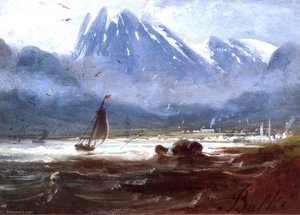
In Vue de la montagne Kielhornet à Stegen, Peder Balke turns his gaze toward the rugged architecture of the Norwegian wilderness. The scene centers on a singular, towering mountain that dominates the view. This jagged peak rises sharply, its stony edges cutting through a hazy, muted atmosphere. Below the heights, the water meets the shore in a quiet line, separating the massive stone from the stillness of the coast.

4
Vardøhus Fortress (1832) (1889) -ja Peder Balke

Vardøhus Fortress

1832 · Oil · Nordnorsk Kunstmuseum, Tromsø

In the quiet, evocative strokes of Peder Balke’s 1832 masterpiece, Vardøhus Fortress, we are transported to the rugged, windswept edges of the Norwegian coast. This painting serves as a profound window into the Romantic era, capturing a moment where the human presence meets the untamed majesty of the North. The scene unfolds within a bustling harbor, where the rhythmic movement of various vessels—ranging from small, intimate boats tucked near the…

5
North Cape (1860) (1889) -ja Peder Balke

North Cape

1860 · Oil · Nordnorsk Kunstmuseum, Tromsø

In the evocative masterpiece North Cape, created in 1860, the legendary Norwegian painter Peder Balke invites us into a realm where the raw power of nature meets a profound, quiet solitude. The canvas unfolds as a dramatic encounter between the restless Atlantic and the rugged coastline, capturing the very essence of the Romantic movement. As waves crash against the shore with visible ferulence, the painting breathes with the rhythm of…

Peder Balke festményei, 11. helyezéstől 100. helyezésig

11"View of Torghatten and the Church of Brön Öe, current Brönnöy (sketch)" (1847) (1889) -ja Peder Balke"View of Torghatten and the Church of Brön Öe, current Brönnöy (sketch)"1847 12"View of Kronbourg at Öresund (sketch)" (1847) (1889) -ja Peder Balke"View of Kronbourg at Öresund (sketch)"1847 13"A [boat] 'Otring' under the Seven Sisters (sketch)" (1847) (1889) -ja Peder Balke"A [boat] 'Otring' under the Seven Sisters (sketch)"1847 14"View of Sarps Fossen (sketch)" (1847) (1889) -ja Peder Balke"View of Sarps Fossen (sketch)"1847 15"View of Fredriks-hald, current Halden (sketch)" (1847) (1889) -ja Peder Balke"View of Fredriks-hald, current Halden (sketch)"1847 16"View of the Parish of Stegen (sketch)" (1847) (1889) -ja Peder Balke"View of the Parish of Stegen (sketch)"1847 17"View of Hjelms-Öe, current Hjelmsö (sketch)" (1847) (1889) -ja Peder Balke"View of Hjelms-Öe, current Hjelmsö (sketch)"1847 18"View of Eidsvold (sketch)" (1847) (1889) -ja Peder Balke"View of Eidsvold (sketch)"1847 19"View of the Altön-Talvig Waterfall (sketch)" (1847) (1889) -ja Peder Balke"View of the Altön-Talvig Waterfall (sketch)"1847 20"View of Fugle-Öe, 'the island of birds' (sketch)" (1847) (1889) -ja Peder Balke"View of Fugle-Öe, 'the island of birds' (sketch)"1847 21"View of North Cape (Norway)" (1847) (1889) -ja Peder Balke"View of North Cape (Norway)"1847 22"View of Drontheim (Norway)" (1847) (1889) -ja Peder Balke"View of Drontheim (Norway)"1847 23The Lighthouse (1845) (1889) -ja Peder BalkeThe Lighthouse1845 · National Museum of Art, Architecture and Design 24From North Cape (1840) (1889) -ja Peder BalkeFrom North Cape1840 · National Museum of Art, Architecture and Design 25Old Trees (1847) (1889) -ja Peder BalkeOld Trees1847 · Statens Museum for Kunst 26Cliffs by the Coast of Northern Norway (1840) (1889) -ja Peder BalkeCliffs by the Coast of Northern Norway1840 27Jostedalsbreen (1840) (1889) -ja Peder BalkeJostedalsbreen1840 · Gothenburg Museum of Art 28The North Cape (1845) (1889) -ja Peder BalkeThe North Cape1845 · Nordnorsk Kunstmuseum 29Seascape (1845) (1889) -ja Peder BalkeSeascape1845 · Statens Museum for Kunst 30The Harbor at Skjervøy (1846) (1889) -ja Peder BalkeThe Harbor at Skjervøy1846 31The Mountain Range 'Trolltindene' (1845) (1889) -ja Peder BalkeThe Mountain Range 'Trolltindene'1845 32Landscape with mill and rapids (1840) (1889) -ja Peder BalkeLandscape with mill and rapids1840 33Moonlight on the Coast at Steigen (1842) (1889) -ja Peder BalkeMoonlight on the Coast at Steigen1842 · Bergen Kunstmuseum 34Frognerkilen and Bygdøy seen from Skillebekk (1855) (1889) -ja Peder BalkeFrognerkilen and Bygdøy seen from Skillebekk1855 · Oslo Museum 35Steigen (1849) (1889) -ja Peder BalkeSteigen1849 36From Hammerfest 1851 (1851) (1889) -ja Peder BalkeFrom Hammerfest 18511851 37Vardøhus Fortress (1850) (1889) -ja Peder BalkeVardøhus Fortress1850 · KODE Art museums and composer homes 38Dresden in Moonlight (1851) (1889) -ja Peder BalkeDresden in Moonlight1851 · National Museum of Art, Architecture and Design 39Tree in a Wintry Forest (1850) (1889) -ja Peder BalkeTree in a Wintry Forest1850 · Statens Museum for Kunst 40Rough Sea with a Steamer near the Coast of Norway (1850) (1889) -ja Peder BalkeRough Sea with a Steamer near the Coast of Norway1850 · Statens Museum for Kunst 41Seascape (1849) (1889) -ja Peder BalkeSeascape1849 · Nationalmuseum 42View of Fredriksten Fortress in Moonlight (1852) (1889) -ja Peder BalkeView of Fredriksten Fortress in Moonlight1852 43A Distant View of Mount Stetind (1849) (1889) -ja Peder BalkeA Distant View of Mount Stetind1849 44The North Cape (1850) (1889) -ja Peder BalkeThe North Cape1850 45View of the Sarpsfossen (1852) (1889) -ja Peder BalkeView of the Sarpsfossen1852 46The North Cape (1853) (1889) -ja Peder BalkeThe North Cape1853 47Moonlit View of Stockholm (1850) (1889) -ja Peder BalkeMoonlit View of Stockholm1850 · Statens Museum for Kunst 48Fredrikshald (1852) (1889) -ja Peder BalkeFredrikshald1852 49Moonlit View of Trondheim (1849) (1889) -ja Peder BalkeMoonlit View of Trondheim1849 50Ullevål gård (1860) (1889) -ja Peder BalkeUllevål gård1860 · Oslo Museum 51Løkken Karlstad by Bogstadveien (1858) (1889) -ja Peder BalkeLøkken Karlstad by Bogstadveien1858 · Oslo Museum 52Rjukanfossen (1860) (1889) -ja Peder BalkeRjukanfossen1860 · Museum Boijmans Van Beuningen 53Coastal Landscape with Wreck (1860) (1889) -ja Peder BalkeCoastal Landscape with Wreck1860 · National Museum of Art, Architecture and Design 54Coastal Landscape (1860) (1889) -ja Peder BalkeCoastal Landscape1860 · Nordnorsk Kunstmuseum 55From the Coast (1860) (1889) -ja Peder BalkeFrom the Coast1860 · National Museum of Art, Architecture and Design 56Coastal Landscape (1860) (1889) -ja Peder BalkeCoastal Landscape1860 · National Museum of Art, Architecture and Design 57A Waterfall (1860) (1889) -ja Peder BalkeA Waterfall1860 · National Museum of Art, Architecture and Design 58Coastal Landscape (1860) (1889) -ja Peder BalkeCoastal Landscape1860 59Finnmark Landscape (1860) (1889) -ja Peder BalkeFinnmark Landscape1860 60Northern Lights (1870) (1889) -ja Peder BalkeNorthern Lights1870 61Månelys (1870) (1889) -ja Peder BalkeMånelys1870 62Vardøhus Fortress (1870) (1889) -ja Peder BalkeVardøhus Fortress1870 · National Museum of Art, Architecture and Design 63Stormy Sea (1870) (1889) -ja Peder BalkeStormy Sea1870 · National Museum of Art, Architecture and Design 64Northern Lights over Coastal Landscape (1870) (1889) -ja Peder BalkeNorthern Lights over Coastal Landscape1870 65From Nordland (1864) (1889) -ja Peder BalkeFrom Nordland1864 · Nationalmuseum 66Nordkapp (1870) (1889) -ja Peder BalkeNordkapp1870 · Trondheim Kunstmuseum 67Mount Gausta (1869) (1889) -ja Peder BalkeMount Gausta1869 68Mount Stetind with Birch (1864) (1889) -ja Peder BalkeMount Stetind with Birch1864 · National Museum of Art, Architecture and Design 69Mount Stetind in the Fog (1864) (1889) -ja Peder BalkeMount Stetind in the Fog1864 70Lighthouse in Mist (1865) (1889) -ja Peder BalkeLighthouse in Mist1865 71Lighthouse on the Coast (1869) (1889) -ja Peder BalkeLighthouse on the Coast1869 · Nordnorsk Kunstmuseum 72North Cape (1869) (1889) -ja Peder BalkeNorth Cape1869 · Nordnorsk Kunstmuseum 73View of Grimstad (1875) (1889) -ja Peder BalkeView of Grimstad1875 · National Museum of Art, Architecture and Design 74VUE DE KONGSBERG (1889) -ja Peder BalkeVUE DE KONGSBERGLouvre Múzeum 75Lighthouse (1874) (1889) -ja Peder BalkeLighthouse1874 76VUE DE COPENHAGUE (1889) -ja Peder BalkeVUE DE COPENHAGUELouvre Múzeum 77VUE DE FUGLO OE (AUJOURD'HUI FUGLOY) (1889) -ja Peder BalkeVUE DE FUGLO OE (AUJOURD'HUI FUGLOY)Louvre Múzeum 78Sea Fortress (1844) (1889) -ja Peder BalkeSea Fortress1844 79UN BATEAU OTRING SOUS LA MONTAGNE LES SEPT SOEURS (1889) -ja Peder BalkeUN BATEAU OTRING SOUS LA MONTAGNE LES SEPT SOEURSLouvre Múzeum 80Landscape from Finnmark with Sami and Reindeer (1889) -ja Peder BalkeLandscape from Finnmark with Sami and ReindeerNordnorsk Kunstmuseum 81VUE DE CHRISTIANIA (AUJOURD'HUI OSLO) (1889) -ja Peder BalkeVUE DE CHRISTIANIA (AUJOURD'HUI OSLO)Louvre Múzeum 82Snøhetta hegy, Dovre (1877) (1889) -ja Peder BalkeSnøhetta hegy, Dovre1877 · Trondheim Kunstmuseum 83VUE DE FREDRIKSHALD (AUJOURD'HUI HALDEN) (1889) -ja Peder BalkeVUE DE FREDRIKSHALD (AUJOURD'HUI HALDEN)Louvre Múzeum 84Gaustatoppen (1889) -ja Peder BalkeGaustatoppen 85Coastal Cliffs in Stormy Weather (1889) -ja Peder BalkeCoastal Cliffs in Stormy WeatherNational Museum of Art, Architecture and Design 86Mount Stetind in Fog (1889) -ja Peder BalkeMount Stetind in FogStatens Museum for Kunst 87Northern Lights over Four Men in a Rowboat (1889) -ja Peder BalkeNorthern Lights over Four Men in a Rowboat 88Kielhomet in Stegen (1889) -ja Peder BalkeKielhomet in Stegen 89VUE DE LA PAROISSE DE STEGEN (1889) -ja Peder BalkeVUE DE LA PAROISSE DE STEGENLouvre Múzeum 90VUE DE BOD OE (AUJOURD'HUI BODO) (1889) -ja Peder BalkeVUE DE BOD OE (AUJOURD'HUI BODO)Louvre Múzeum 91VUE DE DRAMMEN (1889) -ja Peder BalkeVUE DE DRAMMENLouvre Múzeum 92VUE DE HJELMS OE (AUJOURD'HUI HJELMSO) (1889) -ja Peder BalkeVUE DE HJELMS OE (AUJOURD'HUI HJELMSO)Louvre Múzeum 93VUE DE MINDE A EIDSVOLD (1889) -ja Peder BalkeVUE DE MINDE A EIDSVOLDLouvre Múzeum 94Two Sailing boats by moonlight (1889) -ja Peder BalkeTwo Sailing boats by moonlight 95Seascape (1889) -ja Peder BalkeSeascape 96VUE DE PARADIS BAKKEN (LA COTE DU PARADIS) (1889) -ja Peder BalkeVUE DE PARADIS BAKKEN (LA COTE DU PARADIS)Louvre Múzeum 97VUE D'ALTONA (1889) -ja Peder BalkeVUE D'ALTONALouvre Múzeum 98UN BATEAU SEXRING PRES DE LA PAROISSE DE STEGEN (1889) -ja Peder BalkeUN BATEAU SEXRING PRES DE LA PAROISSE DE STEGENLouvre Múzeum 99VUE DU PRESBYTERE D'EIDSVOLD (1889) -ja Peder BalkeVUE DU PRESBYTERE D'EIDSVOLDLouvre Múzeum 100VUE DE STAPPENA DEPUIS FLAVOEN (AUJOURD'HUI FLAVO) (1889) -ja Peder BalkeVUE DE STAPPENA DEPUIS FLAVOEN (AUJOURD'HUI FLAVO)Louvre Múzeum

A témák, amelyek Peder Balke figyelmét meghúzták

A négy leggyakorobban előforduló téma ebben az eredeti művekben, mindegyik a legkiválóbb példájával.

A műemlékek, amelyek Peder Balke eredeti műveit őrzik

A 8 olyan múzeum, amely a legtöbb ezen az oldalon szereplő festményet őrzi.

Múzeum Város Peder Balke művei Ebből a listából származó festmények
Louvre Múzeum, PárizsLouvre Múzeum Párizs 25 Vue de la montagne Kielhornet à Stegen, VUE DE KONGSBERG, VUE DE COPENHAGUE
National Museum of Art, Architecture and Design, OsloNational Museum of Art, Architecture and Design Oslo 13 The Lighthouse, From North Cape, Dresden in Moonlight
Nordnorsk Kunstmuseum, TromsøNordnorsk Kunstmuseum Tromsø 7 Vardøhus Fortress, North Cape, The North Cape
Oslo Museum, OsloOslo Museum Oslo 6 View from Ekeberg, Eidsvollsbygningen, Majorstua facing Vestre Aker
Statens Museum for Kunst, KoppenhágaStatens Museum for Kunst Koppenhága 6 Old Trees, Seascape, Tree in a Wintry Forest
Trondheim Kunstmuseum, TrondheimTrondheim Kunstmuseum Trondheim 3 Nordkapp, Snøhetta hegy, Dovre
Nationalmuseum, StockholmNationalmuseum Stockholm 2 Seascape, From Nordland
Metropolitan Művészeti Múzeum, New YorkMetropolitan Művészeti Múzeum New York 1 The North Cape by Moonlight

Peder Balke, egy aláírott festmény évtizedenként

Művek évtizedenként

Váassz ki egy évtizedet, hogy megnézhesd az azt meghatározó eredetiműveket.

Peder Balke festményei: a galéria válaszai

Melyik Peder Balke festmény a leghíresebb?Fedje fel a választ

Old Trees (1840). Ezt követi The North Cape by Moonlight (1848) és Vue de la montagne Kielhornet à Stegen.

Hány éves volt Peder Balke, amikor elkészítette a(t): Old Trees?Fedje fel a választ

36 éves: Old Trees 1840-ből származik, Peder Balke pedig 1804-ben született.

Melyek Peder Balke top 10 festménye?Fedje fel a választ

Old Trees, The North Cape by Moonlight, Vue de la montagne Kielhornet à Stegen, Vardøhus Fortress, North Cape, View from Ekeberg, Eidsvollsbygningen, Majorstua facing Vestre Aker, "View of Troms-Øe (sketch)" és "Ród-Øe, current Rödøy (sketch)". A fenti rangsor a művek évszamarát és a múzeumát jelzi.

Hány műve született Peder Balke nevére?Fedje fel a választ

Katalógusunkban 112 mű található Peder Balke alkotótól, 1829 és 1877 év közötti időszakból.

Hol találhatóak Peder Balke leghíresebb eredeti művei?Fedje fel a választ

Leginkább Louvre Múzeum (Párizs), National Museum of Art, Architecture and Design (Oslo) és Nordnorsk Kunstmuseum (Tromsø) található. A fenti múzeumi táblázatban mindegyik felsorolásra került.

Mikor festette Peder Balke le leghíresebb műveit?Fedje fel a választ

1840s alatt: a jelen laphonon található 100 műből 33 készült ebben az időszakban, köztük Old Trees.

Melyek Peder Balke legkorábbi és legutóbbi híres művei?Fedje fel a választ

Ezen az oldalon a leghitelesebb View from Ekeberg (1829), a legutóbbi pedig Snøhetta hegy, Dovre (1877).

Mely témakörökkel foglaltaszkodott a legtöbbször Peder Balke?Fedje fel a választ

Norway (11), Mountains (11) és Seascape (6), a jelen oldalon található 100 műművészeti alkotás között.

Melyik technikával foglalt leginkább Peder Balke?Fedje fel a választ

Oil On Canvas, a jelen oldalon található 100 műből 8 darab esetén.

Mely művészeti irányhoz tartozik Peder Balke?Fedje fel a választ

Romantic landscape painting, ezen az oldalon található eredetiek alapján.

Mely Peder Balke eredeti műveit őrzi a Louvre Múzeum?Fedje fel a választ

Vue de la montagne Kielhornet à Stegen, VUE DE KONGSBERG és VUE DE COPENHAGUE: a Louvre Múzeum, Párizs 17 művet őrzi ezen az oldalon.

Peder Balke: a művész

A Norwegian Romantic Visionary: The Life and Art of Peder Balke

Peder Andersen Balke, born in 1804 on the humble island of Helgøya in Norway, emerged as a profoundly original voice within the landscape tradition of the 19th century. His life story is one of determined artistic pursuit against a backdrop of rural hardship and societal constraints. Growing up amidst the stark beauty of the Norwegian countryside instilled in him a deep connection to nature that would become the defining characteristic of his oeuvre. Though born into a family of farmers, Balke’s innate talent was recognized by his community, who pooled resources to support his artistic education – a testament to the value placed on creativity even within modest means. This early encouragement propelled him towards formal training, first with Heinrich August Grosch and Jacob Munch, then venturing further afield to study at the Royal Swedish Academy of Fine Arts in Stockholm under Carl Johan Fahlcrantz, and later refining his skills alongside Johan Christian Dahl.

Balke’s formative years were marked by considerable adversity. His family, consisting of his father Anders Thoresen and mother Pernille Pedersdatter, were simple farm laborers working on a smallholding called Svennerud on the island of Helgøya, situated in the middle of Lake Mjøsa – Norway's largest and one of its deepest lakes. They possessed no land of their own; they were essentially impoverished servants of the farmer. This precarious existence profoundly shaped Balke’s early life. The family endured a particularly devastating famine in 1812 due to a blockade by British forces, disrupting vital grain supplies. Balke vividly recalled this period, describing how his mother and brother resorted to eating bark from trees to survive – an experience that undoubtedly fueled his later fascination with the raw power and resilience of nature.

The Shaping of a Unique Style

Balke’s artistic development was marked by a restless exploration of technique and expression. He wasn't content to simply replicate the visual world; instead, he sought to capture its emotional essence, its sublime power. His paintings are immediately recognizable for their dramatic lighting, often depicting scenes bathed in an ethereal glow or shrouded in atmospheric darkness. This fascination with light – particularly the fleeting effects of moonlight and twilight – became a hallmark of his style. He developed a distinctive brushwork characterized by textured strokes and an unconventional use of color, creating a dreamlike quality that sets his work apart from more conventional Romantic landscapes. It’s as if he wasn't merely painting what he *saw*, but rather what he *felt* in the presence of nature.

Balke’s artistic journey involved several key influences. He initially received instruction from Heinrich August Grosch and Jacob Munch, both local artists who provided him with a foundational understanding of technique. He then pursued formal training at the Royal Swedish Academy of Fine Arts in Stockholm under Carl Johan Fahlcrantz, gaining exposure to the prevailing trends of Scandinavian art. Crucially, he also spent time studying alongside Johan Christian Dahl, a prominent Norwegian landscape painter known for his dramatic compositions and masterful use of light. This interaction with Dahl proved particularly significant, shaping Balke’s approach to depicting the Norwegian wilderness.

Landscapes of Norway: A National Identity on Canvas

Balke is best known for his evocative depictions of the Norwegian landscape, a subject he returned to repeatedly throughout his career. Works like Vue de Christiania (aujourd'hui Oslo), painted in 1872, offer a compelling glimpse into the urban life of Norway’s capital, yet even here, the natural world looms large, framing the cityscape and reminding viewers of its connection to the surrounding wilderness. The Harbor at Skjervøy (1846) showcases his meticulous attention to detail alongside an ability to capture the bustling energy of a coastal port. Old Trees (1840), with its stark winter scene and powerful lighting, exemplifies his mastery of mood and atmosphere. Seascape (1845) and The North Cape by Moonlight (1848) further demonstrate his ability to convey the rugged beauty and untamed spirit of Norway’s coastline and northern reaches. These weren't simply picturesque views; they were statements about national identity, a celebration of Norway’s unique natural heritage.

Balke’s paintings often captured the dramatic light conditions prevalent in the Norwegian landscape – particularly the long, low-hanging sunlight of winter and the ethereal glow of moonlight. He skillfully employed techniques to convey these effects, creating a sense of mystery and grandeur that resonated deeply with viewers. His work became closely associated with the concept of the “Nordic Sublime,” reflecting a growing interest in the power and beauty of nature during the 19th century.

Beyond the Canvas: A Social Conscience

Peder Balke was more than just an artist; he was a committed social reformer who actively engaged with the pressing issues of his time. He believed in using his resources and influence to improve the lives of others, most notably through the Balkeby project – a new suburb of Oslo designed to provide decent living conditions for workers. He provided loans and enforced strict building regulations, demonstrating a practical commitment to social justice. Furthermore, Balke tirelessly advocated for financial support for artists, arguing for grants and pensions for both men and women, recognizing the vital role that creativity played in society. This dedication to social causes reveals a compassionate and forward-thinking individual who saw art as intrinsically linked to human well-being.

Rediscovery and Legacy

Despite his significant contributions, Balke’s work was largely overlooked for many years after his death in 1887. It wasn't until the late 20th and early 21st centuries that a renewed appreciation for his unique vision began to emerge. Major exhibitions at prestigious institutions like the National Gallery in London (2014-2015) and the Metropolitan Museum of Art (2017) brought his paintings to a wider audience, sparking critical acclaim and scholarly interest. Today, Peder Balke is recognized as a pivotal figure in Norwegian art history, an artist whose dramatic landscapes and emotional depth continue to resonate with viewers. His influence can be seen in the work of subsequent Nordic artists, solidifying his place as a true visionary who captured the soul of Norway on canvas.