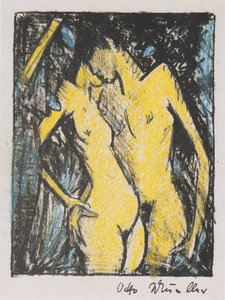
Otto Mueller portréja

A 94 legnevezesebb Otto Mueller festmény, egy galériaválaszték

Frissítve: november 2026 · rangsorolva népszerűségi pontszámunk alapján (minden mű keresései, látogatásai és megrendelései alapján) · 114 mű Otto Mueller alkotása a katalógusunkban

Röviden

Otto Mueller hagyatékából a leghíresebb alkotás Self-Portrait (1921), amely a Saint Louis városi Saint Louis Art Museum gyűjteményében található. Röviddel ezután követik őket Large bathers és Bathers (1913). Katalógusunkban 114 mű található Otto Mueller alkotótól; a galéria megőrizte a világ által leginkább csodált 94 darabot, melyeket a dátummal, a múzeummal és a történetükkel együtt mutatunk be.

1874 – 1930, Liebau Expressionism A legtöbb mű: Museum Folkwang

Otto Mueller legjobb 10 festménye: a galéria válogatása

1
Self-Portrait (1921) (1889) -ja Otto Mueller

Self-Portrait

1921 · Tempera · Saint Louis Art Museum, Saint Louis

A man stares from the shadows, his eyes fixed on a point just beyond the viewer. The face is a landscape of bone and light, carved by a heavy, directional glow that leaves half the features in a deep, murky darkness. This is not a casual glance but a piercing, psychological confrontation. The skin appears textured, built up through thick, visible brushstrokes that suggest the physical struggle of the artist…

2
Large bathers (1889) -ja Otto Mueller

Large bathers

Painting

The scene unfolds through Large bathers, a work that carries the unmistakable hand of Otto Mueller. He brings a specific, rhythmic energy to the canvas, a quality born from his deep connection to the natural world. Born in 1874 in Liebau, Silesia, Mueller carries the spirit of a wanderer into his compositions. His vision seeks a quiet harmony, even when the forms he depicts appear simplified or distorted. There is…

3
Bathers (1913) (1889) -ja Otto Mueller

Bathers

1913 · Oil On Canvas · Westfälisches Landesmuseum, Münster

The canvas presents Bathers, a work that emerges from the creative spirit of Otto Mueller. Created about 1913, this piece captures a moment of quietude through the lens of the Die Brücke expressionist movement. The artist, who was born in 1874 in Lubawka, Poland, brings a specific sense of rhythm to the scene, seeking a harmony between the human form and the natural landscape. His vision remains fixed on the…

4
Two bathing girls (1917) (1889) -ja Otto Mueller

Two bathing girls

1917 · Oil On Canvas

In this 1917 work, Otto Mueller presents a quiet moment of intimacy through his depiction of two female figures. The subjects are captured while bathing in a body of water, their forms partially submerged within the lower third of the frame. This placement creates a sense of closeness, as if the viewer has stumbled upon a private, undisturbed scene in the natural world. The figures exist within a landscape of…

5
Two Nudes in the Thicket (1915) (1889) -ja Otto Mueller

Two Nudes in the Thicket

1915 · Oil On Canvas · Museum Folkwang, Essen

Two Nudes in the Thicket is an expressionist oil painting by Otto Mueller. Created in 1915, the work captures a moment of quietude within a dense, stylized landscape. The artist, Otto Mueller, sought to find a specific harmony through the distortion of form, moving away from academic realism toward a more subjective, emotional truth.

6
Nudes in Dunes (1920) (1889) -ja Otto Mueller

Nudes in Dunes

1920 · Tempera

is a work by the German painter and printmaker Otto Mueller. Created about 1920, the piece belongs to the period in which Mueller was a member of the Die Brücke expressionist movement. This collective sought to establish a new visual language by rejecting academic traditions in favor of subjective perception and raw emotion.

7
Two Sisters (Russian Pair of Girls) (1918) (1889) -ja Otto Mueller

Two Sisters (Russian Pair of Girls)

1918 · Oil

In this intimate portrait, titled Two Sisters (Russian Pair of Girls), we encounter the quiet presence of two young women. The work was painted by Otto Mueller in 1918. It captures a moment of companionship, rendered with the specific sensitivity that defined his approach to the human form.

8
Three Nudes Before a Mirror (1922) (1889) -ja Otto Mueller

Three Nudes Before a Mirror

1922 · Oil On Canvas

In 1922, Otto Mueller applied oil to canvas to bring Three Nudes Before a Mirror into being. The work emerged from a period of intense expressionist exploration, a time when the artist sought to find harmony within distortion. This specific piece captures a quiet, intimate moment through a layered arrangement of figures. The composition relies on the interplay of light and shadow to define the human form, moving away from…

9
Liebespaar (1920) (1889) -ja Otto Mueller

Liebespaar

1920 · Oil On Canvas

In a dimly lit interior, a man and a woman exist in a moment of profound closeness. The air feels heavy, thick with the quiet intensity of their embrace. She leans her head against his shoulder, a gesture of complete surrender and trust. Their bodies, rendered with simplified contours, merge into a single silhouette of intimacy. The lighting is uneven, casting deep shadows that swallow the corners of the room,…

10
Olympia (1924) (1889) -ja Otto Mueller

Olympia

1924 · Black and White Photography

In this 1924 portrait, we find a young woman captured in a moment of quiet composure. The composition is vertically oriented, placing the subject slightly to the right of center, balanced by a small pedestal table on the left. There is a certain stillness here, a sense of a moment suspended in time. The lighting, soft and directional from the upper left, casts gentle shadows across her face and clothing,…

A Otto Mueller válogatás folytatódik: 11 – 94

11Three Huts, One with Red Roof (Gypsy Huts) (1928) (1889) -ja Otto MuellerThree Huts, One with Red Roof (Gypsy Huts)1928 12Two Girls in the Forest (1923) (1889) -ja Otto MuellerTwo Girls in the Forest1923 · Staatliche Kunsthalle Karlsruhe 13Two Nudes on the Grass (1924) (1889) -ja Otto MuellerTwo Nudes on the Grass1924 14Seated Gypsy Girl (1926) (1889) -ja Otto MuellerSeated Gypsy Girl1926 15Am Ufer Sitzendes Mädchen (1926) (1889) -ja Otto MuellerAm Ufer Sitzendes Mädchen1926 16Stehende Zigeunerkinder (1927) (1889) -ja Otto MuellerStehende Zigeunerkinder1927 · Germanisches Nationalmuseum 17Badende (1914) (1889) -ja Otto MuellerBadende1914 · Museum Folkwang 18Three girls in profile (1889) -ja Otto MuellerThree girls in profile 19A tree (1889) -ja Otto MuellerA tree 20Two sitting in dunes girl (1889) -ja Otto MuellerTwo sitting in dunes girlThyssen-Bornemisza Múzeum 21Family of Gypsies (1915) (1889) -ja Otto MuellerFamily of Gypsies1915 · Museum Folkwang 22Three Nudes (1910) (1889) -ja Otto MuellerThree Nudes1910 · Kunstpalast 23Nudes Under Three Trees (1900) (1889) -ja Otto MuellerNudes Under Three Trees1900 24Stehender Maedchenakt mit Dolch (Lukretia) (1903) (1889) -ja Otto MuellerStehender Maedchenakt mit Dolch (Lukretia)1903 25Neger und Taenzerin (1903) (1889) -ja Otto MuellerNeger und Taenzerin1903 26Taenzerin mit Schleier (1903) (1889) -ja Otto MuellerTaenzerin mit Schleier1903 27Portrait of Maschka Mueller (1889) -ja Otto MuellerPortrait of Maschka MuellerWallraf-Richartz Múzeum 28Boy in front of two standing nudes and a seated nudes (1910) (1889) -ja Otto MuellerBoy in front of two standing nudes and a seated nudes1910 29Badende (1911) (1889) -ja Otto MuellerBadende1911 30Adam and Eve (1889) -ja Otto MuellerAdam and EveStädel Múzeum 31Bathers (1916) (1889) -ja Otto MuellerBathers1916 · National Gallery of Art 32Liegendes Mädchen (1914) (1889) -ja Otto MuellerLiegendes Mädchen1914 33Badeszene Mit Vier Figuren, Haus Und Boot (nach Rechts) (1914) (1889) -ja Otto MuellerBadeszene Mit Vier Figuren, Haus Und Boot (nach Rechts)1914 34Mädchen Am See (1916) (1889) -ja Otto MuellerMädchen Am See1916 35Drei Badende Im Wasser (1913) (1889) -ja Otto MuellerDrei Badende Im Wasser1913 36Paar Mit Grünem Fächer (1913) (1889) -ja Otto MuellerPaar Mit Grünem Fächer1913 37Landschaft Mit Badenden (1915) (1889) -ja Otto MuellerLandschaft Mit Badenden1915 · Kirchner Museum Davos 38Five Bathers in Lake Landscape (1918) (1889) -ja Otto MuellerFive Bathers in Lake Landscape1918 39Forest Stream with Bathers (1919) (1889) -ja Otto MuellerForest Stream with Bathers1919 40Landscape with Yellow Nudes (1919) (1889) -ja Otto MuellerLandscape with Yellow Nudes1919 · MoMA - Museum of Modern Art 41Doppelbildnis (1922) (1889) -ja Otto MuellerDoppelbildnis1922 42Polnische Familie (1919) (1889) -ja Otto MuellerPolnische Familie1919 43Badende Am Waldsee (1919) (1889) -ja Otto MuellerBadende Am Waldsee1919 44Mädchen Und Knabe Am Waldteich (1922) (1889) -ja Otto MuellerMädchen Und Knabe Am Waldteich1922 45Marischka Mit Maske (1919) (1889) -ja Otto MuellerMarischka Mit Maske1919 · Museum Folkwang 46Waldstück Mit Stein Und Gebüsch (1919) (1889) -ja Otto MuellerWaldstück Mit Stein Und Gebüsch1919 47Liebespaar (1919) (1889) -ja Otto MuellerLiebespaar1919 · Museum der bildenden Künste 48Two Girls by the Lake (Seated and Standing Nude in Forest Landscape) (1926) (1889) -ja Otto MuellerTwo Girls by the Lake (Seated and Standing Nude in Forest Landscape)1926 49Self-Portrait with the Rooster (1927) (1889) -ja Otto MuellerSelf-Portrait with the Rooster1927 50Two Girls (1927) (1889) -ja Otto MuellerTwo Girls1927 51Bathers in the Reed Trench (1924) (1889) -ja Otto MuellerBathers in the Reed Trench1924 52Two Girls in the Grass (1926) (1889) -ja Otto MuellerTwo Girls in the Grass1926 · Bavári Állami Festırménygyűjtemények 53Zwei Zigeunerinnen (1923) (1889) -ja Otto MuellerZwei Zigeunerinnen1923 54Akt Im Wald (1923) (1889) -ja Otto MuellerAkt Im Wald1923 55Zigeunerwagen (1927) (1889) -ja Otto MuellerZigeunerwagen1927 56Sitzender Akt in Landschaft (1927) (1889) -ja Otto MuellerSitzender Akt in Landschaft1927 57Zigeunermadonna (1926) (1889) -ja Otto MuellerZigeunermadonna1926 58Waldstück Mit Blumen Und Teich (1925) (1889) -ja Otto MuellerWaldstück Mit Blumen Und Teich1925 59Stehende Zigeunerin Mit Kind (1926) (1889) -ja Otto MuellerStehende Zigeunerin Mit Kind1926 60Große Kniende (1926) (1889) -ja Otto MuellerGroße Kniende1926 61Waldlandschaft Mit Akt (1924) (1889) -ja Otto MuellerWaldlandschaft Mit Akt1924 · Aargauer Kunsthaus 62Zwischen Bäumen Stehendes Mädchen (1925) (1889) -ja Otto MuellerZwischen Bäumen Stehendes Mädchen1925 63Stehender Weiblicher Akt Zwischen Bäumen (1927) (1889) -ja Otto MuellerStehender Weiblicher Akt Zwischen Bäumen1927 64Stehende Zigeunerin mit Kind (1927) (1889) -ja Otto MuellerStehende Zigeunerin mit Kind1927 65Seated Nude in the Countryside (1925) (1889) -ja Otto MuellerSeated Nude in the Countryside1925 66Two Nude Girls in a Sand Dune, One Sitting, One Lying (1924) (1889) -ja Otto MuellerTwo Nude Girls in a Sand Dune, One Sitting, One Lying1924 · Scottish National Gallery of Modern Art 67Gypsy Child with Donkey (1929) (1889) -ja Otto MuellerGypsy Child with Donkey1929 68Zigeunerkind Im Dorf (1929) (1889) -ja Otto MuellerZigeunerkind Im Dorf1929 69Zigeunerin Im Garten (1929) (1889) -ja Otto MuellerZigeunerin Im Garten1929 70Stehender Mädchenakt Im Grünen (1929) (1889) -ja Otto MuellerStehender Mädchenakt Im Grünen1929 71Zwei Akte Im Freien (1927) (1889) -ja Otto MuellerZwei Akte Im Freien1927 · Albertina 72Three Nudes in the Forest (1889) -ja Otto MuellerThree Nudes in the Forest 73Negerpaar (1889) -ja Otto MuellerNegerpaar 74Selbstbildnis mit Pentagramm (1889) -ja Otto MuellerSelbstbildnis mit Pentagramm 75Bildnis des Malers Otto Mueller (1889) -ja Otto MuellerBildnis des Malers Otto Mueller 76Three Girls in a Wood (1889) -ja Otto MuellerThree Girls in a WoodSaint Louis Art Museum 77Three nudes in landscape (1889) -ja Otto MuellerThree nudes in landscape 78Landscape with Bathers (1889) -ja Otto MuellerLandscape with Bathers 79Three acts (1889) -ja Otto MuellerThree acts 80Naked woman sitting on branch (1889) -ja Otto MuellerNaked woman sitting on branch 81Landscape with forked tree (1889) -ja Otto MuellerLandscape with forked tree 82Standing couple (1889) -ja Otto MuellerStanding couple 83Cowering in the Forest Act (1889) -ja Otto MuellerCowering in the Forest Act 84Lovers (1889) -ja Otto MuellerLovers 85Five acts on water (1889) -ja Otto MuellerFive acts on water 86Bathers im Schilfgraben (1889) -ja Otto MuellerBathers im Schilfgraben 87Blue bathers (1889) -ja Otto MuellerBlue bathers 88Farmstead in France (1889) -ja Otto MuellerFarmstead in France 89Gypsy lovers (1889) -ja Otto MuellerGypsy lovers 90Gypsy Horse at Black Water (1889) -ja Otto MuellerGypsy Horse at Black WaterGermanisches Nationalmuseum 91Evening landscape (forest landscape) (1889) -ja Otto MuellerEvening landscape (forest landscape) 92Zwei Akte Im Freien (1923) (1889) -ja Otto MuellerZwei Akte Im Freien1923 · Albertina 93Half-Length Portrait of Two Nude Women (1919) (1889) -ja Otto MuellerHalf-Length Portrait of Two Nude Women1919 · Museum Ludwig 94Liebespaar (1920) (1889) -ja Otto MuellerLiebespaar1920 · Sprengel Museum Hannover

Otto Mueller híres festményei, korszakonként

A témák, amelyek Otto Mueller figyelmét meghúzták

A négy leggyakorobban előforduló téma ebben az eredeti művekben, mindegyik a legkiválóbb példájával.

A műemlékek, amelyek Otto Mueller eredeti műveit őrzik

A 8 olyan múzeum, amely a legtöbb ezen az oldalon szereplő festményet őrzi.

Múzeum Város Otto Mueller művei Ebből a listából származó festmények
Museum Folkwang, EssenMuseum Folkwang Essen 4 Two Nudes in the Thicket, Badende, Family of Gypsies
Saint Louis Art Museum, Saint LouisSaint Louis Art Museum Saint Louis 2 Self-Portrait, Three Girls in a Wood
Germanisches Nationalmuseum, NürnbergGermanisches Nationalmuseum Nürnberg 2 Stehende Zigeunerkinder, Gypsy Horse at Black Water
Albertina, BécsAlbertina Bécs 2 Zwei Akte Im Freien, Zwei Akte Im Freien
Westfälisches Landesmuseum, MünsterWestfälisches Landesmuseum Münster 1 Bathers
Staatliche Kunsthalle Karlsruhe, KarlsruheStaatliche Kunsthalle Karlsruhe Karlsruhe 1 Two Girls in the Forest
Thyssen-Bornemisza Múzeum, MadridThyssen-Bornemisza Múzeum Madrid 1 Two sitting in dunes girl
Kunstpalast, DüsseldorfKunstpalast Düsseldorf 1 Three Nudes

Otto Mueller évtizede folgtva: az eredeti művek, amelyek meghatározzák az egyes korzakot

Művek évtizedenként

Váassz ki egy évtizedet, hogy megnézhesd az azt meghatározó eredetiműveket.

Gyűjtői kérdések Otto Mueller festményeivel kapcsolatban

Melyik művel a(z) Otto Mueller a leghíresebb?Fedje fel a választ

Self-Portrait (1921), Saint Louis Art Museum, Saint Louis. Ezután Large bathers és Bathers (1913) következik.

Hány éves volt Otto Mueller, amikor a Self-Portrait készült?Fedje fel a választ

47 éves: Self-Portrait 1921-ből származik, Otto Mueller pedig 1874-ben született.

Melyek a tíz leghíresebb Otto Mueller festmény?Fedje fel a választ

Self-Portrait, Large bathers, Bathers, Two bathing girls, Two Nudes in the Thicket, Nudes in Dunes, Two Sisters (Russian Pair of Girls), Three Nudes Before a Mirror, Liebespaar és Olympia. A fenti rangsor a művek évszamarát és a múzeumát jelzi.

Hány festményet hagyott hátra Otto Mueller?Fedje fel a választ

Katalógusunkban 114 mű található Otto Mueller alkotótól, 1900 és 1929 év közötti időszakból.

Mely múzeumokban állnak Otto Mueller remekművei?Fedje fel a választ

Leginkább Museum Folkwang (Essen), Saint Louis Art Museum (Saint Louis) és Germanisches Nationalmuseum (Nürnberg) található. A fenti múzeumi táblázatban mindegyik felsorolásra került.

Mely években festette Otto Mueller leghíresebb műveit?Fedje fel a választ

1920s alatt: a jelen laphonon található 94 műből 39 készült ebben az időszakban, köztük Self-Portrait.

Mikszétek az első és az utolsó híres eredeti műve a(z) Otto Mueller alkotótól?Fedje fel a választ

Ezen az oldalon a leghitelesebb Nudes Under Three Trees (1900), a legutóbbi pedig Gypsy Child with Donkey (1929).

Milyen témaköröket választott leggyakrabban Otto Mueller?Fedje fel a választ

Landscape (10), Nude figures (6) és Nudes (6), a jelen oldalon található 94 műművészeti alkotás között.

Melyik technikát alkalmazta leggyakrabban Otto Mueller?Fedje fel a választ

Oil On Canvas, a jelen oldalon található 94 műből 9 darab esetén.

Mely művészeti irányba tartozik Otto Mueller?Fedje fel a választ

Expressionism, ezen az oldalon található eredetiek alapján.

Mely Otto Mueller művei láthatóak a Museum Folkwang kiállتításán?Fedje fel a választ

Two Nudes in the Thicket, Badende és Family of Gypsies: a Museum Folkwang, Essen 4 művet őrzi ezen az oldalon.

Otto Mueller: életmű és életút

A Vándorlélek: Otto Mueller Élete és Művészete

Otto Mueller, akinek a nevét gyakran suttogásban emlegetik a német expresszionizmus úttörői között, egy olyan művész volt, aki mélyen beteljesedett a természet ritmusával és az élet peremén élők világával. 1874-ben született Liebauban, Sziléziában – ma Lubawka, Lengyelország –, útjának kezdete egy olyan táj között indult, amely örökre lenyomta a bélyegét művészi látásmódjára. A Görlitzben és Breslauban szerzett korai litográfiai képzés megalapozta számára a vonal- és textúraművészet mesterségét, ami jellemezte majdani munkáit. Továbbtanult a presztízsös dresdeni és müncheni akadémiákon is, de Franz von Stuck elutasító megjegyzése a müncheni akadémián önálló felfedezés időszakához vezetett. Ezek az évek során Mueller a lenyomást, a Jugendstilt és a szimbolizmust vette magára, mégis nyugtalan maradt, saját hangjának keresése folytatódott.

A Torzulás Harmóniája: Az Expresszionista Út

Fordulópontot jelentett Mueller berlini költözése 1908-ban. Itt, a város virágzó művészeti ébredésének közepén stílusa drámai átalakuláson ment keresztül. Wilhelm Lehmbruck és Rainer Maria Rilke alakjainak köszönhetően megnőtt az érdeklődése az emberi tapasztalatok mélyebb érzelmi rétegei iránt. 1910-ben hivatalosan is csatlakozott a "Die Brücke" (Az Átkelőhely) művészcsoportjához, amelynek tagjai elutasították az akadémiai konvenciókat és egy új vizuális nyelvet akartak létrehozni, amely gyökerezik a nyers érzelmekben és a szubjektív érzékelésben. Bár kollégái gyakran harsány színpalettát és agresszív ecsetvonásokat fogadtak be, Mueller egy másik utat járt be. A torzuláson belül harmóniát keresett, egyszerűsítette az alakokat és a vonalakat, hogy feltárja az emberiség és a természet közötti alapvető egységet. Tájképjei, csendes intenzitással telve, Vincent van Gogh szellemére emlékeztetnek, míg alakjai – különösen a romák nőalakjai – hátborzongató eleganciával rendelkeznek. Ez az időszak rögzítette a "Cigány Müller" becenevét is, bár ez a jelző inkább a témái iránti vonzódásból született, mintsem valamilyen bizonyított családi kapcsolatból.

Egyedi Technika és Ismétlődő Motívumok

Mueller művészi folyamata olyan különleges volt, mint maga a látásmódja. A durva vászonra alkalmazott temperát – egy víz alapú festéket – kedvelte, ami matt felületet eredményezett, amely földes, majdnem ősi minőséget kölcsönzött munkáinak. Ez a technika jelentősen hozzájárult a képek általános hangulatához, intimitás és sérülékenység érzetét keltve. Alkotásainak témái állandóan néhány kulcsszóra összpontosítottak: csillagos éjszakákat idéző csendes tájak, kifejező meztelenek, amelyek egyszerre testesítik meg a szexualitást és a melankóliát, valamint leginkább a romák ábrázolása. Ezek az alakok nem csupán portrék voltak; a szabadság iránti vágyat, a természettel való kapcsolatot és egy alternatív életmódot képviseltek a polgári társadalom korlátozásain kívül. Számos nyomatot is készített, litográfiát kedvelte leginkább, de voltak fafaragványai és metszetei is. A vonalak egyszerűsége ezekben a nyomatokban tovább hangsúlyozta témái érzelmi magját.

A Háború Árnyékai és Örökség

Mint sok kortársa, Mueller élete mélyen érintett az első világháború. Mind a francia, mind az orosz frontokon szolgált katonaként, tapasztalata kétségtelenül nyomot hagyott benne, bár nem változtatta meg drámaian művészeti stílusát. A háborút követően a Breslaui Képzőművészeti Akadémián tanári állást fogadott el, és haláláig oda szentelte magát a tanítást. Tragikusan munkássága áldozatul esett a náci rezsim ideológiai megtisztításának 1937-ben, amikor több mint háromszáz alkotását lefoglaltak német múzeumokból és "romló művészetnek" bélyegezték. Ennek ellenére Mueller művészi öröksége élt tovább. Ma a német expresszionizmus kulcsfontosságú alakjaként ismert, egy olyan művész, akinek érzékeny ábrázolásai az emberiségről és a természetről máig rezonálnak a közönségben világszerte. Munkássága megdöbbentő emlékeztető a művészet erejéről, hogy politikai határokat lép túl és a mindenható emberi létezéshez szólítsa fel a figyelmet.