Master Mateo portréja

A 44 legnevesebbebb Master Mateo festmény, mindegyik egyedistens

Frissítve: október 2026 · rangsorolva népszerűségi pontszámunk alapján (minden mű keresései, látogatásai és megrendelései alapján) · 44 mű Master Mateo alkotása a katalógusunkban

Röviden

The disappeared façade at the end of the Camino (1211) az a Master Mateo festmény, amely a legtöbb tekintetet felvonja; az eredeti mű a A Santiago de Compostela katedrális alapítványi múzeum gyűjteményében található, Santiago de Compostela. Ezután a tekintet Base of the mullion of the Portico of Glory (1188) és Trinity of the Portico of Glory (1188) elemre irányul. A Master Mateo 44 műve közül a katalógusunkban megtalálható 44 legnépesebb alkotás, melyeket az év, a múzeum és az örökévalóságának okai kísérnek.

1161 – 1217 Romanesque A legtöbb mű: A Santiago de Compostela katedrális alapítványi múzeum

A galéria szemével: Master Mateo legjobb 10 festménye

2
Base of the mullion of the Portico of Glory (1188) szerzője Master Mateo

Base of the mullion of the Portico of Glory

1188 · Stone · A Santiago de Compostela katedrális alapítványi múzeum, Santiago de Compostela

To stand before the Portico of Glory is to witness a profound shift in the language of stone. This specific base of the mullion, carved around 1188, offers a glimpse into the transition from the rigid forms of the Romanesque to a more fluid, naturalistic sensibility. Here, the stone does not merely exist; it breathes. The sculptor, Master Mateo, utilized a technique known as trabajo vivo, layering limestone to create…

3
Trinity of the Portico of Glory (1188) szerzője Master Mateo

Trinity of the Portico of Glory

1188 · Stone · A Santiago de Compostela katedrális alapítványi múzeum, Santiago de Compostela

Divine Presence in Stone The capital features God the Father holding the Christ child upon his lap. Above them, the Holy Spirit takes form as a dove at the peak of the composition. Angels surround these central figures, carrying incense burners to complete the celestial scene. This sculptural arrangement uses the trabajo vivo technique, layering stone slabs to create textures that mimic flesh and fabric. The result is a sense…

4
Statue-column of king David (1188) szerzője Master Mateo

Statue-column of king David

1188 · Stone · A Santiago de Compostela katedrális alapítványi múzeum, Santiago de Compostela

In the hallowed atmosphere of the Santiago Cathedral, where history and spirituality converge, stands a figure of profound majesty: the Statue-column of King David. Carved by the legendary Master Mateo around 1188, this Romanesque masterpiece is far more than a mere architectural ornament; it is a window into the soul of the twelfth century. The sculpture captures the biblical monarch in a moment of eternal resonance, seated upon a cross-frame…

5
The Glory, Central Arch, Portico of Glory (1211) szerzője Master Mateo

The Glory, Central Arch, Portico of Glory

1211 · Stone · A Santiago de Compostela katedrális alapítványi múzeum, Santiago de Compostela

The Glory, Central Arch, Portico of Glory is a sculptural work by Master Mateo. It forms a primary component of the Portico of Glory, located at the Cathedral of Santiago de Compostela in Spain. This specific section of the portal was part of a complete three-piece set that reached its conclusion in 1211. The work is currently held at The Catedral de Santiago Foundation in Santiago de Compostela.

6
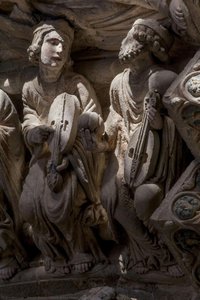
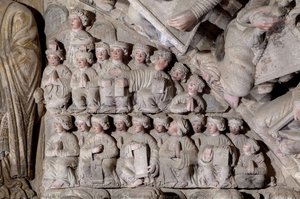
The Elders holding instruments, Central Arch, Portico of Glory (1211) szerzője Master Mateo

The Elders holding instruments, Central Arch, Portico of Glory

1211 · Stone · A Santiago de Compostela katedrális alapítványi múzeum, Santiago de Compostela

Within the sacred shadows of the Portico of Glory, a profound scene unfolds in stone. The Elders holding instruments, Central Arch, Portico of Glory emerges from the limestone, appearing as if caught in a moment of eternal preparation. This work, created by the hands of Master Mateo, brings the figures of the Apocalypse into a tangible, breathing presence. They sit amidst the radial archivolts, their bodies leaning toward one another…

8
Saint Matthew, Central Arch, Portico of Glory (1211) szerzője Master Mateo

Saint Matthew, Central Arch, Portico of Glory

1211 · Stone · A Santiago de Compostela katedrális alapítványi múzeum, Santiago de Compostela

The stone breathes under the soft, diffuse light of the cathedral, revealing a figure caught in a moment of eternal devotion. Here, within the central arch of the Portico of Glory, Saint Matthew sits with a quiet, heavy presence. He is a winged presence, his form emerging from the granite with a startling sense of life. He leans over a desk, his knees supporting the weight of his task, as…

9
Saint Luke, Central Arch, Portico of Glory (1211) szerzője Master Mateo

Saint Luke, Central Arch, Portico of Glory

1211 · Stone · A Santiago de Compostela katedrális alapítványi múzeum, Santiago de Compostela

The limestone relief of Saint Luke, carved around 1211, occupies a central position within the Portico of Glory at the Cathedral of Santiago de Compostela in Spain. The figure is depicted reclining on his right side, a posture that suggests both physical repose and deep introspection. In his left hand, he holds a book, while his head rests upon a lamb, a direct reference to his role as an Evangelist…

10
Arma Christi, Central Arch, Portico of Glory (1211) szerzője Master Mateo

Arma Christi, Central Arch, Portico of Glory

1211 · Stone · A Santiago de Compostela katedrális alapítványi múzeum, Santiago de Compostela

The relief known as Arma Christi, Central Arch, Portico of Glory is a sculptural work by the artist Master Mateo. This specific piece is situated within the Central Arch of the Portico of Glory. It was created in 1211. The work is part of a larger architectural and sculptural program located at the Santiago de Compostela Cathedral in Galicia, Spain.

Master Mateo híres festményei, 11 és 44 között

11Santo dos Croques of the Portico of Glory (1200) szerzője Master MateoSanto dos Croques of the Portico of Glory1200 · A Santiago de Compostela katedrális alapítványi múzeum 12Saint Matthew (1200) szerzője Master MateoSaint Matthew1200 · A Santiago de Compostela katedrális alapítványi múzeum 13Statues of David and Solomon (1188) szerzője Master MateoStatues of David and Solomon1188 · A Santiago de Compostela katedrális alapítványi múzeum 14Portico de la Gloria (1168) szerzője Master MateoPortico de la Gloria1168 · Cathedral 15Portico de la Gloria (detail) (1168) szerzője Master MateoPortico de la Gloria (detail)1168 · Cathedral 16Portico de la Gloria (1168) szerzője Master MateoPortico de la Gloria1168 · Cathedral 17Portico de la Gloria (detail) (1168) szerzője Master MateoPortico de la Gloria (detail)1168 · Cathedral 18Right arch of the Portico of Glory. Iconography of the condemned (1188) szerzője Master MateoRight arch of the Portico of Glory. Iconography of the condemned1188 · A Santiago de Compostela katedrális alapítványi múzeum 19Right arch of the Portico of Glory (1188) szerzője Master MateoRight arch of the Portico of Glory1188 · A Santiago de Compostela katedrális alapítványi múzeum 20Left arch of the Portico of Glory (1188) szerzője Master MateoLeft arch of the Portico of Glory1188 · A Santiago de Compostela katedrális alapítványi múzeum 21Right columns of the central arch of the Portico of Gloryh (1188) szerzője Master MateoRight columns of the central arch of the Portico of Gloryh1188 · A Santiago de Compostela katedrális alapítványi múzeum 22Saint Marcus, Central Arch, Portico of Glory (1211) szerzője Master MateoSaint Marcus, Central Arch, Portico of Glory1211 · A Santiago de Compostela katedrális alapítványi múzeum 23Saint John, Central Arch, Portico of Glory (1211) szerzője Master MateoSaint John, Central Arch, Portico of Glory1211 · A Santiago de Compostela katedrális alapítványi múzeum 24Ordo Prophetarum, The counter facade, Portico of Glory (1211) szerzője Master MateoOrdo Prophetarum, The counter facade, Portico of Glory1211 · A Santiago de Compostela katedrális alapítványi múzeum 25The Sybil, The counter facade, Portico of Glory (1211) szerzője Master MateoThe Sybil, The counter facade, Portico of Glory1211 · A Santiago de Compostela katedrális alapítványi múzeum 26Right arch of the Portico of Glory. Iconography of the blessed (1211) szerzője Master MateoRight arch of the Portico of Glory. Iconography of the blessed1211 · A Santiago de Compostela katedrális alapítványi múzeum 27Detail of the Elders, Central Arch, Portico of Glory (1211) szerzője Master MateoDetail of the Elders, Central Arch, Portico of Glory1211 · A Santiago de Compostela katedrális alapítványi múzeum 28Tribune of Portico of Glory (1211) szerzője Master MateoTribune of Portico of Glory1211 · A Santiago de Compostela katedrális alapítványi múzeum 29Angels, The Tribune, Portico of Glory (1211) szerzője Master MateoAngels, The Tribune, Portico of Glory1211 · A Santiago de Compostela katedrális alapítványi múzeum 30Portico of Glory (1211) szerzője Master MateoPortico of Glory1211 · A Santiago de Compostela katedrális alapítványi múzeum 31Keystones from Portico of the Glory (1211) szerzője Master MateoKeystones from Portico of the Glory1211 · A Santiago de Compostela katedrális alapítványi múzeum 32Detail Maiestas Domini of The Portico of Glory (1211) szerzője Master MateoDetail Maiestas Domini of The Portico of Glory1211 · A Santiago de Compostela katedrális alapítványi múzeum 33Arma Christi, Central Arch, Portico of Glory (1211) szerzője Master MateoArma Christi, Central Arch, Portico of Glory1211 · A Santiago de Compostela katedrális alapítványi múzeum 34The Just, Central Arch, Portico of Glory (1211) szerzője Master MateoThe Just, Central Arch, Portico of Glory1211 · A Santiago de Compostela katedrális alapítványi múzeum 35Detail of the Elders, Central Arch, Portico of Glory (1211) szerzője Master MateoDetail of the Elders, Central Arch, Portico of Glory1211 · A Santiago de Compostela katedrális alapítványi múzeum 36Detail of the Blessed, Central Arch, Portico of Glory (1211) szerzője Master MateoDetail of the Blessed, Central Arch, Portico of Glory1211 · A Santiago de Compostela katedrális alapítványi múzeum 37Central Arch of The Portico of Glory (1211) szerzője Master MateoCentral Arch of The Portico of Glory1211 · A Santiago de Compostela katedrális alapítványi múzeum 38Organistrum, Central Arch, Portico of Glory (1211) szerzője Master MateoOrganistrum, Central Arch, Portico of Glory1211 · A Santiago de Compostela katedrális alapítványi múzeum 39Drawing José Vega y Verdugo (1656-1657) Archivo de la Catedral (1657) szerzője Master MateoDrawing José Vega y Verdugo (1656-1657) Archivo de la Catedral1657 · A Santiago de Compostela katedrális alapítványi múzeum 40Left arch of the Portico of Glory. Iconography (1188) szerzője Master MateoLeft arch of the Portico of Glory. Iconography1188 · A Santiago de Compostela katedrális alapítványi múzeum 41Estatuas-columna de dos profetas procedentes de la desaparecida fachada exterior del Pórtico de la Gloria\n\n- Isaac (1188) szerzője Master MateoEstatuas-columna de dos profetas procedentes de la desaparecida fachada exterior del Pórtico de la Gloria\n\n- Isaac1188 · A Santiago de Compostela katedrális alapítványi múzeum 42Rose window (1200) szerzője Master MateoRose window1200 · A Santiago de Compostela katedrális alapítványi múzeum 43Stony choir reconstruction (1211) szerzője Master MateoStony choir reconstruction1211 · A Santiago de Compostela katedrális alapítványi múzeum 44Lintels Central Arch of The Portico of Glory (1188) szerzője Master MateoLintels Central Arch of The Portico of Glory1188 · A Santiago de Compostela katedrális alapítványi múzeum

A témák, amelyek Master Mateo figyelmét meghúzták

A négy leggyakorobban előforduló téma ebben az eredeti művekben, mindegyik a legkiválóbb példájával.

A műemlékek, amelyek Master Mateo eredeti műveit őrzik

A 2 olyan múzeum, amely a legtöbb ezen az oldalon szereplő festményet őrzi.

Múzeumok Város Master Mateo művei Ebből a listából származó festmények
A Santiago de Compostela katedrális alapítványi múzeum, Santiago de CompostelaA Santiago de Compostela katedrális alapítványi múzeum Santiago de Compostela 40 The disappeared façade at the end of the Camino, Base of the mullion of the Portico of Glory, Trinity of the Portico of Glory
Cathedral, Santiago de CompostelaCathedral Santiago de Compostela 4 Portico de la Gloria, Portico de la Gloria (detail), Portico de la Gloria

Master Mateo évtizedekig: egy egyedi eredeti mű minden évtizedben

Művek évtizedenként

Váassz ki egy évtizedet, hogy megnézhesd az azt meghatározó eredetiműveket.

Master Mateo festményei: kérdések a galériának

Mi a leghíresebb műve Master Mateonek?Fedje fel a választ

The disappeared façade at the end of the Camino (1211), A Santiago de Compostela katedrális alapítványi múzeum, Santiago de Compostela. Ezután Base of the mullion of the Portico of Glory (1188) és Trinity of the Portico of Glory (1188) következik.

Milyen életkorában alkotta meg Master Mateo a(z) The disappeared façade at the end of the Camino műszt?Fedje fel a választ

50 éves: The disappeared façade at the end of the Camino 1211-ből származik, Master Mateo pedig 1161-ben született.

Melyik tíz festménye Master Mateo a leghíresebb?Fedje fel a választ

The disappeared façade at the end of the Camino, Base of the mullion of the Portico of Glory, Trinity of the Portico of Glory, Statue-column of king David, The Glory, Central Arch, Portico of Glory, The Elders holding instruments, Central Arch, Portico of Glory, Voussoirs with the punishment of lust, Saint Matthew, Central Arch, Portico of Glory, Saint Luke, Central Arch, Portico of Glory és Arma Christi, Central Arch, Portico of Glory. A fenti rangsor a művek évszamarát és a múzeumát jelzi.

Hány mű alkotása ismert Master Mateo nevében?Fedje fel a választ

Katalógusunkban 44 mű található Master Mateo alkotótól, 1188 és 1211 év közötti időszakból.

Hol tekinthetők meg a leghíresebb Master Mateo eredetijeit?Fedje fel a választ

Leginkább A Santiago de Compostela katedrális alapítványi múzeum (Santiago de Compostela) és Cathedral (Santiago de Compostela) található. A fenti múzeumi táblázatban mindegyik felsorolásra került.

Melyik időszakban alkotta Master Mateo a leghíresebb festményeit?Fedje fel a választ

1210s alatt: a jelen laphonon található 44 műből 24 készült ebben az időszakban, köztük The disappeared façade at the end of the Camino.

Melyik híres Master Mateo festmény a legkorábbi, és melyik a legutóbb készült?Fedje fel a választ

Ezen az oldalon a leghitelesebb Base of the mullion of the Portico of Glory (1188), a legutóbbi pedig The disappeared façade at the end of the Camino (1211).

Milyen témakörket kedvelt Master Mateo?Fedje fel a választ

Sculpture (5), Medieval art (5) és Stone (3), a jelen oldalon található 44 műművészeti alkotás között.

Milyen anyagokkal festett leggyakrabban Master Mateo?Fedje fel a választ

Stone, a jelen oldalon található 44 műből 10 darab esetén.

Mely művészeti irányba tartozik Master Mateo műve?Fedje fel a választ

Romanesque és Gothic, ezen az oldalon található eredetiek alapján.

Milyen Master Mateo eredeti műveket láthatok a A Santiago de Compostela katedrális alapítványi múzeum kiállításaiban?Fedje fel a választ

The disappeared façade at the end of the Camino, Base of the mullion of the Portico of Glory és Trinity of the Portico of Glory: a A Santiago de Compostela katedrális alapítványi múzeum, Santiago de Compostela 40 művet őrzi ezen az oldalon.

Hol rendelhetek egy kézzel festett Master Mateo reprodukciót?Fedje fel a választ

Igen, reprodukcióként: az eredeti mű a múzeumban marad, de ezen az oldalon látható bármelyik festmény megmaleríthető Önnek, egyedi igény alapján, a festmény saját oldalán keresztül.

Master Mateo: a művész portréja

The Soul of Santiago’s Glory

Master Mateo, a sculptor whose name remains shrouded in mystery despite his monumental contribution to the Catedral de Santiago de Compostela Cathedral, stands as one of the most revered figures of Romanesque art in Spain. Born around 1161 in Galicia, though precise details about his life are scarce, Mateo’s legacy rests primarily on his unparalleled achievement: the Portico de la Gloria. This breathtaking architectural marvel dominates the cathedral’s façade and embodies the spiritual fervor of the twelfth century. He emerged as a sculptor during a period marked by fervent religious devotion and artistic innovation, stepping into a world where the pilgrimage route to Santiago was already a transformative journey for thousands of souls.

The genesis of his greatest work began around 1188, when he was tasked with overseeing the creation of the triple doorway that would become his magnum opus. The Cathedral project itself had been conceived decades earlier, driven by King Alfonso VIII and fueled by the immense religious significance of the site. Within this sacred context, Mateo did not merely carve stone; he breathed life into it. His involvement in the Portico de la Adamant was a divine undertaking, transforming a structural necessity into a theological narrative that continues to captivate pilgrims and art historians alike.

A Symphony in Stone: Technique and Style

Mateo's sculptural style is characterized by a remarkable realism that represented a profound departure from earlier, more rigid Romanesque conventions. While his contemporaries often relied on stylized, flat figures, Mateo meticulously studied human anatomy and the complex behavior of drapery, achieving an astonishing accuracy in his depictions. His mastery of limestone carving was unparalleled, particularly through his use of a technique known as trabajo vivo. This method involved layering stone slabs to create textured surfaces that mimicked the appearance of flesh and fabric, lending a sense of movement and vitality to the static medium.

This innovative approach allowed him to bridge the gap between the earthly and the divine. When observing his work, one can see how he skillfully employed light and shadow to enhance the depth of his reliefs. His ability to manipulate stone to suggest the softness of a saint's robe or the muscular tension of a biblical figure elevated his craftsmanship to a level of sophistication rarely seen in the Middle Ages. This technical brilliance ensured that his figures were not merely symbols, but palpable presences within the cathedral's entrance.

The Portico de la Gloria: A Testament to Faith

The Portico de la Gloria serves as the ultimate testament to Mateo’s artistic and spiritual vision. Its central panels depict profound scenes from the Gospels—including the Nativity, Annunciation, and the Crucifixion—arranged in a way that guides the viewer through a sacred history. The iconography is vast and complex, featuring:

  • The Central Arch: Featuring iconic figures such as Saint Luke, where the intricate Romanesque sculpture displays profound religious symbolism.
  • The Left Arch: A masterclass in 12th-century Spanish relief carving, showcasing detailed biblical narratives.
  • The Right Arch: An exhibition of intricate beauty that demonstrates his ability to manage complex architectural and sculptural integration.

Through these works, Mateo achieved a level of historical significance that transcends the era of his birth. He transitioned the Romanesque style toward the burgeoning elegance of the Gothic, leaving behind a legacy that remains the heartbeat of Santiago de Compostela. His work stands as a permanent bridge between the medieval mind and the eternal, ensuring that even centuries after his death in 1217, the glory of his stone symphony continues to inspire awe.

Minden 44 műmű Master Mateo alkotása →