Franz Marc portréja

Franz Marc festményei: A 100 leghíresebb alkotás, egy galéria szemével

Frissítve: október 2026 · rangsorolva népszerűségi pontszámunk alapján (minden mű keresései, látogatásai és megrendelései alapján) · 493 mű Franz Marc alkotása a katalógusunkban

Röviden

A galéria szerint Franz Marc leghíresebb festménye a Kék ló I (1911), amelynek eredeti példája a Lenbachhaus múzeumában található, München városában. untitled (4325) és A Vöröslovakok (1911) kiegészítik azt a triót, amelyet minden szem felismer. A katalógusunkban szereplő 493 művész Franz Marc alkotásából a galéria az alábbi 100 leghíresebbet mutatja be, amelyek mind egyedi originális művek, a készítés évszámával, a múzeum megnevezésével és a különlegességük leírásával.

1880 – 1916, München Expresszionizmus A legtöbb mű: Lenbachhaus

A galéria top 10 Franz Marc festménye

1
Kék ló I (1911) szerzője Franz Marc

Kék ló I

1911 · Akril festmény vászonon · Lenbachhaus, München

Franz Marc „Kék ló I” című alkotása, amelyet 1911-ben festett, több, mint puszta egy lovas motívum ábrázolása; ez az emberiség és a természet közötti kapcsolat mély meditációja, amelyet megdöbbentő intenzitással örökítött meg, amely meghatározza a német EXPRESSIONIZMUS szívét. A 85 x 112 cm-es méretű alkotás azonnal magába ábsztolja a nézőt a telített kékek és sárga színek világába, amelyek nem csupán a valóság egyszerű ábrázolására, hanem az érzelmek felidézésére szolgálnak szándékos…

2
untitled (4325) szerzője Franz Marc

untitled (4325)

Oil On Canvas · Alte Nationalgalerie, Berlin

To stand before a work by Franz Marc is to encounter not merely paint on canvas, but a vibrant echo of the soul’s deepest inquiries. This piece, with its arresting depiction of three magnificent horses alongside observing figures, draws the viewer immediately into a realm where the material world dissolves into pure emotional resonance. Marc, a pivotal figure in German Expressionism, never simply painted what he saw; rather, he sought…

3
A Vöröslovakok (1911) szerzője Franz Marc

A Vöröslovakok

1911 · Olajfestmény vászonon · Walker Art Center, Minneapolis

Franz Marc 1911-ben alkotott meg egy olyan festményt, amely nem pusztán tájképet ábrázol, hanem a természet szellemi lényegét próbálja megfogalmazni. A "Nagy Kék Végvárak" (Die grossen blauen Pferde) egy igazi német ekspreszionista remekmű, mely Marc művésziségének egyik legjelentősebb darabjává tette. A festmény a szellem és a természet közötti mély kapcsolatot, a természeti világban rejlő spirituális energiát idézi meg, egy olyan világban, ahol az állatok nem pusztán fizikai lények, hanem a…

4
Tirol (1914) szerzője Franz Marc

Tirol

1914 · Olajfestmény vászonon · Staatsgalerie Moderner Kunst, München

Franz Marc „Tyrol” (1914) című alkotása a német expresszionizmus lenyűgöző példája, amely a művész merész színezetét és formanyelvét mutatja be, hogy érzelmeket és mozgást közvetítsen. Ez az életerős, absztrakt kompozíció energiát és intenzitást áraszt, így bármely kortárs művészeti gyűjtemény vagy modern enteriőr lenyűgöző kiegészítőjévé válik.

5
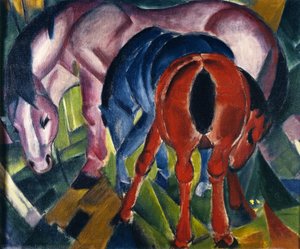
Gazdasági lóak (The Red Horses) (1911) szerzője Franz Marc

Gazdasági lóak (The Red Horses)

1911 · Olajfestmény vászonon

Franz Marc, a német festőművész, aki 1880-ban született Münchenben, egy olyan művészeti utat tett meg, amely mélyen átformázta a német expressionizmus alakját. Életének története egy szellemi keresés, amelyet a természet tisztasága révén fejez ki – különösen az állatok világában. Kezdeti hatása volt fivére, Wilhelm Marc tájfestője munkájára, de fiatalon a teológiába is betekertetett, majd végül elhatározta, hogy a művészetet tanulja az Akademie der Bildenden Künste Münchenben. Ez az egyetemi képzés…

6
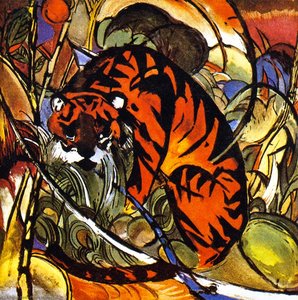
Szilárd tigris (1912) szerzője Franz Marc

Szilárd tigris

1912 · Olajfestmény vászonon

Alany és Kompozíció Ez a lenyűgöző műalkotás egy fenséges félragadozó, valószínűleg egy tigris vagy egy hasonló nagy kisméretű vadállat körül épülkedik, melyet a csendes erő és az önreflexió pillanatában örökítettek meg. Az állat áttörhetetlen tekintete magába vonja a nézőt a saját világába, titokzatos hangulatot és érzelmi mélységet keltve. A kompozíció dinamikus, mégis egyensúlyozott; a fragmented, geometrikus felületek több perspektívát is sugallnak, arra invitálva a látogatót, hogy kutassa a témát különböző…

7
A fehér macska (a Tom macska sárga párnán nevén is ismert) (1912) szerzője Franz Marc

A fehér macska (a Tom macska sárga párnán nevén is ismert)

1912 · Akril festmény vászonon

A Serene Vision of Feline Tranquility Franz Marc’s *The White Cat* (also known as *Tom Cat on Yellow Pillow*) from 1912 is a captivating example of early Expressionism, radiating a quiet intimacy and symbolic depth. More than just a portrait of a domestic animal, this oil painting offers a glimpse into Marc's evolving artistic philosophy and his belief in the spiritual essence of nature – particularly within the animal kingdom.…

8
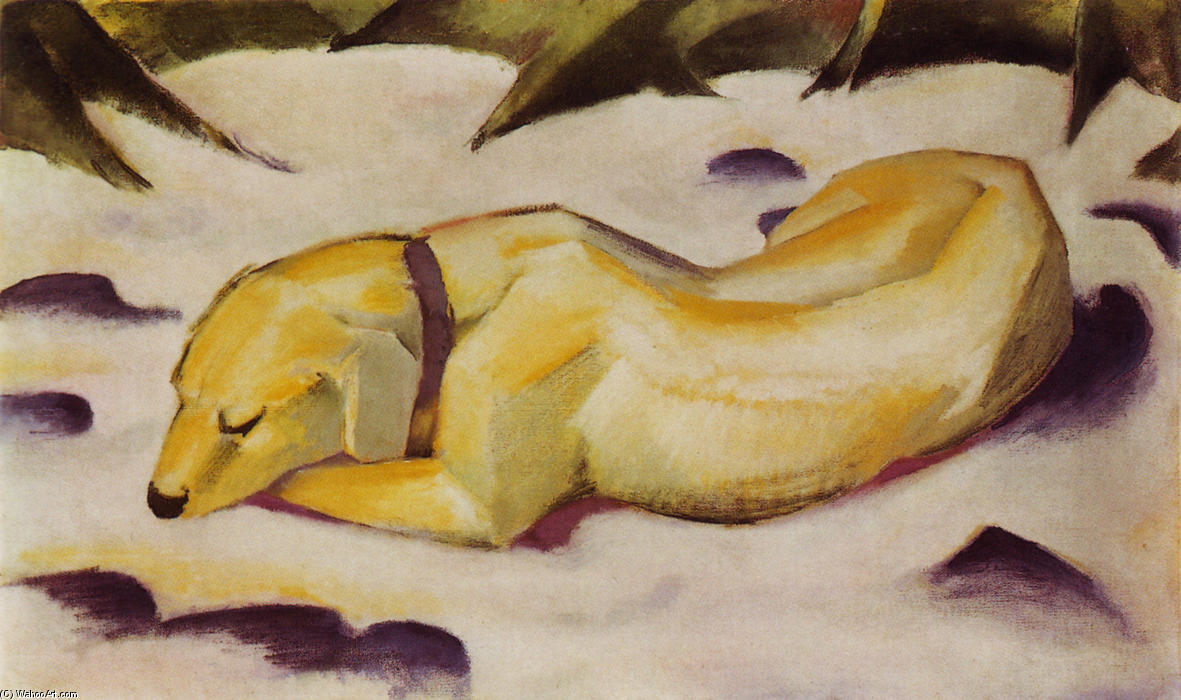
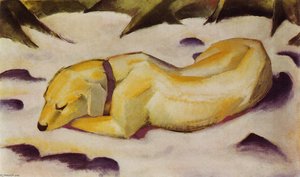
Dog Lying in the Snow (1911) szerzője Franz Marc

Dog Lying in the Snow

1911 · Oil On Canvas · Städel Múzeum, Frankfurt

Franz Marc's "Dog Lying in the Snow," painted in 1911, isn’t merely a depiction of a canine resting outdoors; it’s a profound meditation on stillness, spirituality, and the interconnectedness between humanity and the natural world. This oil-on-canvas masterpiece, currently residing at the Stadelsches Kunstinstitut in Frankfurt, embodies the core tenets of Expressionism while simultaneously radiating an almost unbearable sense of peace. Marc, a pivotal figure in the movement, sought to…

9
A mandrill (1913) szerzője Franz Marc

A mandrill

1913 · Olajfestmény vászonon · Staatsgalerie Moderner Kunst, München

A német expresszionizmus panteonjában kevés alkotás ragadja meg a természet világának nyers, spirituális pulzusát olyan vibráló módon, mint a „A mandrill”. Franz Marc 1913-as remekműve mély meditációként szolgál minden élő lény összekapcsoltságáról. A festmény szíve nem csupán egy primate ábrázolása; ez a megjelenés feletti lényeg felfedezése. Marc, a befolyásos Der Blaue Reiter mozgalom alapító tagja, törekedett a valóság felszínességének meghaladására, hogy feltárjon egy mélyebb, szellemiségibb igazságot. Lencséjén keresztül a mandrill…

10
Stables (1913) szerzője Franz Marc

Stables

1913 · Acrylic · Solomon R. Guggenheim Múzeum, New York

Franz Marc’s “Stables,” completed in 1913, stands as a cornerstone of German Expressionism—a movement that sought to convey raw emotion and subjective experience rather than objective representation. More than just a depiction of livestock within a barn, it's an exploration of primal beauty and spiritual contemplation, reflecting Marc’s unwavering belief in the transformative power of art.

Franz Marc festményei, 11. helyezéstől 100. helyezésig

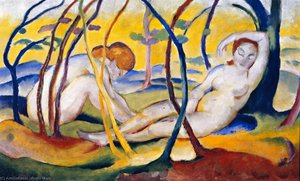
11Animal legend (1912) szerzője Franz MarcAnimal legend1912 12Deer in a Monastery Garden (1912) szerzője Franz MarcDeer in a Monastery Garden1912 · Lenbachhaus 13Erdő mókusssal (úgy is ismert, mint Erdő) (1913) szerzője Franz MarcErdő mókusssal (úgy is ismert, mint Erdő)1913 · Kunsthaus Zürich 14Foxes (also known as Four Foxes) (1913) szerzője Franz MarcFoxes (also known as Four Foxes)1913 15Az Álom (1912) szerzője Franz MarcAz Álom1912 · Thyssen-Bornemisza Múzeum 16Three Animals (Dog, Fox and Cat) (1912) szerzője Franz MarcThree Animals (Dog, Fox and Cat)1912 · Kunsthalle Mannheim 17Fate of the Animals (1913) szerzője Franz MarcFate of the Animals1913 18Kék ló II (1911) szerzője Franz MarcKék ló II1911 · Kunstmuseum Bern 19Szívenylő a erdőben II (1914) szerzője Franz MarcSzívenylő a erdőben II1914 · Staatliche Kunsthalle 20Broken Forms (1914) szerzője Franz MarcBroken Forms1914 · Solomon R. Guggenheim Múzeum 21Blue Horse II (1911) szerzője Franz MarcBlue Horse II1911 22Tájkép fekete lovakkal (1913) szerzője Franz MarcTájkép fekete lovakkal1913 23Madarak (1914) szerzője Franz MarcMadarak1914 · Lenbachhaus 24The Fear of the Hare (1912) szerzője Franz MarcThe Fear of the Hare1912 25Three Horses I (larger version) (1913) szerzője Franz MarcThree Horses I (larger version)1913 26Girl with Cat II (1912) szerzője Franz MarcGirl with Cat II1912 · Franz Marc Múzeum 27Szárnyaló ló szerzője Franz MarcSzárnyaló ló 28Two Horses in Landscape (1912) szerzője Franz MarcTwo Horses in Landscape1912 29Mountain goats (1913) szerzője Franz MarcMountain goats1913 30Foxes (1913) szerzője Franz MarcFoxes1913 31The Little Yellow Horses (1912) szerzője Franz MarcThe Little Yellow Horses1912 32Nudes in the Open Air (also known as Nudes under Trees) (1911) szerzője Franz MarcNudes in the Open Air (also known as Nudes under Trees)1911 · Museum Kunstpalast 33Tigris az Anyanokban (1912) szerzője Franz MarcTigris az Anyanokban1912 34The Mother Mare of the Blue Horses Ii (1913) szerzője Franz MarcThe Mother Mare of the Blue Horses Ii1913 35Állati Legenda (1912) szerzője Franz MarcÁllati Legenda1912 36The Tower of Blue Horses (1913) szerzője Franz MarcThe Tower of Blue Horses1913 37The Dream (1912) szerzője Franz MarcThe Dream1912 38Elephant, Horse, Cattle (1914) szerzője Franz MarcElephant, Horse, Cattle1914 39Grazing Horses IV (1911) szerzője Franz MarcGrazing Horses IV1911 40Gazellák (1913) szerzője Franz MarcGazellák1913 41The Yellow Cow (1911) szerzője Franz MarcThe Yellow Cow1911 42The Mother Mare of the Blue Horses I (1913) szerzője Franz MarcThe Mother Mare of the Blue Horses I1913 · Musée Hyacinthe Rigaud 43The Enchanted Mill (1913) szerzője Franz MarcThe Enchanted Mill1913 · Art Institute of Chicago 44The Little Blue Horses (1911) szerzője Franz MarcThe Little Blue Horses1911 45The Fox (1913) szerzője Franz MarcThe Fox1913 46Fairy Animals (1913) szerzője Franz MarcFairy Animals1913 47Horse and House with Rainbow (1913) szerzője Franz MarcHorse and House with Rainbow1913 · Bavári Állami Festırménygyűjtemények 48Dog Lying in the Snow (1911) szerzője Franz MarcDog Lying in the Snow1911 · Städel Múzeum 49Shepherds (1912) szerzője Franz MarcShepherds1912 · Bayerische Staatsgemäldesammlungen 50Green Horse (1912) szerzője Franz MarcGreen Horse1912 · Franz Marc Múzeum 51Three Deer (1911) szerzője Franz MarcThree Deer1911 52Grazing Horses II (1910) szerzője Franz MarcGrazing Horses II1910 · Staatsgalerie Stuttgart 53Mandrill (1913) szerzője Franz MarcMandrill1913 · Lenbachhaus 54Sárga női ábrázolás ülő pozícióban (1913) szerzője Franz MarcSárga női ábrázolás ülő pozícióban1913 55The Little Mountain Goats (1914) szerzője Franz MarcThe Little Mountain Goats1914 · Saint Louis Art Museum 56Red Deer (1912) szerzője Franz MarcRed Deer1912 57Tájkép állatokkal és szivargával (1911) szerzője Franz MarcTájkép állatokkal és szivargával1911 58Red Cattle (1913) szerzője Franz MarcRed Cattle1913 59Lion Hunt (after Delacroix) (1913) szerzője Franz MarcLion Hunt (after Delacroix)1913 60Liegő bika (1913) szerzője Franz MarcLiegő bika1913 · Museum Folkwang 61Blue Horse I (1911) szerzője Franz MarcBlue Horse I1911 62The Steer (The Bull) (1911) szerzője Franz MarcThe Steer (The Bull)1911 63Szarvasok a nádasban (1909) szerzője Franz MarcSzarvasok a nádasban1909 · Bayerische Staatsgemäldesammlungen 64Red Deer I (1910) szerzője Franz MarcRed Deer I1910 65Cats (1910) szerzője Franz MarcCats1910 66Cats, Red and White (1912) szerzője Franz MarcCats, Red and White1912 67Three Horses (1912) szerzője Franz MarcThree Horses1912 68Deer in the Forest I (1913) szerzője Franz MarcDeer in the Forest I1913 · The Phillips Collection 69Kis ló-szereplés I (1905) szerzője Franz MarcKis ló-szereplés I1905 · Bavári Állami Festırménygyűjtemények 70The blue foals (1913) szerzője Franz MarcThe blue foals1913 71Halott szarv (1913) szerzője Franz MarcHalott szarv1913 72Mare with Foals (1912) szerzője Franz MarcMare with Foals1912 73Ünnepélyes képet Franz Marc művéből: Egy kiszámolásló ló és aranyszínű virágmező szerzője Franz MarcÜnnepélyes képet Franz Marc művéből: Egy kiszámolásló ló és aranyszínű virágmezőStaatsgalerie Stuttgart 74Three Horses at the Watering Place (also known as Three Horses at a Watering Place in the Woods) (1913) szerzője Franz MarcThree Horses at the Watering Place (also known as Three Horses at a Watering Place in the Woods)1913 75Three horses at the watering place (1913) szerzője Franz MarcThree horses at the watering place1913 · Staatliche Kunsthalle Karlsruhe 76The trees showed their rings, the animals their veins (1913) szerzője Franz MarcThe trees showed their rings, the animals their veins1913 77Three Animals on the Blue Mountain (1913) szerzője Franz MarcThree Animals on the Blue Mountain1913 78Bathing Women (1910) szerzője Franz MarcBathing Women1910 79cím nélküleg (9194) szerzője Franz Marccím nélküleg (9194) 80Horse (1912) szerzője Franz MarcHorse1912 81Two Reclining Black Cats (1913) szerzője Franz MarcTwo Reclining Black Cats1913 82Grazing Horses II (1910) szerzője Franz MarcGrazing Horses II1910 83Sleeping Shepherdness (1912) szerzője Franz MarcSleeping Shepherdness1912 84Fighting Forms (Kampfende Formen) szerzője Franz MarcFighting Forms (Kampfende Formen) 85Lying Dog (also known as Portrait of a Dog) (1909) szerzője Franz MarcLying Dog (also known as Portrait of a Dog)1909 86Cat with Kittens (1912) szerzője Franz MarcCat with Kittens1912 87Black and white horse in mountain landscape with rainbow (1911) szerzője Franz MarcBlack and white horse in mountain landscape with rainbow1911 · Albertina 88Three Deer (1911) szerzője Franz MarcThree Deer1911 89The Unfortunte Land of Tyrol (1913) szerzője Franz MarcThe Unfortunte Land of Tyrol1913 90Little Oak Tree (1909) szerzője Franz MarcLittle Oak Tree1909 · Lenbachhaus 91Two Animals (1913) szerzője Franz MarcTwo Animals1913 92Two Blue Horses in front of a Red Rock (1913) szerzője Franz MarcTwo Blue Horses in front of a Red Rock1913 · Lenbachhaus 93Horses at Pasture I (1910) szerzője Franz MarcHorses at Pasture I1910 94Two Horses, Red and Blue (1912) szerzője Franz MarcTwo Horses, Red and Blue1912 95untitled (2015) szerzője Franz Marcuntitled (2015) 96Horse in a Landscape szerzője Franz MarcHorse in a LandscapeMuseum Folkwang 97Megöltött szarvas szerzője Franz MarcMegöltött szarvasFranz Marc Múzeum 98Dream (1913) szerzője Franz MarcDream1913 · Kunstmuseum Bern 99Nagyszalagszigetesi lófestmény (1908) szerzője Franz MarcNagyszalagszigetesi lófestmény1908 100untitled (8652) szerzője Franz Marcuntitled (8652)Art Institute of Chicago

Franz Marc híres festményei, korszakonként

A témák, amelyek Franz Marc figyelmét meghúzták

A négy leggyakorobban előforduló téma ebben az eredeti művekben, mindegyik a legkiválóbb példájával.

A műemlékek, amelyek Franz Marc eredeti műveit őrzik

A 8 olyan múzeum, amely a legtöbb ezen az oldalon szereplő festményet őrzi.

Múzeumok Város Franz Marc művei Ebből a listából származó festmények
Lenbachhaus, MünchenLenbachhaus München 23 Kék ló I, Deer in a Monastery Garden, Madarak
Franz Marc Múzeum, Kochel am SeeFranz Marc Múzeum Kochel am See 11 Girl with Cat II, Green Horse, Megöltött szarvas
Bavári Állami Festırménygyűjtemények, MunchenBavári Állami Festırménygyűjtemények Munchen 38 Horse and House with Rainbow, Kis ló-szereplés I
Solomon R. Guggenheim Múzeum, New YorkSolomon R. Guggenheim Múzeum New York 10 Stables, Broken Forms
Museum Folkwang, EssenMuseum Folkwang Essen 7 Liegő bika, Horse in a Landscape
Staatsgalerie Stuttgart, StuttgartStaatsgalerie Stuttgart Stuttgart 5 Grazing Horses II, Ünnepélyes képet Franz Marc művéből: Egy kiszámolásló ló és aranyszínű virágmező
Staatsgalerie Moderner Kunst, MünchenStaatsgalerie Moderner Kunst München 4 Tirol, A mandrill
Bayerische Staatsgemäldesammlungen, MunichBayerische Staatsgemäldesammlungen Munich 4 Shepherds, Szarvasok a nádasban

Franz Marc, az év meghatározó festményei

Tíz év, 1905től 1914ig, elegendő volt Franz Marc-nek: a galéria év év után évon keresztül végigvezeti velünk ezeket, egy híres eredetitől a következőig.

Művek évszáma szerint

Váasszon egy évet az eredetiek megtekintéséhez.

Franz Marc festményei: a galéria válaszai

Melyik Franz Marc festmény a leghíresebb?Fedje fel a választ

Kék ló I (1911), Lenbachhaus, München. Ezután untitled (4325) és A Vöröslovakok (1911) következik.

Hány éves volt Franz Marc, amikor elkészítette a(t): Kék ló I?Fedje fel a választ

31 éves: Kék ló I 1911-ből származik, Franz Marc pedig 1880-ben született.

Melyek Franz Marc top 10 festménye?Fedje fel a választ

Kék ló I, untitled (4325), A Vöröslovakok, Tirol, Gazdasági lóak (The Red Horses), Szilárd tigris, A fehér macska (a Tom macska sárga párnán nevén is ismert), Dog Lying in the Snow, A mandrill és Stables. A fenti rangsor a művek évszamarát és a múzeumát jelzi.

Hány műve született Franz Marc nevére?Fedje fel a választ

Katalógusunkban 493 mű található Franz Marc alkotótól, 1905 és 1914 év közötti időszakból.

Hol találhatóak Franz Marc leghíresebb eredeti művei?Fedje fel a választ

Leginkább Lenbachhaus (München), Franz Marc Múzeum (Kochel am See) és Bavári Állami Festırménygyűjtemények (Munchen) található. A fenti múzeumi táblázatban mindegyik felsorolásra került.

Mikor festette Franz Marc le leghíresebb műveit?Fedje fel a választ

1913 alatt: a jelen laphonon található 100 műből 34 készült ebben az időszakban, köztük A mandrill.

Melyek Franz Marc legkorábbi és legutóbbi híres művei?Fedje fel a választ

Ezen az oldalon a leghitelesebb Kis ló-szereplés I (1905), a legutóbbi pedig Tirol (1914).

Mely témakörökkel foglaltaszkodott a legtöbbször Franz Marc?Fedje fel a választ

Landscape (30), Animals (24) és Spirituality (23), a jelen oldalon található 100 műművészeti alkotás között.

Melyik technikával foglalt leginkább Franz Marc?Fedje fel a választ

Oil On Canvas, a jelen oldalon található 100 műből 43 darab esetén.

Mely művészeti irányhoz tartozik Franz Marc?Fedje fel a választ

Expresszionizmus, ezen az oldalon található eredetiek alapján.

Mely Franz Marc eredeti műveit őrzi a Lenbachhaus?Fedje fel a választ

Kék ló I, Deer in a Monastery Garden és Madarak: a Lenbachhaus, München 6 művet őrzi ezen az oldalon.

Kérhető egy Franz Marc festmény kézzel készített másolata?Fedje fel a választ

Igen, reprodukcióként: az eredeti mű a múzeumban marad, de ezen az oldalon látható bármelyik festmény megmaleríthető Önnek, egyedi igény alapján, a festmény saját oldalán keresztül.

Franz Marc: a művész

Early Life, Family and Training

Franz Marc was born in Munich, Germany, into a household where the visual language of landscape was already established. His father, Wilhelm Marc, worked as a professional landscape painter, providing a direct, if not entirely certain, introduction to the mechanics of art. This familial connection meant that the tools of the trade were present from the beginning, yet Marc’s path was not a straight line from inheritance to canvas. Before committing to a life of painting, he spent time grappling with theology, a period of spiritual inquiry that would later dictate the intensity of his visual output. This tension between the sacred and the material is what gives his later work its specific, heavy weight.

His formal training began in 1900 when he enrolled in the arts program at the Ludwig-Maximilians-Universität München. This academic foundation was not a mere formality; it provided the technical rigor necessary to eventually dismantle traditional representation. Following his time at Munich University, he moved on to the Academy of Fine Arts, Munich. This sequence of study moved him from general academic principles toward the specialized, intense focus required for the radical shifts he would eventually lead. He was not a product of accidental talent, but of a deliberate, structured immersion in the formal traditions of Munich.

Artistic Development and Influences

Marc’s early output reflects the heavy weight of academic painting and Impressionism. These traditional foundations provided the technical structure he would eventually dismantle. His time in France, specifically during visits to Paris in 1903 and 1907, acted as a catalyst for this departure. It was in Paris that he encountered the work of Vincent van Gogh. This encounter provided a necessary alternative to the rigid structures of his training, offering a way to use color as a direct tool for emotional expression rather than mere description.

The shift toward abstraction was not a sudden leap but a calculated response to the evolving visual language of the early 20th century. Robert Delaunay’s exploration of abstract forms and intense color palettes provided a blueprint for Marc’s own movement toward simplification. He moved away from the literal representation of the landscape, seeking instead to strip subjects down to their essential shapes. This process allowed him to move past the surface of the natural world to reach a more subjective, charged style of expression.

The Blue Rider and Expressionism

The shift from mere representation to a search for spiritual truth defines Marc's most significant contribution to modernism. Before establishing his own movement, he experimented with the Neue Künstlervereinigung München. This period of trial and error was necessary to break away from the academic constraints of the time. By 1911, Marc co-founded Der Blaue Reiter alongside Wassily Kandinsky. This was not a mere social club; it was a radical departure from the status quo. The group used the Der Blaue Reiter journal to push a specific agenda: the use of abstraction and symbolic color to express inner spiritual realities. They wanted to bypass the surface of the physical world to reach something more essential.

This movement was a direct challenge to the industrial, gray reality of the early 20th century. Marc and his colleagues sought a visual language that could communicate the soul rather than just the eye. They moved toward a style where color functioned as a spiritual frequency. This wasn't about painting what was seen, but about capturing the internal essence of a subject. The focus shifted from the external landscape to a rhythmic, symbolic interpretation of life. This period marked the moment when German Expressionism found its most potent, non-literal voice.

Technique and Symbolic Style

Marc’s visual language relies on a rigid, deliberate system of color symbolism that rejects descriptive accuracy. He did not use hues to mimic the natural world, but to map out a spiritual hierarchy. In his palette, blue represents masculinity and spirituality. Yellow signifies femininity and joy. Red embodies materiality and violence. This was not a loose aesthetic choice; it was a structured attempt to communicate internal truths through external pigment. By stripping away the literal, he forced the viewer to engage with the emotional weight of the color itself.

His technique moved toward a radical simplification of form. He reduced complex biological structures into essential, rhythmic shapes. This reductionism, combined with bold, non-naturalistic colors, created a sense of tension between the subject and its environment. He used short, deliberate brushstrokes and impasto to build texture, giving his compositions a physical presence that contradicts the abstraction of his subjects. The result is a style where the animal is no longer a creature of flesh, but a vessel for a specific, coded energy.

Key Works and Subject Matter

Marc’s mature output centers on the animal kingdom. He moved away from static landscapes to focus on creatures like horses, deer, and foxes. These subjects functioned as vessels for spiritual energy rather than mere biological studies. In 1911, he produced The Large Blue Horses, a work that established his preference for non-naturalistic color. By 1912, his compositions became more aggressive and structured, seen in Tiger and Red Deer. These paintings demonstrate a shift toward capturing the inherent qualities of his subjects through simplified, rhythmic forms.

The evolution of his style shows a clear trajectory toward abstraction. His 1913 work The Foxes reflects the influence of French Cubism, utilizing a crystalline composition to break down form. This approach reached a peak in The World-Cow, painted in 1913, where the subject becomes a symbol of cosmic existence. His work relies on a specific color logic: blue for masculinity and spirituality, yellow for femininity and joy, and red for violence and materiality. This system turned every animal portrait into a philosophical statement rather than a literal depiction.

Later Years and Death

The trajectory of Marc's career was abruptly severed by the onset of World War I in 1914. Despite his status as an artist, he was drafted into the German army to serve as a cavalryman. The conflict forced a shift from his pursuit of spiritual abstraction to the grim realities of military service. Even amidst the chaos of the war, he continued to paint, attempting to find meaning through his brush even as the world around him fractured.

His life ended on March 4, 1916, at the Battle of Verdun. This death occurred two years after the outbreak of the war. He was killed by a shell splinter, a violent end that cut short a career defined by the search for purity. The suddenness of his death at Verdun left a void in the development of German Expressionism, halting his movement toward even more radical abstraction before he could reach its logical conclusion.

Legacy and Influence

Franz Marc remains a central figure in the history of German Expressionism. His impact is measured by how his approach to color and form shifted the focus of modern art from external observation to internal spiritual truth. While his career was cut short, his influence persists through the continued presence of his works in major museums across the globe. His ability to distill the essence of animals into symbolic, non-naturalistic shapes changed the trajectory of early 20th-century painting.

The political landscape of the 1930s attempted to erase this contribution. The Nazi regime labeled Marc a degenerate artist, part of a broader effort to suppress modernism. Despite this systematic campaign, the majority of his output survived the destruction of World War II. This survival ensures that his visual language remains accessible to contemporary audiences. His work continues to resonate because it offers a direct, emotive response to the natural world that avoids the constraints of literal representation.

Where to See the Works Today

To encounter the physical reality of Marc's vision, one must look to specific institutional collections that preserved his output through the turbulence of the 20th century. The Franz Marc Museum in Kochel am See, Germany, functions as a primary site for his legacy, housing over 150 of his works. This collection provides a direct look at the artist's development within the Bavarian landscape. In Munich, the Lenbachhaus maintains an extensive collection, offering a concentrated look at his contribution to German Expressionism. The Staatsgalerie Moderner Kunst in Munich also holds significant pieces, ensuring his presence remains central to the city's art history.

His reach extends far beyond German borders, with major international museums holding his canvases. In the United States, the Art Institute of Chicago possesses The Enchanted Mill. These scattered locations allow for a global understanding of his impact on modern abstraction. Seeing these works in person reveals the actual texture of his brushwork and the specific intensity of his color choices, which often lose their weight in digital reproductions.

Minden 493 műmű Franz Marc alkotása →