Clyfford Still portréja

A 100 legnevesebbebb Clyfford Still festmény, mindegyik egyedistens

Frissítve: november 2026 · rangsorolva népszerűségi pontszámunk alapján (minden mű keresései, látogatásai és megrendelései alapján) · 160 mű Clyfford Still alkotása a katalógusunkban

Röviden

PH-247 (1951) az a Clyfford Still festmény, amely a legtöbb tekintetet felvonja. Ezután a tekintet PH-1007 (1976) és Untitled (1946) elemre irányul. A Clyfford Still 160 műve közül a katalógusunkban megtalálható 100 legnépesebb alkotás, melyeket az év, a múzeum és az örökévalóságának okai kísérnek.

1904 – 1980, Gráncs Abstract expressionism A legtöbb mű: Metropolitan Művészeti Múzeum

A galéria szemével: Clyfford Still legjobb 10 festménye

1
PH-247 (1951) (1889) -ja Clyfford Still

PH-247

1951 · Oil On Canvas

The canvas known as PH-247 emerges from the year 1951, a moment when Clyfford Still was deep within his exploration of abstraction. Created in New York, NY, this oil on canvas work carries a nickname that speaks to its intense presence: "Big Blue." The title itself, a mere alphanumeric designation, reflects the artist's preference for a visual language that resists easy categorization or narrative labels.

2
PH-1007 (1976) (1889) -ja Clyfford Still

PH-1007

1976 · Oil On Canvas

PH-1007 is an oil on canvas painted by Clyfford Still. The work emerged in 1976, a period of late-career intensity for the artist. It exists today within the Clyfford Still Museum in Denver, CO.

3
Untitled (1946) (1889) -ja Clyfford Still

Untitled

1946 · Oil On Canvas · Metropolitan Művészeti Múzeum, New York

Created in 1946, this oil on canvas avoids a central focal point to prioritize a dynamic interplay between colossal, irregular shapes. These vertical forms extend from the top to the bottom of the 178 x 107 cm surface, generating an upward thrust that disrupts visual equilibrium. The arrangement allows spaces between the masses to breathe, fostering a palpable sense of unease through carefully crafted asymmetry.

4
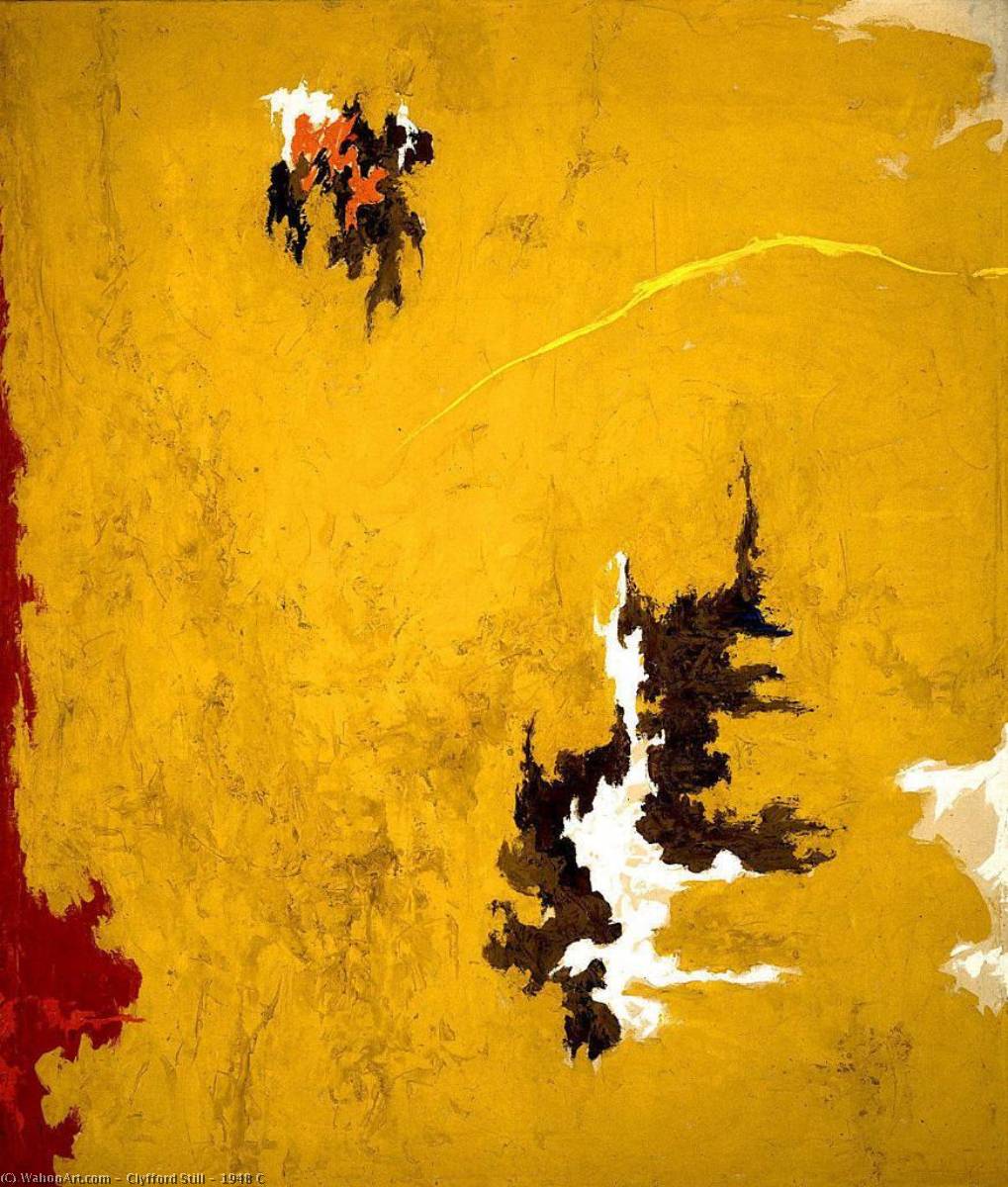
1948 C (1948) (1889) -ja Clyfford Still

1948 C

1948 · Oil On Canvas

In the vast, emotive landscape of Abstract Expressionism, few works command the room with such primal intensity as Clyfford Still’s 1948 C. This monumental canvas is not merely a painting but an immersive environment, a swirling vortex of warmth that captures the very essence of elemental energy. Dominated by a radiant palette of sun-drenched yellows and searing oranges, the work feels as though it were forged in the heart of…

5
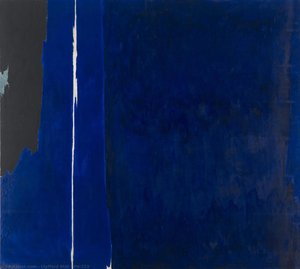
PH-923 (1974) (1889) -ja Clyfford Still

PH-923

1974 · Oil On Canvas

In the vast, emotive landscape of Abstract Expressionism, few works command the eye with such raw, elemental energy as PH-923. Created in 1974 by the master of organic abstraction, Clyfford Still, this painting serves as a profound testament to the power of non-figurative language. At first glance, the viewer is met with an expansive blue canvas, a deep and immersive field that suggests both the infinite reaches of a twilight…

6
PH-160 (1957) (1889) -ja Clyfford Still

PH-160

1957 · Oil On Canvas

Created in 1957, PH-160 by Clyfford Still exists as a field of pure color. The canvas holds a dialogue between blue and yellow. These hues do not merely sit upon the surface; they occupy the space with a heavy, physical presence. The blue carries a weight that anchors the composition, while the yellow provides a sharp, sudden light. It is a quiet collision of elements.

7
PH-272 (1950) (1889) -ja Clyfford Still

PH-272

1950 · Oil On Canvas

In the vast, turbulent landscape of mid-century American art, few voices resonate with as much primal intensity as that of Clyfford Still. His masterpiece, PH-272, stands as a monumental testament to the dawn of Abstract Expressionism, inviting the viewer into a world where color and texture transcend mere representation to touch the very essence of existence. Created in 1950, this work is not merely a painting but an immersive environment.…

8
PH-223 (1956) (1889) -ja Clyfford Still

PH-223

1956 · Oil On Canvas

Created in 1956, this oil on canvas composition operates through a language of fractured planes and intense chromatic tension. The work avoids representational forms, opting instead for a structural arrangement of blue and white fields. A sharp, white line cuts across the upper register, creating a stark boundary that disrupts the visual flow. Below, two distinct blue areas dominate the foreground, their irregular shapes suggesting a sense of geological or…

9
1950 A No. 2 (1950) (1889) -ja Clyfford Still

1950 A No. 2

1950 · Oil On Canvas

To stand before 1950 A No. 2 is to witness a profound dialogue between light and shadow, a visceral confrontation with the elemental forces of nature. As a seminal work from the height of Clyfford Still’s creative powers, this masterpiece transcends mere abstraction to become an existential landscape. The canvas erupts in a dramatic interplay of deep, pulsating reds and brilliant, sun-drenched yellows, creating a sense of movement that feels…

10
1950-W (1950) (1889) -ja Clyfford Still

1950-W

1950 · Oil On Canvas · Metropolitan Művészeti Múzeum, New York

Clyfford Still's "1950-W," painted in 1950, stands as a pivotal work within the trajectory of Abstract Expressionism. More than simply a painting, it’s an immersive experience—a visceral confrontation with color and texture that speaks to the anxieties and burgeoning energy of postwar America. This piece, rendered in layers of intense yellow and gold punctuated by strategic reds and whites, isn't about depicting recognizable objects; instead, it plunges directly into the…

Clyfford Still híres festményei, 11 és 100 között

Clyfford Still híres festményei, korszakonként

A témák, amelyek Clyfford Still figyelmét meghúzták

A négy leggyakorobban előforduló téma ebben az eredeti művekben, mindegyik a legkiválóbb példájával.

A műemlékek, amelyek Clyfford Still eredeti műveit őrzik

A 6 olyan múzeum, amely a legtöbb ezen az oldalon szereplő festményet őrzi.

Múzeum Város Clyfford Still művei Ebből a listából származó festmények
Metropolitan Művészeti Múzeum, New YorkMetropolitan Művészeti Múzeum New York 4 Untitled, 1950-W
Smithsonian American Art Museum, Washington, D.C.Smithsonian American Art Museum Washington, D.C. 2 Row of Elevators
The Phillips Collection, Washington, D.C.The Phillips Collection Washington, D.C. 1 1950 B
Guggenheim Múzeum Bilbao, BilbaoGuggenheim Múzeum Bilbao Bilbao 1 Untitled
San Francisco Museum of Modern Art, San FranciscoSan Francisco Museum of Modern Art San Francisco 1 PH-233 [formerly Self-Portrait]
Nationalmuseum, StockholmNationalmuseum Stockholm 1 PH-416

Clyfford Still évtizedekig: egy egyedi eredeti mű minden évtizedben

Művek évtizedenként

Váassz ki egy évtizedet, hogy megnézhesd az azt meghatározó eredetiműveket.

Clyfford Still festményei: kérdések a galériának

Mi a leghíresebb műve Clyfford Stillnek?Fedje fel a választ

PH-247 (1951). Ezt követi PH-1007 (1976) és Untitled (1946).

Milyen életkorában alkotta meg Clyfford Still a(z) PH-247 műszt?Fedje fel a választ

47 éves: PH-247 1951-ből származik, Clyfford Still pedig 1904-ben született.

Melyik tíz festménye Clyfford Still a leghíresebb?Fedje fel a választ

PH-247, PH-1007, Untitled, 1948 C, PH-923, PH-160, PH-272, PH-223, 1950 A No. 2 és 1950-W. A fenti rangsor a művek évszamarát és a múzeumát jelzi.

Hány mű alkotása ismert Clyfford Still nevében?Fedje fel a választ

Katalógusunkban 160 mű található Clyfford Still alkotótól, 1920 és 1976 év közötti időszakból.

Hol tekinthetők meg a leghíresebb Clyfford Still eredetijeit?Fedje fel a választ

Leginkább Metropolitan Művészeti Múzeum (New York), Smithsonian American Art Museum (Washington, D.C.) és The Phillips Collection (Washington, D.C.) található. A fenti múzeumi táblázatban mindegyik felsorolásra került.

Melyik időszakban alkotta Clyfford Still a leghíresebb festményeit?Fedje fel a választ

1930s alatt: a jelen laphonon található 100 műből 41 készült ebben az időszakban, köztük PH-81.

Melyik híres Clyfford Still festmény a legkorábbi, és melyik a legutóbb készült?Fedje fel a választ

Ezen az oldalon a leghitelesebb PH-274 (1920), a legutóbbi pedig PH-1007 (1976).

Milyen témakörket kedvelt Clyfford Still?Fedje fel a választ

Color field (4), Black and white (4) és Color field painting (3), a jelen oldalon található 100 műművészeti alkotás között.

Milyen anyagokkal festett leggyakrabban Clyfford Still?Fedje fel a választ

Oil On Canvas, a jelen oldalon található 100 műből 17 darab esetén.

Mely művészeti irányba tartozik Clyfford Still műve?Fedje fel a választ

Abstract expressionism, ezen az oldalon található eredetiek alapján.

Milyen Clyfford Still eredeti műveket láthatok a Metropolitan Művészeti Múzeum kiállításaiban?Fedje fel a választ

Untitled és 1950-W: a Metropolitan Művészeti Múzeum, New York 2 művet őrzi ezen az oldalon.

Clyfford Still: a művész portréja

A Pioneer of Abstract Expressionism: The Life and Art of Clyfford Still

Clyfford Still, born in 1904 amidst the vast landscapes of Grandin, North Dakota, stands as a pivotal figure in the evolution of American art. His journey, marked by an unwavering commitment to artistic integrity and a relentless exploration of form and color, positioned him among the leading lights of Abstract Expressionism. Though often overshadowed by contemporaries like Jackson Pollock and Mark Rothko, Still’s contribution was foundational; he ventured into non-figurative painting earlier than many of his peers, forging a path toward a new visual language that would profoundly influence modern art. His early life, spent moving between North Dakota, Washington, and Alberta, Canada, instilled in him a deep connection to the natural world – a resonance that would echo throughout his artistic career. A brief period of study at the Art Students League in New York City in 1925 offered initial exposure to the art world, but it was his subsequent experiences teaching and painting on the West Coast that truly shaped his unique vision. He wasn’t simply seeking to depict nature; he aimed to capture its raw essence, its underlying forces of creation and destruction.

From Representation to Revelation: The Development of a Unique Style

The transformation from representational work to the radical abstraction for which Still is celebrated occurred between 1938 and 1942, a period of intense experimentation and self-discovery. This shift wasn’t merely stylistic; it was profoundly philosophical. He sought to strip away all recognizable imagery, believing that true artistic expression lay in confronting the fundamental elements of painting itself – color, form, and surface. Early works like *PH-616* (1929) offer a glimpse into this transitional period, showcasing his initial exploration of rural life rendered with a muted palette and evocative symbolism. These paintings weren’t simply depictions; they were imbued with a sense of longing, a quiet contemplation of the human condition within the vastness of the American landscape. As he moved further toward abstraction, these representational elements gradually dissolved into jagged planes of color, fractured surfaces, and imposing vertical forms. These weren't merely abstract shapes; they were imbued with raw emotion, existential angst, and the sublime power of nature. He worked primarily with oil paint applied with palette knives, building up layers of texture that created a dynamic interplay between light and shadow. This technique allowed him to create surfaces that seemed to pulse with energy, inviting viewers into an immersive experience—a confrontation with the very act of painting itself.

The Language of Color and Form: Key Characteristics of Still’s Work

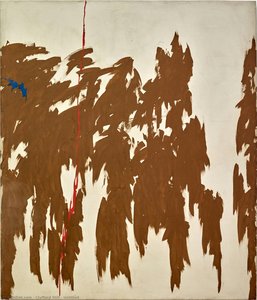
Still's mature paintings are characterized by their monumental scale and dramatic color juxtapositions. He favored large canvases, believing that only through such expansiveness could he convey the full emotional weight of his vision. His compositions typically feature irregular, fractured planes of color – often dark and brooding hues punctuated by flashes of brighter tones. These forms aren’t simply arranged on the canvas; they seem to emerge from it, creating a sense of depth and spatial ambiguity. The vertical element is particularly significant in Still's work, representing what he termed “the vertical necessity of life” – a defiant assertion of human spirit against overwhelming forces. *1957-D No. 1*, with its predominantly black and yellow palette accented by white and red, exemplifies this characteristic use of color and form to evoke powerful emotional responses. He deliberately avoided titles that might suggest specific interpretations, preferring a numerical system (e.g., “1957-D No. 1”) that emphasized the painting’s purely visual qualities. This was part of his broader effort to resist categorization and maintain control over how his work was perceived. He wanted viewers to experience the paintings directly, without preconceived notions or external narratives.
The Influence of a Difficult Childhood

Clyfford Still's artistic development was profoundly shaped by his childhood experiences on a wheat farm in Alberta, Canada. His father, Elmer, was a stern and demanding man who valued hard work above all else. The harsh realities of rural life – the relentless toil, the isolation, and the constant struggle against the elements – instilled in Still a deep sense of resilience and an appreciation for the raw power of nature. However, his relationship with his father was also marked by emotional distance and a lack of affection. As he later recounted, his father seemed to view him as expendable—a tool to be used for the family’s survival. This feeling of being undervalued and overlooked fueled his determination to forge his own path in life, ultimately leading him to abandon the farm and pursue a career as an artist. The memory of this difficult childhood continued to haunt him throughout his life, informing the emotional intensity and often unsettling quality of his work. It's believed that the ghostly figure in *PH-77* (1936), with its elongated limbs and desolate expression, is a direct representation of his father—a silent testament to the complex and enduring impact of family relationships.

Legacy and Recognition

Despite facing considerable resistance from the New York art establishment during much of his career, Clyfford Still’s work gradually gained recognition in the late 1940s and early 1950s. His paintings were exhibited at prestigious galleries such as the Albright-Knox Art Gallery in Buffalo, New York, and the Phoenix Galleries in New York City. In 1959, a comprehensive retrospective of his work at the Albright-Knox solidified his reputation as a major figure in American art. Today, Clyfford Still’s paintings are held in some of the world's most important museums, including the Museum of Modern Art in New York City, the Denver Art Museum, and the National Gallery of Canada. The Clyfford Still Museum in Denver, Colorado, which opened in 2011, houses an extraordinary collection of over 3,125 works—representing 93 percent of his lifetime output and complete archives. This museum provides unparalleled access to the breadth and depth of his artistic vision, ensuring that his contributions will continue to be studied and appreciated for generations to come. His work remains a powerful testament to the transformative power of art and the enduring legacy of an artist who dared to challenge convention and forge his own unique path.

Further Exploration

  • Explore more about Clyfford Still’s artworks at OriginalUniqueArt.com.
  • Discover the Color Field art movement.
  • Learn about artists like Mark Rothko and their influence on the art world.