Carl Larsson portréja

Carl Larsson festményei: A 100 leghíresebb alkotás, egy galéria szemével

Frissítve: november 2026 · rangsorolva népszerűségi pontszámunk alapján (minden mű keresései, látogatásai és megrendelései alapján) · 500 mű Carl Larsson alkotása a katalógusunkban

Röviden

A galéria szerint Carl Larsson leghíresebb festménye a A midtéli Áldozat (1915), amelynek eredeti példája a Nationalmuseum múzeumában található, Stockholm városában. Brita and me (1895) és Title in Swedish: Midvinterblot (1915) kiegészítik azt a triót, amelyet minden szem felismer. A katalógusunkban szereplő 500 művész Carl Larsson alkotásából a galéria az alábbi 100 leghíresebbet mutatja be, amelyek mind egyedi originális művek, a készítés évszámával, a múzeum megnevezésével és a különlegességük leírásával.

1853 – 1919, Stockholm Realism A legtöbb mű: Nationalmuseum

A galéria top 10 Carl Larsson festménye

1
A midtéli Áldozat (1915) (1889) -ja Carl Larsson

A midtéli Áldozat

1915 · Olajfesték · Nationalmuseum, Stockholm

egy monumentális falmenti festmény, amelyet a szentségesség, a rituálé és az epikus narratíva érzése határoz meg. A kompozíció széles és panorámás, egy íve alakú építészeti keret mögött helyezve, amely egy hatalmas, világos színű fából készült templom vagy terem hátterén mutatja be ezt a nagyszabású jelenetet. A színpaletta kifinomult, amelyet a szürke, a bézs és a halványkék világos színek dominálnak, melyeket mély karmaz, királykék, arany és a bal oldalon látható hatalmas…

2
Brita and me (1895) (1889) -ja Carl Larsson

Brita and me

1895 · Acrylic On Canvas · Nationalmuseum, Stockholm

Carl Larsson's "Brita and Me," painted in 1895, isn’t merely a portrait; it’s a carefully constructed tableau of idyllic Swedish life. The scene unfolds with an almost palpable warmth – a man, presumably Carl Larsson himself, gently cradling his young daughter, Brita, on his shoulders as she floats serenely in the air. This isn't a depiction of grand adventure or dramatic action; instead, it’s a quiet celebration of family, domesticity,…

3
Title in Swedish: Midvinterblot (1915) (1889) -ja Carl Larsson

Title in Swedish: Midvinterblot

1915 · Acrylic On Canvas · Nationalmuseum, Stockholm

Carl Larsson's “Midvinterblot,” completed in 1915, isn’t merely a painting; it’s a visceral plunge into the heart of Swedish mythology and a potent commentary on artistic convention. Measuring an imposing 6.5 by 13.5 meters, this mural dominates any space it graces, demanding attention with its scale and arresting imagery. Initially rejected by the Nationalmuseum due to historical inaccuracies and perceived offense – reflecting anxieties about the shifting landscape of modern…

4
august strindberg (1899) (1889) -ja Carl Larsson

august strindberg

1899 · Charcoal

In this 1899 portrait, Carl Larsson captures the likeness of August Strindberg. The subject is a prominent Swedish writer and playwright, rendered with a heavy, unfinished quality. His gaze is cast downward, lost in a private moment of thought. The face carries a weight of introspection, a quiet gravity that settles over the features. It is a study of a man caught in the stillness of his own mind.

5
Mme Jeanne Tramcourt (1889) -ja Carl Larsson

Mme Jeanne Tramcourt

Watercolor

Mme Jeanne Tramcourt sits in a stillness that feels heavy with the weight of a single, suspended second. She is draped in a blue dress, the fabric accented by delicate white lace that catches the light, creating a soft contrast against the deeper tones of her surroundings. In her hands, she holds a single flower, a small gesture of life held against the quietude of her pose. Her gaze meets…

6
modelo escribiendo una tarjeta postal (1906) (1889) -ja Carl Larsson

modelo escribiendo una tarjeta postal

1906 · Oil On Canvas

The work titled modelo escribiendo una tarjeta postal was created in 1906 by the Swedish artist Carl Larsson. This piece reflects the artist's technical precision and his specific focus on the nuances of domestic life. It remains a significant example of his ability to render detail within a private, quiet setting.

7
Christmas Tree Confetti (1889) -ja Carl Larsson

Christmas Tree Confetti

Watercolor

To gaze upon Carl Larsson’s Christmas Tree Confetti is to step directly into the warm, luminous embrace of a cherished holiday memory. This watercolor painting is more than just a depiction of seasonal festivity; it is an immersion into the quiet magic of domestic life, rendered with an almost palpable sense of joy. The scene centers around a young girl, absorbed in the delicate ritual of adorning a magnificent Christmas…

8
Jenny With Flower Girland (1889) -ja Carl Larsson

Jenny With Flower Girland

Drawing

Jenny With Flower Girland is a work by the Swedish painter Carl Larsson. Born on 28 May 1853 in Storkyrkoförsamlingen, Sweden, the artist developed a style that became representative of the Arts and Crafts movement. His hand moved through the years until his death in 1919.

10
La veranda (1896) (1889) -ja Carl Larsson

La veranda

1896

A house porch serves as the stage for a quiet, observational moment. A dog rests on the veranda, preoccupied with something held in its mouth, while two figures occupy the periphery of the scene. One person stands near the left edge, the other closer to the right. The composition is anchored by the architectural lines of the porch, punctuated by a potted plant and a single bird perched to the…

Carl Larsson festményei, 11. helyezéstől 100. helyezésig

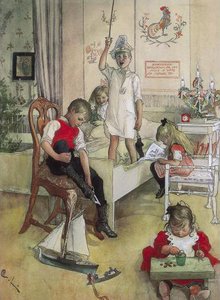
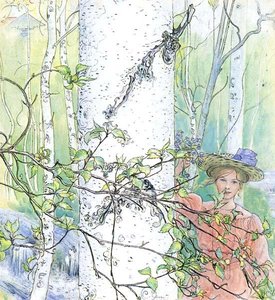
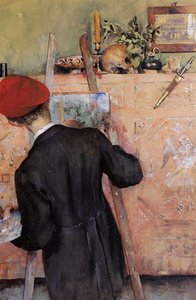
11apple harvest (1903) (1889) -ja Carl Larssonapple harvest1903 12Leontine Sitting In The Atelier (1889) -ja Carl LarssonLeontine Sitting In The Atelier 13A studio idyll. The artist's wife with daughter Suzanne (1889) -ja Carl LarssonA studio idyll. The artist's wife with daughter SuzanneNationalmuseum 14Viking Woman (1889) -ja Carl LarssonViking Woman 15Loggers in the forest (1889) -ja Carl LarssonLoggers in the forest 16"Murre". Portrait of Casimir Laurin (1900) (1889) -ja Carl Larsson"Murre". Portrait of Casimir Laurin1900 · Nationalmuseum 17At The Scaffold Painter (1889) -ja Carl LarssonAt The Scaffold Painter 18The Vine (1884) (1889) -ja Carl LarssonThe Vine1884 · Nationalmuseum 19My Late Husband (1884) (1889) -ja Carl LarssonMy Late Husband1884 · Nationalmuseum 20My Late Wife (1884) (1889) -ja Carl LarssonMy Late Wife1884 · Nationalmuseum 21Carl Skånberg, the Artist (1878) (1889) -ja Carl LarssonCarl Skånberg, the Artist1878 · Nationalmuseum 22A la Campagne (1883) (1889) -ja Carl LarssonA la Campagne1883 23El Viejo y los jovenes arboles (1883) (1889) -ja Carl LarssonEl Viejo y los jovenes arboles1883 · Nationalmuseum 24Rococo (1889) (1889) -ja Carl LarssonRococo1889 · Gothenburg Museum of Art 25Contemporary art (1888) (1889) -ja Carl LarssonContemporary art1888 · Gothenburg Museum of Art 26Study for Rokoko, 1888 (1888) (1889) -ja Carl LarssonStudy for Rokoko, 18881888 · Nationalmuseum 27Little Suzanne (1886) (1889) -ja Carl LarssonLittle Suzanne1886 · Gothenburg Museum of Art 28Second Proposed Decoration of the Walls in the Lower Hall of the Nationalmuseum (1890) (1889) -ja Carl LarssonSecond Proposed Decoration of the Walls in the Lower Hall of the Nationalmuseum1890 · Nationalmuseum 29Lisbeth Prepares A Bath (1889) -ja Carl LarssonLisbeth Prepares A Bath 30Retrato de Gothilda Furstenberg (1891) (1889) -ja Carl LarssonRetrato de Gothilda Furstenberg1891 31Flowers In The Meadow (1889) -ja Carl LarssonFlowers In The Meadow 32Brita With A Cat And A Sandwich (1889) -ja Carl LarssonBrita With A Cat And A Sandwich 33Eva Upmark, 1852-1944, född Kindstrand (1896) (1889) -ja Carl LarssonEva Upmark, 1852-1944, född Kindstrand1896 · National Portrait Gallery of Sweden 34Gustaf Upmark, director of the Nationalmuseum (1894) (1889) -ja Carl LarssonGustaf Upmark, director of the Nationalmuseum1894 · National Portrait Gallery of Sweden 35Martha Winslow as a Girl (1896) (1889) -ja Carl LarssonMartha Winslow as a Girl1896 · Nationalmuseum 36The Art of Sculpture: Carl Michael Bellman in Sergel's studio. Cartoon for the Fresco in the Lower Hall of the NM (1895) (1889) -ja Carl LarssonThe Art of Sculpture: Carl Michael Bellman in Sergel's studio. Cartoon for the Fresco in the Lower Hall of the NM1895 · Nationalmuseum 37Cartoon for the Fresco in the Lower Hall of the NM. The Art Academy: Taraval's Drawing School (1895) (1889) -ja Carl LarssonCartoon for the Fresco in the Lower Hall of the NM. The Art Academy: Taraval's Drawing School1895 · Nationalmuseum 38Christ and Nicodemus (1896) (1889) -ja Carl LarssonChrist and Nicodemus1896 · Nationalmuseum 39Cartoon for the Lower Hall of the NM. Patron of the Fine Arts and Founder of the Museum King Gustav III of Sweden Receiving Antique Pieces of Art (1895) (1889) -ja Carl LarssonCartoon for the Lower Hall of the NM. Patron of the Fine Arts and Founder of the Museum King Gustav III of Sweden Receiving Antique Pieces of Art1895 · Nationalmuseum 40Outdoors Blows the Summer Wind (1904) (1889) -ja Carl LarssonOutdoors Blows the Summer Wind1904 · Finnish National Gallery 41The Author Selma Lagerlöf (1902) (1889) -ja Carl LarssonThe Author Selma Lagerlöf1902 · Nationalmuseum 42Wilhelm and Emelie Josephson 1901 (1901) (1889) -ja Carl LarssonWilhelm and Emelie Josephson 19011901 43On the Farm (1905) (1889) -ja Carl LarssonOn the Farm1905 44The first Lesson (1903) (1889) -ja Carl LarssonThe first Lesson1903 45Hakon, Daga and Edgar (1902) (1889) -ja Carl LarssonHakon, Daga and Edgar1902 46Lisbeth rep. Pajaro (1900) (1889) -ja Carl LarssonLisbeth rep. Pajaro1900 47lisbeth leyendo (1904) (1889) -ja Carl Larssonlisbeth leyendo1904 · Nationalmuseum 48convalescence (1899) (1889) -ja Carl Larssonconvalescence1899 · Nationalmuseum 49After the prom (1908) (1889) -ja Carl LarssonAfter the prom1908 50Portrait of Thorsten Laurin (1908) (1889) -ja Carl LarssonPortrait of Thorsten Laurin1908 · Nationalmuseum 51Ludvig Looström, 1848-1941 (1908) (1889) -ja Carl LarssonLudvig Looström, 1848-19411908 · National Portrait Gallery of Sweden 52Le_adores en el bosque (1906) (1889) -ja Carl LarssonLe_adores en el bosque1906 53First Proposed Decoration of the Walls in the Lower Hall of the National Museum, Stockholm (1913) (1889) -ja Carl LarssonFirst Proposed Decoration of the Walls in the Lower Hall of the National Museum, Stockholm1913 · Nationalmuseum 54Cerca de la bodega (1917) (1889) -ja Carl LarssonCerca de la bodega1917 55Erik Axel Karlfedt, the poet (1918) (1889) -ja Carl LarssonErik Axel Karlfedt, the poet1918 · National Portrait Gallery of Sweden 56October (also known as The Pumpkins) (1882) (1889) -ja Carl LarssonOctober (also known as The Pumpkins)1882 57Midvinterblot (sketch) 4 (1889) -ja Carl LarssonMidvinterblot (sketch) 4 58Toys in the Corner (1889) -ja Carl LarssonToys in the CornerNationalmuseum 59Potato harvest (1889) -ja Carl LarssonPotato harvest 60Ulla (1889) -ja Carl LarssonUlla 61Red Riding Hood (1889) -ja Carl LarssonRed Riding Hood 62Minni And Essi (1889) -ja Carl LarssonMinni And Essi 63Portrait of a Boy. Study for Morning Prayers (1889) -ja Carl LarssonPortrait of a Boy. Study for Morning PrayersNationalmuseum 64Our Guardian Angel (1889) -ja Carl LarssonOur Guardian Angel 65Christmas Morning (1889) -ja Carl LarssonChristmas Morning 66Suzanne And Another (1889) -ja Carl LarssonSuzanne And Another 67Martina In Front Of The Fire (1889) -ja Carl LarssonMartina In Front Of The Fire 68Brita as Iduna (1889) -ja Carl LarssonBrita as Iduna 69At The Breakfast Table (1889) -ja Carl LarssonAt The Breakfast Table 70Spring (1889) -ja Carl LarssonSpring 71Ulf Goes Swimming (1889) -ja Carl LarssonUlf Goes SwimmingNationalmuseum 72Esbjörn And His Apple Tree (1889) -ja Carl LarssonEsbjörn And His Apple Tree 73Woman Lying on a Bench (1889) -ja Carl LarssonWoman Lying on a Bench 74Harvesting The Rye (1889) -ja Carl LarssonHarvesting The Rye 75Girl With Spinning Wheel (1889) -ja Carl LarssonGirl With Spinning Wheel 76SUSANNE I EN SKOGSBACKE (1889) -ja Carl LarssonSUSANNE I EN SKOGSBACKE 77Sewing (1889) -ja Carl LarssonSewing 78LillAnna And The Crocus (1912) (1889) -ja Carl LarssonLillAnna And The Crocus1912 79Landscape Study from Barbizon (1878) (1889) -ja Carl LarssonLandscape Study from Barbizon1878 · Nationalmuseum 80A Bite! (1885) (1889) -ja Carl LarssonA Bite!1885 · Nationalmuseum 81The Vine (1884) (1889) -ja Carl LarssonThe Vine1884 · Nationalmuseum 82oto_o (1884) (1889) -ja Carl Larssonoto_o1884 · Nationalmuseum 83En la huerta jardin (1883) (1889) -ja Carl LarssonEn la huerta jardin1883 · Nationalmuseum 84Garden in Grez Sketch (1883) (1889) -ja Carl LarssonGarden in Grez Sketch1883 85El estanue de Grez-sur-Loing (1883) (1889) -ja Carl LarssonEl estanue de Grez-sur-Loing1883 86Noviembre(La escarcha) - (1882) (1889) -ja Carl LarssonNoviembre(La escarcha) -1882 87Vista de Montcourt (1884) (1889) -ja Carl LarssonVista de Montcourt1884 88Interior de la galeria Furstengerg en Gooteborg (1885) (1889) -ja Carl LarssonInterior de la galeria Furstengerg en Gooteborg1885 89Studio Idyll pastel (1885) (1889) -ja Carl LarssonStudio Idyll pastel1885 90Garden with Sculptures (1881) (1889) -ja Carl LarssonGarden with Sculptures1881 91Second Proposed Decoration of Lunettes in the Upper Hall of the NM (1889) (1889) -ja Carl LarssonSecond Proposed Decoration of Lunettes in the Upper Hall of the NM1889 · Nationalmuseum 92The Day Before Christmas Eve - watercolored pen ink drawing - (1892) (1889) -ja Carl LarssonThe Day Before Christmas Eve - watercolored pen ink drawing -1892 93Interior campesino en invierno (1890) (1889) -ja Carl LarssonInterior campesino en invierno1890 94Christmas Roses (1889) (1889) -ja Carl LarssonChristmas Roses1889 95The Still Life Painter (1886) (1889) -ja Carl LarssonThe Still Life Painter1886 96A Lady Reading a Newspaper (1886) (1889) -ja Carl LarssonA Lady Reading a Newspaper1886 97Lisbeth Angling. From A Home (26 watercolours) (1898) (1889) -ja Carl LarssonLisbeth Angling. From A Home (26 watercolours)1898 · Nationalmuseum 98cozy corner (1897) (1889) -ja Carl Larssoncozy corner1897 99old anna (1897) (1889) -ja Carl Larssonold anna1897 · Nationalmuseum 100lazy nook (1897) (1889) -ja Carl Larssonlazy nook1897

Carl Larsson híres festményei, korszakonként

A témák, amelyek Carl Larsson figyelmét meghúzták

A négy leggyakorobban előforduló téma ebben az eredeti művekben, mindegyik a legkiválóbb példájával.

A műemlékek, amelyek Carl Larsson eredeti műveit őrzik

A 4 olyan múzeum, amely a legtöbb ezen az oldalon szereplő festményet őrzi.

Múzeum Város Carl Larsson művei Ebből a listából származó festmények
Nationalmuseum, StockholmNationalmuseum Stockholm 76 A midtéli Áldozat, Brita and me, Title in Swedish: Midvinterblot
National Portrait Gallery of Sweden, SträngnäsNational Portrait Gallery of Sweden Strängnäs 4 Eva Upmark, 1852-1944, född Kindstrand, Gustaf Upmark, director of the Nationalmuseum, Ludvig Looström, 1848-1941
Gothenburg Museum of Art, GothenburgGothenburg Museum of Art Gothenburg 4 Rococo, Contemporary art, Little Suzanne
Finnish National Gallery, HelsinkiFinnish National Gallery Helsinki 4 Outdoors Blows the Summer Wind

Carl Larsson, egy aláírott festmény évtizedenként

Művek évtizedenként

Váassz ki egy évtizedet, hogy megnézhesd az azt meghatározó eredetiműveket.

Carl Larsson festményei: a galéria válaszai

Melyik Carl Larsson festmény a leghíresebb?Fedje fel a választ

A midtéli Áldozat (1915), Nationalmuseum, Stockholm. Ezután Brita and me (1895) és Title in Swedish: Midvinterblot (1915) következik.

Hány éves volt Carl Larsson, amikor elkészítette a(t): A midtéli Áldozat?Fedje fel a választ

62 éves: A midtéli Áldozat 1915-ből származik, Carl Larsson pedig 1853-ben született.

Melyek Carl Larsson top 10 festménye?Fedje fel a választ

A midtéli Áldozat, Brita and me, Title in Swedish: Midvinterblot, august strindberg, Mme Jeanne Tramcourt, modelo escribiendo una tarjeta postal, Christmas Tree Confetti, Jenny With Flower Girland, A Swedish Fairy Tale és La veranda. A fenti rangsor a művek évszamarát és a múzeumát jelzi.

Hány műve született Carl Larsson nevére?Fedje fel a választ

Katalógusunkban 500 mű található Carl Larsson alkotótól, 1878 és 1918 év közötti időszakból.

Hol találhatóak Carl Larsson leghíresebb eredeti művei?Fedje fel a választ

Leginkább Nationalmuseum (Stockholm), National Portrait Gallery of Sweden (Strängnäs) és Gothenburg Museum of Art (Gothenburg) található. A fenti múzeumi táblázatban mindegyik felsorolásra került.

Mikor festette Carl Larsson le leghíresebb műveit?Fedje fel a választ

1880s alatt: a jelen laphonon található 100 műből 25 készült ebben az időszakban, köztük The Vine.

Melyek Carl Larsson legkorábbi és legutóbbi híres művei?Fedje fel a választ

Ezen az oldalon a leghitelesebb Carl Skånberg, the Artist (1878), a legutóbbi pedig Erik Axel Karlfedt, the poet (1918).

Mely témakörökkel foglaltaszkodott a legtöbbször Carl Larsson?Fedje fel a választ

Woman (20), Man (11) és Vase (9), a jelen oldalon található 100 műművészeti alkotás között.

Melyik technikával foglalt leginkább Carl Larsson?Fedje fel a választ

Watercolor, a jelen oldalon található 100 műből 32 darab esetén.

Mely művészeti irányhoz tartozik Carl Larsson?Fedje fel a választ

Realism, ezen az oldalon található eredetiek alapján.

Mely Carl Larsson eredeti műveit őrzi a Nationalmuseum?Fedje fel a választ

A midtéli Áldozat, Brita and me és Title in Swedish: Midvinterblot: a Nationalmuseum, Stockholm 34 művet őrzi ezen az oldalon.

Carl Larsson: a művész

Early Life, Family and Training

Carl Larsson was born on 28 May 1853 in the Gamla stan neighborhood of Stockholm, Sweden. His early years were shaped by the narrow, crowded streets of the Old Town and a life of significant hardship. Poverty was a constant presence in his household. At one point, his mother was thrown out of the house, leaving Carl and his brother Johan to face the instability of their living situation. These early experiences were marked by a lack of comfort and a sense of uncertainty that defined his childhood.

Despite the difficulties of his upbringing, a path toward formal study emerged in his teens. He was sent to Principskolan, which functioned as a sub-division of the Royal Academy of Fine Arts. This training provided a structured environment away from the struggles of his home life. By 1869, his talent was recognized when he was admitted by the Royal Academy. This admission marked the beginning of his professional development, moving him from the precarious circumstances of his youth toward the disciplined study of art.

The Years in Grez-sur-Loing

In 1882, Carl moved to Grez-sur-Loing, a Scandinavian artists' colony located just outside Paris. He lived there alongside other Swedish painters, finding a community that shared his interests. It was in this setting that he met Karin Bergöö. The two married in 1883, beginning a partnership that would shape much of his future work. Their first child, Suzanne, was born in 1884.

The light and atmosphere of the colony prompted a change in his technical approach. He began working in watercolor, a medium that allowed him to capture the specific qualities of the surroundings in a way his previous oil paintings had not. Many of the works from this period remain in watercolor, reflecting the quiet, observational nature of his time in France. He focused on the people and the immediate environment of the colony, moving away from the heavier styles of his earlier training.

Life and Art at Lilla Hyttnäs

In 1888, following a suggestion from Pontus Fürstenberg of Gothenburg, the Larssons traveled to Paris. They left their two children with Karin's parents in Hallsberg before settling into a new rhythm. That same year, the family was given a small house named Lilla Hyttnäs in Sundborn, just outside Falun in Dalarna. They began spending summers at the cottage in 1889, using the space to test a way of living that would eventually define their domestic life. By 1901, the family moved to Sundborn permanently.

The house became a place where the couple developed a distinct style. Their approach to the interior was shaped by the National Romantic style and the ideas of the British artist William Morris, alongside the Arts and Crafts movement. They moved away from the heavy, dark furnishings common in bourgeois homes of the time. Instead, they favored simple furniture and clear colors. Karin designed much of the textiles, weaving fabrics and tapestries that filled the rooms, while Carl used the light and the daily movements of their eight children as his primary subjects.

  • Lilla Hyttnäs (the cottage)

Technique and Artistic Style

Larsson’s hand moved between many mediums, from the heavy application of oils to the delicate touch required for watercolors and the large-scale demands of frescoes. While his early training involved various techniques, he found his most natural expression in watercolor. This choice allowed him to capture the way light settles in a room or moves across a garden. He often turned his attention to the quiet details of everyday life, finding subjects in landscapes, portraits, and the simple movements of a household. His work reflects the principles of the Arts and Crafts movement, favoring a sense of handcrafted beauty over the heavy, dark furnishings common in the homes of his contemporaries.

There is a specific clarity in how he handles a scene. He often focused on the domestic, using his own family as models to populate his compositions. These scenes are not staged for drama but are observations of people in their natural settings—children playing or family members gathered together. His style often blended elements of Art Nouveau with National Romanticism, using flowing lines and organic forms to frame the people within them. In his watercolors, the light feels thin and honest, much like the sunlight filtering through a window in a Swedish cottage.

Key Works and Monumental Frescoes

While much of his work captures the quiet light of a Swedish home, Larsson looked toward the grand scale of public spaces for his most significant ambitions. He considered his finest achievement to be Midvinterblot (Midwinter Sacrifice), a massive oil painting measuring 6-by-14-metre (20 ft × 46 ft). This work, which depicts an ancient Norse religious ceremony, now hangs within the Swedish National Museum of Fine Arts.

His hand also moved across the walls of the Nationalmuseum in Stockholm through a series of large-scale frescoes. He began decorating the lower staircase entrance hall in 1896, creating works that portray the history of Swedish art. These murals follow a specific sequence; while the lower level handles the earlier history, the upper staircase features his fresco Gustav Vasa Entering Stockholm. On the wall facing this scene, the monumental Midvinterblot finds its place.

  • Midvinterblot
  • Gustav Vasa Entering Stockholm