Alexander Archipenko portréja

A 43 legnevezesebb Alexander Archipenko festmény, egy galériaválaszték

Frissítve: október 2026 · rangsorolva népszerűségi pontszámunk alapján (minden mű keresései, látogatásai és megrendelései alapján) · 43 mű Alexander Archipenko alkotása a katalógusunkban

Röviden

Alexander Archipenko hagyatékából a leghíresebb alkotás The Boxers (La Lutte) (1914). Röviddel ezután követik őket Mask (1911) és Woman combing her hair (1914). Katalógusunkban 43 mű található Alexander Archipenko alkotótól; a galéria megőrizte a világ által leginkább csodált 43 darabot, melyeket a dátummal, a múzeummal és a történetükkel együtt mutatunk be.

1887 – 1964, Kijev Cubism A legtöbb mű: The Phillips Collection

Alexander Archipenko legjobb 10 festménye: a galéria válogatása

A Alexander Archipenko válogatás folytatódik: 11 – 43

A témák, amelyek Alexander Archipenko figyelmét meghúzták

A négy leggyakorobban előforduló téma ebben az eredeti művekben, mindegyik a legkiválóbb példájával.

A műemlékek, amelyek Alexander Archipenko eredeti műveit őrzik

A 3 olyan múzeum, amely a legtöbb ezen az oldalon szereplő festményet őrzi.

Múzeumok Város Alexander Archipenko művei Ebből a listából származó festmények
The Phillips Collection, Washington, D.C.The Phillips Collection Washington, D.C. 1 Standing Woman
Art Gallery of Hamilton, HamiltonArt Gallery of Hamilton Hamilton 1 Woman with Fan
Oldenburg State Museum for Art and Cultural History, OldenburgOldenburg State Museum for Art and Cultural History Oldenburg 1 Geometry

Alexander Archipenko évtizede folgtva: az eredeti művek, amelyek meghatározzák az egyes korzakot

Művek évtizedenként

Váassz ki egy évtizedet, hogy megnézhesd az azt meghatározó eredetiműveket.

Gyűjtői kérdések Alexander Archipenko festményeivel kapcsolatban

Melyik művel a(z) Alexander Archipenko a leghíresebb?Fedje fel a választ

The Boxers (La Lutte) (1914). Ezt követi Mask (1911) és Woman combing her hair (1914).

Hány éves volt Alexander Archipenko, amikor a The Boxers (La Lutte) készült?Fedje fel a választ

27 éves: The Boxers (La Lutte) 1914-ből származik, Alexander Archipenko pedig 1887-ben született.

Melyek a tíz leghíresebb Alexander Archipenko festmény?Fedje fel a választ

The Boxers (La Lutte), Mask, Woman combing her hair, Standing Woman, Carafe, The Past, Nude, Seated Female Nude (Black Torso), Sorrow és The Gondolier. A fenti rangsor a művek évszamarát és a múzeumát jelzi.

Hány festményet hagyott hátra Alexander Archipenko?Fedje fel a választ

Katalógusunkban 43 mű található Alexander Archipenko alkotótól, 1909 és 1963 év közötti időszakból.

Mely múzeumokban állnak Alexander Archipenko remekművei?Fedje fel a választ

Leginkább The Phillips Collection (Washington, D.C.), Art Gallery of Hamilton (Hamilton) és Oldenburg State Museum for Art and Cultural History (Oldenburg) található. A fenti múzeumi táblázatban mindegyik felsorolásra került.

Mely években festette Alexander Archipenko leghíresebb műveit?Fedje fel a választ

1910s alatt: a jelen laphonon található 43 műből 12 készült ebben az időszakban, köztük The Boxers (La Lutte).

Mikszétek az első és az utolsó híres eredeti műve a(z) Alexander Archipenko alkotótól?Fedje fel a választ

Ezen az oldalon a leghitelesebb Sorrow (1909), a legutóbbi pedig King Solomon (1963).

Milyen témaköröket választott leggyakrabban Alexander Archipenko?Fedje fel a választ

Women (11), Nudes (7) és Royalty (3), a jelen oldalon található 43 műművészeti alkotás között.

Mely művészeti irányba tartozik Alexander Archipenko?Fedje fel a választ

Cubism, ezen az oldalon található eredetiek alapján.
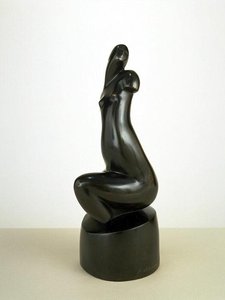
Alexander Archipenko: életmű és életút

A Pioneer of Cubist Sculpture: The Life and Art of Alexander Archipenko

Alexander Archipenko, a name synonymous with the radical transformation of sculpture in the early 20th century, was born in Kyiv, Ukraine, on May 30, 1887. His journey from a promising young artist in his native city to a globally recognized innovator is a testament to his unwavering dedication and bold artistic vision. Archipenko’s life story is intertwined with the vibrant cultural shifts of early 20th-century Europe, particularly the burgeoning avant-garde movements that challenged established artistic conventions. He was the son of Porfirij Antonovych Archipenko, an engineer, and Poroszkovia Vasziljevna Mahova Arhipenko, a woman deeply rooted in Ukrainian traditions. From his youth, Archipenko displayed a keen interest in art, initially receiving training at the Kyiv Art School from 1902 to 1905. However, he quickly grew dissatisfied with the rigid academic approach and sought a more expressive path. He briefly studied under Serhiy Svetoslavsky, but it was his relocation to Paris in 1908 that truly ignited his creative evolution. This move marked a decisive break from traditional artistic practices and propelled him into the heart of Europe’s most dynamic art scene – La Ruche, a collective of artists dedicated to exploring new forms of expression. Here, he encountered influential figures like Fernand Léger and Vladimir Baranoff-Rossinè, absorbing their ideas and forging connections that would profoundly shape his own artistic development.

Deconstructing Form: The Birth of a New Sculptural Language

Archipenko’s artistic philosophy was fundamentally shaped by the revolutionary Cubist movement, yet he refused to simply replicate its principles in three dimensions. Instead, he sought to redefine sculpture itself—to move beyond the traditional emphasis on solid mass and volume. His groundbreaking approach centered on the concept of *negative space* – the voids within a form that became as integral to its definition as the material it was made from. This daring innovation challenged the very essence of what constituted a sculpture, suggesting that an artwork could be defined not only by what was present but also by what was absent. Masterfully manipulating convex and concave surfaces, Archipenko created dynamic interplay of light and shadow, imbuing his works with an unprecedented sense of movement and energy. This wasn’t merely about representing objects realistically; it was about capturing their essence—their dynamism, their interaction with space. He experimented relentlessly with materials – wood, metal, glass, and even painted surfaces – pushing the boundaries of sculptural possibility. His early work, such as *Le Repos* (1912), a reclining female figure that draws inspiration from Matisse’s *Blue Nude* and Picasso’s *Demoiselles d'Avignon*, exemplifies this innovative approach, utilizing simplified forms and fragmented planes to evoke a sense of both intimacy and dynamism.

Major Works and Artistic Innovations

The 1910s witnessed the production of a series of seminal works that firmly established Archipenko’s reputation as a leading figure in modern sculpture. Family Life (1912), an early example of his Cubist approach to the human form, showcases fragmented planes and abstracted figures, capturing a sense of domestic intimacy through geometric deconstruction. Walking Woman (1912) exemplifies his innovative use of voids, creating a dynamic impression of movement as if the figure is perpetually in motion. Boxing Match (1913), with its abstract cubic and ovoid forms, powerfully conveys the energy and brutality of the sport. Perhaps Archipenko’s most distinctive contribution was the development of what he termed “sculpto-paintings.” These works blurred the lines between sculpture and painting by incorporating painted color onto intersecting planes, creating a layered effect that challenged traditional notions of artistic mediums. Inspired by Cubist collage techniques, he further expanded his material palette, utilizing glass, wood, and metal in innovative ways – most notably in his captivating “Medrano” series depicting circus performers. These works weren’t simply representations of figures; they were investigations into the very essence of sculptural possibility—a testament to his desire to break free from conventional artistic boundaries.

Legacy and Influence: A Lasting Impact on Modern Art

Alexander Archipenko's impact on the trajectory of modern art is undeniable. He stands as one of the first artists to successfully translate the principles of Cubism into three-dimensional form, effectively revolutionizing sculpture. His innovative use of voids, unconventional materials, and “sculpto-paintings” dramatically expanded the possibilities of the medium, inspiring generations of artists to challenge traditional conventions. After emigrating to the United States in 1923 and becoming a citizen in 1928, Archipenko continued to create and teach, introducing Cubist ideas and experimental techniques to a wider audience. He held teaching positions at various institutions, including the New Bauhaus, further disseminating his artistic philosophy. His election to the American Academy of Arts and Letters in 1962 served as a formal recognition of his significant contribution to art history. Archipenko’s legacy extends beyond specific artworks; it lies in his unwavering commitment to innovation and his willingness to question fundamental assumptions about what sculpture could be—a spirit that continues to resonate with artists and audiences today.

Minden 43 műmű Alexander Archipenko alkotása →