Thomas Wyck portréja

A 80 legnevesebbebb Thomas Wyck festmény, mindegyik egyedistens

Frissítve: november 2026 · rangsorolva népszerűségi pontszámunk alapján (minden mű keresései, látogatásai és megrendelései alapján) · 89 mű Thomas Wyck alkotása a katalógusunkban

Röviden

St Anthony, Archbishop of Florence (1654) az a Thomas Wyck festmény, amely a legtöbb tekintetet felvonja; az eredeti mű a Nationalmuseum gyűjteményében található, Stockholm. Ezután a tekintet Interior of a Dutch Farm Cottage (1654) és The Alchemist (1650) elemre irányul. A Thomas Wyck 89 műve közül a katalógusunkban megtalálható 80 legnépesebb alkotás, melyeket az év, a múzeum és az örökévalóságának okai kísérnek.

1616 – 1677, Beverwijk Dutch golden age A legtöbb mű: Bavári Állami Festırménygyűjtemények

A galéria szemével: Thomas Wyck legjobb 10 festménye

1
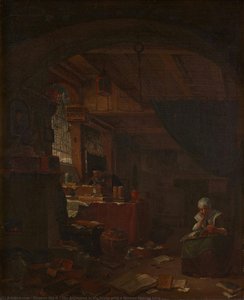
St Anthony, Archbishop of Florence (1654) (1889) -ja Thomas Wyck

St Anthony, Archbishop of Florence

1654 · Oil · Nationalmuseum, Stockholm

The saint stands within a frame of heavy, arched architecture. He is a pillar of white and black, his monastic habit catching a sharp, directional light from the upper left. This light carves the folds of his robes and illuminates a face set with solemn authority. In one hand, he holds a tall processional cross; in the other, a scale. The metal of the scale catches the light, a small…

2
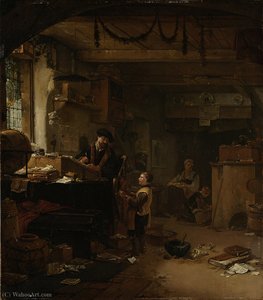
Interior of a Dutch Farm Cottage (1654) (1889) -ja Thomas Wyck

Interior of a Dutch Farm Cottage

1654 · Oil · Statens Museum for Kunst, Koppenhága

In this 1654 work, we find ourselves drawn into the hushed, dim atmosphere of a rustic farm cottage. The composition is anchored by a heavy, dark architectural archway in the foreground, which acts as a threshold, inviting us to peer into a private, domestic world. A soft, directional light enters from a window on the left, casting a gentle glow across the scene. This light catches the subtle textures of…

3
The Alchemist (1650) (1889) -ja Thomas Wyck

The Alchemist

1650 · Oil · Mauritshuis, Haag

The Alchemist is a detailed 17th-century genre painting that captures a cluttered workshop filled with a sense of intense scholarly focus. The composition is densely packed, utilizing a deep, shadowed interior that directs the viewer's eye toward a light source entering from a window on the left. The color palette is dominated by earthy tones, such as ochres and browns, which are sharply interrupted by the vibrant, saturated red of…

4
The Tinker (1654) (1889) -ja Thomas Wyck

The Tinker

1654 · Oil On Canvas · Statens Museum for Kunst, Koppenhága

The Tinker is a genre painting by the Dutch artist Thomas Wijck. Created about 1654, the work depicts a man engaged in his manual trade within a workshop setting. The subject matter focuses on the specific activities of a laborer, providing a view into the daily existence of a traveling repairman. This depiction of a craftsman at work places the figure within the tradition of seventeenth-century Dutch genre scenes.

5
Almsgiving (1660) (1889) -ja Thomas Wyck

Almsgiving

1660 · Oil On Canvas · Philadelphia Művészeti Múzeum, Philadelphia

Almsgiving is a somber and atmospheric genre painting from 1660 that depicts a scene of charity within an old European setting. The composition is framed by a large, dark architectural archway in the foreground, which creates a sense of depth and directs the viewer's eye toward the central group of figures. The subject matter focuses on the interaction between people in a moment of social welfare, evoking themes of piety,…

6
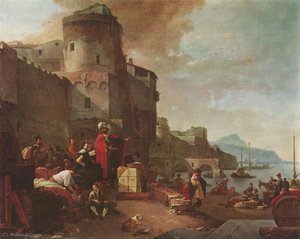
Capriccio of a Fort by the Sea, with Orientals and an Antique Statue (1673) (1889) -ja Thomas Wyck

Capriccio of a Fort by the Sea, with Orientals and an Antique Statue

1673 · Oil On Canvas · National Trust, Thames

To gaze upon this magnificent Capriccio of a Fort by the Sea is to step directly into a sun-drenched moment plucked from the heart of the Dutch Golden Age. Thomas Wyck’s masterful oil painting, dated 1673, transports us to a vibrant, almost theatrical harbor scene where the solidity of classical architecture meets the ephemeral energy of human endeavor. It is more than just a depiction of a port; it is…

7
Woman at Her Sewing Table (1655) (1889) -ja Thomas Wyck

Woman at Her Sewing Table

1655 · Oil On Canvas · Städel Múzeum, Frankfurt

In this intimate scene from 1655, we find ourselves drawn into a private, domestic moment. A woman sits at her sewing table, her attention entirely consumed by the needlework in her hands. The composition is tightly framed, pulling the viewer into the stillness of her world. Light enters from an unseen source to the left, washing over the bright white of her linen collar and the fabric she works upon,…

8
View of the Bay of Naples with Orientals and an Antique Statue (1673) (1889) -ja Thomas Wyck

View of the Bay of Naples with Orientals and an Antique Statue

1673 · Oil On Canvas · National Trust, Thames

Gaze upon this exquisite vision of the Bay of Naples, a scene that transports the viewer directly to an era of opulent leisure and artistic contemplation. The composition is alive with the gentle murmur of activity—the distant sails catching the sun, the figures gathered along the shore engaging in moments of quiet enjoyment. It is more than just a depiction of a beautiful vista; it is an immersion into a…

9
A rustic interior (1654) (1889) -ja Thomas Wyck

A rustic interior

1654 · Oil On Panel · Museum Boijmans Van Beuningen, Rotterdam

The air inside this room feels heavy and still, thick with the scent of woodsmoke and old stone. A low, heavy ceiling presses down upon the scene, creating a sense of profound intimacy that wraps around the figures like a shroud. Light enters from a single, unseen source to the left, slicing through the gloom to catch the bright white of a woman's headscarf. This sudden brightness pulls the eye…

10
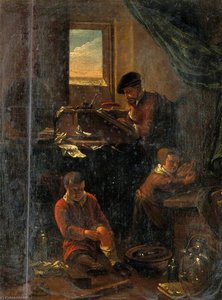
An Alchemist in His Studio (1600) (1889) -ja Thomas Wyck

An Alchemist in His Studio

1600 · Oil · Science History Institute, Philadelphia

A soft, warm light spills across a cluttered desk, illuminating an old man lost in the silent labor of thought. He sits hunched over a book, his eyes tracing lines of text that perhaps hold the secrets of the universe. The room feels heavy with the scent of old parchment and the stillness of a life dedicated to study. Around him, the tools of his obsession are scattered like fragments…

Thomas Wyck híres festményei, 11 és 80 között

11Harbor Scene (1646) (1889) -ja Thomas WyckHarbor Scene1646 · Bavári Állami Festırménygyűjtemények 12An Alchemist (1646) (1889) -ja Thomas WyckAn Alchemist1646 · Bavári Állami Festırménygyűjtemények 13Italian Landscape with Figures at a Fountain among Antique Ruins (1647) (1889) -ja Thomas WyckItalian Landscape with Figures at a Fountain among Antique Ruins1647 · Städel Múzeum 14man reading in his laboratory (1641) (1889) -ja Thomas Wyckman reading in his laboratory1641 15Southern Sea-Harbour with architecture; tradesmen (1641) (1889) -ja Thomas WyckSouthern Sea-Harbour with architecture; tradesmen1641 16Morra-Players (1640) (1889) -ja Thomas WyckMorra-Players1640 · Academy of Fine Arts Vienna 17On the Gulf of Naples (1650) (1889) -ja Thomas WyckOn the Gulf of Naples1650 · Bavári Állami Festırménygyűjtemények 18Interior with Two Men and a Woman with a Baby (1656) (1889) -ja Thomas WyckInterior with Two Men and a Woman with a Baby1656 19Merchants with commodities in a Levante Harbour (1660) (1889) -ja Thomas WyckMerchants with commodities in a Levante Harbour1660 · Musée Fabre 20Painting (1656) (1889) -ja Thomas WyckPainting1656 · National Museum of Art, Architecture and Design 21The Gipsy Woman Telling the Soldiers their Fortunes (1660) (1889) -ja Thomas WyckThe Gipsy Woman Telling the Soldiers their Fortunes1660 · Statens Museum for Kunst 22The Yard of an Italian Tavern (1654) (1889) -ja Thomas WyckThe Yard of an Italian Tavern1654 · Statens Museum for Kunst 23The Weaver at Work in his Home (1654) (1889) -ja Thomas WyckThe Weaver at Work in his Home1654 · Statens Museum for Kunst 24A scholar in his Study (1660) (1889) -ja Thomas WyckA scholar in his Study1660 · Hallwyl Museum 25Alchemist in his laboratory (1650) (1889) -ja Thomas WyckAlchemist in his laboratory1650 · Staatliches Museum Schwerin 26An alchemist's workshop (1654) (1889) -ja Thomas WyckAn alchemist's workshop1654 · Gemäldegalerie 27The Alchemist in his Study with a Woman Making Lace (1660) (1889) -ja Thomas WyckThe Alchemist in his Study with a Woman Making Lace1660 · Science History Institute 28An Alchemist in his Laboratory (1654) (1889) -ja Thomas WyckAn Alchemist in his Laboratory1654 · Statens Museum for Kunst 29An Alchemist and His Family (1660) (1889) -ja Thomas WyckAn Alchemist and His Family1660 · Science History Institute 30Landscape with Arch Bridge (1646) (1889) -ja Thomas WyckLandscape with Arch Bridge1646 · Bavári Állami Festırménygyűjtemények 31Italian street scene (1889) -ja Thomas WyckItalian street scene 32Alchemist (1889) -ja Thomas WyckAlchemistRijksmuseum 33Mountain Monastery (1646) (1889) -ja Thomas WyckMountain Monastery1646 · Bavári Állami Festırménygyűjtemények 34Rock Landscape (1646) (1889) -ja Thomas WyckRock Landscape1646 · Bavári Állami Festırménygyűjtemények 35At the Seaport (1646) (1889) -ja Thomas WyckAt the Seaport1646 · Bavári Állami Festırménygyűjtemények 36Vegetable Market (1646) (1889) -ja Thomas WyckVegetable Market1646 · Bavári Állami Festırménygyűjtemények 37Italian Harbor with Fortifications and Staffage (1641) (1889) -ja Thomas WyckItalian Harbor with Fortifications and Staffage1641 38Italian Coastal Landscape (1640) (1889) -ja Thomas WyckItalian Coastal Landscape1640 39Interior of a Cave (1640) (1889) -ja Thomas WyckInterior of a Cave1640 40Apple Seller at a City Gate (1654) (1889) -ja Thomas WyckApple Seller at a City Gate1654 · National Museum in Wrocław 41A washerwoman and children by a river before a walled bridge (1654) (1889) -ja Thomas WyckA washerwoman and children by a river before a walled bridge1654 · Wallraf-Richartz Múzeum 42Figures in the Courtyard of a House (1660) (1889) -ja Thomas WyckFigures in the Courtyard of a House1660 · Fairfax House 43An Alchemist at Work, with a Mother by a Cradle Beyond (1650) (1889) -ja Thomas WyckAn Alchemist at Work, with a Mother by a Cradle Beyond1650 · Science History Institute 44View of port of Ripa Grande. (1670) (1889) -ja Thomas WyckView of port of Ripa Grande.1670 · Musée Fabre 45A View of the Forum (1674) (1889) -ja Thomas WyckA View of the Forum1674 · National Trust 46An Alchemist in His Laboratory (1673) (1889) -ja Thomas WyckAn Alchemist in His Laboratory1673 · National Trust 47Capriccio of a Seaport with Orientals, Ruins, and an Antique Statue (1673) (1889) -ja Thomas WyckCapriccio of a Seaport with Orientals, Ruins, and an Antique Statue1673 · National Trust 48An Alchemist in His Laboratory, with an Assistant (1673) (1889) -ja Thomas WyckAn Alchemist in His Laboratory, with an Assistant1673 · National Trust 49Italian Courtyard (1677) (1889) -ja Thomas WyckItalian Courtyard1677 · Dulwich Picture Gallery 50Landscape with Bay (1646) (1889) -ja Thomas WyckLandscape with Bay1646 · Bavári Állami Festırménygyűjtemények 51Old Building (1889) -ja Thomas WyckOld BuildingKunsthistorisches Museum 52Interior of a Weaver's Cottage (1889) -ja Thomas WyckInterior of a Weaver's CottageNational Gallery of Ireland 53landscape with fountain and fig. (1889) -ja Thomas Wycklandscape with fountain and fig. 54horsemen resting before an inn (1889) -ja Thomas Wyckhorsemen resting before an inn 55Figures outside a tavern with a woman sewing, travellers on a bridge beyond (1889) -ja Thomas WyckFigures outside a tavern with a woman sewing, travellers on a bridge beyond 56Whitehall and St James's Park, London (1889) -ja Thomas WyckWhitehall and St James's Park, London 57Capriccio of a Roman Ruins with Orientals, a Fountain and an Antique Statue (1889) -ja Thomas WyckCapriccio of a Roman Ruins with Orientals, a Fountain and an Antique StatueNational Trust 58An Alchemist (1889) -ja Thomas WyckAn AlchemistHermitaeus-múzeum 59Dancing couple + many people at ruins (1889) -ja Thomas WyckDancing couple + many people at ruins 60A church interior (1889) -ja Thomas WyckA church interior 61Washerwomen at the Foot of the Torre delle Milizie, Rome (1889) -ja Thomas WyckWasherwomen at the Foot of the Torre delle Milizie, Rome 62Italian port (1889) -ja Thomas WyckItalian port 63Levantijnse haven (1889) -ja Thomas WyckLevantijnse havenRijksmuseum 64Southern Landscape (1889) -ja Thomas WyckSouthern Landscape 65Washerwomen in a yard. (1889) -ja Thomas WyckWasherwomen in a yard.Varsói Nemzeti Múzeum 66The Alchemist (1889) -ja Thomas WyckThe AlchemistFitzwilliam Múzeum 67Riders by Italianate ruins with a seaport beyond (1889) -ja Thomas WyckRiders by Italianate ruins with a seaport beyond 68Italian Street Scene (1889) -ja Thomas WyckItalian Street SceneThe Ashmolean Museum of Art and Archaeology 69Spinning farmer (1889) -ja Thomas WyckSpinning farmerRijksmuseum 70View of the Thames at Westminster on Lord Mayor's Day (1889) -ja Thomas WyckView of the Thames at Westminster on Lord Mayor's Day 71The Poor Being Fed at a Monastery (1889) -ja Thomas WyckThe Poor Being Fed at a Monastery 72The Wreckers, Stormy Coast Scene with Tower (1889) -ja Thomas WyckThe Wreckers, Stormy Coast Scene with Tower 73A Philosopher in His Study, with Two Children (1889) -ja Thomas WyckA Philosopher in His Study, with Two Children 74Interior with an Alchemist (1889) -ja Thomas WyckInterior with an Alchemist 75Interior with an Alchemist Making a Gesture of Surprise, and a Female Assistant (1889) -ja Thomas WyckInterior with an Alchemist Making a Gesture of Surprise, and a Female Assistant 76Interior with an Alchemist Examining a Bowl Brought by a Boy (1889) -ja Thomas WyckInterior with an Alchemist Examining a Bowl Brought by a Boy 77Interior with an Alchemist Studying a Book, His Assistant Pouring Liquid into a Bowl (1889) -ja Thomas WyckInterior with an Alchemist Studying a Book, His Assistant Pouring Liquid into a Bowl 78Interior with an Alchemist Seated at a Table, Looking out of the Picture (1889) -ja Thomas WyckInterior with an Alchemist Seated at a Table, Looking out of the Picture 79Interior with an Alchemist Seated at a Table, Looking out of the Picture (1889) -ja Thomas WyckInterior with an Alchemist Seated at a Table, Looking out of the Picture 80Kitchen interior (1889) -ja Thomas WyckKitchen interiorFinnish National Gallery

Thomas Wyck híres festményei, korszakonként

A témák, amelyek Thomas Wyck figyelmét meghúzták

A négy leggyakorobban előforduló téma ebben az eredeti művekben, mindegyik a legkiválóbb példájával.

A műemlékek, amelyek Thomas Wyck eredeti műveit őrzik

A 8 olyan múzeum, amely a legtöbb ezen az oldalon szereplő festményet őrzi.

Múzeum Város Thomas Wyck művei Ebből a listából származó festmények
Bavári Állami Festırménygyűjtemények, MunchenBavári Állami Festırménygyűjtemények Munchen 9 Harbor Scene, An Alchemist, On the Gulf of Naples
National Trust, ThamesNational Trust Thames 7 Capriccio of a Fort by the Sea, with Orientals and an Antique Statue, View of the Bay of Naples with Orientals and an Antique Statue, A View of the Forum
Statens Museum for Kunst, KoppenhágaStatens Museum for Kunst Koppenhága 6 Interior of a Dutch Farm Cottage, The Tinker, The Gipsy Woman Telling the Soldiers their Fortunes
Science History Institute, PhiladelphiaScience History Institute Philadelphia 4 An Alchemist in His Studio, The Alchemist in his Study with a Woman Making Lace, An Alchemist and His Family
Rijksmuseum, AmsterdamRijksmuseum Amsterdam 3 Alchemist, Levantijnse haven, Spinning farmer
Städel Múzeum, FrankfurtStädel Múzeum Frankfurt 2 Woman at Her Sewing Table, Italian Landscape with Figures at a Fountain among Antique Ruins
Musée Fabre, MontpellierMusée Fabre Montpellier 2 Merchants with commodities in a Levante Harbour, View of port of Ripa Grande.
Nationalmuseum, StockholmNationalmuseum Stockholm 1 St Anthony, Archbishop of Florence

Thomas Wyck évtizedekig: egy egyedi eredeti mű minden évtizedben

Művek évtizedenként

Váassz ki egy évtizedet, hogy megnézhesd az azt meghatározó eredetiműveket.

Thomas Wyck festményei: kérdések a galériának

Mi a leghíresebb műve Thomas Wycknek?Fedje fel a választ

St Anthony, Archbishop of Florence (1654), Nationalmuseum, Stockholm. Ezután Interior of a Dutch Farm Cottage (1654) és The Alchemist (1650) következik.

Milyen életkorában alkotta meg Thomas Wyck a(z) St Anthony, Archbishop of Florence műszt?Fedje fel a választ

38 éves: St Anthony, Archbishop of Florence 1654-ből származik, Thomas Wyck pedig 1616-ben született.

Melyik tíz festménye Thomas Wyck a leghíresebb?Fedje fel a választ

St Anthony, Archbishop of Florence, Interior of a Dutch Farm Cottage, The Alchemist, The Tinker, Almsgiving, Capriccio of a Fort by the Sea, with Orientals and an Antique Statue, Woman at Her Sewing Table, View of the Bay of Naples with Orientals and an Antique Statue, A rustic interior és An Alchemist in His Studio. A fenti rangsor a művek évszamarát és a múzeumát jelzi.

Hány mű alkotása ismert Thomas Wyck nevében?Fedje fel a választ

Katalógusunkban 89 mű található Thomas Wyck alkotótól, 1640 és 1677 év közötti időszakból.

Hol tekinthetők meg a leghíresebb Thomas Wyck eredetijeit?Fedje fel a választ

Leginkább Bavári Állami Festırménygyűjtemények (Munchen), National Trust (Thames) és Statens Museum for Kunst (Koppenhága) található. A fenti múzeumi táblázatban mindegyik felsorolásra került.

Melyik időszakban alkotta Thomas Wyck a leghíresebb festményeit?Fedje fel a választ

1650s alatt: a jelen laphonon található 80 műből 17 készült ebben az időszakban, köztük St Anthony, Archbishop of Florence.

Melyik híres Thomas Wyck festmény a legkorábbi, és melyik a legutóbb készült?Fedje fel a választ

Ezen az oldalon a leghitelesebb Morra-Players (1640), a legutóbbi pedig Italian Courtyard (1677).

Milyen témakörket kedvelt Thomas Wyck?Fedje fel a választ

Man (16), People (14) és Books (13), a jelen oldalon található 80 műművészeti alkotás között.

Milyen anyagokkal festett leggyakrabban Thomas Wyck?Fedje fel a választ

Oil, a jelen oldalon található 80 műből 25 darab esetén.

Mely művészeti irányba tartozik Thomas Wyck műve?Fedje fel a választ

Dutch golden age és Baroque, ezen az oldalon található eredetiek alapján.

Milyen Thomas Wyck eredeti műveket láthatok a Bavári Állami Festırménygyűjtemények kiállításaiban?Fedje fel a választ

Harbor Scene, An Alchemist és On the Gulf of Naples: a Bavári Állami Festırménygyűjtemények, Munchen 9 művet őrzi ezen az oldalon.

Thomas Wyck: a művész portréja

A Thomas Wyck életútja és öröksége

A művészi kreációk hagyatékos dinasztiájában született Thomas Wyck a holland aranykor festészetének vibráló tájában vált meghatározó alakává. Művészeti pályája az apja felvigyázó tekintete alatt kezdődött, aki alapvető képzését biztosította számára, egy olyan kezdés, amely mélyen gyökereztette őt ipmártja hagyományai között. Az olajfestészet technikai finomságaiBA való korai elmélyülés felkészítette őt a felfedezésekre és stilisztikai fejlődésre övezett életre. Mint a kikötői látományok és a művészeti jelenetű (genre) alkotások festője, Wyck egyedülálló képességgel rendelkezett a tengeri kereskedelem lenyűgöző energiájának és a mindennapi élet intimebb, gyakran misztikus pillanatainak megörökítésére.

Karrierje pályafutását mélyen meghatározta a mediterrán környéki utazásai. Bár pontos mozgásaihoz kapcsolódó történelmi feljegyzések a tudományos viták tárgyai, a bizonyítékok azt sugallják, hogy 1640 körül egy Tommaso fiammingo néven ismert festő már aktív Rómában, akiről sokan azt hiszik, hogy az ίδ maga Wyck. Az olasz hatás ebben a korszakban érezhetővé válik műveiben; vászonai gyakran a római tájak fényével és légkörével, valamint Nápoly partvidéki szépségével lélegziket. Nápoly környékén aprózva készített vázlatok később részletes tengerparti látományokként virágoztak fel, demonstrálva éles szemét a természeti nagorság és az emberi jelenlét metszetpontján.

A művészeti műfajok és a tengerészeti jelenetek mesterificája

Wyck művészeti repertoárja figyelemreteljesen sokszínű volt, az olaszos tájképek teatervárosos karakterétől kezdve a művészeti jelenetekben felfedezhető mély szimbolikáig terjedt. Kiválóan játszott a capriccio alkotások terén – ezek képzelt, gyakran építészeti fantáziák, mint például a tengerparti erődök ábrázolása, ahol az ókori antikvitet a kortárs tengerészeti élet élénk mozgása találkoztatja. A jelenetek számos alakjal való megtöltésére való képessége lehetővé tette számára, hogy a kereskedelem, a kikapcsolódás és a történelmi reverencia összetett narratíváit egyetlen kompozícióba szője.

A kikötők és öblök hatalmas látkozatain túl Wyck az emberi tapasztalás árnyaltabb, belsőbb dimenzióiba is elmerült. Műve, Az Alkemista, lenyűgöző példája képességének az intellektuális feszültség megörökítésében. Ebben a alkotásban a művész egy elszigetelt laboratórium környezetét használja fel, hogy feltárja az ébreşenő tudomány és az ősi misztika közötti elmosódott határokat. Az órák, könyvek és manuskriptumok gibi tárgyak gondos elrendezésén keresztül arra hívja a nézőt, hogy Contemplálálja az idő, a kitartás és a titokzatos tudás elszakadtatlan keresésének témáit.

Prozessionális tekintély és maradandó hatás

Az Észak-Hollandiahoz való 1642-es visszatérése után Wyck a művészeti közösség oszlopává vált. Szakmai státuszát a Haarlem Szent Lőrinc Céghoz való csatlakozása szilárdította meg, egy olyan intézményben, ahol végül 1660-ban elnyerte a tiszteletes dékán hivatalt. Életének ez szakasza a helyi befolyás és elismertség csúcspontját jelentette, miközben a holland művészet központi alakjává vált.

Wyck hatása messze túlnyúlt a Hollandia határokon kívülre is. Az angol Restitúció korszakában Angliába utazott, ahol tehetségét rendkívül nagy igénybe vették. Örökségét továbbá tanítói szerepű is növelte; fia és tanmása, Jan Wyck, jelentős alakká vált az angol sportfestészet fejlődésében, míg diákja, Jan van der Vaart szintén ezeket a hagyományokat új vidékekre vitte. Fiait és tanítványait tekintve, Thomas Wyck művészeti zsenialitása és atmoszférikus érzékenysége évszázadokon keresztül ressonálva folytatta életét, maradandó nyomot hagyva az európai festészet történetében.