Thomas Faed portréja

A 67 legnevezesebb Thomas Faed festmény, egy galériaválaszték

Frissítve: november 2026 · rangsorolva népszerűségi pontszámunk alapján (minden mű keresései, látogatásai és megrendelései alapján) · 67 mű Thomas Faed alkotása a katalógusunkban

Röviden

Thomas Faed hagyatékából a leghíresebb alkotás Worn Out. Röviddel ezután követik őket Faults on Both Sides (1861) és Highland Mary (1857). Katalógusunkban 67 mű található Thomas Faed alkotótól; a galéria megőrizte a világ által leginkább csodált 67 darabot, melyeket a dátummal, a múzeummal és a történetükkel együtt mutatunk be.

1826 – 1900, Kirkcudbright Realism A legtöbb mű: Scottish National Gallery

Thomas Faed legjobb 10 festménye: a galéria válogatása

1
Worn Out (1889) -ja Thomas Faed

Worn Out

Oil On Canvas

In 1868, Thomas Faed presented Worn Out at the Royal Academy. The oil on canvas captures a quiet, heavy moment within a Highland interior. It depicts a working man who has spent a restless night watching over his small boy. Now, as the grey light of dawn touches the room, both father and child have finally succumbed to sleep.

2
Faults on Both Sides (1861) (1889) -ja Thomas Faed

Faults on Both Sides

1861 · Oil

The air in the room feels heavy with the weight of unspoken words. A man and a woman sit close together, their presence anchoring the space. He holds a stick or cane, a silent companion to his posture, while she rests beside him. They are caught in a moment of shared existence, perhaps a conversation that has drifted into a comfortable silence or a shared glance that says more than…

3
Highland Mary (1857) (1889) -ja Thomas Faed

Highland Mary

1857 · Oil On Canvas

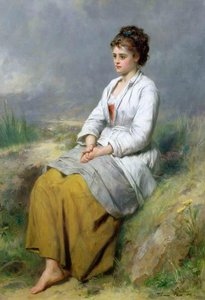
is an oil on canvas work by the Scottish artist Thomas Faed. Executed in 1857, the portrait captures a woman dressed in a pink dress. The subject is positioned amidst a rugged landscape, her attire and presence anchoring the composition within a specific social and natural context.

4
The Doctor's Visit (1889) (1889) -ja Thomas Faed

The Doctor's Visit

In this 1889 oil painting, a domestic interior becomes a stage for a quiet, private drama. A woman lies in her bed, her presence defined by the stillness of her repose. Beside her, a man stands in a posture of attentive concern, while two other figures occupy the periphery of the room, their presence adding to the gravity of the scene. The composition is anchored by the mundane objects of…

5
Sir Walter Scott and his friends at Abbotsford (1849) (1889) -ja Thomas Faed

Sir Walter Scott and his friends at Abbotsford

1849 · Oil On Canvas · Scottish National Portrait Gallery, Edinburgh

The large-scale historical group portrait titled Sir Walter Scott and his friends at Abbotsford captures a specific gathering of distinguished men. Painted by Thomas Faed, the work places Sir Walter Scott and his contemporaries within a shared moment of social engagement. The scene is set around a dining table, where the figures are gathered in a dense, centralized arrangement.

6
Boy with a Hound (1850) (1889) -ja Thomas Faed

Boy with a Hound

1850 · Oil On Canvas · The Hunterian Museum and Art Gallery, Glasgow

In this 1850 oil portrait, we find ourselves in a moment of profound stillness. A young boy is positioned slightly off-center, his presence defined by a soft, direct gaze that establishes an immediate connection with the viewer. Beside him, a hound rests, their companionship forming the emotional core of the composition. The lighting, appearing to descend from the upper left, brushes against the boy's rosy cheeks and illuminates the side…

7
The Reaper (1863) (1889) -ja Thomas Faed

The Reaper

1863 · Oil

The wind carries the scent of salt and damp earth across a vast, turbulent landscape. A solitary woman moves through the field, her figure centered against a sky that churns with heavy, bruised clouds. She is a quiet presence in a world of movement, her hands steady as she works the harvested grain. The golden hues of the wheat stalks catch a filtered, dramatic light, creating a sharp contrast against…

8
A Seaside Toilet (1868) (1889) -ja Thomas Faed

A Seaside Toilet

1868 · Oil On Canvas

A solitary female figure stands alone against a rugged, cliffside backdrop in A Seaside Toilet. This oil painting by Thomas Faed captures a quiet, mundane moment as the woman pauses to adjust her clothing by the sea. The scene unfolds in a coastal setting, where the salt air and the movement of the wind seem to linger around her. She exists in a private interval, caught in a simple act…

9
Forgiven (1874) (1889) -ja Thomas Faed

Forgiven

1874 · Oil On Canvas · Guildhall Art Gallery, London

In this intimate oil on canvas, titled Forgiven, the Scottish artist Thomas Faed explores the quietude of domestic life. Created in 1874, the work offers a glimpse into the sentimental realism that defined much of Faed's career. The piece is modest in scale, measuring 36 x 48 cm, which encourages a close, personal encounter with the figures depicted.

10
His Only Pair (1860) (1889) -ja Thomas Faed

His Only Pair

1860 · Oil On Canvas

In this 1860 oil on canvas, we find ourselves drawn into a private, domestic moment that feels almost overheard. The scene is set within a room bathed in soft light, where a woman sits while a man stands beside her. They are caught in a moment of quiet connection, perhaps sharing a thought or a passage from the books resting upon the dining table. A single potted plant introduces a…

A Thomas Faed válogatás folytatódik: 11 – 67

11Listeners Ne'er Hear Any Good Of Themselves (1889) -ja Thomas FaedListeners Ne'er Hear Any Good Of Themselves 12The First Break In The Family (1889) -ja Thomas FaedThe First Break In The Family 13Scottish Settlers In North America (1889) -ja Thomas FaedScottish Settlers In North America 14Pot Luck (1889) -ja Thomas FaedPot Luck 15The Last of the Clan (1865) (1889) -ja Thomas FaedThe Last of the Clan1865 16The Gamekeeper's Cottage (1845) (1889) -ja Thomas FaedThe Gamekeeper's Cottage1845 17Four Saints Saint George, Saint Catherine, Saint Margaret and Saint Andrew (1848) (1889) -ja Thomas FaedFour Saints Saint George, Saint Catherine, Saint Margaret and Saint Andrew1848 · Scottish National Gallery 18Life Study of John Mongo, The Punka Walla (1847) (1889) -ja Thomas FaedLife Study of John Mongo, The Punka Walla1847 · Scottish National Gallery 19Molly's Toilet (1855) (1889) -ja Thomas FaedMolly's Toilet1855 · Grundy Art Gallery 20The Fishergirl (1859) (1889) -ja Thomas FaedThe Fishergirl1859 21The Listener Ne'er Hears Gude o' Himsel (1858) (1889) -ja Thomas FaedThe Listener Ne'er Hears Gude o' Himsel1858 22Highland Lassie (1871) (1889) -ja Thomas FaedHighland Lassie1871 · Touchstones Rochdale Arts And Heritage Centre 23Jessie, the Flower of Dunblane (1867) (1889) -ja Thomas FaedJessie, the Flower of Dunblane1867 24Milkmaid (1869) (1889) -ja Thomas FaedMilkmaid1869 25Free from Care (1878) (1889) -ja Thomas FaedFree from Care1878 26In Time of War (1876) (1889) -ja Thomas FaedIn Time of War1876 27Sunday In The Backwoods Of Canada (1889) -ja Thomas FaedSunday In The Backwoods Of Canada 28The Home Of The Faeds (1889) -ja Thomas FaedThe Home Of The Faeds 29The Flower of Dunblane (1889) -ja Thomas FaedThe Flower of Dunblane 30Seeing them off (1889) -ja Thomas FaedSeeing them off 31Meg Merilees (1861) (1889) -ja Thomas FaedMeg Merilees1861 · Gracefield Arts Center 32A Highland Gypsy (1870) (1889) -ja Thomas FaedA Highland Gypsy1870 · Guildhall Art Gallery 33Ere Care Begins (1865) (1889) -ja Thomas FaedEre Care Begins1865 34Home and the Homeless (1856) (1889) -ja Thomas FaedHome and the Homeless1856 · Scottish National Gallery 35A Lowland Lassie (1873) (1889) -ja Thomas FaedA Lowland Lassie1873 36From Hand To Mouth (1889) -ja Thomas FaedFrom Hand To Mouth 37Highland lassie (1889) -ja Thomas FaedHighland lassie 38The shooting match (1889) -ja Thomas FaedThe shooting match 39Too Young To Be Married (1889) -ja Thomas FaedToo Young To Be Married 40Good News (1889) -ja Thomas FaedGood News 41Forgiven (1889) -ja Thomas FaedForgiven 42Maternal joy (1889) -ja Thomas FaedMaternal joy 43Lucy's Flittin (1889) -ja Thomas FaedLucy's Flittin 44The Pedlar (1889) -ja Thomas FaedThe Pedlar 45Hard Times (1889) -ja Thomas FaedHard Times 46Study For Head Of A Woman (1889) -ja Thomas FaedStudy For Head Of A Woman 47Sunday In The Backwoods (1889) -ja Thomas FaedSunday In The BackwoodsMontreal Museum of Fine Arts 48A highland gypsy (1889) -ja Thomas FaedA highland gypsy 49Self Portrait Of The Artist (1889) -ja Thomas FaedSelf Portrait Of The Artist 50Home and the Homeless (1889) -ja Thomas FaedHome and the Homeless 51The Ray Of Sunlight (1889) -ja Thomas FaedThe Ray Of Sunlight 52Taking rest (1889) -ja Thomas FaedTaking rest 53Sir Walter Scott And His Literary Friends (1889) -ja Thomas FaedSir Walter Scott And His Literary Friends 54Lady Writing a Letter (1889) -ja Thomas FaedLady Writing a Letter 55The soldier's return (1889) -ja Thomas FaedThe soldier's return 56The End Of A Happy Day (1889) -ja Thomas FaedThe End Of A Happy Day 57The Pet Lamb (1889) -ja Thomas FaedThe Pet Lamb 58A Highland Tryst (1889) -ja Thomas FaedA Highland TrystBroughton House - Garden 59The Silken Gown (1889) -ja Thomas FaedThe Silken Gown 60Maternal Joy (1889) -ja Thomas FaedMaternal JoyStirling Smith Art Gallery And Museum 61Evangeline (1889) -ja Thomas FaedEvangelineManchester Art Gallery 62The Mitherless Bairn (1889) -ja Thomas FaedThe Mitherless Bairn 63Interior with Figures (1889) -ja Thomas FaedInterior with Figures 64A Flower from Paddy's Land (1889) -ja Thomas FaedA Flower from Paddy's Land 65A Game of Draughts (1889) -ja Thomas FaedA Game of DraughtsSheffield City Art Galleries 66God's Acre (1889) -ja Thomas FaedGod's AcreThe New Art Gallery 67The Freedom of the Press (1889) -ja Thomas FaedThe Freedom of the Press

Thomas Faed híres festményei, korszakonként

A témák, amelyek Thomas Faed figyelmét meghúzták

A négy leggyakorobban előforduló téma ebben az eredeti művekben, mindegyik a legkiválóbb példájával.

A műemlékek, amelyek Thomas Faed eredeti műveit őrzik

A 8 olyan múzeum, amely a legtöbb ezen az oldalon szereplő festményet őrzi.

Múzeum Város Thomas Faed művei Ebből a listából származó festmények
Scottish National Gallery, EdinburghScottish National Gallery Edinburgh 3 Four Saints Saint George, Saint Catherine, Saint Margaret and Saint Andrew, Life Study of John Mongo, The Punka Walla, Home and the Homeless
Guildhall Art Gallery, LondonGuildhall Art Gallery London 2 Forgiven, A Highland Gypsy
Queen's University Belfast, BelfastQueen's University Belfast Belfast 1 The Doctor's Visit
Scottish National Portrait Gallery, EdinburghScottish National Portrait Gallery Edinburgh 1 Sir Walter Scott and his friends at Abbotsford
The Hunterian Museum and Art Gallery, GlasgowThe Hunterian Museum and Art Gallery Glasgow 1 Boy with a Hound
Grundy Art Gallery, BlackpoolGrundy Art Gallery Blackpool 1 Molly's Toilet
Touchstones Rochdale Arts And Heritage Centre, RochdaleTouchstones Rochdale Arts And Heritage Centre Rochdale 1 Highland Lassie
Gracefield Arts Center, DumfriesGracefield Arts Center Dumfries 1 Meg Merilees

Thomas Faed évtizede folgtva: az eredeti művek, amelyek meghatározzák az egyes korzakot

Művek évtizedenként

Váassz ki egy évtizedet, hogy megnézhesd az azt meghatározó eredetiműveket.

Gyűjtői kérdések Thomas Faed festményeivel kapcsolatban

Melyik művel a(z) Thomas Faed a leghíresebb?Fedje fel a választ

Worn Out. Ezt követi Faults on Both Sides (1861) és Highland Mary (1857).

Melyek a tíz leghíresebb Thomas Faed festmény?Fedje fel a választ

Worn Out, Faults on Both Sides, Highland Mary, The Doctor's Visit, Sir Walter Scott and his friends at Abbotsford, Boy with a Hound, The Reaper, A Seaside Toilet, Forgiven és His Only Pair. A fenti rangsor a művek évszamarát és a múzeumát jelzi.

Hány festményet hagyott hátra Thomas Faed?Fedje fel a választ

Katalógusunkban 67 mű található Thomas Faed alkotótól, 1845 és 1889 év közötti időszakból.

Mely múzeumokban állnak Thomas Faed remekművei?Fedje fel a választ

Leginkább Scottish National Gallery (Edinburgh), Guildhall Art Gallery (London) és Queen's University Belfast (Belfast) található. A fenti múzeumi táblázatban mindegyik felsorolásra került.

Mely években festette Thomas Faed leghíresebb műveit?Fedje fel a választ

1860s alatt: a jelen laphonon található 67 műből 9 készült ebben az időszakban, köztük Faults on Both Sides.

Mikszétek az első és az utolsó híres eredeti műve a(z) Thomas Faed alkotótól?Fedje fel a választ

Ezen az oldalon a leghitelesebb The Gamekeeper's Cottage (1845), a legutóbbi pedig The Doctor's Visit (1889).

Milyen témaköröket választott leggyakrabban Thomas Faed?Fedje fel a választ

Woman (8), Domestic scene (6) és Scottish art (6), a jelen oldalon található 67 műművészeti alkotás között.

Melyik technikát alkalmazta leggyakrabban Thomas Faed?Fedje fel a választ

Oil On Canvas, a jelen oldalon található 67 műből 9 darab esetén.

Mely művészeti irányba tartozik Thomas Faed?Fedje fel a választ

Realism, ezen az oldalon található eredetiek alapján.

Mely Thomas Faed művei láthatóak a Scottish National Gallery kiállتításán?Fedje fel a választ

Four Saints Saint George, Saint Catherine, Saint Margaret and Saint Andrew, Life Study of John Mongo, The Punka Walla és Home and the Homeless: a Scottish National Gallery, Edinburgh 3 művet őrzi ezen az oldalon.

Thomas Faed: életmű és életút

A Legacy of Scottish Sentiment

Thomas Faed holds a singular place in the annals of Scottish art, often described with the profound reverence that one might accord to Robert Burns’s impact on Scottish song. Born in Kirkcudbrightshire at Barlay Mill, Faed was part of a remarkable family of creators; his brothers James and John, along with his sister Susan, all shared this deep artistic calling. His early life was rooted in the ruggedly beautiful landscape of Galloway, an environment that undoubtedly informed the warmth and domesticity found within his most cherished works. After receiving his formal art education at the school of design in Edinburgh, he began a journey that would lead him from the heart of Scotland to the prestigious studios of London.

His career was marked by significant professional milestones, including his election as an associate of the Royal Scottish Academy in 1849. As his reputation grew, so did his influence within the British art scene; he became an associate of the Royal Academy in 1861 and eventually achieved the status of academician in 1864. This progression reflected not only his technical mastery but also his ability to capture the very essence of Victorian life through a lens of tender realism.

The Art of the Domestic and the Soulful

Faed’s oeuvre is celebrated for its mastery of genre scenes and portraits, works that often serve as windows into the intimate, quiet moments of human existence. He possessed a rare ability to convey complex emotions through subtle details—a downward cast gaze, the gentle clasping of hands, or the soft glow of a fireplace. In his masterpiece Forgiven, created in 1874, he presents a heartwarming scene of familial connection, using soft colors and expressive facial expressions to evoke a sense of serenity and peace. His work often invites the viewer to step into an intimate world, where the innocence of a child or the compassion of a mother can be felt almost tangibly.

Beyond the domestic sphere, Faed’s technical skill allowed him to explore more contemplative and even symbolic themes. In Meg Merilees, he utilized oil on panel to create a luminous finish, capturing a study of human emotion through meticulous brushwork and the strategic use of light and shadow. This piece, much like his other celebrated works such as The Last of the Clan, demonstrates his capacity to imbue a single portrait with profound depth and spiritual aspiration. Whether depicting the ruggedness of the Highlands or the quietude of an interior room, Faed’s paintings remain evocative studies of the human condition.

Artistic Significance and Enduring Presence

The historical significance of Thomas Faed lies in his ability to bridge the gap between rigorous realism and the emotive storytelling characteristic of his era. His works are not merely representations of subjects but are narratives that speak to the values and aesthetics of the mid-19th century. Many of his most important pieces have found permanent homes in some of the world's most esteemed institutions, ensuring that his vision continues to resonate with generations of art lovers:

Through his dedication to capturing the essence of human relationships and the beauty of the Scottish landscape, Faed left behind a legacy of visual storytelling that remains as captivating today as it was during his lifetime in London.